Within Useful Data
What Weather Data Can Reveal About a UFO
Cloud height, visibility and winds at different altitudes can explain balloons, lanterns, obscured aircraft lights and displaced reflections.
On this page
- Matching visibility and cloud layers to the report
- Comparing surface wind with winds aloft
- Weather clues for balloons lights and reflections
Page outline Jump by section
Introduction
Weather records are among the most valuable independent sources of evidence when assessing a reported UFO sighting. Unlike witness memories, they provide an objective snapshot of the atmosphere at a specific place and time. Cloud layers, visibility, wind direction, wind speed at different altitudes and atmospheric conditions can often explain why ordinary objects such as balloons, aircraft lights or reflected sunlight appeared unusual. Equally important, weather data can help rule out some conventional explanations when they do not match the reported behaviour.
This does not mean weather automatically explains every unidentified sighting. Rather, it provides an essential baseline. NASA’s independent study of unidentified anomalous phenomena (UAP) concluded that scientific progress depends on combining witness reports with high-quality environmental and sensor data instead of relying on testimony alone. Weather observations are one of the easiest forms of independent evidence to recover after an event.[NASA Science]science.nasa.govScience UAPNASA ScienceUAP - NASA ScienceFebruary 23, 2026…
Matching visibility and cloud layers to the report
One of the first questions investigators ask is whether the reported appearance matches the actual atmospheric conditions.
Surface weather observations and aviation reports typically record:[aviationweather.gov]aviationweather.govSource details in endnotes.
- Horizontal visibility.
- Cloud cover and cloud-base height.
- Fog, haze or smoke.
- Rain, snow or other precipitation.
- Temperature and humidity.
These details matter because atmospheric conditions strongly affect what can be seen.
For example, if a witness describes a sharply outlined object disappearing behind clouds, weather records can confirm whether cloud layers actually existed at the reported altitude. Conversely, if official observations show a completely clear sky, then explanations involving cloud obscuration become much less likely.
Visibility is equally important. In hazy conditions, distant aircraft lights often lose their surrounding structure, leaving only bright points of light that appear isolated. Low cloud can scatter urban lighting, producing glowing patches or reflections that seem detached from the ground. Aviation weather services routinely classify cloud ceilings and visibility because they have a major impact on visual perception during flight.[Aviation Weather Center]aviationweather.govOpen source on aviationweather.gov.
Comparing surface wind with winds aloft
A common mistake is assuming that the wind experienced on the ground is the same throughout the atmosphere.
In reality, wind direction and speed often change dramatically with altitude. A balloon at several thousand metres may travel in a completely different direction from leaves, smoke or flags observed at ground level.
Upper-air winds are measured using radiosondes—instrument packages carried beneath weather balloons—which provide detailed profiles of:
- Wind speed.
- Wind direction.
- Temperature.
- Pressure.
- Humidity.
These observations extend through much of the atmosphere and are widely used for weather forecasting. The balloons themselves may drift hundreds of kilometres while ascending because of changing wind patterns at different heights.[National Weather Service]weather.govNational Weather Service Radiosonde ObservationNational Weather Service Radiosonde Observation
This information becomes especially useful when a witness reports that an object:
- moved steadily without obvious propulsion;
- drifted in a consistent direction;
- changed apparent speed during the observation; or
- seemed stationary despite noticeable wind on the ground.
Rather than comparing the sighting only with local weather at street level, investigators compare the reported motion with the wind profile at the likely altitude of the object. A balloon carried by strong upper-level winds may appear to move surprisingly quickly, while one travelling almost directly towards or away from the observer may appear nearly stationary despite substantial actual motion.
Weather clues for balloons, lights and reflections
Weather frequently affects how ordinary aerial objects appear.

Balloons
Weather balloons, research balloons and recreational balloons generally drift with the surrounding air rather than following powered flight paths. Their apparent behaviour depends on:
- changing winds with altitude;
- viewing angle;
- sunlight;
- cloud background; and
- observer movement.
A balloon illuminated by the low Sun can appear brilliantly white even after sunset at ground level because it remains in direct sunlight at high altitude. Changes in reflective angle may also produce sudden bright flashes.
Aircraft lights
Thin cloud, moisture and haze scatter light from aircraft navigation lights and landing lights.
This can create the impression that:
- a light has grown dramatically in size;
- multiple lights have merged into one object;
- an aircraft is hovering when it is actually approaching nearly head-on; or
- the object has changed shape.
Without weather information, these optical effects are easily mistaken for unusual behaviour.
Reflections
Certain atmospheric conditions also favour reflections.
Ice crystals, thin cloud layers and temperature inversions can alter the appearance of bright light sources. Ground lighting reflected from cloud bases may create luminous patches that appear detached from the surface, while sunlight reflecting from high-altitude aircraft or balloons can generate brief flashes that resemble manoeuvring objects.
The existence of suitable cloud layers therefore becomes an important test rather than an afterthought.
Why weather affects perception as well as the object
Weather influences not only what is in the sky but also how observers interpret it.
Aviation safety research documents several visual illusions that become more common in darkness or poor visibility. One of the best known is autokinesis, in which a stationary point of light viewed against a dark background appears to drift or move. Sparse visual references, low cloud, haze and false horizons can also distort estimates of distance, speed and direction. These effects are well recognised in aviation because they have contributed to accidents despite experienced observers being involved.[Skybrary]skybrary.aeroVisual Illusions | SKYbrary Aviation SafetyVisual Illusions | SKYbrary Aviation Safety…
For UFO investigations, this means a witness may accurately report what they perceived while still misjudging the true motion or position of the observed object.
Reconstructing the atmospheric conditions
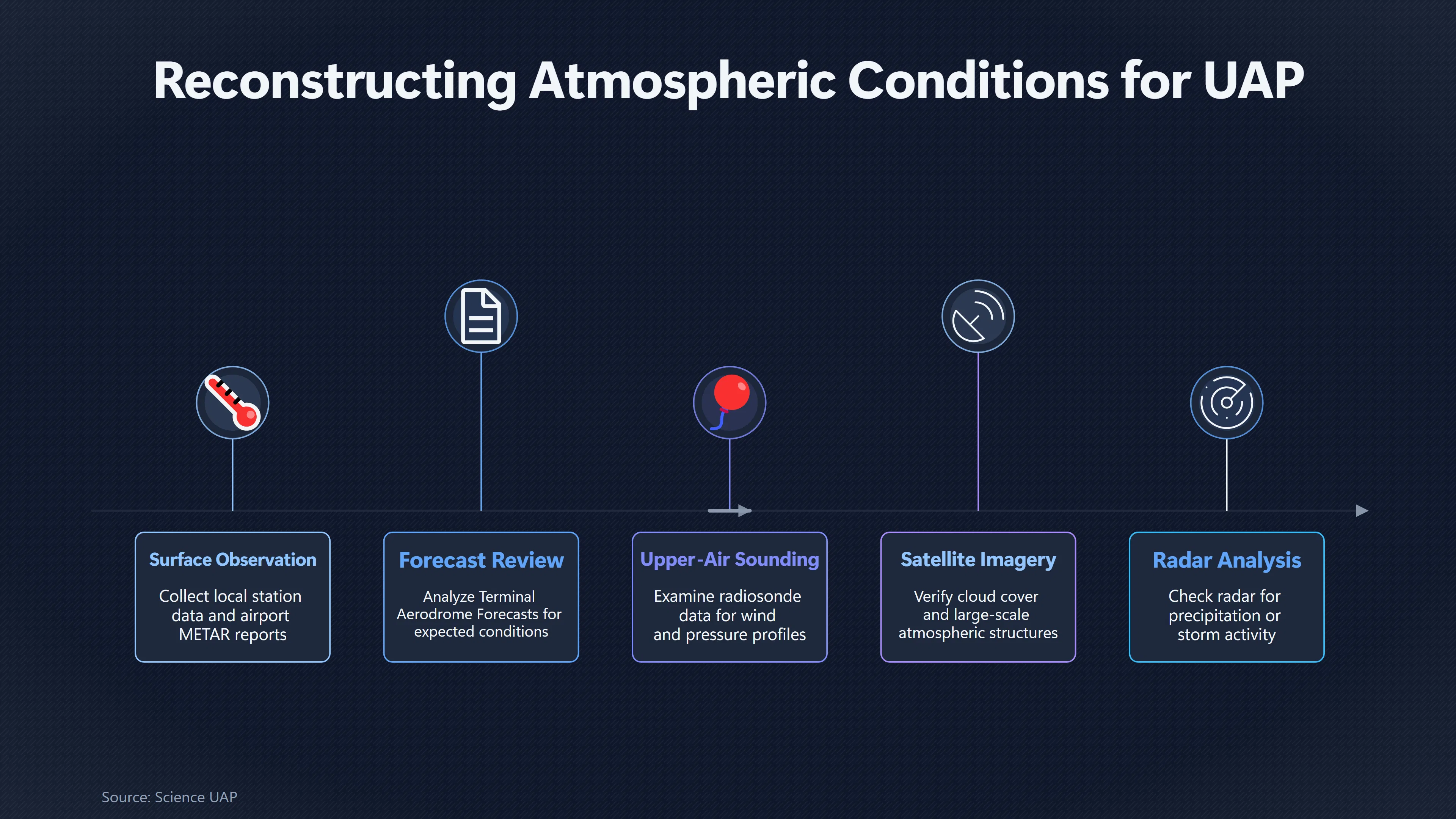
A useful weather review combines several independent datasets rather than relying on a single observation.
Investigators commonly compare:
- Official surface weather observations from nearby stations.
- Aviation METAR reports, which provide routine airport weather observations.[aviationweather.gov]aviationweather.govSource details in endnotes.
- Terminal Aerodrome Forecasts (TAFs) describing expected conditions.
- Upper-air soundings showing winds and atmospheric structure.
- Satellite imagery revealing cloud cover.
- Weather radar where precipitation or storm activity is relevant.
Cross-checking multiple sources reduces the chance that local variations or reporting gaps will produce misleading conclusions. Aviation weather services provide archived observations that often allow investigators to reconstruct conditions with reasonable precision for a reported event.[Aviation Weather Center]aviationweather.govOpen source on aviationweather.gov.
What weather data can and cannot establish
Weather evidence is valuable because it is independent of witness testimony, but it has clear limits.
It can often determine whether atmospheric conditions were consistent with balloons, obscured aircraft, reflections or reduced visibility. It can also identify situations in which the reported motion conflicts with measured winds, making a simple drifting-object explanation less convincing.
However, weather alone rarely identifies an object with certainty. A complete assessment still requires accurate timing, location, viewing direction, astronomical conditions, nearby aircraft activity and, where available, original photographs or sensor data. Weather records should therefore be treated as one component of a broader evidence-based reconstruction rather than as a standalone explanation.
Amazon book picks
Further Reading
Books and field guides related to What Weather Data Can Reveal About a UFO. Use these as the next step if you want deeper reading beyond the article.
The Demon-haunted World
Rating: 4.5/5 from 43 Google Books ratings
Are we on the brink of a new Dark Age of irrationality and superstition? In this book, the writer shows how scientific thinking is necess...
The Weather Book: Why It Happens and Where It Comes From
The Nature Book is your one-stop guide to reconnecting and appreciating nature once more.
The AMS Weather Book: The Ultimate Guide to America's Weather
America has one of the most varied and dynamic weather systems in the world. Every year, the Gulf Coast is battered by hurricanes, the Gr...
eBay marketplace picks
Marketplace Samples
Live-tested eBay searches with available results related to this page.
Selected fromweather station display oneBay.co.uk.
Endnotes
1.
Source: science.nasa.gov
Title: Science UAP
Link:https://science.nasa.gov/uap/
Source snippet
NASA ScienceUAP - NASA ScienceFebruary 23, 2026...
Published: February 23, 2026
2.
Source: weather.gov
Title: National Weather Service Radiosonde Observation
Link:https://www.weather.gov/upperair/factsheet
3.
Source: weather.gov
Link:https://www.weather.gov/upperair/Faq
4.
Source: skybrary.aero
Title: Visual Illusions | SKYbrary Aviation Safety
Link:https://skybrary.aero/index.php/articles/visual-illusions
Source snippet
Visual Illusions | SKYbrary Aviation Safety...
5.
Source: science.nasa.gov
Title: s awe completes mission to study earths effect on space weather
Link:https://science.nasa.gov/science-research/heliophysics/nasas-awe-completes-mission-to-study-earths-effect-on-space-weather/
Source snippet
nasa.govNASA’s AWE Completes Mission to Study Earth’s Effect on Space Weather - NASA ScienceMay 21, 2026 — 4 Min Read NASA’S AWE COMPLETE...
Published: May 21, 2026
6.
Source: weather.gov
Title: See Fig. 1 for U.S. locations. The observation system consists of an inst
Link:https://www.weather.gov/epz/upperair
Source snippet
Upper AirDecember 10, 2024 — Figure 1 Upper air observations are taken twice a day around the world at 1200 hours and 0000 hours GMT (5 a...
Published: December 10, 2024
7.
Source: nasa.gov
Title: UPDAT E: NASA Shares UAP Independent Study Report; Names Director
Link:https://www.nasa.gov/news-release/update-nasa-shares-uap-independent-study-report-names-director/
8.
Source: science.nasa.gov
Title: identifying ufos and uaps
Link:https://science.nasa.gov/solar-system/skywatching/night-sky-network/identifying-ufos-and-uaps/
9.
Source: weather.gov
Link:https://www.weather.gov/upperair/reqdahdr
10.
Source: weather.gov
Link:https://www.weather.gov/about/observation-equipment
11.
Source: skybrary.aero
Link:https://skybrary.aero/index.php/articles/sun-pillar
12.
Source: skybrary.aero
Link:https://skybrary.aero/index.php/articles/fata-morgana
13.
Source: skybrary.aero
Link:https://skybrary.aero/index.php/articles/pileus-pil
14.
Source: skybrary.aero
Link:https://skybrary.aero/index.php/articles/transient-luminous-events-tles
15.
Source: skybrary.aero
Link:https://skybrary.aero/index.php/articles/cumulonimbus-cb
16.
Source: skybrary.aero
Link:https://skybrary.aero/index.php/articles/runway-visual-perspective
17.
Source: aviationweather.gov
Link:https://aviationweather.gov/
18.
Source: weather.gov.hk
Link:https://www.weather.gov.hk/en/aviat/decode_metar.htm
19.
Source: prod-01-alb-www-noaa.woc.noaa.gov
Link:https://prod-01-alb-www-noaa.woc.noaa.gov/jetstream/upperair/radiosondes
20.
Source: connect.aviationweather.gov
Link:https://www.connect.aviationweather.gov/
21.
Source: aviationweather.gov
Link:https://aviationweather.gov/help/data/
22.
Source: weather.metoffice.gov.uk
Title: metoffice.gov.uk Unusual cloud formations
Link:https://weather.metoffice.gov.uk/learn-about/weather/types-of-weather/clouds/unusual-cloud-formations
Additional References
23.
Source: aliencouncil.com
Link:https://aliencouncil.com/guides/fg-036-five-confused-mundane-phenomena/
24.
Source: skyatnightmagazine.com
Title: 17 things commonly mistaken for UFOs | BBC Sky at Night Magazine
Link:https://www.skyatnightmagazine.com/space-science/things-mistaken-for-ufos
Source snippet
Consider the following possibilities... Get monthly inspiration to your door with BBC Sky At Night Magazine - subscribe toda...
25.
Source: youtube.com
Title: WINDS ALOFT and Other XC Weather Charts EXPLAINED (PPL Lesson 41)
Link:https://www.youtube.com/watch?v=aMsLBdnxiWg
Source snippet
Mick West weather balloon UFO analysis wind direction UFO Weather: How to find wind direction for older UFO reports...
26.
Source: vlab.noaa.gov
Title: GOE S Fog and Low Stratus
Link:https://vlab.noaa.gov/web/towr-s/goes-16-fog-and-low-stratus
Source snippet
GOES Fog and Low Stratus - Total Operational Weather Readiness - Satellites (TOWR-S) - Virtual Lab...
27.
Source: youtube.com
Title: How to read a METAR aviation weather report
Link:https://www.youtube.com/watch?v=HRFqfbSK9p4
Source snippet
WINDS ALOFT and Other XC Weather Charts EXPLAINED (PPL Lesson 41)...
28.
Source: youtube.com
Title: UFO Weather: How to find wind direction for older UFO reports
Link:https://www.youtube.com/watch?v=XtNRnMOeJvI
Source snippet
Decoding METARs and TAFs | Part 107 Test Tips | How to Read a METAR and TAF...
29.
Source: faa.gov
Link:https://www.faa.gov/air_traffic/publications/atpubs/aim_html/chap7_section_1.html
30.
Source: faa.gov
Link:https://www.faa.gov/air_traffic/publications/atpubs/aip_html/chap7_section_1.html
31.
Source: youtube.com
Title: How To Read A Winds Aloft Forecast
Link:https://www.youtube.com/watch?v=HeahUZFaWZA
Source snippet
How to read a METAR aviation weather report - Sporty's Private Pilot Training Tips...
32.
Source: youtube.com
Title: Decoding METARs and TAFs | Part 107 Test Tips | How to Read a METAR and TAF
Link:https://www.youtube.com/watch?v=nb3gyUVVMlw
Source snippet
How To Read A Winds Aloft Forecast...