Within Multi Sensor Study
Can a UFO's Light Reveal What It Is
A spectrum may distinguish reflected sunlight, thermal radiation and artificial lighting, but weak fast targets remain difficult.
On this page
- What a spectrum can show
- Why fast targets produce poor readings
- How tracking telescopes improve the measurement
Page outline Jump by section
Introduction
Spectroscopy can sometimes reveal whether the light from an unidentified aerial object is reflected sunlight, heat emitted by a warm object, or light produced by an artificial source. It cannot, however, identify an object’s nature simply because a spectrum looks unusual. The technique works by separating incoming light into its component wavelengths and comparing the resulting pattern with known physical processes. In a modern multi-sensor UFO investigation, spectroscopy is therefore used as a diagnostic tool rather than a stand-alone detector. Combined with tracking cameras, infrared imaging and range measurements, it can strengthen or weaken competing explanations, but only if the target is bright enough and can be observed long enough to obtain a reliable spectrum.[Galileo Project]galileo.hsites.harvard.eduGalileo ProjectThe Scientific Investigation of Unidentified Aerial Phenomena (UAP) Using Multimodal Ground-Based Observatories | The Gali…
What a spectrum can show
Every light source has a characteristic spectral signature. By measuring how brightness changes across different wavelengths, spectroscopy can answer several practical questions.
Reflected sunlight. An object illuminated primarily by the Sun often displays a spectrum resembling sunlight, modified by the reflectivity of its surface. Aircraft, balloons and satellites commonly fall into this category. Surface coatings, paints or metals alter the balance of reflected colours, but the underlying solar spectrum usually remains recognisable.[NASA Science]science.nasa.govScience Spectroscopy 101 – Types of Spectra and SpectroscopyNASA ScienceSpectroscopy 101 – Types of Spectra and Spectroscopy - NASA Science…
Thermal radiation. Hot objects emit infrared radiation according to their temperature. Engines, exhaust plumes and heated surfaces produce broad thermal spectra that differ from reflected visible light. Measuring the shape of this emission allows researchers to estimate temperature and determine whether the object is self-heated or simply reflecting external illumination.[NASA Science]science.nasa.govScience TESNASA ScienceTES - NASA ScienceJune 10, 2025…
Artificial lighting. Electric light sources frequently contain distinctive emission lines. Sodium lamps, mercury vapour lamps, LEDs and lasers each produce characteristic spectral patterns that can often be recognised. If an unidentified light matches one of these known signatures, spectroscopy provides evidence for a conventional explanation rather than an unknown technology.[NASA Science]science.nasa.govScience Spectroscopy 101 – Types of Spectra and SpectroscopyNASA ScienceSpectroscopy 101 – Types of Spectra and Spectroscopy - NASA Science…
The technique is especially valuable because spectra depend on physics rather than appearance. Two objects may look equally bright to the eye yet have completely different spectral fingerprints.
Why fast targets produce poor readings
Spectroscopy works best when a stable source remains within the instrument’s field of view. Many reported UFOs present exactly the opposite conditions.
A faint object provides relatively few photons, forcing the instrument to collect light over a longer period. If the target moves rapidly during that exposure, the spectrum becomes blurred, reducing both sensitivity and wavelength accuracy. Motion can also spread light across multiple detector pixels, making weak spectral features impossible to distinguish from background noise.[Wikipedia]WikipediaSlitless spectroscopySlitless spectroscopy
Atmospheric effects introduce additional uncertainty. Turbulence causes the apparent position of distant objects to wander, while haze, moisture and aerosols selectively absorb or scatter certain wavelengths. At low elevations above the horizon, these effects become more pronounced and may distort the observed spectrum.
Brightness also changes unexpectedly. Aircraft navigation lights flash, rotating satellites vary in reflectivity, and tumbling objects alternately expose bright and dark surfaces. Such variations complicate interpretation because the measured spectrum may represent a changing mixture of reflected sunlight and artificial illumination rather than a single stable source.
These limitations explain why an unusual-looking spectrum is rarely enough to support extraordinary conclusions. A poor-quality spectrum may simply reflect inadequate signal rather than unusual physics.
How tracking telescopes improve the measurement
The most effective way to improve spectral quality is to keep the target centred continuously while collecting light.
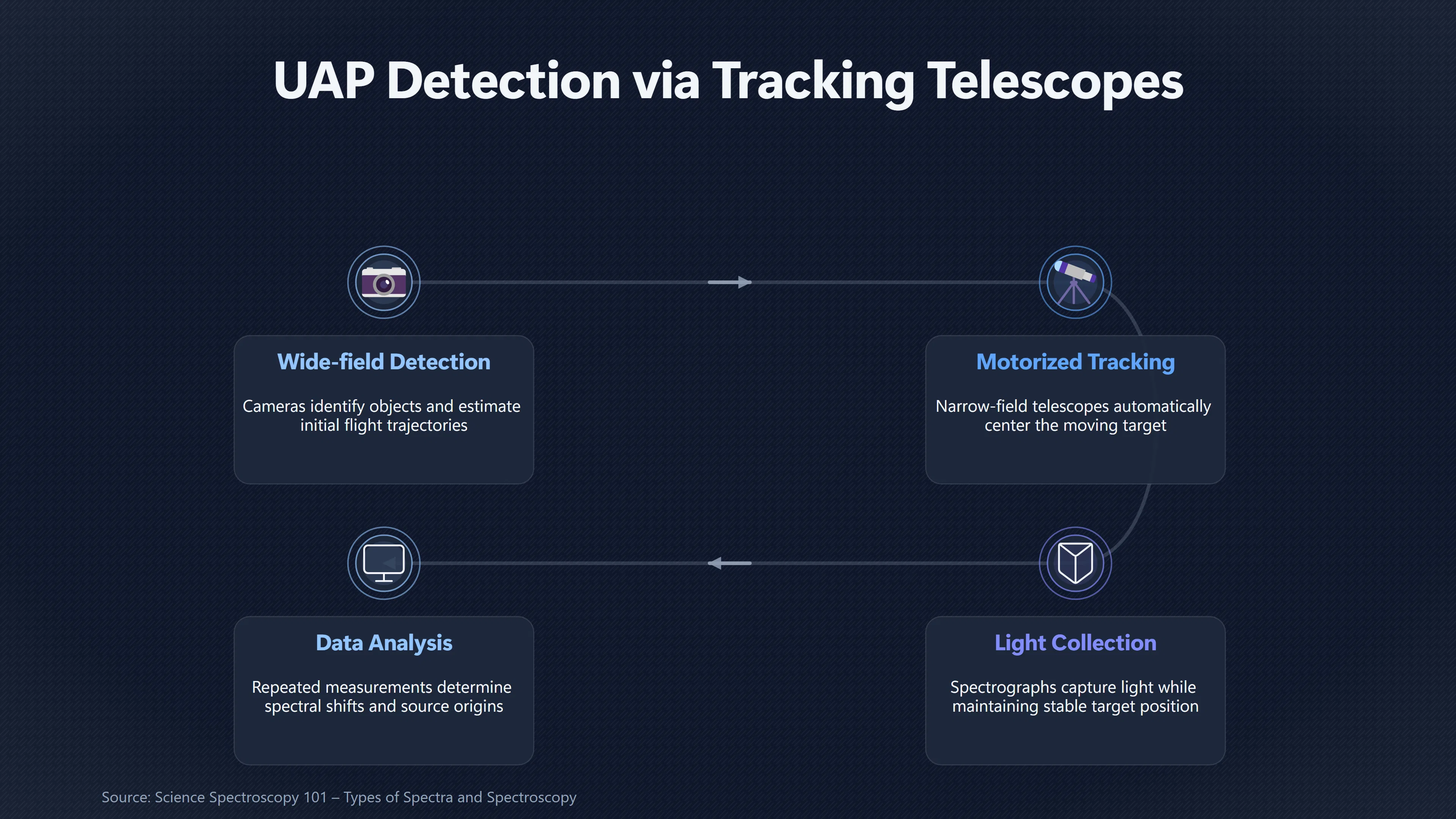
Modern observatories designed for UAP research typically begin with wide-field cameras that detect an object and estimate its trajectory. Once detected, a motorised narrow-field telescope can automatically follow the target while directing its light into a spectrograph. This increases the exposure time without allowing the image to drift across the detector, greatly improving the signal-to-noise ratio.[Galileo Project]galileo.hsites.harvard.eduGalileo ProjectThe Scientific Investigation of Unidentified Aerial Phenomena (UAP) Using Multimodal Ground-Based Observatories | The Gali…
Accurate tracking also allows repeated measurements throughout an observation. Researchers can determine whether the spectrum changes as the viewing angle changes, whether apparent colour shifts are caused by atmospheric conditions, or whether different parts of the object emit different wavelengths.
Some astronomical instruments employ slitless spectroscopy, which records an image and its spectrum simultaneously. This avoids the difficulty of placing a fast-moving target precisely behind a narrow entrance slit, although it introduces its own challenges when multiple bright sources overlap in the field of view.[Wikipedia]WikipediaSlitless spectroscopySlitless spectroscopy
Why spectroscopy is strongest within a multi-sensor system
Spectral measurements become much more informative when combined with independent measurements from other instruments.
For example:
- A visible spectrum resembling sunlight, combined with triangulated distance and daylight observations, supports the possibility of reflected sunlight from a physical object.
- A strong infrared thermal signature accompanied by radar tracking may indicate an actively powered aircraft or another heat-emitting object.
- An emission spectrum containing narrow artificial lines can be compared with known lighting technologies used on aircraft, drones or ground installations.
- If spectroscopy indicates thermal emission but infrared cameras detect no corresponding heat source, investigators would first examine calibration, atmospheric effects or instrumental error before considering less conventional explanations.
The Galileo Project’s proposed multimodal observatories include spectroscopy alongside photometry, polarimetry, visible and infrared imaging, radar receivers, radio-frequency monitoring and environmental sensors. The aim is not to rely on any single measurement but to cross-check multiple independent observations so that artefacts and ordinary objects can be separated from genuinely unexplained cases.[Galileo Project]galileo.hsites.harvard.eduGalileo ProjectThe Scientific Investigation of Unidentified Aerial Phenomena (UAP) Using Multimodal Ground-Based Observatories | The Gali…

What spectroscopy cannot prove
Spectroscopy cannot determine an object’s distance, size or speed on its own. It also cannot establish that an unidentified object represents advanced or extraterrestrial technology.
A spectrum may demonstrate that a light source is inconsistent with common aircraft lighting or ordinary reflected sunlight, but many terrestrial explanations can remain, including atmospheric phenomena, unusual viewing geometry, sensor limitations or previously unrecognised conventional sources. Conversely, a spectrum matching familiar materials or lighting provides positive evidence for an ordinary explanation.
For this reason, spectroscopy is best viewed as one component of an evidence chain. It narrows possibilities by identifying the physical origin of observed light, but reliable identification depends on combining spectral data with accurate tracking, positional measurements and corroboration from independent sensors. This emphasis on multiple calibrated measurements reflects the broader scientific approach now advocated for systematic investigations of unidentified aerial phenomena.[Galileo Project]galileo.hsites.harvard.eduGalileo ProjectThe Scientific Investigation of Unidentified Aerial Phenomena (UAP) Using Multimodal Ground-Based Observatories | The Gali…
Amazon book picks
Further Reading
Books and field guides related to Can a UFO's Light Reveal What It Is. Use these as the next step if you want deeper reading beyond the article.
Spectroscopy: The Key to the Stars
While most amateur astronomers know about the red shift, have a general idea of the way that the emission and absorption lines in stellar...
Astrophysical Techniques
Long used in undergraduate and introductory graduate courses, Astrophysical Techniques, Seventh Edition provides an accessible yet compre...
Light: A Radiant History from Creation to the Quantum Age
Light begins at Stonehenge, where crowds cheer a solstice sunrise. After sampling myths explaining First Light, the story moves on to ear...
The Analysis of Starlight: Two Centuries of Astronomical Spec...
A reference for astronomers and historians on astronomical spectroscopy, from the discovery of spectral lines through to the year 2000.
eBay marketplace picks
Marketplace Samples
Live-tested eBay searches with available results related to this page.
Selected fromUFO display model oneBay.co.uk.
Current eBay listing
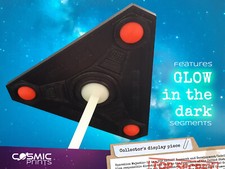
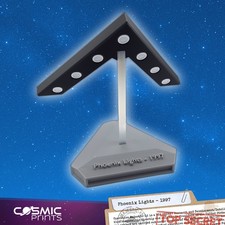
UFO Model – Belgium Wave 1989 Triangular UAP Craft | Sci-Fi Display
Current eBay listing
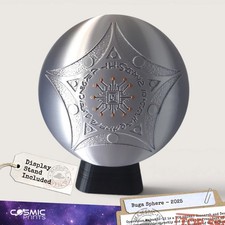
Buga Sphere UFO Model With Display Stand | 15cm (5.9") Diameter UAP

Endnotes
1.
Source: science.nasa.gov
Title: Science Spectroscopy 101 – Types of Spectra and Spectroscopy
Link:https://science.nasa.gov/mission/webb/science-overview/science-explainers/spectroscopy-101-types-of-spectra-and-spectroscopy/
Source snippet
NASA ScienceSpectroscopy 101 – Types of Spectra and Spectroscopy - NASA Science...
2.
Source: science.nasa.gov
Title: Science TES
Link:https://science.nasa.gov/mission/aura/tes/
Source snippet
NASA ScienceTES - NASA ScienceJune 10, 2025...
Published: June 10, 2025
3.
Source: Wikipedia
Title: Slitless spectroscopy
Link:https://en.wikipedia.org/wiki/Slitless_spectroscopy
4.
Source: science.nasa.gov
Title: Astronomers use light in a similar way, but light fr
Link:https://science.nasa.gov/mission/hubble/science/science-behind-the-discoveries/hubble-spectroscopy/
Source snippet
Spectroscopy - NASA ScienceJune 15, 2026 — SPECTROSCOPY'S ORIGINS When we turn on a light in a dark room, it illuminates our surroundings...
Published: June 15, 2026
5.
Source: science.nasa.gov
Title: spectroscopy 101
Link:https://science.nasa.gov/mission/webb/science-overview/science-explainers/spectroscopy-101-introduction/
Source snippet
Know what you’re looking for? Jump ahead in the series! * Part 2: Light and Matter * Part 3: Types of Spectra and Spectroscopy * Part...
6.
Source: galileo.hsites.harvard.edu
Link:https://galileo.hsites.harvard.edu/publications/scientific-investigation-unidentified-aerial-phenomena-uap-using-multimodal
Source snippet
Galileo ProjectThe Scientific Investigation of Unidentified Aerial Phenomena (UAP) Using Multimodal Ground-Based Observatories | The Gali...
7.
Source: galileo.hsites.harvard.edu
Link:https://galileo.hsites.harvard.edu/publications/integrated-computing-platform-detection-and-tracking-unidentified-aerial
8.
Source: galileo.hsites.harvard.edu
Link:https://galileo.hsites.harvard.edu/FAQ
9.
Source: eso.org
Title: slitless spectroscopy
Link:https://www.eso.org/~rfosbury/home/natural_colour/spectrophot/nc_spec_slitless.html
10.
Source: galileo.hsites.harvard.edu
Title: project goal
Link:https://galileo.hsites.harvard.edu/project-goal
11.
Source: galileo.hsites.harvard.edu
Link:https://galileo.hsites.harvard.edu/search
12.
Source: galileo.hsites.harvard.edu
Link:https://galileo.hsites.harvard.edu/project/background
13.
Source: galileo.hsites.harvard.edu
Link:https://galileo.hsites.harvard.edu/scope
14.
Source: cfa.harvard.edu
Title: galileo project
Link:https://www.cfa.harvard.edu/research/galileo-project
15.
Source: hq.eso.org
Link:https://www.hq.eso.org/public/teles-instr/technology/spectroscopy/
Additional References
16.
Source: doi.org
Title: The Author(s). Published by the American Astronomical Society.,, Citatio
Link:https://doi.org/10.3847/1538-4357/ae7c6c
Source snippet
Solar Slitless Spectroscopy with Learned Reconstruction - IOPscienceJuly 20, 2026 — SOLAR SLITLESS SPECTROSCOPY WITH LEARNED RECONSTRUCTI...
Published: July 20, 2026
17.
Source: pubmed.ncbi.nlm.nih.gov
Link:https://pubmed.ncbi.nlm.nih.gov/39943425
Source snippet
an All-Sky Infrared Camera Array for Detection of Airborne Objects - PubMedJanuary 28, 2025 — ABSTRACT To date, there is little publicly...
Published: January 28, 2025
18.
Source: youtube.com
Title: Searching for Solid Evidence of UAPs
Link:https://www.youtube.com/watch?v=GMK3XYTdxdE
Source snippet
What are these twin-brother-engineers researching on Long Island?...
19.
Source: youtube.com
Title: Unidentified Aerial Phenomena: Real or Fantasy?
Link:https://www.youtube.com/watch?v=XP23zFRdokQ
Source snippet
The Galileo Project's First Data on Half a Million Objects with Avi Loeb...
20.
Source: pbs.org
Link:https://www.pbs.org/wgbh/nova/universe/moving_nf_03.html
21.
Source: youtube.com
Link:https://www.youtube.com/watch?v=slIsEXi0s10
Source snippet
Unidentified Aerial Phenomena: Real or Fantasy?...
22.
Source: youtube.com
Title: What are these twin-brother-engineers researching on Long Island?
Link:https://www.youtube.com/watch?v=AaVBPe2LDQo
Source snippet
Nov 2023 J Allen Hynek Lecture Promo...
23.
Source: youtube.com
Title: The Galileo Project’s First Data on Half a Million Objects with Avi Loeb
Link:https://www.youtube.com/watch?v=uJtER5ahdPY
24.
Source: hst-docs.stsci.edu
Title: edu12.1 Slitless First-Order Spectroscopy
Link:https://hst-docs.stsci.edu/stisihb/chapter-12-special-uses-of-stis/12-1-slitless-first-order-spectroscopy
25.
Source: jwst-docs.stsci.edu
Title: miri lrs slitless target acquisition
Link:https://jwst-docs.stsci.edu/jwst-mid-infrared-instrument/miri-operations/miri-target-acquisition/miri-lrs-slitless-target-acquisition