Within Eyewitness Memory
Did the Witness See It or Learn It Later?
A remembered image may come from the sighting, a documentary, a photograph or a later conversation without the witness knowing which.
On this page
- How source monitoring works
- Why documentaries and conversations blur origins
- Testing details against early records
Page outline Jump by section
Introduction
Celebrity UFO accounts often acquire additional detail over time, but one important explanation is source confusion, also known as a source-monitoring error. This is not a claim that a witness is dishonest. Rather, it reflects a well-established feature of human memory: people may accurately remember a striking image or idea while gradually losing track of where that information came from. A detail may originate in the original sighting, a later documentary, a newspaper illustration, another witness’s account or years of conversation, yet eventually feel as though it was personally observed. Cognitive psychologists have studied this process for decades, and it has particular relevance to celebrity UFO stories because famous witnesses are repeatedly interviewed, exposed to media reconstructions and asked to revisit experiences that may have occurred decades earlier.[PubMed]pubmed.ncbi.nlm.nih.govPub Med Source monitoringSource monitoring - PubMed…
Did the Witness See It or Learn It Later?
The central question in source confusion is not whether a remembered detail exists, but whether the witness can still identify its origin.
Research on source monitoring distinguishes remembering content from remembering provenance. Someone may vividly recall “three lights in a triangle” yet no longer know whether that configuration came directly from the original observation, from a television reconstruction, or from later discussions with investigators. The memory can feel completely genuine because familiarity itself is often mistaken for evidence that something was personally experienced.[PubMed]pubmed.ncbi.nlm.nih.govPub Med Source monitoringSource monitoring - PubMed…
Marcia K. Johnson’s source-monitoring framework explains that people normally judge the origin of memories by evaluating characteristics such as perceptual richness, emotional context, surrounding circumstances and reflective thought. As those cues fade with time, people increasingly rely on plausibility and familiarity rather than direct evidence of origin. This creates opportunities for sincere but inaccurate source attributions.[PubMed]pubmed.ncbi.nlm.nih.govPub Med Source monitoringSource monitoring - PubMed…
Within celebrity UFO accounts, this mechanism is especially relevant because:
- interviews may span several decades;
- documentaries repeatedly visualise the event;
- journalists ask witnesses to elaborate on ambiguous memories;
- fans repeat and interpret the story in ways the witness later encounters.
Each exposure creates another potential source that can eventually become difficult to distinguish from the original experience.
How Source Monitoring Works
Source monitoring is not a separate memory store. Instead, it is the brain’s process for deciding where remembered information originated.
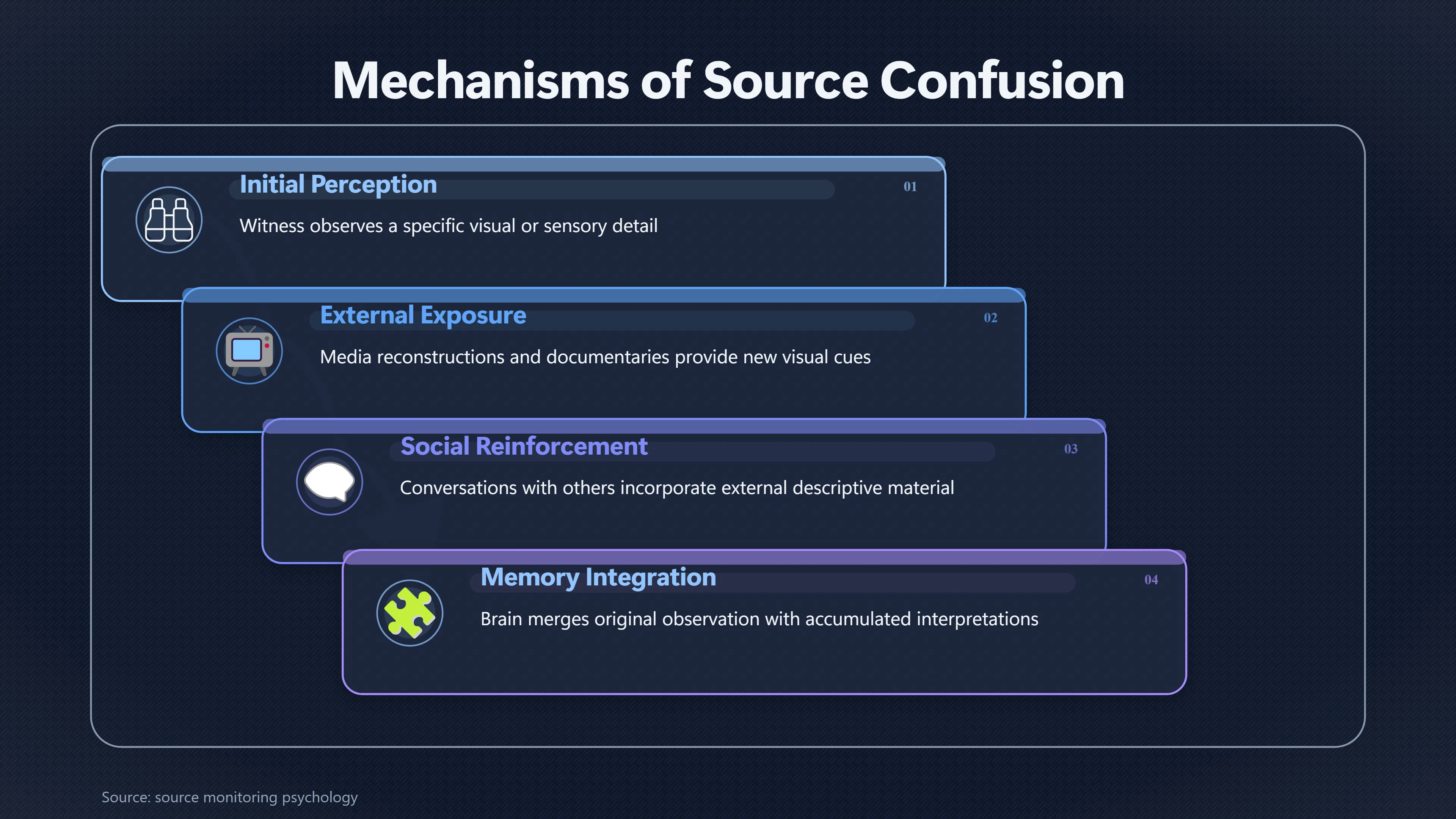
Psychological research identifies several common forms of source confusion relevant to UFO testimony:
- Perception versus inference: A witness remembers an object as metallic, although the original observation only established a bright light and the metallic interpretation emerged later.
- Personal observation versus media exposure: An image from a documentary reconstruction becomes mentally associated with the actual event.
- Own memory versus another witness’s account: Repeated conversations between witnesses can blur which individual originally observed a particular feature.
- Observation versus imagination: Visualising an event during repeated interviews can strengthen imagined details until they possess many of the qualities of genuine perception.[PubMed]pubmed.ncbi.nlm.nih.govPub Med Source monitoring and memory distortionSource monitoring and memory distortion - PubMed…
None of these processes requires deception. They arise because memories are reconstructed rather than replayed exactly as they were experienced.
Why Documentaries and Conversations Blur Origins
Celebrity experiences occupy an unusual media environment. Unlike most eyewitnesses, famous individuals often revisit the same story across television interviews, podcasts, autobiographies and documentaries.
Each retelling introduces additional descriptive material. Producers may display computer-generated reconstructions, dramatic artwork or historical photographs while the witness narrates the event. Even when clearly labelled as illustrations, these images can later become highly familiar.
Psychological studies show that people often remember information while losing the contextual markers that identify its source. After many years, the remembered image may survive even if the witness no longer remembers whether it originated in direct perception or subsequent exposure.[PubMed]pubmed.ncbi.nlm.nih.govPub Med Source monitoringSource monitoring - PubMed…
Conversations have a similar effect. Friends, investigators and family members frequently exchange memories after unusual events. Research on memory attribution shows that post-event information can become incorporated into later recollections when people misattribute the conversational source to their own original observation.[PubMed]pubmed.ncbi.nlm.nih.govPub Med Source monitoring and memory distortionSource monitoring and memory distortion - PubMed…
For celebrities, this process can be amplified because:
- numerous interviewers ask similar questions over decades;
- published biographies may restate events in more concrete language;
- fan communities reinforce particular interpretations;
- repeated public performances encourage a stable narrative, even if the original perception was less definite.
The resulting account may therefore represent a mixture of original observation and accumulated interpretation.

Celebrity UFO Accounts as a Special Case
Celebrity witnesses differ from ordinary eyewitnesses in one important respect: their memories are continuously rehearsed in public.
Repeated retrieval generally strengthens access to a story, but psychologists distinguish remembering the retold narrative from remembering the original event. Every interview reinforces whichever version is currently being recalled. If that version already contains later additions, those additions may become increasingly difficult to separate from the earliest memory.[PubMed]pubmed.ncbi.nlm.nih.govPub Med Source monitoring and memory distortionSource monitoring and memory distortion - PubMed…
This does not mean celebrity UFO reports are uniquely unreliable. Rather, they are unusually exposed to the very conditions known to increase source-monitoring challenges:
- long delays before detailed interviews;
- extensive media coverage;
- repeated questioning;
- public expectations for a coherent narrative;
- continual exposure to other UFO stories.
These factors make provenance—the history of each remembered detail—as important as the detail itself.
Testing Details Against Early Records
Because source confusion primarily concerns the origin of remembered information, the strongest way to evaluate a celebrity UFO account is chronological rather than psychological.
The most informative evidence usually includes:
- contemporaneous diary entries;
- dated interviews conducted soon after the sighting;
- original police or aviation reports where applicable;
- early media coverage recorded before later UFO narratives became attached to the case.
If a distinctive detail appears consistently in records created immediately after the event, confidence increases that it formed part of the original recollection. Conversely, if a striking feature first appears decades later after documentaries, books or extensive interviews, it may represent a later reconstruction rather than an original observation.
This approach mirrors recommendations from memory research: examine how recollections change over time instead of assuming every later elaboration reflects improved recall.[PubMed]pubmed.ncbi.nlm.nih.govPub Med Source monitoring and memory distortionSource monitoring and memory distortion - PubMed…
What Source Confusion Can—and Cannot—Explain
Source confusion offers a mechanism for understanding why celebrity UFO stories sometimes become richer, more visual or more internally coherent over time. It explains how genuine witnesses can misattribute the origins of remembered details without fabricating an experience.
At the same time, the mechanism has clear limits. It cannot determine whether the original observation was an aircraft, an astronomical object, an unexplained aerial phenomenon or something else entirely. Nor does the presence of source-monitoring risks prove that any specific detail is false.
Instead, it provides a framework for evaluating testimony. The key question becomes not simply “Does the witness remember this?” but “How confidently can the origin of that memory be traced?” For long-delayed celebrity UFO accounts, distinguishing what was first seen from what was learned later is often one of the most informative steps in assessing the historical reliability of the narrative.[PubMed]pubmed.ncbi.nlm.nih.govPub Med Source monitoring and memory distortionSource monitoring and memory distortion - PubMed…
Amazon book picks
Further Reading
Books and field guides related to Did the Witness See It or Learn It Later?. Use these as the next step if you want deeper reading beyond the article.
The Seven Sins of Memory: How the Mind Forgets and Remembers
Rating: 3.5/5 from 5 Google Books ratings
A New York Times Notable Book: A psychologist's "gripping and thought-provoking" look at how and why our brains sometimes fail us (Steven...
The Seven Sins of Memory
Rating: 3.5/5 from 5 Google Books ratings
A New York Times Notable Book: A psychologist's "gripping and thought-provoking" look at how and why our brains sometimes fail us (Steven...
The Memory Illusion: Remembering, Forgetting, and the Science...
THE INTERNATIONAL BESTSELLER 'Truly fascinating.' Steve Wright, BBC Radio 2 - Have you ever forgotten the name of someone you’ve met doze...
Searching for Memory: The Brain, the Mind, and the Past
Memory. There may be nothing more important to human beings than our ability to enshrine experience and recall it. While philosophers and...
eBay marketplace picks
Marketplace Samples
Live-tested eBay searches with available results related to this page.
Selected fromUFO poster oneBay.co.uk.


Endnotes
1.
Source: unexplained.co
Link:https://www.unexplained.co/news/bob-oechsler-nasa-engineer-ufo-claims
Source snippet
NASA Engineer Bob Oechsler UFO Claims: 20 Sightings and the Money Behind SecrecyMay 4, 2026 — Articles NASA ENGINEER BOB OECHSLER UFO CLA...
Published: May 4, 2026
2.
Source: neurolaunch.com
Title: source monitoring psychology
Link:https://neurolaunch.com/source-monitoring-psychology/
Source snippet
Source Monitoring in Psychology: Memory Attribution ProcessesSeptember 14, 2024 — SOURCE MONITORING IN PSYCHOLOGY: EXPLORING MEMORY ATTRI...
Published: September 14, 2024
3.
Source: history.com
Title: first alien abduction account barney betty hill
Link:https://www.history.com/articles/first-alien-abduction-account-barney-betty-hill
4.
Source: pubmed.ncbi.nlm.nih.gov
Title: Pub Med Source monitoring
Link:https://pubmed.ncbi.nlm.nih.gov/8346328/
Source snippet
Source monitoring - PubMed...
5.
Source: pubmed.ncbi.nlm.nih.gov
Title: Pub Med Source monitoring and memory distortion
Link:https://pubmed.ncbi.nlm.nih.gov/9415926/
Source snippet
Source monitoring and memory distortion - PubMed...
6.
Source: pmc.ncbi.nlm.nih.gov
Title: Pub Med Central (PMC)Source monitoring and memory distortion
Link:https://pmc.ncbi.nlm.nih.gov/articles/PMC1692093/
Source snippet
PubMed Central (PMC)Source monitoring and memory distortion - PMC...
7.
Source: pubmed.ncbi.nlm.nih.gov
Link:https://pubmed.ncbi.nlm.nih.gov/35391596/
Source snippet
Sources and destinations of misattributions in recall of instances of repeated events - PubMed...
8.
Source: pubmed.ncbi.nlm.nih.gov
Link:https://pubmed.ncbi.nlm.nih.gov/23282942/
9.
Source: pubmed.ncbi.nlm.nih.gov
Link:https://pubmed.ncbi.nlm.nih.gov/2725271/
10.
Source: pubmed.ncbi.nlm.nih.gov
Link:https://pubmed.ncbi.nlm.nih.gov/2522502/
11.
Source: encyclopedia.com
Link:https://www.encyclopedia.com/psychology/encyclopedias-almanacs-transcripts-and-maps/source-monitoring
Additional References
12.
Source: psychologytoday.com
Link:https://www.psychologytoday.com/gb/blog/the-forensic-view/202505/anal-probes-and-aliens-why-so-many-people-fell-for-a-joke-story
Source snippet
Sharps Ph.D. The Forensic View ANAL PROBES AND ALIENS: WHY SO MANY PEOPLE FELL FOR A JOKE STORY THE RESPONSE TO A RECENT SATIRICAL NEWS A...
13.
Source: disclosdex.com
Title: Bob Lazar S-4 Account | Disclosdex
Link:https://disclosdex.com/documents/1989-bob-lazar-s4-account
Source snippet
June 23, 2025 — BOB LAZAR S-4 ACCOUNT Analysis Analysis of media appearances describing the 1988-89 testing of exotic technology at S-4 D...
Published: June 23, 2025
14.
Source: science.nasa.gov
Link:https://science.nasa.gov/uap/
Source snippet
NASA ScienceFebruary 23, 2026 — Explore This Section UAP CONTENTS * NASA Unidentified Anomalous Phenomena Independent Study * Final Repor...
Published: February 23, 2026
15.
Source: youtube.com
Title: How Reliable is Eyewitness Testimony?
Link:https://www.youtube.com/watch?v=ChgPk2OiZCw
Source snippet
Source monitoring error human memory false memories loftus Cognition Lecture 6 2 Source Memory and Source Monitoring...
16.
Source: ojp.gov
Link:https://www.ojp.gov/ncjrs/virtual-library/abstracts/distortions-[eyewitness-memory
17.
Source: history.co.uk
Link:https://www.history.co.uk/shows/alien-files-unsealed/articles/celebrity-alien-stories
18.
Source: nhinewsnetwork.com
Link:https://nhinewsnetwork.com/biographies/[dan-aykroyd
19.
Source: uaprad.org
Link:https://uaprad.org/witnesses/david-fravor/
20.
Source: cognitivepsychology.com
Link:https://www.cognitivepsychology.com/Source_Monitoring
21.
Source: youtube.com
Title: Travis Walton Tells His Story of Alien Abduction
Link:https://www.youtube.com/watch?v=DsiKEBAFmm4
Source snippet
Are all of your memories real? - Daniel L. Schacter...