Within Size and Speed
Why UFO Lights Become Harder to Judge at Night
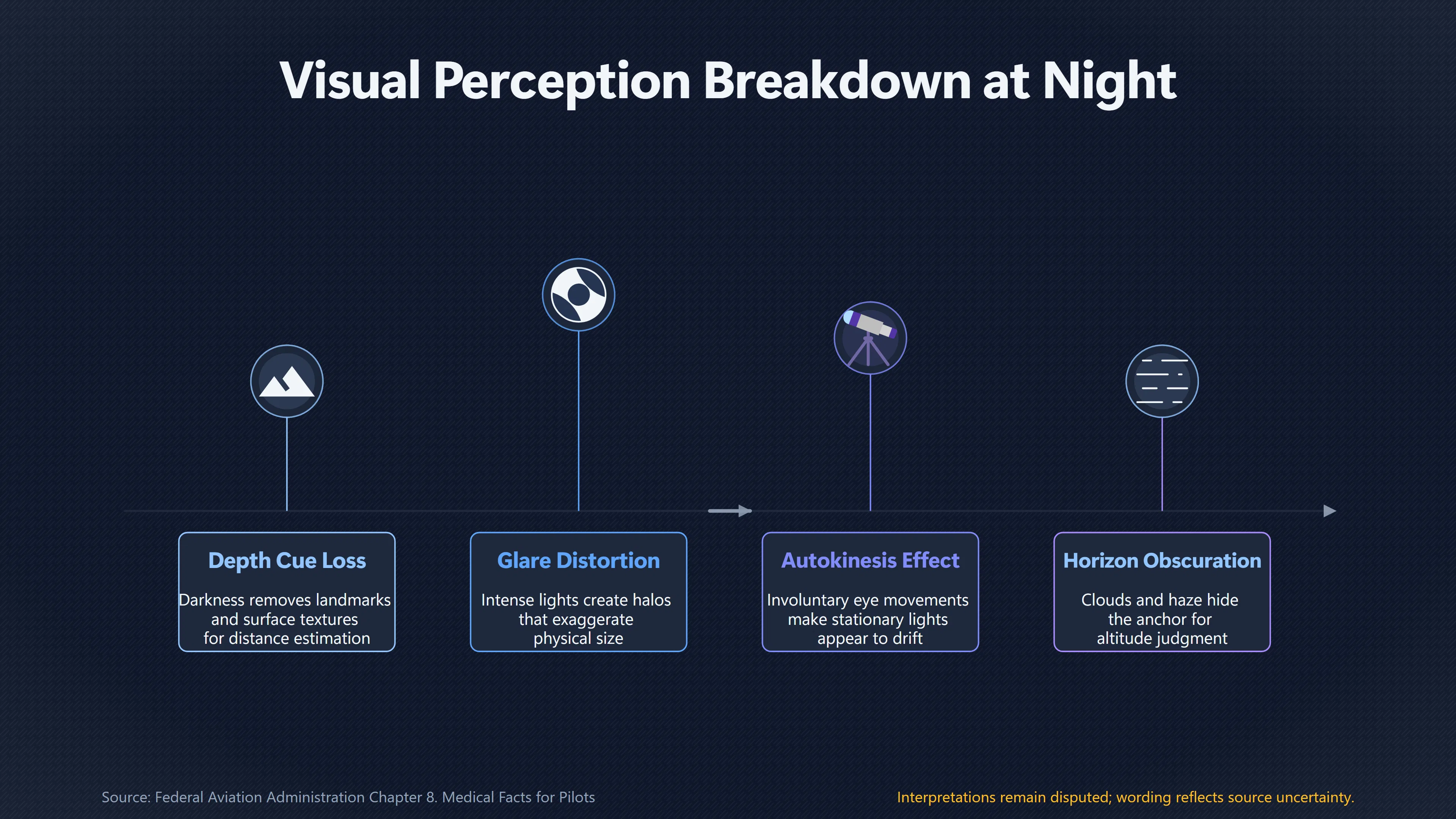
Darkness removes depth cues and can make isolated lights seem larger, nearer, faster or more erratic than they are.
On this page
- Depth cues lost after dark
- Glare and brightness as false size clues
- Clouds, haze and horizon loss
Page outline Jump by section
Introduction
Reports of unidentified lights are disproportionately common at night because darkness removes many of the visual cues that people normally rely on to judge distance, size and motion. A single bright light against a featureless sky provides very little information about how far away it is, whether it is moving, or even whether it is large or small. As a result, witnesses may sincerely perceive a light as accelerating, hovering unnaturally or changing direction when the available visual information is too limited to support reliable estimates. This does not mean that every night-time UFO report has an ordinary explanation, but it does mean that darkness significantly increases the risk of perceptual error. NASA’s review of unidentified anomalous phenomena (UAP) similarly notes that establishing reliable distance is essential before extraordinary claims about speed or manoeuvrability can be evaluated.[Federal Aviation Administration]faa.govFederal Aviation Administration Chapter 8. Medical Facts for PilotsFederal Aviation Administration Chapter 8. Medical Facts for Pilots
Depth cues disappear after dark
During daylight, the human visual system constantly estimates distance using familiar landmarks, surface textures, shadows, perspective and the visible horizon. At night, many of these cues vanish.
An isolated point of light offers almost none of the information needed to determine its range. A nearby drone, a distant aircraft, a bright planet or a satellite may all appear as similar pinpoints. Without knowing the actual distance, the observer cannot calculate true size or speed because those depend directly on range.
This becomes especially important in UFO reports. A witness may conclude that a light crossed “miles of sky in seconds”, but the observation often measures only its angular movement across the observer’s field of view. If the object’s distance is unknown, its true velocity cannot be determined reliably. NASA’s UAP assessment and aviation guidance both stress that missing range information is one of the biggest obstacles to interpreting aerial observations.[Federal Aviation Administration]faa.govFederal Aviation Administration Chapter 8. Medical Facts for PilotsFederal Aviation Administration Chapter 8. Medical Facts for Pilots
Glare and brightness can make lights seem larger or nearer
Brightness is a poor guide to physical size.
Human vision tends to interpret intense lights as larger than their actual angular size because of glare and light scattering within the eye. Atmospheric moisture, haze and thin cloud can further spread light into a glowing halo that appears substantially bigger than the light source itself.
This can create several misleading impressions:
- A small but bright light may appear to be a much larger object.
- A glowing halo can make the source appear closer than it really is.
- Changes in atmospheric clarity may make the light seem to expand or shrink even if its actual size is unchanged.
- Brightness fluctuations caused by haze or thin cloud can resemble changes in distance or speed.
Modern aviation guidance warns that glare, reduced contrast and featureless night scenes routinely distort visual judgement, even among trained pilots.[Federal Aviation Administration]faa.govFederal Aviation Administration Chapter 8. Medical Facts for PilotsFederal Aviation Administration Chapter 8. Medical Facts for Pilots
Why stationary lights sometimes appear to move
One of the best documented night-time visual illusions is autokinesis.[skybrary.aero]skybrary.aeroSource details in endnotes.
When someone stares at a single stationary light against a dark background for several seconds, tiny involuntary eye movements occur continuously. Because there are no surrounding reference points, the brain may incorrectly interpret these eye movements as motion of the light itself.
The result can be the convincing impression that a star, planet or distant aircraft is:
- drifting sideways;
- making small circles;
- suddenly changing direction;
- zig-zagging; or
- slowly approaching or receding.
The illusion has been recognised in aviation medicine for decades because pilots can mistakenly believe that a fixed light is moving. Flight training specifically teaches pilots to avoid staring continuously at isolated lights and instead use systematic scanning to reduce the effect.[faa.gov]faa.govFederal Aviation Administration Chapter 8. Medical Facts for PilotsFederal Aviation Administration Chapter 8. Medical Facts for Pilots
Clouds, haze and the disappearing horizon
Night conditions frequently remove the horizon that normally anchors visual perception.
When clouds obscure the skyline or haze blends the ground into the sky, observers lose an important reference for judging whether an object is climbing, descending or maintaining altitude.
Additional atmospheric effects further complicate interpretation:
- Thin cloud can partially obscure a light, making it appear to blink or change shape.
- Passing haze alters brightness, creating the impression of acceleration or deceleration.
- Refraction through uneven layers of air near the horizon can slightly shift a light’s apparent position.
- Scattered light around moisture or aerosols enlarges bright sources, making them appear closer than they are.
The Federal Aviation Administration identifies obscured horizons, dark scenes with sparse visual references and atmospheric conditions as well-known causes of visual illusion during night flight because they interfere with normal depth perception.[Federal Aviation Administration]faa.govFederal Aviation Administration Chapter 8. Medical Facts for PilotsFederal Aviation Administration Chapter 8. Medical Facts for Pilots
Why celebrity sightings are especially difficult to interpret
Within reports involving celebrities or other public figures, night-time observations often receive intense media attention despite having limited measurable information.
Many widely discussed accounts describe a bright, isolated light rather than a clearly resolved object. Because darkness removes distance cues, later descriptions may unintentionally exaggerate apparent speed, size or manoeuvrability. This does not imply that witnesses are dishonest. Instead, it reflects a fundamental limitation of human visual perception under low-light conditions.
Investigators therefore look for independent evidence such as multiple viewing locations, radar data, calibrated video, astronomical records or aircraft tracking before attempting to estimate an object’s actual motion. Without such information, apparent extraordinary movement may remain impossible to distinguish from normal objects viewed under difficult night-time conditions.[Federal Aviation Administration]faa.govFederal Aviation Administration Chapter 8. Medical Facts for PilotsFederal Aviation Administration Chapter 8. Medical Facts for Pilots
Why night observations require extra caution
Darkness does not merely make objects harder to see—it changes how the brain interprets what is seen. Losing depth cues, relying on brightness as a proxy for distance, experiencing glare and encountering illusions such as autokinesis all increase uncertainty when judging isolated lights.
For that reason, investigators treat witness estimates of distance, size and speed from night-time sightings with particular caution. Before concluding that a light performed extraordinary manoeuvres, the first question is usually the simplest: was there enough visual information to judge its distance in the first place? If the answer is no, then claims about remarkable motion become far less secure, regardless of how vivid or sincere the observation may have been.[faa.gov]faa.govFederal Aviation Administration Chapter 8. Medical Facts for PilotsFederal Aviation Administration Chapter 8. Medical Facts for Pilots

Amazon book picks
Further Reading
Books and field guides related to Why UFO Lights Become Harder to Judge at Night. Use these as the next step if you want deeper reading beyond the article.
The Invisible Gorilla
NEW YORK TIMES BESTSELLER • Our minds don’t work the way we think they do. Two renowned psychologists explain how and why our intuitions...
The Demon-haunted World
Rating: 4.5/5 from 43 Google Books ratings
Are we on the brink of a new Dark Age of irrationality and superstition? In this book, the writer shows how scientific thinking is necess...
Eye and Brain
Since the publication of the first edition in 1966, Eye and Brain has established itself worldwide as an essential introduction to the ba...
Thinking, Fast and Slow
Why is there more chance we'll believe something if it's in a bold type face? Why are judges more likely to deny parole before lunch? Why...
eBay marketplace picks
Marketplace Samples
Live-tested eBay searches with available results related to this page.
Selected fromUFO collectible oneBay.co.uk.
Endnotes
1.
Source: faa.gov
Title: Federal Aviation Administration Chapter 8. Medical Facts for Pilots
Link:https://www.faa.gov/Air_traffic/publications/atpubs/aim_html/chap8_section_1.html
2.
Source: faa.gov
Title: Federal Aviation Administration Chapter 8. Medical Facts for Pilots
Link:https://www.faa.gov/air_traffic/publications/atpubs/aim/aim0801.html
3.
Source: science.nasa.gov
Link:https://science.nasa.gov/uap/
Source snippet
NASA ScienceFebruary 23, 2026 — Explore This Section UAP CONTENTS * NASA Unidentified Anomalous Phenomena Independent Study * Final Repor...
Published: February 23, 2026
4.
Source: ssd.jpl.nasa.gov
Title: “Labels” refers to column headings at the start of the output table. TIME One o
Link:https://ssd.jpl.nasa.gov/horizons/manual.html
Source snippet
SystemNovember 21, 2025 — DEFINITION OF OBSERVER TABLE QUANTITIES The detailed description of the selectable observer table quantities fo...
Published: November 21, 2025
5.
Source: science.nasa.gov
Title: photographing the moon illusion
Link:https://science.nasa.gov/resource/photographing-the-moon-illusion/
Source snippet
The orange-colored rising moon on the lower left had just cleared low clouds on the horizon, around 8:30 p.m. PDT...
6.
Source: science.nasa.gov
Title: the atmosphere after dark
Link:https://science.nasa.gov/sun/the-atmosphere-after-dark/
Source snippet
After Dark! - NASA ScienceJanuary 21, 2025 — Image: Glowing bands over Earth at night. THE ATMOSPHERE... AFTER DARK! What transpires in t...
Published: January 21, 2025
7.
Source: science.nasa.gov
Title: nsn night lights
Link:https://science.nasa.gov/solar-system/skywatching/night-sky-network/nsn-night-lights/
8.
Source: nasa.gov
Title: NAS A to Release, Discuss Unidentified Anomalous Phenomena Report
Link:https://www.nasa.gov/news-release/nasa-to-release-discuss-unidentified-anomalous-phenomena-report/
9.
Source: science.nasa.gov
Title: the moon illusion why does the moon look so big sometimes
Link:https://science.nasa.gov/solar-system/moon/the-moon-illusion-why-does-the-moon-look-so-big-sometimes/
10.
Source: science.nasa.gov
Title: hubble detects ghostly glow surrounding our solar system
Link:https://science.nasa.gov/missions/hubble/hubble-detects-ghostly-glow-surrounding-our-solar-system/
11.
Source: nasa.gov
Link:https://www.nasa.gov/missions/aim/rocket-launches-can-create-night-shining-clouds-away-from-the-poles-nasas-aim-mission-reveals/
12.
Source: imagine.gsfc.nasa.gov
Title: night sky
Link:https://imagine.gsfc.nasa.gov/ask_astro/night_sky.html
13.
Source: apod.nasa.gov
Link:https://apod.nasa.gov/apod/ap160630.html
14.
Source: science.nasa.gov
Title: identifying ufos and uaps
Link:https://science.nasa.gov/solar-system/skywatching/night-sky-network/identifying-ufos-and-uaps/
15.
Source: nasa.gov
Title: Meteor Smoke Makes Strange Clouds
Link:https://www.nasa.gov/missions/aim/meteor-smoke-makes-strange-clouds/
16.
Source: science.nasa.gov
Title: dissecting a light echo
Link:https://science.nasa.gov/photojournal/dissecting-a-light-echo/
17.
Source: jpl.nasa.gov
Title: pia10723 dissecting a light echo
Link:https://www.jpl.nasa.gov/images/pia10723-dissecting-a-light-echo/
18.
Source: science.nasa.gov
Title: watching the world go by
Link:https://science.nasa.gov/earth/earth-observatory/watching-the-world-go-by/
19.
Source: faa.gov
Title: Office of Aerospace Medicine Technical Reports | Federal Aviation Administration
Link:https://www.faa.gov/data_research/research/med_humanfacs/oamtechreports/1970s/1978/197815
20.
Source: faa.gov
Link:https://www.faa.gov/air_traffic/publications/atpubs/aip_html/chap8_section_1.html
21.
Source: faa.gov
Link:https://www.faa.gov/data_research/research/med_humanfacs/oamtechreports/1970s/1977/197712
22.
Source: faa.gov
Link:https://www.faa.gov/air_traffic/publications/atpubs/aip_html/chap7_section_6.html
23.
Source: faa.gov
Title: EN R 1.15: Medical Facts for Pilots7.. JUDGMENT ASPECTS OF COLLISION AVOIDANCE 1
Link:https://www.faa.gov/air_traffic/publications/atpubs/aip_html/part2_enr_section_1.15.html
24.
Source: faa.gov
Link:https://www.faa.gov/air_traffic/publications/atpubs/aim_html/chap10_section_2.html
25.
Source: faasafety.gov
Title: Your Senses In The Shadows
Link:https://www.faasafety.gov/files/events/SO/SO15/2024/SO15134204/YourSensesInTheShadows.pdf
Source snippet
FAA SafetyYour Senses in the Shadows. Nighttime Visual Illusions and Spatial… | by FAA Safety Briefing Magazine | Jan, 2025 | Medium...
26.
Source: skybrary.aero
Link:https://skybrary.aero/index.php/articles/visual-illusions
27.
Source: faasafety.gov
Link:https://www.faasafety.gov/gslac/ALC/libview_chapter.aspx?chapter=Illusions+-+Have+I+Considered+Them%3F&id=6580
Additional References
28.
Source: youtube.com
Title: “Pyramid UFO”
Link:https://www.youtube.com/watch?v=-r2oaQWmqkk
Source snippet
Mick West UFO distance parallax motion illusion Effet de parallaxe sur une cible immobile...
29.
Source: ufouap.net
Link:https://www.ufouap.net/en/explainers/autokinesis-stationary-light-illusion
Source snippet
Autokinesis: Why a Stationary Light Seems to Move | Global UFO ArchiveJuly 11, 2026 — Evidence / Updated 2026-07-11 / 7 min read AUTOKINE...
Published: July 11, 2026
30.
Source: faraim.org
Link:https://www.faraim.org/faa/aim/chapter-8/section-8-1-5.html
31.
Source: af.mil
Link:https://www.af.mil/News/Article-Display/Article/2209213/black-box-sheds-light-on-night-vision-challenges-for-aircrew-students/
32.
Source: youtube.com
Title: These UFOs are Starlink Flares, 100%
Link:https://www.youtube.com/watch?v=Ea8BCl2yVU0
Source snippet
"Pyramid UFO" - NEW FOOTAGE. It's Just Bokeh, not a Pyramid...
33.
Source: youtube.com
Title: Explained: “Go Fast” UFO Video
Link:https://www.youtube.com/watch?v=PLyEO0jNt6M
Source snippet
UFO Parallax Illusion...
34.
Source: youtube.com
Title: UFO Parallax Illusion
Link:https://www.youtube.com/watch?v=IRd1RY2PuvA
Source snippet
Why "Racetrack" UFOs are mostly Starlink Flares...
35.
Source: youtube.com
Title: Why “Racetrack” UFOs are mostly Starlink Flares
Link:https://www.youtube.com/watch?v=_VmrRGln1XA
Source snippet
These UFOs are Starlink Flares, 100%...
36.
Source: youtube.com
Title: Mick West
Link:https://www.youtube.com/watch?v=e-WDx7byI0k
Source snippet
Brazil UFO Flap Solved! (Starlink Again) Mick West...
37.
Source: aopa.org
Title: Tricked by Illusions
Link:https://www.aopa.org/training-and-safety/online-learning/safety-spotlights/spatial-disorientation/tricked-by-illusions