Within NASA Standard
Should the Public Be Able to Recheck UAP Claims?
Independent access to original files, processing steps and uncertainty estimates allows scientific claims about UAPs to be checked and challenged.
On this page
- What a reproducible UAP record must include
- How processing and compression can alter evidence
- Balancing scientific openness with security and privacy
Page outline Jump by section
Introduction
NASA’s approach to unidentified anomalous phenomena (UAP) shifts attention away from asking whether the public should trust an official conclusion and towards whether the underlying evidence can be independently tested. That distinction is central to scientific practice. A conclusion—even from a respected agency—is only as reliable as the observations, methods and assumptions supporting it. When original observations, processing methods and uncertainty estimates are available, other researchers can check whether a finding holds, identify errors, propose alternative explanations or improve the analysis. Where security, privacy or operational concerns prevent full disclosure, agencies can often still release declassified datasets, metadata or methodological details that preserve scientific value without exposing sensitive capabilities. NASA’s 2023 UAP study argued that this culture of transparency is essential if UAP research is to move beyond debate over authority and towards reproducible evidence.[NASA Science]science.nasa.govScience UAPNASA ScienceUAP - NASA ScienceFebruary 23, 2026…
Should the Public Be Able to Recheck UAP Claims?
Science does not advance because institutions issue definitive statements. It advances because independent investigators can examine the same evidence and determine whether they reach the same conclusions.
This principle is especially important for UAP investigations because many reported events involve incomplete observations, uncertain distances, multiple sensor systems or rapidly changing environmental conditions. Small differences in processing or interpretation can change whether an object appears extraordinary or entirely conventional.
NASA’s independent study deliberately emphasised transparency over institutional authority. The report concluded that the present evidence base contains too few high-quality observations to support firm scientific conclusions, making careful documentation, calibrated measurements and accessible methodologies more valuable than confident declarations alone.[NASA]nasa.govUPDATE: NASA Shares UAP Independent Study Report; Names DirectorUPDATE: NASA Shares UAP Independent Study Report; Names Director - NASA…
For readers interested in UFO cases involving celebrities or high-profile witnesses, this principle is equally important. Public attention may focus on who reported an event, but scientific confidence depends on whether independent analysts can examine the same evidence rather than relying on reputation or official interpretation.
What a Reproducible UAP Record Must Include
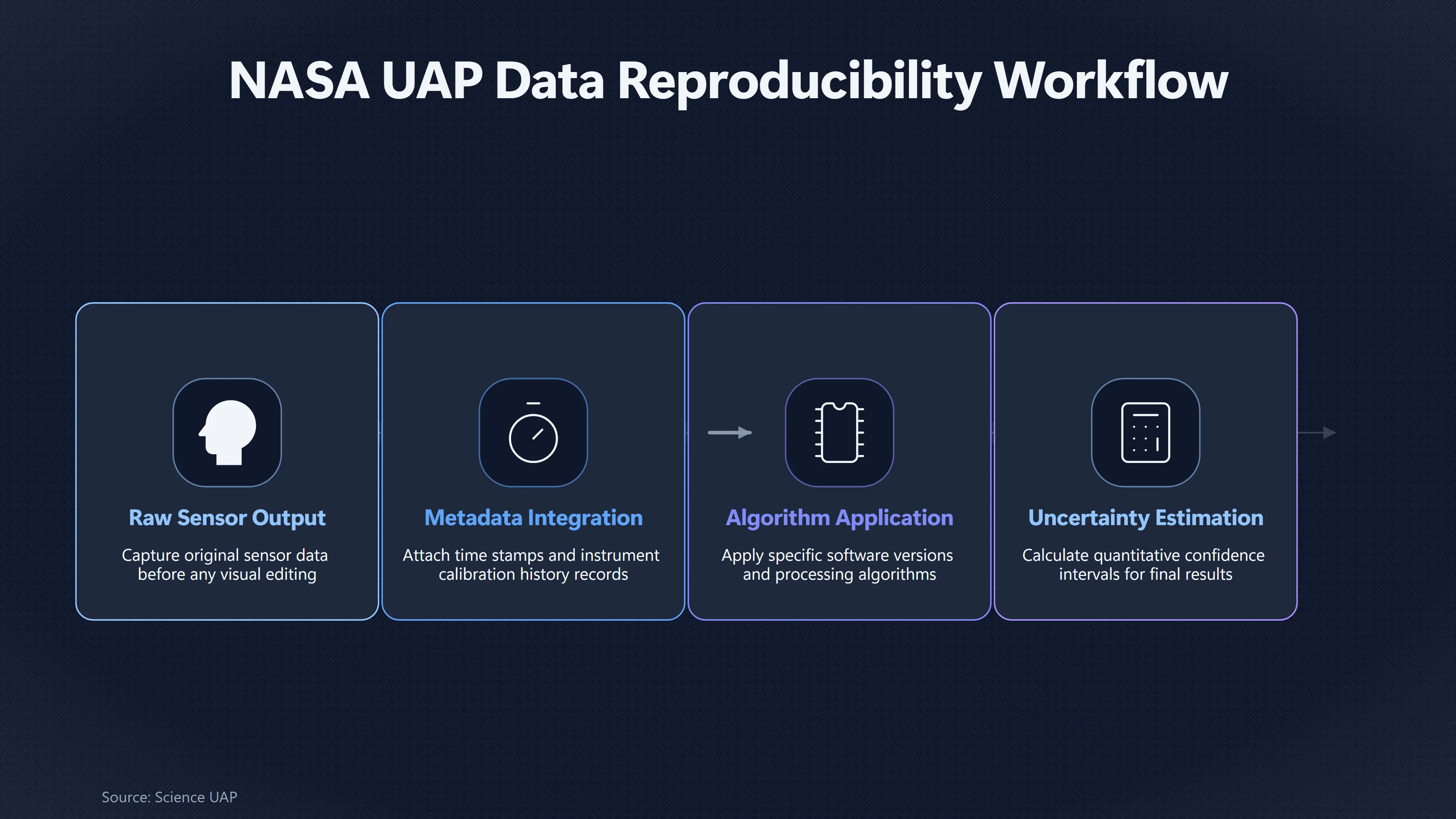
A reproducible UAP investigation requires much more than releasing a photograph or issuing a written summary. Other researchers must be able to reconstruct how the evidence became the published result.
A scientifically useful record typically includes:
- the original sensor output rather than only edited images or videos;
- exact timestamps and synchronisation between sensors;
- instrument specifications, calibration history and operating mode;
- environmental information such as weather, astronomical conditions and aircraft traffic;
- processing software, algorithms and version numbers;
- every major processing step from raw observation to final visualisation;
- quantitative uncertainty estimates rather than only qualitative confidence statements.
These requirements mirror broader scientific standards for reproducible computational research. Modern reproducibility guidance consistently treats metadata—the information describing how data were collected and processed—as essential because it allows other researchers to understand provenance, identify possible sources of error and repeat the analytical workflow.[nih.gov]ncbi.nlm.nih.govReproducibility and Replicability in Science - NCBI BookshelfMay 7, 2019…
Without this information, an outside investigator cannot meaningfully evaluate whether an apparent anomaly reflects an unusual object, an instrument limitation or a processing choice.
How Processing and Compression Can Alter Evidence
One of the least appreciated challenges in UAP analysis is that images rarely represent direct observations. Most have already passed through multiple stages of processing.
Digital cameras routinely perform noise reduction, sharpening, colour correction, contrast enhancement and compression before an image is viewed. Video platforms frequently apply additional compression that removes fine detail while introducing artefacts. Infrared systems, radar displays and military sensors often generate processed visualisations rather than raw measurements.
Each transformation can influence interpretation.
For example:
- compression may create block patterns or distort object edges;
- stabilisation software can exaggerate apparent motion;
- automatic exposure adjustments may alter brightness relationships;
- image interpolation can smooth or reshape small objects;
- cropped footage removes contextual information needed to estimate motion;
- missing timing information makes speed calculations unreliable.
These effects do not imply deliberate manipulation. They simply illustrate why access to the original files and documented processing history matters more than polished public releases.
Scientific disciplines from astronomy to remote sensing routinely preserve raw observations alongside processed products for precisely this reason. Published images are useful for communication, but reproducibility depends upon preserving the underlying measurements and documenting every transformation applied during analysis.[NCBI]ncbi.nlm.nih.govReproducibility and Replicability in Science - NCBI BookshelfMay 7, 2019…
Why Uncertainty Estimates Matter as Much as the Data
Scientific measurements always contain uncertainty.
A reported object’s position may have an angular error. Distance estimates may depend on assumptions. Radar returns may include measurement tolerances. Image-derived speeds may vary depending on tracking algorithms.
Without quantified uncertainty, readers often interpret measurements as precise facts when they are actually estimates.
NASA’s UAP framework encourages treating uncertainty as information rather than weakness. Publishing confidence intervals, known sensor limitations and alternative interpretations allows later researchers to determine whether different assumptions materially change the result.[NASA]nasa.govUPDATE: NASA Shares UAP Independent Study Report; Names DirectorUPDATE: NASA Shares UAP Independent Study Report; Names Director - NASA…
An unexplained observation therefore becomes more scientifically valuable when its uncertainties are explicitly documented, because future investigators can improve upon the original analysis rather than starting from scratch.

Balancing Scientific Openness with Security and Privacy
Complete public release is not always possible.
Military sensor capabilities, classified operating procedures, personal information and national security concerns may legitimately restrict disclosure. Air traffic information or sensitive surveillance systems can also require protection.
NASA recognised these practical limits while still arguing that openness should be maximised wherever possible. Rather than framing transparency as all-or-nothing, the study encourages selective release of information that preserves scientific usefulness without compromising security.[NASA Science]science.nasa.govScience UAPNASA ScienceUAP - NASA ScienceFebruary 23, 2026…
Possible approaches include:
- removing personally identifying information from reports;
- releasing calibrated measurements without revealing sensor performance limits;
- publishing processing methods even when raw classified imagery cannot be disclosed;
- providing uncertainty estimates and metadata separately from sensitive operational details;
- allowing independent review under controlled access where public release is impossible.
This layered approach recognises that scientific credibility and operational security need not always be in conflict.
Open Data Builds Confidence Regardless of the Outcome
Transparent data benefit every possible conclusion.
If a reported UAP ultimately proves to be a balloon, satellite, atmospheric effect or imaging artefact, independent verification strengthens confidence that the explanation is correct. If an observation remains unexplained after multiple groups analyse the same evidence, that result also carries greater scientific weight because the uncertainty has survived rigorous testing rather than resting on institutional authority alone.
The principle therefore protects against both false positives and false negatives. It reduces the risk of extraordinary claims surviving because no one can inspect the evidence, while also reducing the risk that potentially important anomalies are dismissed without sufficient examination.
For a subject that attracts intense public interest—including claims promoted by celebrities, former officials and social media personalities—this distinction is crucial. Public debate often centres on competing narratives. Scientific progress depends instead on evidence that remains open to independent challenge.
NASA’s proposed standard reflects that broader philosophy: conclusions are provisional, but well-documented data can continue generating better conclusions as methods improve.[nasa.gov]science.nasa.govScience UAPNASA ScienceUAP - NASA ScienceFebruary 23, 2026…
Amazon book picks
Further Reading
Books and field guides related to Should the Public Be Able to Recheck UAP Claims?. Use these as the next step if you want deeper reading beyond the article.
Bad Science
Rating: 5.0/5 from 5 Google Books ratings
Have you ever wondered how one day the media can assert that alcohol is bad for us and the next unashamedly run a story touting the benef...
The Seven Deadly Sins of Psychology
Why psychology is in peril as a scientific discipline—and how to save it Psychological science has made extraordinary discoveries about t...
Reproducibility and Replicability in Science
"One of the pathways by which the scientific community confirms the validity of a new scientific discovery is by repeating the research t...
The Demon-Haunted World: Science as a Candle in the Dark
Are we on the brink of a new Dark Age of irrationality and superstition? In this book, the writer shows how scientific thinking is necess...
eBay marketplace picks
Marketplace Samples
Live-tested eBay searches with available results related to this page.
Selected fromUFO poster oneBay.co.uk.




Endnotes
1.
Source: science.nasa.gov
Title: Science UAP
Link:https://science.nasa.gov/uap/
Source snippet
NASA ScienceUAP - NASA ScienceFebruary 23, 2026...
Published: February 23, 2026
2.
Source: nasa.gov
Title: UPDATE: NASA Shares UAP Independent Study Report; Names Director
Link:https://www.nasa.gov/news-release/update-nasa-shares-uap-independent-study-report-names-director/
Source snippet
UPDATE: NASA Shares UAP Independent Study Report; Names Director - NASA...
3.
Source: ncbi.nlm.nih.gov
Link:https://www.ncbi.nlm.nih.gov/books/NBK547532/
Source snippet
Reproducibility and Replicability in Science - NCBI BookshelfMay 7, 2019...
Published: May 7, 2019
4.
Source: sciencedirect.com
Title: ScienceDirect The role of metadata in reproducible computational research
Link:https://www.sciencedirect.com/science/article/pii/S2666389921001707
Source snippet
The role of metadata in reproducible computational research - ScienceDirect...
5.
Source: science.nasa.gov
Title: satellite data evaluation
Link:https://science.nasa.gov/earth-science/csda/satellite-data-evaluation/
Source snippet
NASA ScienceJune 30, 2026 — DELIVERING SCIENCE-AS-A-SERVICE NASA’s Commercial Satellite Data Acquisition (CSDA) program delivers “science...
Published: June 30, 2026
6.
Source: science.nasa.gov
Link:https://science.nasa.gov/open-science/
Source snippet
Science at NASA - NASA ScienceMay 5, 2026 — OPEN SCIENCE AT NASA NASA is making a long-term commitment to building an open science commun...
Published: May 5, 2026
7.
Source: science.nasa.gov
Link:https://science.nasa.gov/about-us/ocsdo/reports/
Source snippet
of the Chief Science Data Officer Reports - NASA ScienceMay 5, 2026 — Office of the Chief Science Data Officer * OCSDO Overview * Artific...
Published: May 5, 2026
8.
Source: data.nasa.gov
Title: sentinel 1a metadata raw f7778
Link:https://data.nasa.gov/dataset/sentinel-1a-metadata-raw-f7778
Source snippet
nasa.govSentinel-1A Level 0 Product Metadata - Dataset - NASA Open Data PortalMarch 10, 2026 — SENTINEL-1A LEVEL 0 PRODUCT METADATA Total...
Published: March 10, 2026
9.
Source: science.nasa.gov
Title: science information policy faq
Link:https://science.nasa.gov/researchers/science-information-policy_faq/
10.
Source: earthdata.nasa.gov
Title: data use policy
Link:https://www.earthdata.nasa.gov/engage/open-data-services-software/data-use-policy
11.
Source: pmc.ncbi.nlm.nih.gov
Title: Pub Med Central (PMC)The role of metadata in reproducible computational research
Link:https://pmc.ncbi.nlm.nih.gov/articles/PMC8441584/
Source snippet
PubMed Central (PMC)The role of metadata in reproducible computational research - PMC...
12.
Source: pmc.ncbi.nlm.nih.gov
Link:https://pmc.ncbi.nlm.nih.gov/articles/PMC11380994/
13.
Source: pubmed.ncbi.nlm.nih.gov
Link:https://pubmed.ncbi.nlm.nih.gov/34553169/
14.
Source: pmc.ncbi.nlm.nih.gov
Link:https://pmc.ncbi.nlm.nih.gov/articles/PMC10390076/
Additional References
15.
Source: youtube.com
Link:https://www.youtube.com/watch?v=MUQgQlWw5b4
Source snippet
Replay! NASA's Release of the Unidentified Anomalous Phenomena Report...
16.
Source: youtube.com
Title: Public Meeting on Unidentified Anomalous Phenomena (Official NASA Broadcast)
Link:https://www.youtube.com/watch?v=bQo08JRY0iM
Source snippet
Unidentified Anomalous Phenomena Independent Study Report...
17.
Source: youtube.com
Title: Unidentified Anomalous Phenomena Independent Study Report
Link:https://www.youtube.com/watch?v=TQcqOW39ksk
Source snippet
Inside NASA's UAP Report with Commission Chair David Spergel & Neil deGrasse Tyson...
18.
Source: nature.com
Link:https://www.nature.com/articles/s41597-022-01163-2
19.
Source: archives.gov
Link:https://www.archives.gov/records-mgmt/uap-guidance
20.
Source: youtube.com
Title: Replay! NASA’s Release of the Unidentified Anomalous Phenomena Report
Link:https://www.youtube.com/watch?v=nuBMnluJfs0
Source snippet
NASA UFO Panel Holds First Public Meeting...
21.
Source: [aaro]({{ ‘aaro/’ | relative_url }}). mil
Link:https://www.aaro.mil/FAQ/
22.
Source: uap-archive.org
Link:https://uap-archive.org/uap/learn/aaro-case-resolution-reports-overview/
23.
Source: nature.com
Title: Guidelines for Research Data Integrity (GRDI) | Scientific Data
Link:https://www.nature.com/articles/s41597-024-04312-x
24.
Source: ufotransparency.com
Link:https://ufotransparency.com/files/decade-2020s-aaro-fy2024-consolidated-report-2024-dod-aaro-consolidated-annual-report-on-uap-nov2024