Within Size and Speed
Why a Still Light Can Seem to Move
The autokinetic illusion can make a fixed light seem to wander or dart when no stable visual reference is present.
On this page
- What triggers the autokinetic illusion
- Why tiny eye movements matter
- How pilots reduce misinterpretation
Page outline Jump by section
Introduction
Yes. Under the right conditions, a completely stationary light can appear to drift, dart, wobble or trace small irregular paths across the sky even though it is not moving at all. This well-documented visual phenomenon is known as the autokinetic illusion (or autokinesis). It occurs most readily when an isolated point of light is viewed against a featureless dark background with no reliable visual references, such as a star, distant aircraft light or bright planet seen at night. The effect is particularly relevant when assessing UFO reports because it can create a convincing impression of erratic motion without any actual movement by the light itself. Aviation authorities explicitly train pilots to recognise this illusion, as misinterpreting it has contributed to dangerous control inputs during night flight.[faa.gov]faa.govFederal Aviation Administration Chapter 8. Medical Facts for PilotsFederal Aviation Administration Chapter 8. Medical Facts for Pilots
What triggers the autokinetic illusion?
The autokinetic illusion is most likely when several conditions occur together:
- A single bright point of light is visible.
- The surrounding sky is dark or featureless, providing no horizon or nearby objects.
- The observer stares at the light for several seconds.
- There are no stable reference points against which the brain can judge whether the light has moved.
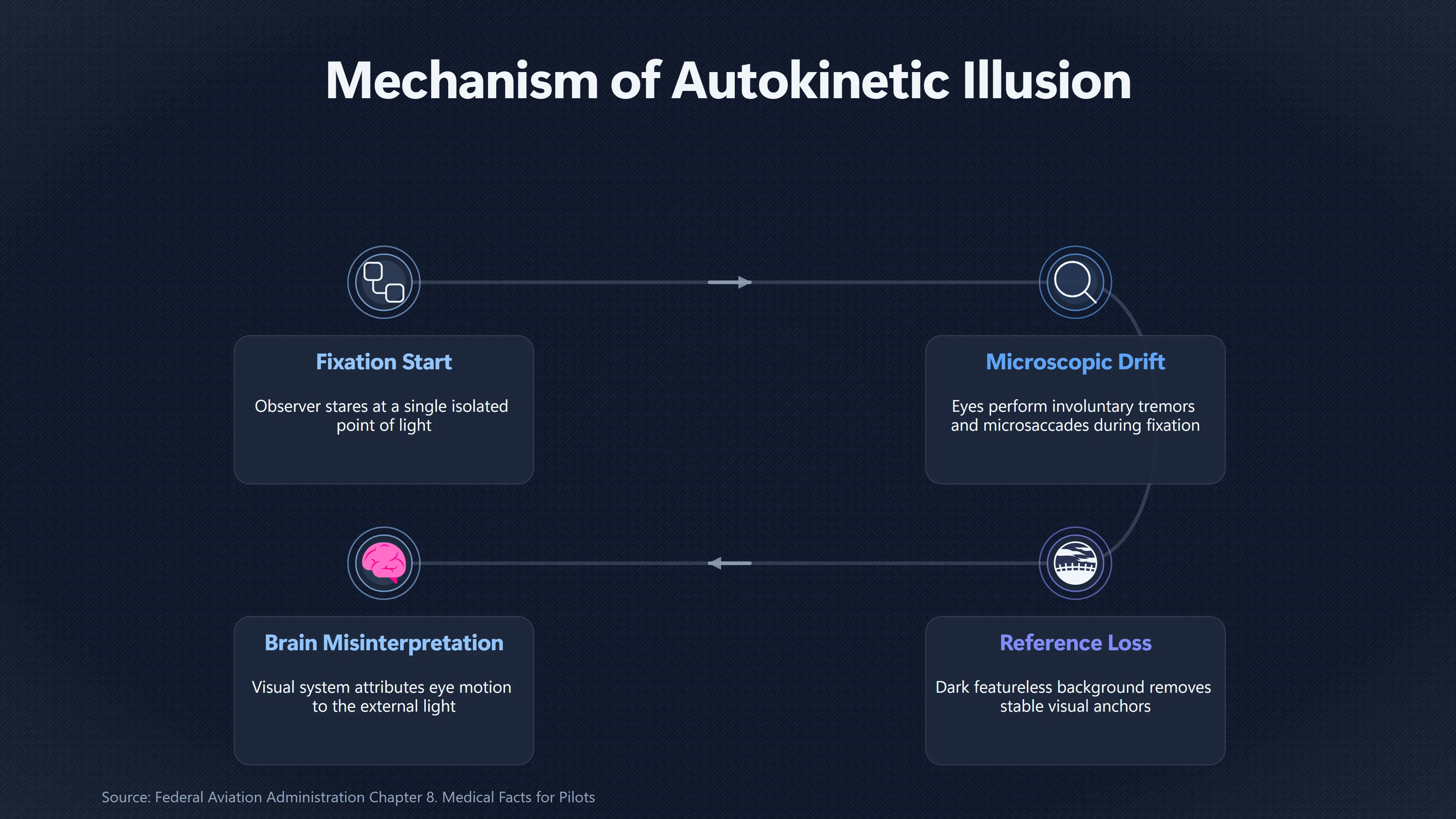
Under these circumstances, the visual system struggles to distinguish genuine object motion from tiny changes in the image falling on the retina. Instead of interpreting those changes as originating from the observer’s own visual system, the brain may attribute them to the external object.
The resulting apparent movement is usually irregular rather than smooth. Witnesses commonly describe the light as drifting, zigzagging, making sudden jumps, circling or “darting” unpredictably. Different observers may even perceive different directions of movement while looking at the same stationary light because the illusion arises within each observer’s visual processing rather than from the object itself.[sagepub.com]journals.sagepub.comSage Journals The Origin of the Autokinetic EffectSage JournalsThe Origin of the Autokinetic Effect - R. L. Gregory, O. L. Zangwill, 1963…
Within the broader question of why distance and speed are difficult to judge, this illusion is especially important because an apparently moving light may also appear to accelerate dramatically despite remaining fixed in space.
Why tiny eye movements matter
A common misconception is that the eyes remain perfectly still when fixating on an object. In reality, they never do.
Even during steady fixation, the eyes continuously make tiny involuntary movements known as fixational eye movements, including microscopic drifts, tremors and microsaccades. These movements are essential because they prevent the retinal image from fading and help maintain visual perception.[Nature]nature.comThe role of fixational eye movements in visual perception | Nature Reviews Neuroscience…
Normally, the brain distinguishes these miniature eye movements from movement in the outside world because surrounding objects provide a stable visual framework. A horizon, buildings or trees all remain fixed relative to one another, allowing the brain to discount the eye’s own motion.
When the only visible object is an isolated light, that reference framework largely disappears. The visual system has far less information with which to separate eye motion from object motion. As a result, some of the normal fixational movements may be perceived as though the light itself has shifted position. This does not mean that eye movements alone completely explain every instance of autokinesis—research has shown that muscular, perceptual and central neural mechanisms all contribute—but involuntary fixation movements form an important part of the overall explanation.[Sage Journals]journals.sagepub.comSage Journals The Origin of the Autokinetic EffectSage JournalsThe Origin of the Autokinetic Effect - R. L. Gregory, O. L. Zangwill, 1963…
Why pilots are taught to recognise it
Autokinesis is not simply an academic curiosity. It has practical safety implications in aviation.
The US Federal Aviation Administration (FAA) includes autokinesis among recognised visual illusions encountered during night flying. Its Aeronautical Information Manual warns that, after staring at a stationary light in darkness for several seconds, pilots may perceive the light as moving and may unconsciously manoeuvre the aircraft in an attempt to align with it.[Federal Aviation Administration]faa.govFederal Aviation Administration Chapter 8. Medical Facts for PilotsFederal Aviation Administration Chapter 8. Medical Facts for Pilots
Pilot training therefore emphasises several ways to reduce misinterpretation:
- Avoid prolonged fixation on a single isolated light.
- Scan the sky rather than staring continuously.
- Cross-check visual impressions against flight instruments.
- Use the natural horizon or other reliable visual references whenever available.
These techniques reduce reliance on a single ambiguous visual cue and help distinguish genuine object motion from perceptual illusion.[Federal Aviation Administration]faa.govFederal Aviation Administration Chapter 8. Medical Facts for PilotsFederal Aviation Administration Chapter 8. Medical Facts for Pilots
Why this matters when evaluating UFO reports
The autokinetic illusion does not prove that every reported moving light is stationary, nor does it explain sightings observed simultaneously by radar, multiple cameras or multiple independent visual references.
However, it provides a well-established explanation for one specific class of reports: an isolated point of light seen against an otherwise empty night sky that appears to wander, hover while subtly shifting position, or make abrupt small movements despite lacking any independent evidence of motion.
This is particularly relevant when witnesses describe a light that seems to “dance” or “dart around” yet leaves no measurable track relative to the stars or horizon. Without stable reference points, observers can sincerely report extraordinary motion that originates in normal visual processing rather than in the object itself. Recognising this possibility helps investigators distinguish between apparent motion caused by perception and motion that can be independently verified.[faa.gov]faa.govFederal Aviation Administration Chapter 8. Medical Facts for PilotsFederal Aviation Administration Chapter 8. Medical Facts for Pilots
Amazon book picks
Further Reading
Books and field guides related to Why a Still Light Can Seem to Move. Use these as the next step if you want deeper reading beyond the article.
The Invisible Gorilla
NEW YORK TIMES BESTSELLER • Our minds don’t work the way we think they do. Two renowned psychologists explain how and why our intuitions...
Eye and Brain
Since the publication of the first edition in 1966, Eye and Brain has established itself worldwide as an essential introduction to the ba...
The Demon-haunted World
Rating: 4.5/5 from 43 Google Books ratings
Are we on the brink of a new Dark Age of irrationality and superstition? In this book, the writer shows how scientific thinking is necess...
Thinking, Fast and Slow
Why is there more chance we'll believe something if it's in a bold type face? Why are judges more likely to deny parole before lunch? Why...
eBay marketplace picks
Marketplace Samples
Live-tested eBay searches with available results related to this page.
Selected fromUFO t shirt oneBay.co.uk.




Endnotes
1.
Source: faa.gov
Title: Federal Aviation Administration Chapter 8. Medical Facts for Pilots
Link:https://www.faa.gov/Air_traffic/publications/atpubs/aim_html/chap8_section_1.html
2.
Source: nature.com
Link:https://www.nature.com/articles/nrn1348
Source snippet
The role of fixational eye movements in visual perception | Nature Reviews Neuroscience...
3.
Source: faa.gov
Title: Air Traffic Plans and Publications
Link:https://www.faa.gov/air_traffic/publications/
Source snippet
July 28, 2026 — AIR TRAFFIC PLANS AND PUBLICATIONS * Image: Print * Manuals * Publications * Orders * GENOT/Notices * Plans * Air Traffic...
Published: July 28, 2026
4.
Source: faa.gov
Title: Air Traffic Plans and Publications
Link:https://www.faa.gov/air_traffic/publications/?_hsmi=83660902
Source snippet
March 16, 2026 — AIR TRAFFIC PLANS AND PUBLICATIONS * Image: Print * Manuals * Publications * Orders * GENOT/Notices * Plans * Air Traffi...
Published: March 16, 2026
5.
Source: faa.gov
Title: Chapter 8. Medical Facts for Pilots
Link:https://www.faa.gov/air_traffic/publications/atpubs/aim/aim0801.html
6.
Source: nature.com
Link:https://www.nature.com/articles/nrn3405
7.
Source: faa.gov
Link:https://www.faa.gov/air_traffic/publications/atpubs/aip_html/chap8_section_1.html
8.
Source: faa.gov
Link:https://www.faa.gov/data_research/research/med_humanfacs/oamtechreports/1960s/1969/196923
9.
Source: faa.gov
Link:https://www.faa.gov/data_research/research/med_humanfacs/oamtechreports/1960s/1967/196719
10.
Source: faa.gov
Title: Aerospace Medicine Technical Reports | Federal Aviation Administration
Link:https://www.faa.gov/data_research/research/med_humanfacs/oamtechreports/1960s/1966/196639
11.
Source: journals.sagepub.com
Title: Sage Journals The Origin of the Autokinetic Effect
Link:https://journals.sagepub.com/doi/10.1080/17470216308416334
Source snippet
Sage JournalsThe Origin of the Autokinetic Effect - R. L. Gregory, O. L. Zangwill, 1963...
12.
Source: journals.sagepub.com
Link:https://journals.sagepub.com/doi/10.1177/2041669517752716
13.
Source: journals.sagepub.com
Link:https://journals.sagepub.com/doi/10.2466/pms.1966.22.1.319
Additional References
14.
Source: af.mil
Link:https://www.af.mil/News/Article-Display/Article/2209213/black-box-sheds-light-on-night-vision-challenges-for-aircrew-students/
Source snippet
June 7, 2020 — Work on the unaided NV trainer began a few years ago in response to a request from an aerospace physiology technician and...
Published: June 7, 2020
15.
Source: angleofattack.com
Title: Illusions in Flight — AIM 8-1-5 Explained | Angle of Attack
Link:https://www.angleofattack.com/aim/chapter-8/8-1-5/
Source snippet
The pilot who does not recognize this illusion will steepen the approach, often quite abruptly. 6. Ground lighting illusions. Lights along a...
16.
Source: faasafety.gov
Title: FAA Safety Learning Center Library Contents
Link:https://www.faasafety.gov/gslac/ALC/libview_printerfriendly.aspx?id=6580
Source snippet
FAA SafetyLearning Center Library Contents - FAA - FAASTeam - FAASafety.gov...
17.
Source: ufouap.net
Link:https://www.ufouap.net/en/explainers/autokinesis-stationary-light-illusion
Source snippet
Autokinesis: Why a Stationary Light Seems to Move | Global UFO ArchiveJuly 11, 2026 — Evidence / Updated 2026-07-11 / 7 min read AUTOKINE...
Published: July 11, 2026
18.
Source: youtube.com
Title: Conformity Research: Sherif’s Autokinetic Effect Experiment
Link:https://www.youtube.com/watch?v=1-pbW6kc7q0
Source snippet
PPGS Lesson 14.2 | Aeromedical: Illusions...
19.
Source: faraim.org
Link:https://faraim.org/faa/aim/chapter-7/section-7-6-14.html
20.
Source: faraim.org
Link:https://www.faraim.org/faa/aim/chapter-8/section-8-1-5.html
21.
Source: studylib.net
Link:https://studylib.net/doc/25850506/instrument-flying-handbook
22.
Source: annualreviews.org
Title: Control and Functions of Fixational Eye Movements | Annual Reviews
Link:https://www.annualreviews.org/doi/10.1146/annurev-vision-082114-035742
23.
Source: frontiersin.org
Title: Frontiers | Fixational eye movements and binocular vision
Link:https://www.frontiersin.org/journals/integrative-neuroscience/articles/10.3389/fnint.2014.00052/full