Within Storytelling
When UFO Editing Starts to Feel Like Proof
Rapid cuts, delayed reveals and strategic sequencing can make separate weak clues feel like one strong case.
On this page
- How mystery programmes build a reveal
- Why separate claims seem mutually reinforcing
- Questions viewers can ask about sequence and context
Page outline Jump by section
Introduction
Suspense editing does not create evidence, but it can make limited evidence feel increasingly convincing. In many commercially produced UFO documentaries and television series, rapid cuts, delayed reveals, dramatic pauses and carefully ordered interviews encourage viewers to experience a growing sense of discovery. By the time the programme reaches its climax, the emotional impression of certainty may be much stronger than the underlying factual record.

This matters because editing shapes how information is experienced, not just what information is presented. A witness statement, an ambiguous video, an expert discussing possibilities and a narrator asking provocative questions may each have limited evidential value on their own. Yet when arranged as a carefully paced mystery, they can feel like pieces of a single puzzle pointing towards one conclusion. Studies of documentary editing and paranormal television argue that these storytelling techniques are central to how audiences experience uncertainty, even when definitive proof remains absent.[oup.com]academic.oup.comAcademic Time | How Documentaries Work | Oxford AcademicOUP AcademicTime | How Documentaries Work | Oxford AcademicDecember 15, 2022…
How mystery programmes build a reveal
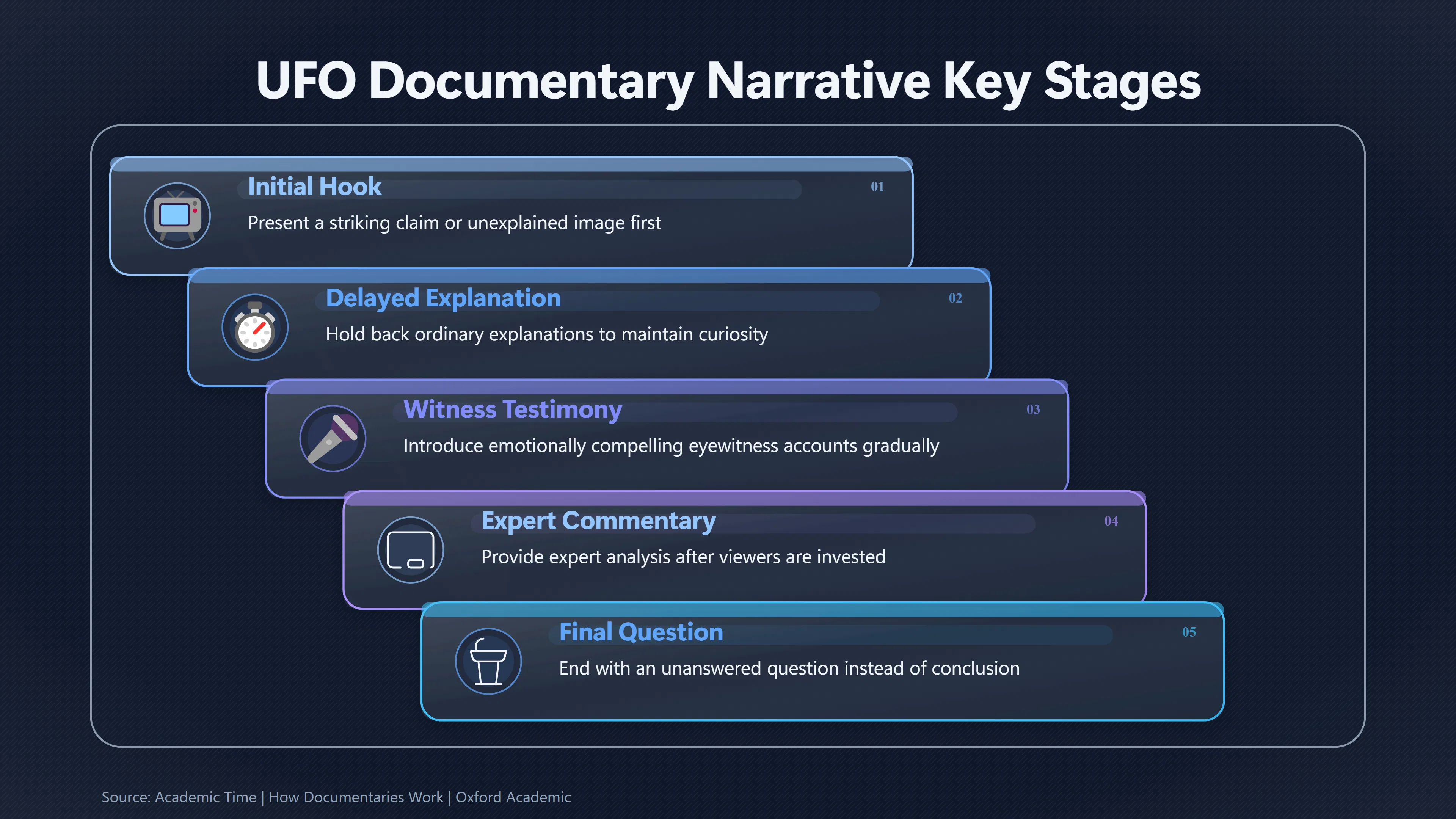
Commercial UFO programmes typically organise information according to dramatic rather than investigative priorities. Instead of presenting all available evidence at once, editors distribute information to maximise curiosity.
A common sequence looks like this:
- Begin with a striking claim or unexplained image.
- Delay ordinary explanations.
- Introduce emotionally compelling eyewitnesses.
- Reveal additional testimony one piece at a time.
- Present expert commentary after viewers have become invested.
- Finish with a final unanswered question rather than a definitive conclusion.
This pattern resembles the structure of suspense fiction. The audience continually expects that the next interview or newly revealed document will finally explain everything. Even when the programme ends without confirmation, viewers may remember the feeling of approaching proof more vividly than the absence of proof itself.
Research on documentary editing notes that manipulating temporal order, interleaving different storylines and presenting events as though they are unfolding in the present are established filmmaking techniques designed to sustain engagement rather than reproduce the exact chronology of investigation.[OUP Academic]academic.oup.comAcademic Time | How Documentaries Work | Oxford AcademicOUP AcademicTime | How Documentaries Work | Oxford AcademicDecember 15, 2022…
Why separate claims seem mutually reinforcing
One of the most persuasive effects of suspense editing is cumulative reinforcement.
Rather than evaluating each claim independently, viewers encounter a rapid sequence of suggestive material:
- an eyewitness recalling unusual lights;
- military footage;
- a retired official discussing unidentified incidents;
- scientists explaining what advanced technology could theoretically resemble;
- dramatic reconstructions;
- reactions from other witnesses.
Although these elements often differ greatly in evidential strength, editing places them within one continuous narrative. The result is psychological coherence rather than scientific corroboration.
For example, a physicist explaining hypothetical propulsion systems is discussing possibilities, not authenticating a specific UFO video. Likewise, a government official acknowledging that some sightings remain unidentified is not necessarily endorsing extraterrestrial explanations. When these separate ideas appear consecutively, however, viewers can experience them as mutually supportive simply because the sequence encourages that interpretation.
Film scholars have long observed that editing itself creates argumentative meaning by determining what follows what. Even documentaries that avoid overt narration inevitably make interpretive choices through selection and sequence.[Benjamins]benjamins.comChapter 6. The argumentative relevance of visual and multimodal antithesis in Frederick Wiseman’s documentariesDecember 20, 2017…
The power of delayed information
Delayed revelation is particularly effective because people naturally seek closure.
A programme may briefly show an unclear infrared clip without explanation, allowing viewers to wonder what it depicts. Several minutes later, an interview introduces a pilot describing extraordinary manoeuvres. Later still, another expert comments that some aerial phenomena remain unexplained.
Each segment appears to answer questions raised earlier while simultaneously introducing new mysteries. The audience experiences progress even if no individual piece substantially strengthens the overall evidence.
This differs from a scientific report, where the complete context for a piece of evidence is usually presented immediately so readers can evaluate it independently. Suspense television deliberately spaces information to maintain curiosity and emotional momentum.[OUP Academic]academic.oup.comAcademic Time | How Documentaries Work | Oxford AcademicOUP AcademicTime | How Documentaries Work | Oxford AcademicDecember 15, 2022…
Emotional pacing can substitute for evidential pacing
Editors frequently synchronise pacing with emotional intensity.
Rapid cutting, rising music, close-up reactions and carefully timed pauses signal that viewers should expect an important discovery. Emotional escalation can therefore occur independently of evidential escalation.
A typical sequence may involve:
- increasingly urgent narration;
- dramatic reaction shots from interviewees;
- repeated slow-motion examination of blurry footage;
- countdown-style editing before revealing an expert opinion.
Because emotional intensity rises steadily, viewers may intuitively assume the evidence itself is becoming stronger. In reality, the programme may simply be varying presentation while introducing no fundamentally new information.
Scholars examining paranormal reality television argue that these productions deliberately combine documentary conventions—which imply factual investigation—with stylistic devices borrowed from horror and suspense genres. The mixture encourages audiences to interpret uncertain material through both analytical and emotional responses simultaneously.[OUP Academic]academic.oup.comOUP AcademicViewer Discretion Advised | Ghost Channels: Paranormal Reality Television and the Haunting of Twenty-First-Century America |…
Celebrity and expert appearances gain extra force through sequencing
Within programmes about UFOs and celebrities, editing can increase the perceived authority of familiar faces without changing what they actually say.
A well-known actor, television presenter, military veteran or public official may appear immediately after dramatic footage or an emotional eyewitness account. Even if their remarks are cautious—for example, stating only that a case deserves investigation—the placement encourages viewers to experience their presence as validation of everything shown previously.
The persuasive effect comes from association rather than explicit endorsement. Recognition, confidence and screen time can all reinforce the programme’s narrative rhythm.
This is especially noticeable when celebrity interviews are withheld until late in an episode. Their appearance functions as a narrative reward, making previous claims feel as though they have culminated in authoritative confirmation, even when the celebrity merely expresses curiosity or personal belief.
Questions viewers can ask about sequence and context
Rather than asking whether a programme feels convincing, viewers can examine how the information has been organised.
Useful questions include:
- Would each interview seem equally persuasive if viewed independently?
- Are eyewitness accounts presented before alternative explanations?
- Does the programme delay important context to create suspense?
- Are experts discussing the specific case or speaking in general terms?
- Does emotional pacing increase faster than the quality of evidence?
- Are unrelated incidents edited together to imply a larger pattern?
These questions shift attention from the emotional experience of watching to the actual relationship between the evidence.
Suspense is not proof
Suspense editing is neither deceptive by definition nor unique to UFO television. It is a standard storytelling technique used across documentaries, true crime series and investigative programmes to hold audience attention. The problem arises when dramatic sequencing makes uncertainty feel progressively resolved despite little change in the available evidence.
Understanding this distinction helps explain why some UFO documentaries feel highly persuasive even when they ultimately present inconclusive material. The strongest impression often comes not from any single witness, document or video, but from the carefully constructed sequence that encourages viewers to experience separate uncertainties as one compelling narrative.[monash.edu]research.monash.eduUniversity The curious case of paranormal televisionMonash UniversityThe curious case of paranormal television - Monash University…
Amazon book picks
Further Reading
Books and field guides related to When UFO Editing Starts to Feel Like Proof. Use these as the next step if you want deeper reading beyond the article.
Documentary Storytelling: Creative Nonfiction on Screen
Now updated with new case studies and conversations with award-winning filmmakers, "Documentary Storytelling" offers advice for producers...
In the Blink of an Eye: A Perspective on Film Editing
Comprises a revised second edition of film editor Walter Murch's thought-provoking essay on the art and process of film editing. Original...
Introduction to Documentary
Introduction to Documentary provides a one-of-a-kind overview of the most important topics and issues in documentary history and criticis...
The Demon-Haunted World: Science as a Candle in the Dark
Rating: 4.5/5 from 43 Google Books ratings
NEW YORK TIMES BESTSELLER • From the renowned astronomer and author of Cosmos comes a “powerful [and] stirring defense of informed ration...
eBay marketplace picks
Marketplace Samples
Live-tested eBay searches with available results related to this page.
Selected fromUFO wall art oneBay.co.uk.
Current eBay listing
UFO ABDUCTION OVER THE OCEAN -FRAMED WALL ART PAPER PRINT POSTER
Current eBay listing
UFO ABDUCTION OVER THE OCEAN -DEEP FRAMED CANVAS WALL ART PRINT
Endnotes
1.
Source: academic.oup.com
Title: Academic Time | How Documentaries Work | Oxford Academic
Link:https://academic.oup.com/book/44918/chapter-abstract/384771667
Source snippet
OUP AcademicTime | How Documentaries Work | Oxford AcademicDecember 15, 2022...
Published: December 15, 2022
2.
Source: research.monash.edu
Title: University The curious case of paranormal television
Link:https://research.monash.edu/en/publications/the-curious-case-of-paranormal-television/
Source snippet
Monash UniversityThe curious case of paranormal television - Monash University...
3.
Source: academic.oup.com
Link:https://academic.oup.com/mississippi-scholarship-online/book/44243/chapter-abstract/372534129
Source snippet
OUP AcademicViewer Discretion Advised | Ghost Channels: Paranormal Reality Television and the Haunting of Twenty-First-Century America |...
4.
Source: academic.oup.com
Title: Academic Time | How Documentaries Work | Oxford Academic
Link:https://academic.oup.com/book/44918/chapter/384771667
Source snippet
OUP AcademicTime | How Documentaries Work | Oxford Academic...
5.
Source: benjamins.com
Link:https://benjamins.com/catalog/aic.14.07tse
Source snippet
Chapter 6. The argumentative relevance of visual and multimodal antithesis in Frederick Wiseman’s documentariesDecember 20, 2017...
Published: December 20, 2017
6.
Source: academic.oup.com
Link:https://academic.oup.com/joc/article-abstract/47/4/69/4160337
Source snippet
OUP AcademicEditing Strategies in Television News Documentaries | Journal of Communication | Oxford Academic...
7.
Source: research-information.bris.ac.uk
Link:https://research-information.bris.ac.uk/en/publications/tension-and-release-and-tension-and-the-ethics-of-narrative-and-a/
Source snippet
True Crime Docuseries - University of Bristol...
Additional References
8.
Source: sciencedirect.com
Link:https://www.sciencedirect.com/science/article/abs/pii/S0378216622001564
9.
Source: sciencedirect.com
Link:https://www.sciencedirect.com/science/article/abs/pii/S0304422X26000355
Source snippet
Narrative pacing under fragmented attention: A structural approach to suspense in serialized television - ScienceDirect...
10.
Source: eprints.worc.ac.uk
Title: worc.ac.uk WRa P
Link:https://eprints.worc.ac.uk/14107/
Source snippet
ester Research and PublicationsJuly 18, 2024 — ‘TENSION AND RELEASE AND TENSION AND…’: THE ETHICS OF NARRATIVE AND AESTHETIC CONSTRUC...
Published: July 18, 2024
11.
Source: sciencedirect.com
Link:https://www.sciencedirect.com/science/article/abs/pii/S2211695826000620
12.
Source: youtube.com
Title: How We Staged a UFO Hoax
Link:https://www.youtube.com/watch?v=-cW8RsWNnKg
Source snippet
Skinwalker Ranch: Science, Sensationalism or Both?...
13.
Source: youtube.com
Title: Breakdown of the Pentagon UFO Videos with Mick West
Link:https://www.youtube.com/watch?v=Le7Fqbsrrm8
Source snippet
[Alien Autopsy]({{ 'alien-autopsy/' | relative_url }}): Fact or Fiction?...
14.
Source: youtube.com
Title: Skinwalker Ranch: Science, Sensationalism or Both?
Link:https://www.youtube.com/watch?v=ym4xqCEioAY
15.
Source: youtube.com
Title: Are They Aliens?
Link:https://www.youtube.com/watch?v=q0HRS_IzTmU
Source snippet
Breakdown of the Pentagon UFO Videos with Mick West...
16.
Source: youtube.com
Title: Alien Autopsy: Fact or Fiction?
Link:https://www.youtube.com/watch?v=tfHGExsEm1A
Source snippet
How We Staged a UFO Hoax...
17.
Source: onlinelibrary.wiley.com
Title: j.1460 2466.1997.tb02726.x
Link:https://onlinelibrary.wiley.com/doi/abs/10.1111/j.1460-2466.1997.tb02726.x