Within Useful Data
Why the Original UFO File Matters Most
Untouched photos and videos preserve capture details and scene context that screenshots, edits and repeated uploads often remove.
On this page
- What metadata can reveal about a recording
- How cropping and compression distort apparent features
- Preserving originals and documenting every edit
Page outline Jump by section
Introduction
A compelling UFO photograph or video is not necessarily a useful one. For investigators, researchers and journalists, the most valuable evidence is the original, untouched file together with a documented history of how it has been handled. Once a recording has been cropped, compressed, converted into a screenshot or repeatedly uploaded to social media, important technical information may disappear permanently. That lost information can make the difference between identifying an ordinary aircraft, satellite or camera artefact and leaving an event genuinely unexplained.
This matters just as much for celebrity UFO claims as for any other sighting. A widely shared clip may attract millions of views, but if only a compressed social media copy survives, independent analysts cannot reliably examine the recording’s provenance, timing or capture conditions. The original file therefore has evidential value beyond the visible image itself.
Why the original file is more valuable than a viral copy
A digital photograph or video contains two distinct forms of evidence:
- The visible pixels that people see.
- The hidden technical information stored alongside or within the file.
Every time a file is edited, re-encoded, uploaded to many social platforms or converted into another format, some of that information may be altered or removed. In many cases, social media services deliberately strip metadata to reduce file size or protect user privacy, while also recompressing images and videos into new versions.
An original camera file allows investigators to examine not only what appears in the frame but also how the recording was created. By contrast, a screenshot of the same frame usually preserves only the visible image while discarding nearly all capture information.
This distinction mirrors broader scientific practice. NASA, for example, distinguishes between archival-quality original image data and compressed preview images because compression and format conversion inevitably discard information needed for detailed technical analysis.[NASA Science]science.nasa.govScience Raw Images FAQNASA ScienceRaw Images FAQ - NASA ScienceNovember 2, 2024…
What metadata can reveal about a recording
Metadata is often described as “data about the data”. Although metadata cannot prove that an unusual object is extraordinary, it can answer many practical questions that affect an investigation.
Useful metadata may include:
- Exact capture date and time.
- Camera or phone model.
- Lens information and focal length.
- Exposure settings, shutter speed and ISO.
- GPS coordinates, if location recording was enabled.
- Image orientation.
- Original file dimensions and bit depth.
- Software used after capture, if the file has been edited.
These details help investigators reconstruct the circumstances of the recording. For example:
- A long exposure may explain apparent light trails.
- A digital zoom setting may explain reduced detail.
- A precise timestamp can be compared with aircraft transponder records, satellite passes or astronomical events.
- GPS information can establish viewing geometry and permit independent reconstruction of sight lines.
Metadata should be treated as supporting evidence rather than definitive proof. Some fields can be edited manually, while others disappear during normal sharing. Nevertheless, when metadata remains intact and is consistent with the recording itself, it strengthens confidence that analysts are examining the original capture rather than a later derivative.
How cropping and compression change what people think they see
Many famous UFO images circulate only as cropped or compressed versions. These alterations can unintentionally exaggerate apparent anomalies.
Cropping removes scene context that may include:
- The horizon.
- Buildings or trees.
- Clouds.
- Other aircraft.
- Reference stars or planets.
Without these reference points, estimating motion, distance or size becomes substantially harder.
Compression introduces a different problem. Modern image and video codecs reduce file size by discarding visual information that is considered less noticeable to human viewers. Fine detail, subtle gradients and small structures may be lost or replaced with compression artefacts.
Repeated saving and uploading can produce:
- Blocky edges.
- Ringing around bright objects.
- Artificial sharpening.
- Smearing during motion.
- Loss of faint background features.
These effects may accidentally create the appearance of unusual shapes or obscure features that would otherwise assist identification.
The principle is well established in technical imaging disciplines. High-quality original data preserve substantially more measurable information than compressed versions, which are intended primarily for convenient viewing rather than detailed analysis.[NASA Science]science.nasa.govScience Raw Images FAQNASA ScienceRaw Images FAQ - NASA ScienceNovember 2, 2024…
Why the full recording matters more than a single frame
Individual still frames often become the focus of online discussion because they appear dramatic. However, investigators generally prefer the complete recording.
The full sequence can reveal:
- Camera movement before the object appears.
- Autofocus behaviour.
- Exposure adjustments.
- Changes in zoom.
- The object’s apparent motion relative to fixed background features.
- What happened immediately before and after the event.
A short viral clip trimmed to five seconds may omit several minutes of footage showing that the object behaved consistently with an aircraft, balloon or drone. Conversely, the complete sequence may preserve observations that strengthen the case for further investigation.
Maintaining the original file timestamps also allows multiple recordings from different witnesses to be synchronised more accurately.
Preserving originals and documenting every edit
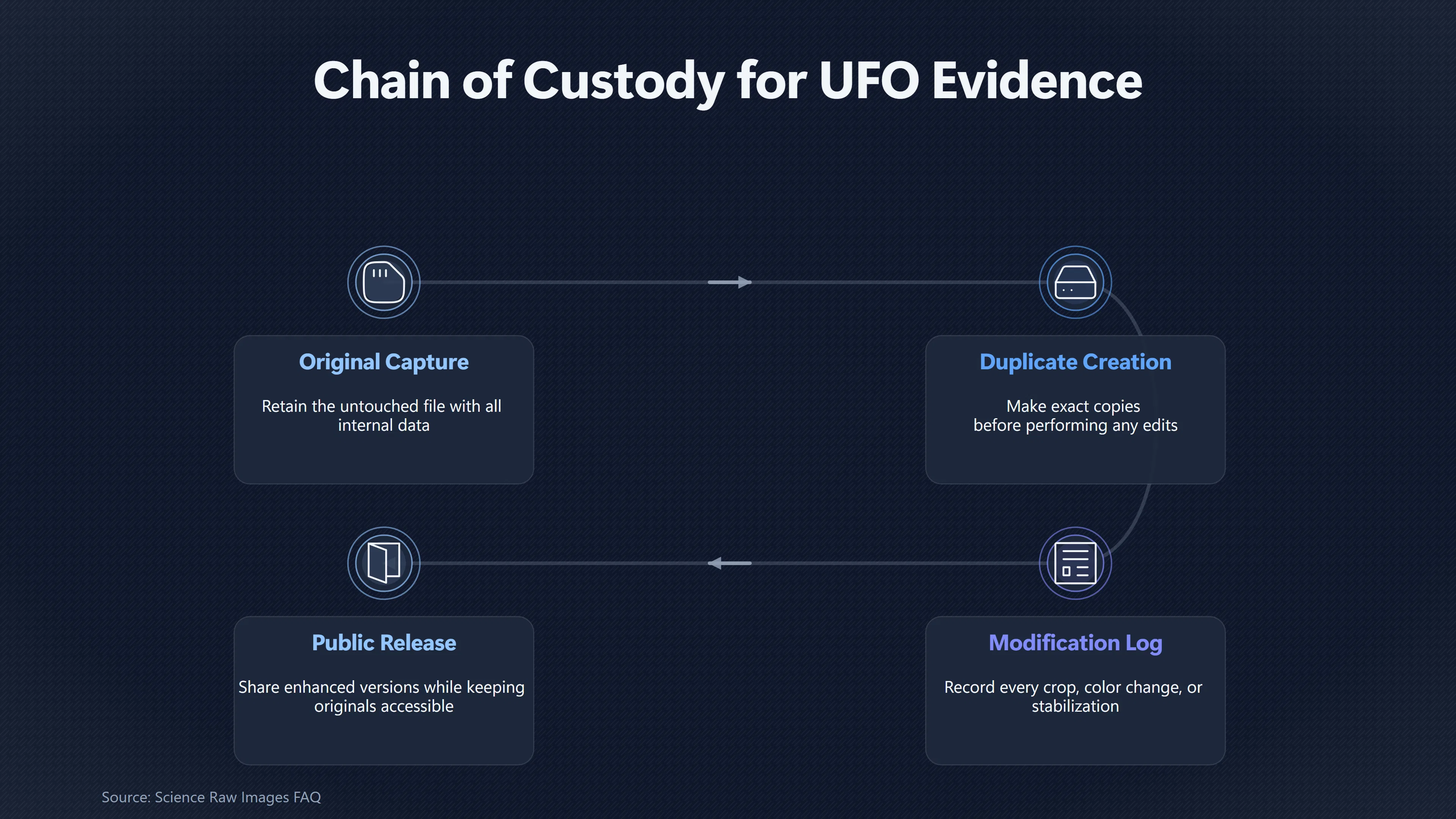
The strongest evidence comes from a clear chain of custody—the documented history of how a file has been handled.
Good practice includes:
- Keep the original file unchanged.
- Make copies before performing any editing.
- Record every modification, including cropping, colour adjustments or stabilisation.
- Retain the original filename where practical.
- Store the complete video rather than isolated frames.
- Preserve associated files, such as Live Photos or burst sequences, if available.
If an enhanced version is released publicly, the original should remain available for independent examination. This allows other analysts to evaluate whether enhancements introduced misleading artefacts or altered important details.
The importance of preserving original digital evidence is widely recognised in digital forensics, where maintaining an authentic record and documenting every processing step are considered essential for reliable examination.[NIST]nist.govDigital Evidence Preservation: Considerations for Evidence Handlers | NISTSeptember 28, 2022…
Modern provenance tools help, but they are not decisive
New technologies are beginning to record how digital media are created and edited. Some modern cameras and software can embed provenance information or cryptographically signed content credentials describing aspects of a file’s creation and editing history.
These systems may help establish that a file originated from a particular workflow or indicate that specific edits occurred after capture. However, they cannot establish whether the recorded scene itself depicts an unusual phenomenon. Likewise, the absence of provenance information does not imply manipulation, particularly because many messaging applications and social media platforms remove such data during upload.
For UFO investigations, provenance technologies should therefore be viewed as one additional line of evidence rather than a substitute for careful examination of the original recording and its surrounding circumstances.
What makes an original UFO file genuinely useful?
An untouched file does not prove that an extraordinary event occurred. It simply gives investigators the best opportunity to determine what actually happened.
The most valuable recordings typically combine:
- The original, unedited file.
- Intact metadata.
- A complete recording rather than selected clips.
- Accurate timestamps.
- A documented editing history.
- Independent witness accounts.
- Supporting contextual information such as location, weather and viewing direction.
When any of these elements are missing, confidence in later conclusions—whether identifying an ordinary explanation or recognising an unresolved observation—necessarily decreases. Preserving the original file therefore increases the scientific value of a UFO report, even when the final explanation turns out to be entirely conventional.
Amazon book picks
Further Reading
Books and field guides related to Why the Original UFO File Matters Most. Use these as the next step if you want deeper reading beyond the article.
UFOs: Generals, Pilots, and Government Officials Go on the Re...
NEW YORK TIMES BESTSELLER • Impeccably researched, this riveting journalistic investigation separates fact from fiction, and documents th...
The Demon-haunted World
Rating: 4.5/5 from 43 Google Books ratings
Are we on the brink of a new Dark Age of irrationality and superstition? In this book, the writer shows how scientific thinking is necess...
The Invisible Gorilla
NEW YORK TIMES BESTSELLER • Our minds don’t work the way we think they do. Two renowned psychologists explain how and why our intuitions...
Eye and Brain
Since the publication of the first edition in 1966, Eye and Brain has established itself worldwide as an essential introduction to the ba...
eBay marketplace picks
Marketplace Samples
Live-tested eBay searches with available results related to this page.
Selected fromUFO poster oneBay.co.uk.



Endnotes
1.
Source: science.nasa.gov
Title: Science Raw Images FAQ
Link:https://science.nasa.gov/solar-system/multimedia/raw-images-faq/
Source snippet
NASA ScienceRaw Images FAQ - NASA ScienceNovember 2, 2024...
Published: November 2, 2024
2.
Source: nist.gov
Title: Digital and Multimedia Evidence | NIST
Link:https://www.nist.gov/forensic-science/digital-and-multimedia-evidence
Source snippet
Digital and Multimedia Evidence | NIST...
3.
Source: nist.gov
Link:https://www.nist.gov/itl/csd/secure-systems-and-applications/computer-forensics-tool-testing-program-cftt/digital
Source snippet
Digital Evidence Preservation: Considerations for Evidence Handlers | NISTSeptember 28, 2022...
Published: September 28, 2022
4.
Source: science.nasa.gov
Link:https://science.nasa.gov/uap/
5.
Source: pages.nist.gov
Link:https://pages.nist.gov/800-63-4/sp800-63a.html
6.
Source: pages.nist.gov
Title: sp800 63
Link:https://pages.nist.gov/800-63-4/sp800-63.html
7.
Source: nist.gov
Title: digital and multimedia evidence
Link:https://www.nist.gov/spo/forensic-science-program/forensic-science-research/digital-and-multimedia-evidence
8.
Source: nist.gov
Title: user guide nist media forensic challenge mfc datasets
Link:https://www.nist.gov/publications/user-guide-nist-media-forensic-challenge-mfc-datasets
9.
Source: nist.gov
Title: best practices collection and use biometric and forensic datasets
Link:https://www.nist.gov/publications/best-practices-collection-and-use-biometric-and-forensic-datasets
10.
Source: pages.nist.gov
Link:https://pages.nist.gov/800-63-3/sp800-63-3.html
11.
Source: nist.gov
Link:https://www.nist.gov/publications/jpeg-2000-codec-certification-guidance-1000-ppi-fingerprint-friction-ridge-imagery
12.
Source: nist.gov
Title: compression guidance 1000 ppi friction ridge imagery
Link:https://www.nist.gov/publications/compression-guidance-1000-ppi-friction-ridge-imagery
13.
Source: earthdata.nasa.gov
Title: data use policy
Link:https://www.earthdata.nasa.gov/engage/[open-data
14.
Source: GOV.UK
Title: www.gov.uk Digital Imaging and Multimedia Procedure v3.0
Link:https://www.gov.uk/government/publications/digital-investigations-digital-imaging-and-multimedia-procedure/digital-imaging-and-multimedia-procedure-v30
15.
Source: spec.c2pa.org
Title: Content Credentials
Link:https://spec.c2pa.org/specifications/specifications/2.2/specs/ContentCredentials.html
16.
Source: spec.c2pa.org
Title: Content Credentials
Link:https://spec.c2pa.org/specifications/specifications/2.4/specs/ContentCredentials.html
Additional References
17.
Source: disclosdex.com
Title: Disclosure Rating — 4/10 Department of War PURSUE Release 01 identifies FBI P
Link:https://disclosdex.com/documents/2026-pursue-release-01-109-fbi-photo-a3
Source snippet
FBI Photo A3 | DisclosdexMay 8, 2026 — FBI PHOTO A3 FBI FBI still image from PURSUE Release 01 showing a reticle-centered dark circular o...
Published: May 8, 2026
18.
Source: archives.gov
Title: Appendix A: Tables of File Formats | National Archives
Link:https://www.archives.gov/records-mgmt/policy/transfer-guidance-tables.html
Source snippet
March 11, 2026 — National Imagery Transmission Format (NITF) | 2.0 and 2.1 | MIL-STD-2500A--Department of Defense Interface Standard: htt...
Published: March 11, 2026
19.
Source: openskyprotocol.com
Title: Several solid black rectangular blocks, gray side bands
Link:https://www.openskyprotocol.com/explore/wiki/evidence/war-gov/war-gov-dow-uap-pr41-unresolved-uap-report-middle-east-2020-1006094
Source snippet
Open Sky — The UFO archive that investigates itselfMay 8, 2026 — WHAT THE FILE APPEARS TO CONTAIN The reviewed frames show a monochrome i...
Published: May 8, 2026
20.
Source: aatip.com
Title: UAP Case Files & Official Reports | AATIP.com
Link:https://www.aatip.com/inpage/case-files/
Source snippet
Eight widely discussed incidents, checked against official imagery, resolution reports and primary government records. What was reported...
21.
Source: pursue.report
Title: img nasa uap vm006 apollo 17 1972
Link:https://pursue.report/records/img-nasa-uap-vm006-apollo
Source snippet
NASA-UAP-VM006, Apollo 17, 1972 — DisclosureMay 8, 2026 — IMG img-nasa-uap-vm006-apollo-17-1972 NASA-UAP-VM006, APOLLO 17, 1972 As part o...
Published: May 8, 2026
22.
Source: uaplogbook.com
Title: pr 046 ai reconstruction
Link:https://uaplogbook.com/pr-046-ai-reconstruction/
Source snippet
PR-046 UAP video: AI reconstruction and missing metadataMay 11, 2026 — note / May 11, 2026 AI COMPLETES THE UAP FOR YOU By Jan for UAP Lo...
Published: May 11, 2026
23.
Source: youtube.com
Link:https://www.youtube.com/watch?v=i805eRAWoio
Source snippet
ExifTool Explained: How Investigators Extract Hidden Metadata...
24.
Source: youtube.com
Title: More Weird UFO Files Just Released: Forensic Expert Analysis
Link:https://www.youtube.com/watch?v=F9Vmsk6CcmI
Source snippet
Footage From Inside a UFO?! | MUFON's 10-Month Investigation | Abduction Experience | Ep. 74...
25.
Source: youtube.com
Title: Digital Image [Authenticity]({{ ‘authenticity/’ | relative_url }}) And Integrity With Amped Authenticate
Link:https://www.youtube.com/watch?v=PWF47_VJkEs
Source snippet
OSINT At Home #2 - Five ways to find EXIF/metadata in a photo or video...
26.
Source: youtube.com
Title: Exif Tool Explained: How Investigators Extract Hidden Metadata
Link:https://www.youtube.com/watch?v=HdgRkjebf2g
Source snippet
Digital Image Authenticity And Integrity With Amped Authenticate...