Within Early vs Late
Why Old UFO Stories Grow Clearer Over Time
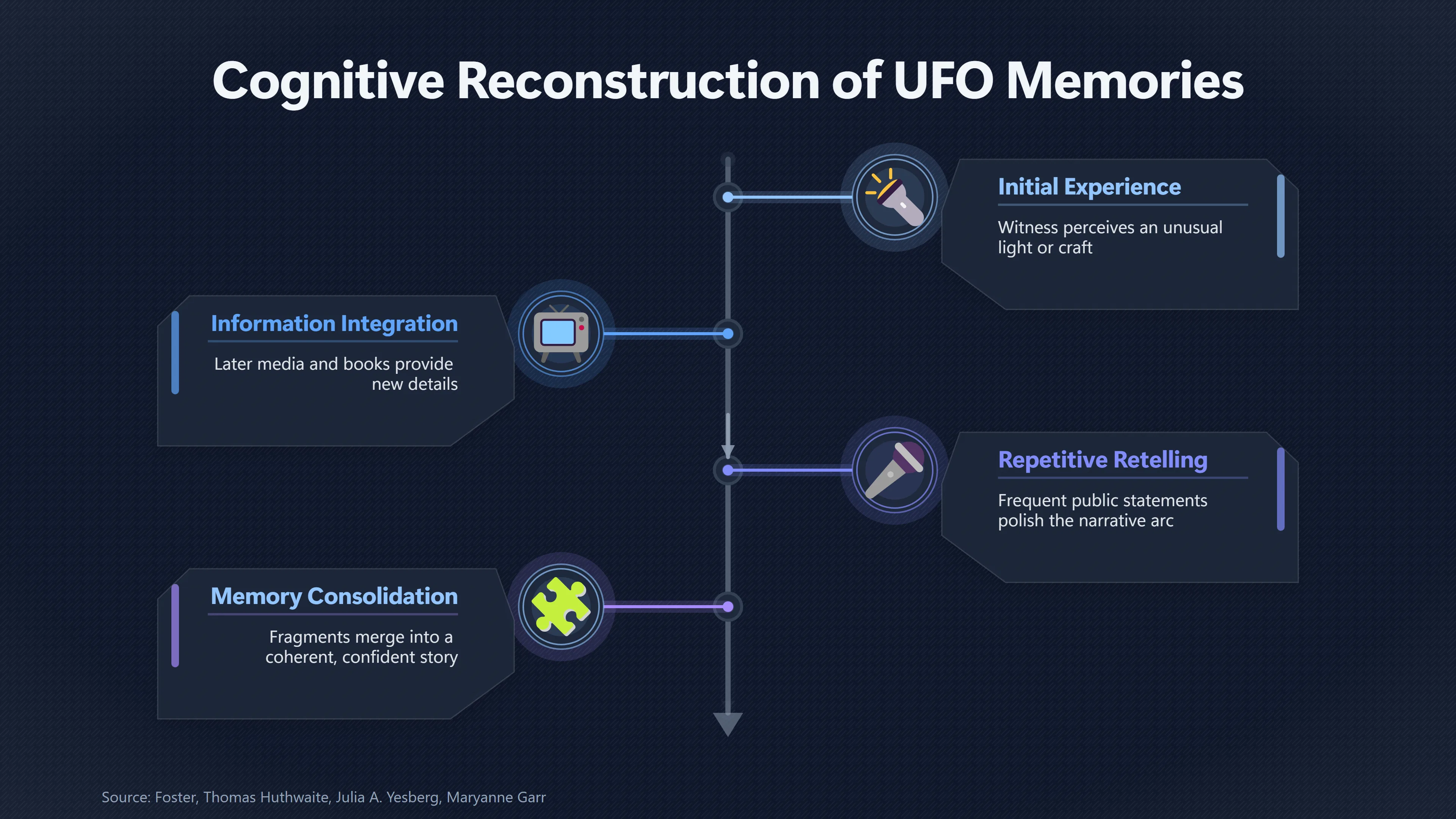
Repeated retelling can make an old celebrity UFO story smoother and more confident even when no new external evidence appears.
On this page
- How memory is reconstructed rather than replayed
- The effects of repetition and later information
- How to separate confidence from corroboration
Page outline Jump by section
Introduction
When a celebrity recounts a UFO sighting decades after it allegedly happened, the story may sound more vivid and more certain than it did originally. That increase in confidence is not, by itself, evidence that the memory has become more accurate. Modern memory research consistently shows that human memory is reconstructive rather than a literal recording. Each act of remembering can rebuild the memory using fragments of the original experience, later knowledge, conversations and repeated retellings. As a result, an old UFO account can remain entirely sincere while becoming smoother, more detailed and more confidently expressed over time.[Sage Journals]journals.sagepub.comSage JournalsIf I’m Certain, Is It True? Accuracy and Confidence in Eyewitness Memory - Elizabeth F. Loftus, Rachel L. Greenspan, 2017Apr…
Within debates about celebrity UFO claims, this distinction matters because many stories were first described publicly years or even decades after the reported event. Historical evaluation therefore depends not only on how convincing a witness appears today, but also on whether contemporary records exist to anchor what was originally claimed.
How memory is reconstructed rather than replayed
Psychologists no longer view autobiographical memory as the brain replaying a stored recording. Instead, remembering involves reconstructing an event from multiple pieces of information, including sensory traces, existing knowledge and current expectations. Each reconstruction is influenced by what the person knows and believes at the time of recall.[Sage Journals]journals.sagepub.comSage JournalsIf I’m Certain, Is It True? Accuracy and Confidence in Eyewitness Memory - Elizabeth F. Loftus, Rachel L. Greenspan, 2017Apr…
This does not imply that memories are fictional. Most everyday memories preserve an authentic core, particularly for emotionally significant experiences. However, peripheral details—such as timing, sequence, distance, colours or conversations—are especially vulnerable to change. A witness may therefore honestly remember seeing an unusual light while becoming progressively more certain about features that were originally ambiguous.
For celebrity UFO accounts, this means that confidence expressed in a recent interview should not automatically be interpreted as evidence that the remembered details were equally clear at the time of the alleged sighting. Unless contemporary documentation survives, it is often impossible to determine which parts of the present-day narrative reflect the original experience and which emerged gradually.
Why repetition makes stories feel stronger
One of the best-established findings in cognitive psychology is that repetition increases familiarity, and familiarity is often mistaken for accuracy. The more often people tell the same story, the easier it becomes to retrieve, making it feel more coherent and convincing.
Experimental research has shown that repeated claims can increase both confidence and susceptibility to misinformation. Importantly, the effect comes from repetition itself rather than from multiple independent sources repeating the same account. Participants became more confident in repeated information even when it was inaccurate.[PubMed]pubmed.ncbi.nlm.nih.govOpen source on nih.gov.
Applied to late celebrity UFO recollections, repeated interviews, documentaries, autobiographies and public appearances may have several effects:
- the narrative becomes more polished because it has been practised many times;
- uncertain or forgotten gaps are unconsciously filled to create a coherent story;
- details that once required effort to remember become easier to retrieve simply because they have been recalled repeatedly;
- listeners often mistake fluency and confidence for historical reliability.
These processes are normal features of human memory rather than signs of deliberate embellishment.
How later information can become part of the memory
A UFO experience rarely exists in isolation. Years after an unusual sighting, a person may encounter books, television programmes, documentaries, other witnesses or popular imagery describing similar events. Those later experiences provide additional information that can become intertwined with the original memory.
Psychological research on the misinformation effect demonstrates that post-event information can alter later recollection without the witness realising that the source has changed. People may sincerely attribute a later-acquired detail to their own original experience rather than to something they read or heard afterwards.[Sage Journals]journals.sagepub.comSage JournalsIf I’m Certain, Is It True? Accuracy and Confidence in Eyewitness Memory - Elizabeth F. Loftus, Rachel L. Greenspan, 2017Apr…
For celebrity UFO narratives, this can subtly reshape descriptions over decades. For example, an initially vague report of unusual lights might later include more specific descriptions of structured craft, movement or appearance that align with widely circulated UFO imagery. This does not necessarily indicate fabrication. Instead, it illustrates how source-monitoring errors—the difficulty of identifying where a remembered detail originated—can occur in entirely honest witnesses.[Sage Journals]journals.sagepub.comSage JournalsIf I’m Certain, Is It True? Accuracy and Confidence in Eyewitness Memory - Elizabeth F. Loftus, Rachel L. Greenspan, 2017Apr…
Confidence is not the same as corroboration
A common misunderstanding is that a witness who sounds certain is therefore more credible. Research does not support such a simple relationship.
Confidence can sometimes correlate with accuracy under carefully controlled conditions, particularly when measured immediately after an event and before contamination occurs. However, confidence is also influenced by repetition, feedback, discussion and later reconstruction. As memories age and accumulate post-event influences, subjective certainty becomes a less reliable indicator of historical accuracy.[Sage Journals]journals.sagepub.comSage JournalsIf I’m Certain, Is It True? Accuracy and Confidence in Eyewitness Memory - Elizabeth F. Loftus, Rachel L. Greenspan, 2017Apr…
For this reason, historians evaluating celebrity UFO stories distinguish between:
- confidence, or how certain the witness appears today;
- consistency, or whether the account has remained stable across time;
- corroboration, meaning independent records, documents or witnesses created close to the event.
Only the third category provides evidence external to memory itself.
Separating sincere recollection from historical evidence
Late recollections deserve neither automatic acceptance nor automatic dismissal. A person can genuinely believe every detail of a decades-old UFO memory while unknowingly recalling a version that has evolved through ordinary cognitive processes.
When assessing such accounts, useful questions include:
- Was the sighting documented shortly after it allegedly occurred?
- Have key details changed across interviews?
- Are there independent witnesses or contemporary records?
- Can the reported timing and location be compared with aviation, astronomical or meteorological records?
- Which parts of the story are supported by evidence outside the witness’s memory?
These questions focus on corroboration rather than on judging sincerity.
What this means for celebrity UFO accounts
Within the broader comparison between contemporary records and late celebrity recollections, memory research offers an important caution rather than a verdict. A polished interview given forty years after an alleged UFO sighting may accurately reflect what the speaker now remembers. It does not necessarily reproduce what was perceived at the time.
That is why historians generally place greater weight on diaries, dated interviews, letters, official reports and independently recorded witness statements created close to the event. Such records preserve what was originally claimed before decades of repetition, discussion and normal memory reconstruction could reshape the narrative.
Understanding this distinction allows celebrity UFO stories to be evaluated more fairly. A later recollection can be emotionally genuine and psychologically understandable while still carrying less historical weight than a contemporary record describing the same event.
Amazon book picks
Further Reading
Books and field guides related to Why Old UFO Stories Grow Clearer Over Time. Use these as the next step if you want deeper reading beyond the article.
The Seven Sins of Memory: How the Mind Forgets and Remembers
Rating: 3.5/5 from 5 Google Books ratings
A New York Times Notable Book: A psychologist's "gripping and thought-provoking" look at how and why our brains sometimes fail us (Steven...
The Memory Illusion: Remembering, Forgetting, and the Science...
THE INTERNATIONAL BESTSELLER 'Truly fascinating.' Steve Wright, BBC Radio 2 - Have you ever forgotten the name of someone you’ve met doze...
The Invisible Gorilla: How Our Intuitions Deceive Us
NEW YORK TIMES BESTSELLER • Our minds don’t work the way we think they do. Two renowned psychologists explain how and why our intuitions...
Extraordinary Popular Delusions and the Madness of Crowds
Rating: 4.0/5 from 5 Google Books ratings
First published in 1841, Extraordinary Popular Delusions and the Madness of Crowds is often cited as the best book ever written about mar...
eBay marketplace picks
Marketplace Samples
Live-tested eBay searches with available results related to this page.
Selected fromUFO wall art oneBay.co.uk.

Current eBay listing
UFO ABDUCTION OVER THE OCEAN -DEEP FRAMED CANVAS WALL ART PRINT



Current eBay listing
UFO ABDUCTION OVER THE OCEAN -FRAMED WALL ART PAPER PRINT POSTER
Endnotes
1.
Source: journals.sagepub.com
Link:https://journals.sagepub.com/doi/10.1177/1529100617699241
Source snippet
Sage JournalsIf I’m Certain, Is It True? Accuracy and Confidence in [Eyewitness Memory]({{ 'eyewitness-memory/' | relative_url }}) - Elizabeth F. Loftus, Rachel L. Greenspan, 2017Apr...
2.
Source: pubmed.ncbi.nlm.nih.gov
Link:https://pubmed.ncbi.nlm.nih.gov/22257711/
3.
Source: ncbi.nlm.nih.gov
Link:https://www.ncbi.nlm.nih.gov/books/NBK621592/
Source snippet
Loftus, Planting Misinformation in the Human Mind: A 30-Year Investigation of the Malleability of Memory, 12 Learning & Memory 361 (2005)...
4.
Source: pubmed.ncbi.nlm.nih.gov
Link:https://pubmed.ncbi.nlm.nih.gov/33228497/
Source snippet
Why we should not over-rely on eyewitness confidence - PubMedJanuary 1, 2022 —. 2022 Jan;30(1):10-15. doi: 10.1080/09658211.2020.1849308...
Published: January 1, 2022
5.
Source: pubmed.ncbi.nlm.nih.gov
Link:https://pubmed.ncbi.nlm.nih.gov/28395653/
6.
Source: pubmed.ncbi.nlm.nih.gov
Link:https://pubmed.ncbi.nlm.nih.gov/10932793/
Additional References
7.
Source: onlinelibrary.wiley.com
Link:https://onlinelibrary.wiley.com/doi/abs/10.1002/acp.1263
Source snippet
Wiley Online LibraryRepeated recall, retention interval and the accuracy–confidence relation in eyewitness memory - Odinot - 2006 - Appli...
8.
Source: sciencedirect.com
Link:https://www.sciencedirect.com/science/article/pii/S000169181100223X
Source snippet
Repetition, not number of sources, increases both susceptibility to misinformation and confidence in the accuracy of eyewitn...
9.
Source: researchers.mq.edu.au
Title: Foster, Thomas Huthwaite, Julia A. Yesberg, Maryanne Garr
Link:https://researchers.mq.edu.au/en/publications/repetition-not-number-of-sources-increases-both-susceptibility-to/
Source snippet
mq.edu.auRepetition, not number of sources, increases both susceptibility to misinformation and confidence in the accuracy of eyewitnesse...
10.
Source: youtube.com
Link:https://www.youtube.com/watch?v=kcGtWU5WrAg
Source snippet
Cognitive Psychology: Reconstructive Memory & Conceptual Knowledge (Why Your Memory Lies to You)...
11.
Source: annualreviews.org
Title: Eavesdropping on Memory | Annual Reviews
Link:https://www.annualreviews.org/content/journals/10.1146/annurev-psych-010416-044138
Source snippet
Loftus^{1} * View Affiliations and Author Notes Hide Affiliations and Author Notes Department of Psychology and...
12.
Source: youtube.com
Link:https://www.youtube.com/watch?v=vJVoI001tak
Source snippet
Elizabeth Loftus - How Does Memory Work?...
13.
Source: youtube.com
Title: How reliable is your memory? | Elizabeth Loftus
Link:https://www.youtube.com/watch?v=PB2OegI6wvI
Source snippet
Can we always trust our own mind? | Professor Elizabeth Loftus on The fiction of memory (2018)...
14.
Source: ojp.gov
Link:https://www.ojp.gov/ncjrs/virtual-library/abstracts/effects-integrative-memorial-and-cognitive-processes-correspondence
15.
Source: ojp.gov
Link:https://www.ojp.gov/ncjrs/virtual-library/abstracts/eyewitness-testimony-1
16.
Source: papers.ssrn.com
Link:https://papers.ssrn.com/sol3/papers.cfm?abstract_id=1998302
Source snippet
Loftus:: SSRNFebruary 2, 2012 — REPETITION, NOT NUMBER OF SOURCES, INCREASES BOTH SUSCEPTIBILITY TO MISINFORMATION AND CONFIDENCE IN THE...
Published: February 2, 2012