Within NASA Standard
The Missing Data Behind Most UAP Videos
Time, location, lens settings, platform motion and weather can turn an ambiguous clip into evidence that investigators can test.
On this page
- Essential metadata for cameras, radar and infrared systems
- How absent context creates false impressions
- A practical checklist for preserving original recordings
Page outline Jump by section
Introduction
A striking UAP video is rarely enough to answer the most basic scientific questions: What was recorded? How far away was it? How fast was it moving? Could the apparent motion be explained by the camera itself? NASA’s framework for stronger UAP research emphasises that these questions depend as much on the recording’s metadata as on the visible image. A clip without its original timing, location, camera settings or platform information may remain permanently ambiguous, even if the imagery appears dramatic. Conversely, complete metadata allows investigators to reconstruct the observation, compare it with aircraft, satellites, weather and astronomical records, and test competing explanations rather than relying on speculation. NASA’s 2023 independent study specifically highlighted thorough sensor metadata, calibrated instruments and multiple independent measurements as essential foundations for scientifically useful UAP investigations.[NASA Science]science.nasa.govScience UAPNASA ScienceUAP - NASA ScienceFebruary 23, 2026…
Why the missing data often matters more than the image
A digital image records only what reached the sensor. Metadata describes how that image was created.
Without this context, investigators cannot reliably determine whether apparent extraordinary behaviour reflects the object itself or the recording system. A bright point crossing a smartphone frame could represent a nearby insect, a distant aircraft, a satellite, lens flare or an unusual atmospheric effect. The pixels alone rarely distinguish among these possibilities.
NASA’s report argues that many unresolved UAP cases suffer not because the imagery is poor, but because the accompanying observational record is incomplete. Missing calibration data, uncertain timestamps and absent environmental information prevent independent researchers from reconstructing the event or testing alternative explanations.[NASA Science]science.nasa.govScience UAPNASA ScienceUAP - NASA ScienceFebruary 23, 2026…
Essential metadata for cameras, radar and infrared systems
Different sensors require different supporting information, but several categories consistently determine whether a recording can be analysed rigorously.
Camera recordings
For conventional digital cameras and smartphones, investigators ideally need:
- Exact date and time, preferably synchronised to an accurate clock.
- GPS location and viewing direction.
- Camera make and model.
- Lens focal length or zoom position.
- Aperture, shutter speed and ISO sensitivity.
- Frame rate and resolution.
- Original file rather than a compressed social media copy.
- Any image stabilisation or digital enhancement settings.
These values often exist within Exchangeable Image File Format (EXIF) metadata for still photographs, although videos frequently preserve less information and many online platforms remove metadata during upload. Digital forensics researchers therefore stress obtaining original files whenever possible because metadata itself becomes evidence about provenance and processing history.[NIST]nist.govMedia Forensics Challenge Image Provenance Evaluation and State-of-the-Art Analysis on Large-Scale Benchmark Datasets | NISTOctober 2…
Radar systems
Radar observations become far more informative when accompanied by:
- Radar type and operating frequency.
- Antenna position and scan pattern.
- Detection range and bearing.
- Signal strength.
- Tracking confidence.
- Processing mode.
- Time synchronisation with other sensors.
Without those parameters, apparent manoeuvres may instead reflect radar processing artefacts, intermittent tracking or limitations in resolution.
Infrared (FLIR) systems
Infrared imagery requires additional context because apparent brightness does not directly represent object temperature.
Useful metadata includes:
- Sensor wavelength band.
- Detector calibration.
- Field of view.
- Optical zoom level.
- Tracking mode.
- Gain settings.
- Platform orientation.
- Atmospheric conditions affecting infrared transmission.
In well-known military videos released publicly, outside researchers have shown that understanding camera tracking behaviour, zoom state and viewing geometry is often crucial before interpreting apparent accelerations or unusual shapes. Metadata enables those calculations; isolated video frames do not.
Platform motion can create convincing illusions
One of the most common misunderstandings in UAP analysis is treating image motion as object motion.
If the recording platform is moving—a commercial aircraft, fighter jet, helicopter, drone or ship—the object’s apparent path depends on both motions simultaneously.
Platform metadata therefore becomes essential:
- Aircraft heading.
- Airspeed.
- Altitude.
- Pitch, roll and yaw.
- Bank angle.
- Sensor mounting position.
- Gimbal orientation.
- Navigation data.
These measurements allow investigators to reconstruct viewing geometry. Once aircraft motion is included, apparently impossible accelerations sometimes become consistent with ordinary distant objects viewed from changing perspectives.
This is precisely why NASA recommends combining multiple calibrated measurements instead of relying on visual impressions from a single recording.[NASA Science]science.nasa.govScience UAPNASA ScienceUAP - NASA ScienceFebruary 23, 2026…
Time and location unlock independent verification
Accurate timestamps are among the most valuable pieces of metadata.
Knowing exactly when and where an event occurred allows investigators to compare the observation against independent datasets such as:
- Civil and military flight records where available.
- Satellite positions.
- Astronomical objects.
- Meteor observations.
- Weather radar.
- Wind conditions.
- Atmospheric soundings.
- Space debris predictions.
Even an error of several minutes can complicate comparisons with fast-moving satellites or aircraft. An uncertain location similarly makes geometric reconstruction difficult because viewing angle determines perceived motion across the sky.
For this reason, official reporting guidance increasingly requests precise observer position, observation time, travel path and all available sensor recordings.[AARO]aaro.milUser Guide InfoAAROAARO User Guide InfoJanuary 25, 2024…
How absent context creates false impressions
Missing metadata can exaggerate several apparent anomalies.
Extreme speed. Without distance information, angular motion across an image cannot be converted into true velocity.
Instant acceleration. Camera movement or automatic target tracking may produce apparent rapid motion.
Unusual shape. Out-of-focus points of light often assume shapes determined by lens optics rather than the object itself.
Brightness changes. Automatic exposure adjustments or changing viewing angles can create dramatic fluctuations without any physical change in the object.
Hovering. A distant aircraft flying almost directly towards an observer may appear stationary for an extended period despite travelling at high speed.
These examples illustrate why “unidentified” frequently reflects insufficient contextual information rather than evidence for extraordinary technology.
Why original files matter
Many widely shared UAP videos have already lost valuable information before investigators see them.
Social media platforms commonly:
- Recompress video.
- Remove or alter metadata.
- Reduce resolution.
- Change frame timing.
- Strip GPS information.
- Convert file formats.
Once this occurs, investigators lose much of the information needed for scientific reconstruction.
Digital forensic research likewise treats metadata as part of a file’s provenance because it helps establish whether material is original, modified or repeatedly reprocessed. Missing metadata does not prove manipulation, but it significantly limits what investigators can conclude with confidence.[NIST]nist.govMedia Forensics Challenge Image Provenance Evaluation and State-of-the-Art Analysis on Large-Scale Benchmark Datasets | NISTOctober 2…
A practical checklist for preserving original recordings
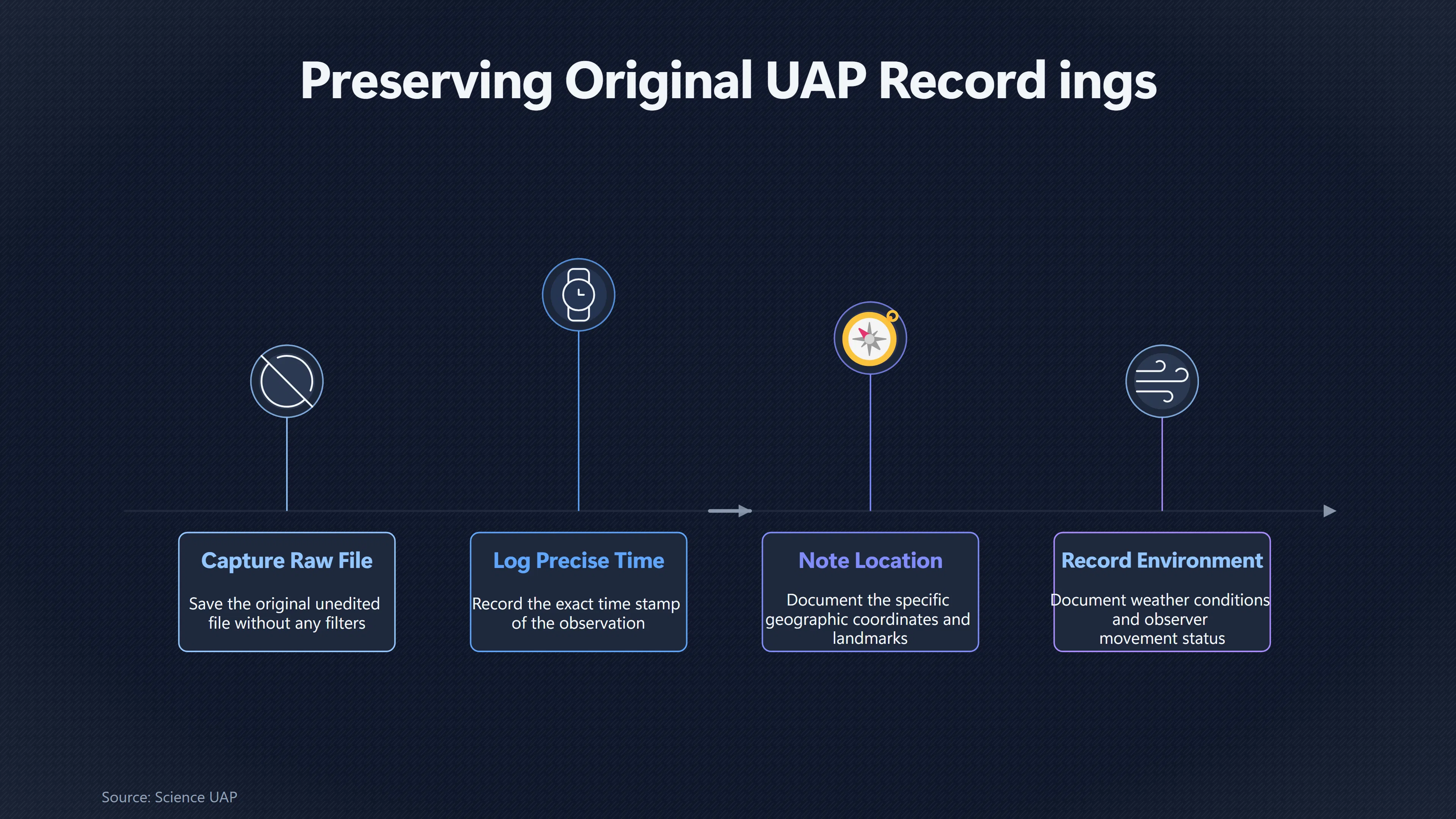
Anyone hoping their recording may contribute to serious investigation should preserve as much original information as possible.
- Keep the original, unedited file.
- Avoid re-encoding or applying filters.
- Record the exact time as accurately as possible.
- Note the observation location.
- Record viewing direction using landmarks or compass headings.
- Document weather conditions.
- Record whether the camera or observer was moving.
- Save related photographs or continuous video before and after the event.
- Preserve recordings from any additional witnesses.
- If multiple sensors exist—such as video, radar or infrared—retain every original dataset together.
Official UAP reporting guidance similarly encourages submitting all available sensor data alongside detailed information about observer location, timing, trajectories and observational circumstances because the supporting context often proves as valuable as the imagery itself.[AARO]aaro.milUser Guide InfoAAROAARO User Guide InfoJanuary 25, 2024…
Better metadata turns sightings into testable evidence
NASA’s proposed standard for stronger UAP research does not require more spectacular videos; it requires better documented ones. Thorough sensor metadata transforms an isolated recording into evidence that other investigators can independently examine, reconstruct and challenge. Time, location, lens settings, platform motion and environmental conditions allow researchers to calculate distances, estimate speeds, compare observations against known objects and identify ordinary explanations when they fit the data.
When that information is absent, even a visually striking video may remain scientifically inconclusive. When it is preserved, the same recording becomes part of a reproducible investigation rather than a permanent mystery.[nasa.gov]science.nasa.govScience UAPNASA ScienceUAP - NASA ScienceFebruary 23, 2026…
Amazon book picks
Further Reading
Books and field guides related to The Missing Data Behind Most UAP Videos. Use these as the next step if you want deeper reading beyond the article.
Photo Forensics
The first comprehensive and detailed presentation of techniques for authenticating digital images. Photographs have been doctored since p...
Metadata
Everything we need to know about metadata, the usually invisible infrastructure for information with which we interact every day. When “m...
Calling Bullshit: The Art of Skepticism in a Data-Driven World
Bullshit isn’t what it used to be. Now, two science professors give us the tools to dismantle misinformation and think clearly in a world...
The DAM Book: Digital Asset Management for Photographers
Provides information on building an archive for digital photographs.
eBay marketplace picks
Marketplace Samples
Live-tested eBay searches with available results related to this page.
Selected fromUFO poster oneBay.co.uk.



Endnotes
1.
Source: science.nasa.gov
Title: Science UAP
Link:https://science.nasa.gov/uap/
Source snippet
NASA ScienceUAP - NASA ScienceFebruary 23, 2026...
Published: February 23, 2026
2.
Source: nasa.gov
Title: UPDATE: NASA Shares UAP Independent Study Report; Names Director
Link:https://www.nasa.gov/news-release/update-nasa-shares-uap-independent-study-report-names-director/
Source snippet
UPDATE: NASA Shares UAP Independent Study Report; Names Director - NASA...
3.
Source: nist.gov
Link:https://www.nist.gov/publications/media-forensics-challenge-image-provenance-evaluation-and-state-art-analysis-large
Source snippet
Media Forensics Challenge Image Provenance Evaluation and State-of-the-Art Analysis on Large-Scale Benchmark Datasets | NISTOctober 2...
4.
Source: [aaro]({{ ‘aaro/’ | relative_url }}). mil
Title: User Guide Info
Link:https://www.aaro.mil/Portals/136/PDFs/Information_for_UAP_Analysis-20240125.pdf
Source snippet
AAROAARO User Guide InfoJanuary 25, 2024...
Published: January 25, 2024
5.
Source: science.nasa.gov
Link:https://science.nasa.gov/uap/faqs/
6.
Source: science.nasa.gov
Title: raw images faq
Link:https://science.nasa.gov/solar-system/multimedia/raw-images-faq/
7.
Source: csrc.nist.gov
Link:https://csrc.nist.gov/glossary/term/provenance
8.
Source: nist.gov
Title: digital investigation techniques nist scientific foundation review
Link:https://www.nist.gov/publications/digital-investigation-techniques-nist-scientific-foundation-review
9.
Source: nist.gov
Title: digital investigation techniques nist scientific
Link:https://www.nist.gov/spo/forensic-science-program/foundation-studies/digital-investigation-techniques-nist-scientific
10.
Source: nist.gov
Title: user guide nist media forensic challenge mfc datasets
Link:https://www.nist.gov/publications/user-guide-nist-media-forensic-challenge-mfc-datasets
11.
Source: nist.gov
Link:https://www.nist.gov/publications/media-forensics-challenge-image-provenance-evaluation-and-state-art-analysis-large-0
12.
Source: nist.gov
Title: digital video exchange standards
Link:https://www.nist.gov/programs-projects/digital-video-exchange-standards
13.
Source: data.nasa.gov
Title: uavsar insar metadata
Link:https://data.nasa.gov/dataset/uavsar-insar-metadata
14.
Source: pages.nist.gov
Title: NISTIR 8112
Link:https://pages.nist.gov/NISTIR-8112/NISTIR-8112.html
15.
Source: data.nist.gov
Link:https://data.nist.gov/pdr/
Additional References
16.
Source: ufouap.net
Link:https://www.ufouap.net/en/explainers/official-uap-reports
Source snippet
July 16, 2026 — Official records / Updated 2026-07-16 / 6 min read OFFICIAL UAP REPORTS: HOW TO READ GOVERNMENT UFO DOCUMENTS WITHOUT GET...
Published: July 16, 2026
17.
Source: uap-archive.org
Title: NAS A UAP Independent Study — Public Meeting & Briefings | UAP Records Archive
Link:https://uap-archive.org/uap/records/nasa-uap-independent-study-public-events/
Source snippet
NASA UAP Independent Study — Public Meeting & Briefings | UAP Records ArchiveJune 6, 2026 — NASA UAP INDEPENDENT STUDY — PUBLIC MEETING &...
Published: June 6, 2026
18.
Source: ufouap.net
Title: NAS A UAP Study: Findings and Remaining Questions | Global UFO Archive
Link:https://www.ufouap.net/en/explainers/nasa-uap-study
Source snippet
NASA UAP Study: Findings and Remaining Questions | Global UFO ArchiveJuly 23, 2026 — Science / Updated 2026-07-23 / 9 min read NASA AND U...
Published: July 23, 2026
19.
Source: youtube.com
Link:https://www.youtube.com/watch?v=fh3znHctOkA
Source snippet
All-domain Anomaly Resolution Office (AARO): a Duality in Mission Regarding UAPs (Sean Kirkpatrick)...
20.
Source: ufouap.net
Title: It is a structured record of time, p
Link:https://www.ufouap.net/en/explainers/how-to-report-a-ufo-sighting
Source snippet
How to Report a UFO or UAP Sighting | Global UFO ArchiveJuly 23, 2026 — Reporting / Updated 2026-07-23 / 10 min read HOW TO REPORT A UFO...
Published: July 23, 2026
21.
Source: youtube.com
Link:https://www.youtube.com/watch?v=bi0H_mkwTW0
Source snippet
Just Released MILITARY VIDEO of THREE UAP's in the Western U.S...
22.
Source: youtube.com
Title: Pentagon UAP Videos: What the Cameras Really Show
Link:https://www.youtube.com/watch?v=9vD5DOZCPrc
Source snippet
Pentagon claims to debunk famous 'GOFAST' UFO radar video, but still has not ID'd mysterious object...
23.
Source: faa.gov
Link:https://www.faa.gov/air_traffic/publications/atpubs/foa_html/chap4_section_7.html
24.
Source: faa.gov
Link:https://www.faa.gov/air_traffic/publications/ATpubs/AIM_html/chap7_section_7.html
25.
Source: archives.gov
Link:https://www.archives.gov/records-mgmt/uap-guidance