Within Eyewitness Memory
When UFO Questions Supply the Missing Story
Questions that assume a craft, beings or intention can reshape how an uncertain sighting is later described and remembered.
On this page
- Assumptions hidden inside interview wording
- How language changes later recollection
- Signs an account followed the interviewer's frame
Page outline Jump by section
Introduction
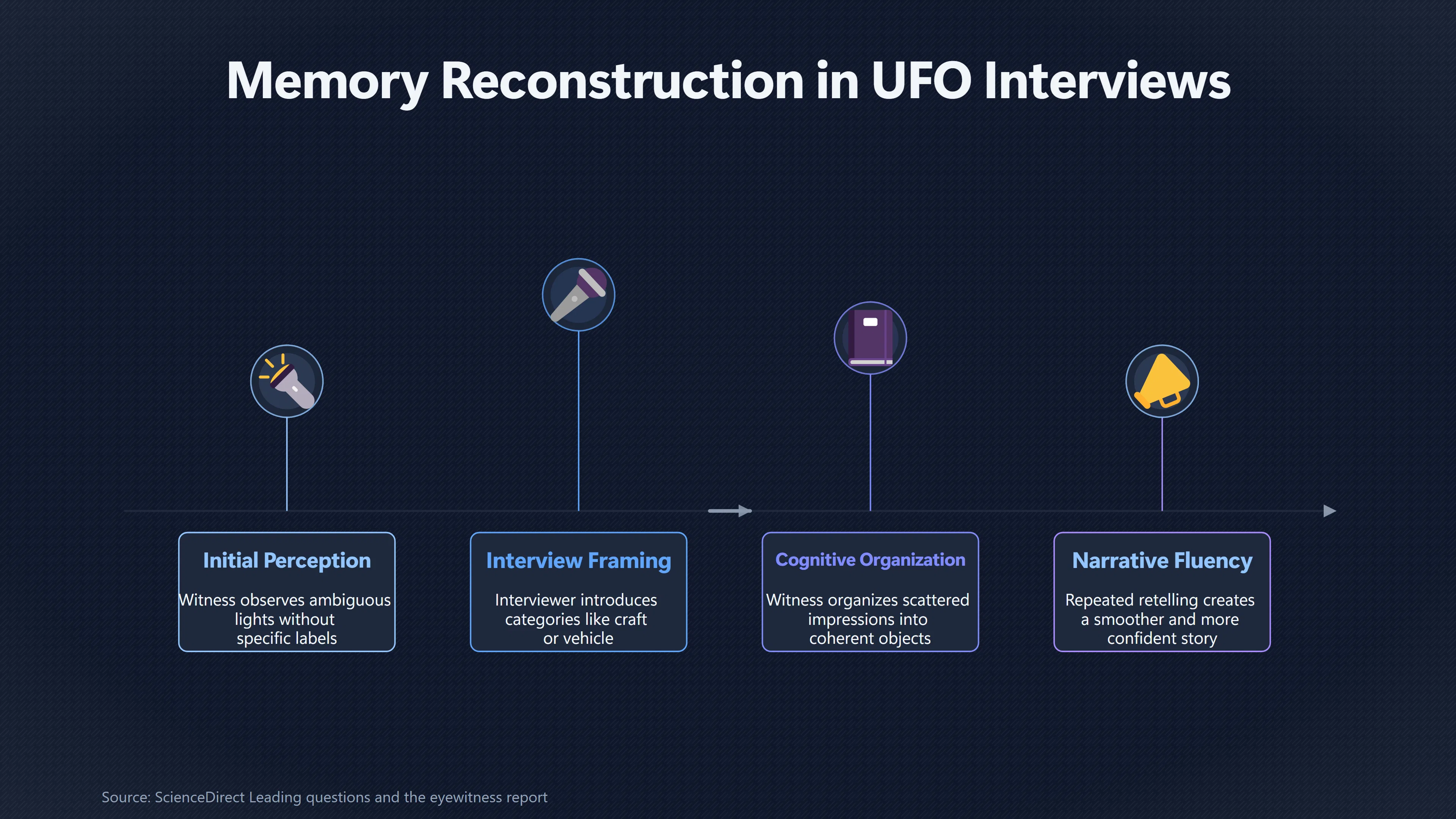
When an unusual light in the sky is discussed years later, the interview itself can become part of the story. Research on eyewitness memory shows that questions are not always neutral prompts to retrieve information. If they assume that a witness saw a “craft”, “vehicle” or “visitors”, they can encourage the witness to organise an originally uncertain perception around those ideas. This does not require dishonesty. Instead, it reflects the reconstructive nature of memory, in which recall is influenced by later language, expectations and repeated retelling. In the context of celebrity UFO interviews, where compelling narratives are often rewarded, this effect helps explain how accounts of ambiguous lights may gradually become descriptions of structured objects with apparent purpose.[ScienceDirect]sciencedirect.comScienceDirect Leading questions and the eyewitness reportLeading questions and the eyewitness report - ScienceDirect…
Assumptions Hidden Inside Interview Wording
A central finding from eyewitness psychology is that questions frequently contain presuppositions. Rather than asking what was observed, they may quietly assume facts that have not been established.
Compare these examples:
- Neutral: “Can you describe everything you remember seeing?”
- Assumptive: “When did you realise it was a craft?”
- More suggestive: “How large was the spacecraft?”
The first asks the witness to retrieve memories. The latter two introduce a category—”craft” or “spacecraft”—before the witness has independently described one.
Elizabeth Loftus’ classic experiments demonstrated that leading questions can alter later recollection, including increasing reports of objects that participants had not originally seen. Even true presuppositions influence recall by directing attention, while false presuppositions can become incorporated into memory over time.[ScienceDirect]sciencedirect.comScienceDirect Leading questions and the eyewitness reportLeading questions and the eyewitness report - ScienceDirect…
In celebrity interviews, this framing is often subtle. Interviewers may ask:
- “Did you think the occupants knew you were there?”
- “What shape was the craft?”
- “Did it seem to be intelligently controlled?”
Each question supplies an interpretive framework. A witness who originally recalled only unusual lights may now answer within the assumptions embedded in the question.
How Language Changes Later Recollection
Memory researchers distinguish between remembering an event and reconstructing it during recall. Every retelling involves rebuilding the memory using surviving sensory information together with later knowledge and expectations. This makes interview wording especially important after long delays.[Cambridge University Press]cambridge.orgUniversity Press Memory source monitoring and eyewitness testimony (Chapter 2Cambridge University PressMemory source monitoring and eyewitness testimony (Chapter 2) - Adult Eyewitness Testimony…
Three related processes are particularly relevant.
Categories Replace Uncertainty
Many genuine sightings begin with uncertainty:
“I saw several bright lights.”
Repeated interviews may gradually replace that uncertainty with more definite language:
“I saw a triangular craft.”
The change is not necessarily fabricated. Instead, the witness may increasingly organise scattered visual impressions into a coherent object because repeated discussion has supplied an available interpretation.
Labels Become Part of Memory
Words such as craft, vehicle, mother ship or occupants can become retrieval cues. Once those labels are repeatedly associated with the event, later recollections may feel naturally tied to them even if the earliest account never used such terms. This reflects broader findings on source monitoring, where people become less able to distinguish original perception from later information acquired through conversation or media.[Cambridge University Press]cambridge.orgUniversity Press Memory source monitoring and eyewitness testimony (Chapter 2Cambridge University PressMemory source monitoring and eyewitness testimony (Chapter 2) - Adult Eyewitness Testimony…

Confidence Can Increase Without New Evidence
Repeated storytelling generally improves narrative fluency. A smoother account often sounds more convincing to listeners and may also feel more convincing to the speaker. Psychological research shows that confidence and accuracy do not always increase together, particularly after exposure to post-event information.[ScienceDirect]sciencedirect.comScienceDirect Leading questions and the eyewitness reportLeading questions and the eyewitness report - ScienceDirect…
Why Celebrity Interviews Are Especially Vulnerable
Entertainment interviews differ markedly from formal eyewitness interviews.
Their goals commonly include:
- producing an engaging story;
- maintaining audience attention;
- encouraging vivid description;
- highlighting dramatic moments.
Professional eyewitness interviewing takes almost the opposite approach. The cognitive interview developed for investigative work aims to maximise accurate recall while minimising suggestion. It encourages witnesses to give uninterrupted free narratives before specific questions are asked and seeks to avoid wording that supplies details the witness has not independently reported.[Office of Justice Programs]ojp.govOffice of Justice ProgramsEyewitness Responses to Leading and Misleading Questions under the Cognitive Interview | Office of Justice Prog…
Celebrity media interviews rarely follow these principles. Instead, hosts often summarise, speculate or complete sentences for guests. While this may improve storytelling, it also increases opportunities for interviewer framing to influence later recollections.
Signs an Account Followed the Interviewer’s Frame
No single feature proves that an interview reshaped memory, but several patterns deserve attention when evaluating later UFO narratives.
New structural details appear only after prompting. A witness initially discusses lights but begins describing windows, metallic surfaces or specific craft shapes only after questions assume such features.
Interpretation replaces observation. Statements shift from sensory descriptions (“three lights moved together”) to inferred conclusions (“an alien vehicle was scouting the area”) without new observational evidence.
Interview vocabulary is adopted. Terms introduced by the interviewer later become standard parts of the witness’s own retelling.
Earlier uncertainty disappears. Initial hesitation or acknowledgement of ambiguity gives way to increasingly definite accounts despite no new contemporaneous documentation.
These patterns do not establish that the witness is intentionally changing the story. Instead, they are consistent with well-documented mechanisms by which memory can be reconstructed through repeated retrieval and suggestive questioning.[sciencedirect.com]sciencedirect.comScienceDirect Leading questions and the eyewitness reportLeading questions and the eyewitness report - ScienceDirect…
A Better Way to Ask About Unusual Sightings
Research in eyewitness interviewing suggests several practical principles that reduce the risk of supplying details rather than eliciting them.
Interviewers should:
- begin with uninterrupted free recall before asking specific questions;
- ask open-ended questions such as “What happened next?” instead of “When did the craft descend?”;
- separate observation from interpretation by asking what was directly seen before discussing possible explanations;
- preserve expressions of uncertainty rather than encouraging witnesses to resolve ambiguities;
- avoid introducing categories like “spaceship” or “aliens” unless the witness first uses those terms independently.[Office of Justice Programs]ojp.govOffice of Justice ProgramsEyewitness Responses to Leading and Misleading Questions under the Cognitive Interview | Office of Justice Prog…
These methods cannot eliminate normal memory reconstruction, but they reduce the chance that the interview itself becomes another source of remembered detail.
Why This Matters for Celebrity UFO Stories
Within the broader question of how eyewitness memory reshapes UFO stories, interview framing provides a specific mechanism by which ambiguous observations can become increasingly elaborate over time. A celebrity may sincerely remember seeing a structured craft decades after an event that was originally described only as unusual lights. The critical issue is not whether the witness believes the later account, but whether elements of that account originated in perception or emerged through years of interviews, discussion and repeated reconstruction.
For that reason, historians and researchers generally place greater evidential weight on the earliest contemporaneous descriptions than on polished narratives developed after many interviews. Later recollections remain valuable for understanding how witnesses interpret their experiences, but they should be read alongside the wording of the questions that helped shape those memories.[sciencedirect.com]sciencedirect.comScienceDirect Leading questions and the eyewitness reportLeading questions and the eyewitness report - ScienceDirect…
Amazon book picks
Further Reading
Books and field guides related to When UFO Questions Supply the Missing Story. Use these as the next step if you want deeper reading beyond the article.
The Seven Sins of Memory
Rating: 3.5/5 from 5 Google Books ratings
A New York Times Notable Book: A psychologist's "gripping and thought-provoking" look at how and why our brains sometimes fail us (Steven...
Eyewitness Testimony
Every year hundreds of defendants are convicted on little more than the say-so of a fellow citizen. Although psychologists have suspected...
The Memory Illusion: Remembering, Forgetting, and the Science...
THE INTERNATIONAL BESTSELLER 'Truly fascinating.' Steve Wright, BBC Radio 2 - Have you ever forgotten the name of someone you’ve met doze...
The Seven Sins of Memory: How the Mind Forgets and Remembers
Rating: 3.5/5 from 5 Google Books ratings
A New York Times Notable Book: A psychologist's "gripping and thought-provoking" look at how and why our brains sometimes fail us (Steven...
eBay marketplace picks
Marketplace Samples
Live-tested eBay searches with available results related to this page.
Selected fromUFO poster oneBay.co.uk.




Endnotes
1.
Source: sciencedirect.com
Title: ScienceDirect Leading questions and the eyewitness report
Link:https://www.sciencedirect.com/science/article/pii/0010028575900237
Source snippet
Leading questions and the eyewitness report - ScienceDirect...
2.
Source: cambridge.org
Title: University Press Memory source monitoring and eyewitness testimony (Chapter 2)
Link:https://www.cambridge.org/core/books/abs/adult-eyewitness-testimony/memory-source-monitoring-and-eyewitness-testimony/D91E27C9DBCF5DA8E21FAAC672E3C263
Source snippet
Cambridge University PressMemory source monitoring and eyewitness testimony (Chapter 2) - Adult Eyewitness Testimony...
3.
Source: sciencedirect.com
Title: ScienceDirect Leading questions and the eyewitness report
Link:https://www.sciencedirect.com/science/article/abs/pii/0010028575900237
Source snippet
Leading questions and the eyewitness report - ScienceDirect...
4.
Source: youtube.com
Link:https://www.youtube.com/watch?v=16yIMHtLUTg
Source snippet
Psychology - Eyewitness Testimony and Leading Questions...
5.
Source: youtube.com
Link:https://www.youtube.com/watch?v=m6aY9Wr-xjI
Source snippet
The Psychology Of UFO Sightings - Terence McKenna...
6.
Source: ojp.gov
Link:https://www.ojp.gov/library/publications/eyewitness-responses-leading-and-misleading-questions-under-cognitive
Source snippet
Office of Justice ProgramsEyewitness Responses to Leading and Misleading Questions under the Cognitive Interview | Office of Justice Prog...
7.
Source: nij.ojp.gov
Title: enhancing enhanced eyewitness memory refining cognitive interview
Link:https://nij.ojp.gov/library/publications/enhancing-enhanced-eyewitness-memory-refining-cognitive-interview
Source snippet
Enhanced Eyewitness Memory: Refining the Cognitive Interview | National Institute of JusticeJanuary 1, 1987 — ENHANCING ENHANCED EYEWITNE...
Published: January 1, 1987
8.
Source: nij.ojp.gov
Title: eyewitness responses leading and misleading questions under cognitive
Link:https://nij.ojp.gov/library/publications/eyewitness-responses-leading-and-misleading-questions-under-cognitive
Source snippet
Responses to Leading and Misleading Questions under the Cognitive Interview | National Institute of JusticeJanuary 1, 1986 — EYEWITNESS R...
Published: January 1, 1986
9.
Source: ojp.gov
Link:https://www.ojp.gov/ncjrs/virtual-library/abstracts/eyewitness-responses-leading-and-misleading-questions-under
10.
Source: ojp.gov
Title: memory source monitoring and eyewitness testimony adult eyewitness
Link:https://www.ojp.gov/ncjrs/virtual-library/abstracts/memory-source-monitoring-and-eyewitness-testimony-adult-eyewitness
Additional References
11.
Source: tandfonline.com
Link:https://www.tandfonline.com/doi/abs/10.1080/00207147908407572
Source snippet
Effective interrogation of the eyewitness: International Journal of Clinical and Experimental [Hypnosis]({{ 'hypnosis/' | relative_url }}): Vol 27, No 4January 31, 2008 — In...
Published: January 31, 2008
12.
Source: youtube.com
Title: Common Law: The Psychology of Eyewitness Memory with Elizabeth Loftus
Link:https://www.youtube.com/watch?v=Yq6u_4xtVh0
Source snippet
These videos explore Elizabeth Loftus' foundational research on leading questions and reconstructive memory, demonstrating how interview...
13.
Source: youtube.com
Title: How Reliable is Your Memory? | Elizabeth Loftus | TED
Link:https://www.youtube.com/watch?v=PB2OegI6wvI
Source snippet
Loftus and Palmer (1974) Study on Eyewitness Memory and Leading Questions...
14.
Source: journals.sagepub.com
Link:https://journals.sagepub.com/doi/10.1177/0146167287134010
Source snippet
Daniel Lassiter, Julie I. Stone, Michael F. Weigold, 1987December 1, 1987 — First published December 1987 Request permissions EFFECT OF L...
Published: December 1, 1987
15.
Source: researchgate.net
Title: (PDF) Eyewitness testimony: The influence of the wording of a question
Link:https://www.researchgate.net/publication/232444506_Eyewitness_testimony_The_influence_of_the_wording_of_a_question
16.
Source: eric.ed.gov
Link:https://eric.ed.gov/?id=EJ133673