Within Pilot Witnesses
Why Night Cockpits Can Mislead Expert Pilots
Night flying can distort motion, position and brightness, making unfamiliar lights seem more extraordinary than measured data supports.
On this page
- How darkness removes reliable visual reference points
- Glare, refocusing and false impressions of motion
- What instruments can and cannot correct
Page outline Jump by section
Introduction
Celebrity pilots often receive extra attention when they report unidentified lights because they combine public visibility with aviation experience. That experience can make their observations operationally valuable, but it does not remove the limits of human perception at night. A cockpit flying through darkness is a demanding visual environment where distance, size and motion are difficult to judge without reliable external references. Aviation safety research has long recognised that even highly trained pilots can experience compelling visual illusions when viewing isolated lights against a dark sky or when flying over featureless terrain.[Federal Aviation Administration]faa.govFederal Aviation Administration Chapter 8. Medical Facts for PilotsFederal Aviation Administration Chapter 8. Medical Facts for Pilots

For reports that later become associated with UFOs or unidentified aerial phenomena (UAP), this distinction is important. A pilot may accurately report seeing an unusual light while sincerely misjudging its movement, range or behaviour. Understanding these well-documented night-time perceptual effects helps explain why pilot testimony deserves careful investigation without assuming that every interpretation is correct.
How darkness removes reliable visual reference points
Human vision estimates motion and distance by comparing objects with surrounding landmarks. At night, many of those landmarks disappear. Over deserts, oceans or sparsely populated countryside, a pilot may be left with little more than isolated lights against a black background.
Without a visible horizon, the brain loses many of the cues normally used to determine whether another light is climbing, descending, stationary or moving laterally. The US Federal Aviation Administration (FAA) identifies false horizons, obscured horizons and featureless dark scenes as established sources of visual illusion that can lead pilots to misjudge both aircraft attitude and the apparent position of outside lights.[Federal Aviation Administration]faa.govFederal Aviation Administration Chapter 8. Medical Facts for PilotsFederal Aviation Administration Chapter 8. Medical Facts for Pilots
This limitation matters when evaluating pilot UFO reports because many famous sightings occurred:
- during cruise flight after sunset;
- over remote terrain with few ground references;
- while approaching airports at night;
- above cloud layers where the natural horizon was hidden.
In these situations, an unfamiliar light may appear far closer or more dynamic than it actually is simply because there is no stable frame of reference against which to judge it.
Glare, refocusing and false impressions of motion
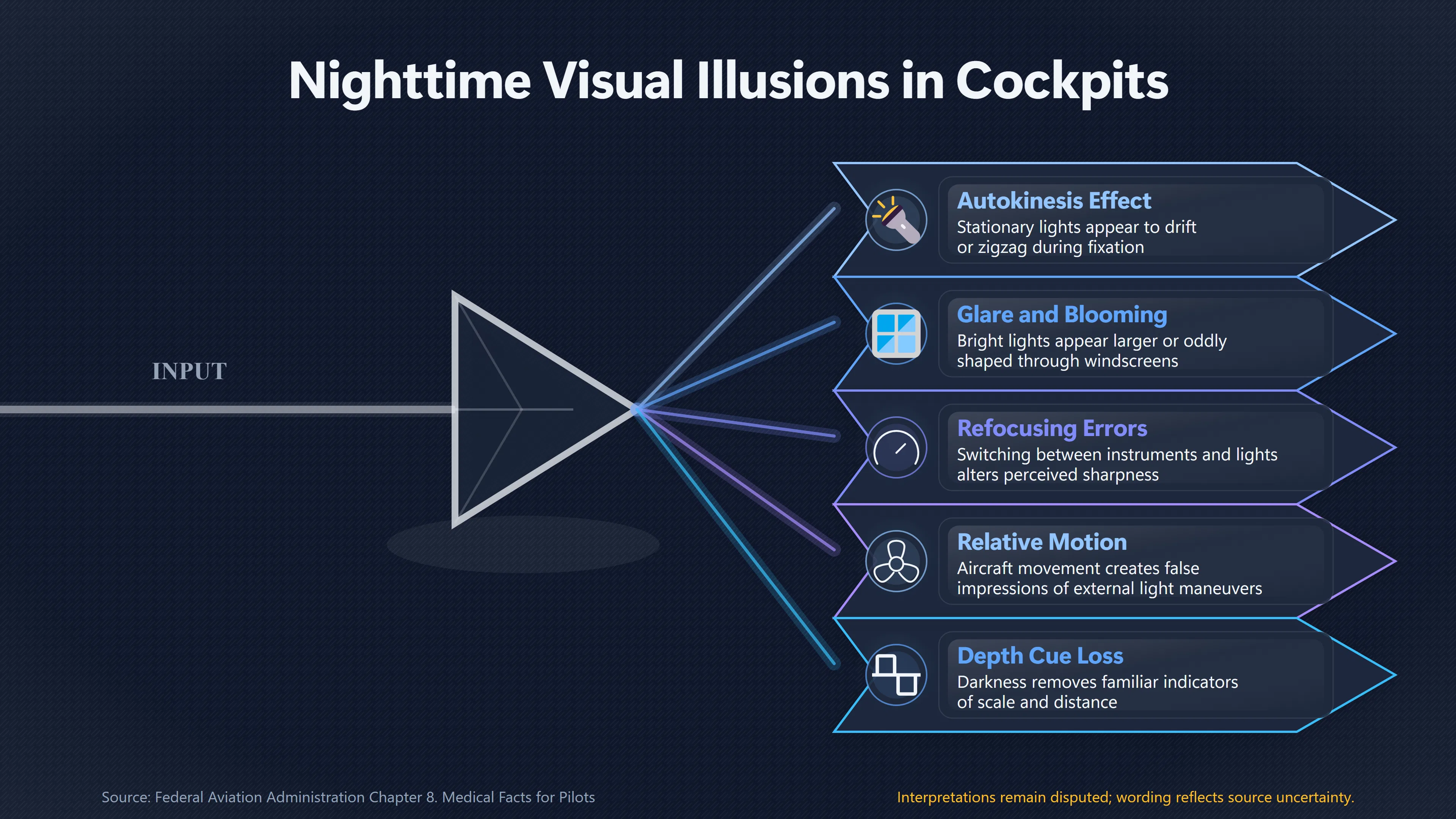
One of the best documented night-time visual phenomena is autokinesis. When a person stares at a single stationary light against a dark background for several seconds, tiny involuntary eye movements can make the light appear to drift or zigzag even though it remains fixed.
The FAA specifically warns pilots about autokinesis because the illusion is sufficiently convincing that some pilots have attempted to manoeuvre their aircraft to “follow” the apparently moving light. The recommended countermeasure is to avoid prolonged fixation and instead scan across the scene while cross-checking instruments.[Federal Aviation Administration]faa.govFederal Aviation Administration Chapter 8. Medical Facts for PilotsFederal Aviation Administration Chapter 8. Medical Facts for Pilots
Several other night-time effects can also contribute to unusual interpretations:
- Glare and blooming. Bright lights viewed through cockpit windscreens can appear larger, less sharply defined or oddly shaped.
- Repeated refocusing. Looking alternately between cockpit instruments and distant lights requires constant accommodation by the eyes, which can alter the apparent sharpness and brightness of external objects.
- Relative motion effects. A pilot’s own aircraft may be turning, climbing or accelerating smoothly while a distant object remains fixed, creating the impression that the outside light is manoeuvring.
- Lack of depth cues. A distant aircraft, satellite or bright planet can be difficult to distinguish from a much nearer object because darkness removes familiar indicators of scale.
None of these effects requires poor eyesight or inexperience. They arise from normal visual processing under unusually demanding conditions.
Why expert pilots remain susceptible
Pilot training significantly improves observation and decision-making, but it does not replace the limits of human sensory systems.
Professional aviators are trained to recognise traffic patterns, aircraft lighting configurations and weather hazards. However, they are also taught that visual perception becomes substantially less reliable at night. FAA guidance explicitly notes that visual illusions are common contributors to spatial disorientation and have featured in numerous fatal aviation accidents. Reliable instrument references are therefore considered essential whenever outside visual cues become ambiguous.[Federal Aviation Administration]faa.govFederal Aviation Administration Chapter 8. Medical Facts for PilotsFederal Aviation Administration Chapter 8. Medical Facts for Pilots
Divided attention also plays a role. During night operations, pilots must simultaneously:
- monitor flight instruments;
- communicate with air traffic control;
- navigate;
- maintain aircraft control;
- scan outside for conflicting traffic.
A brief glimpse of an unexpected light may therefore occur under high workload rather than during prolonged observation. Human factors studies of military night operations similarly identify low illumination, attention demands and fatigue as recurring contributors to visual misperception.[NTRL]ntrl.ntis.govReports Library - NTISJanuary 1, 1991…
What instruments can and cannot correct
Aircraft instruments dramatically improve safety, but they do not automatically identify unfamiliar lights outside the cockpit.
Flight instruments accurately report the aircraft’s own attitude, altitude, speed and heading. They can confirm whether an apparent climb or bank is actually occurring, preventing many dangerous visual illusions. FAA guidance consistently advises pilots to trust instruments whenever outside references become unreliable.[Federal Aviation Administration]faa.govFederal Aviation Administration Chapter 8. Medical Facts for PilotsFederal Aviation Administration Chapter 8. Medical Facts for Pilots
However, instruments cannot always answer the separate question of what an external light represents.
For example:
- A flight display cannot identify a distant satellite.
- Radar may not detect every object visible to the eye, particularly if it lies beyond its coverage or has a small radar cross-section.
- Traffic alert systems only display suitably equipped aircraft transmitting compatible signals.
- Air traffic control may likewise have incomplete information about military operations, satellites or distant atmospheric phenomena.
Consequently, a pilot may correctly conclude that an observed light is unidentified while remaining unable to determine its true nature from cockpit instruments alone.
Lessons from modern pilot UAP investigations
Recent research examining pilot UAP reports illustrates how unusual appearances can emerge from ordinary objects viewed under uncommon conditions.
A detailed 2024 case study reconstructed a commercial-airline sighting in which multiple experienced pilots observed striking lights over the Pacific. By combining flight tracking data with orbital information, researchers concluded that recently launched Starlink satellites, viewed under unusual solar illumination angles, reproduced the appearance reported from the cockpit. The study argued that better awareness of satellite visibility could reduce future misidentifications without questioning the honesty or competence of the flight crews.[arXiv]arxiv.orgEnhancing Space Situational Awareness to Mitigate Risk: A Single-Case Study in the Misidentification of a Recently-Launched Starlink…
The broader lesson is not that every pilot UFO report has a conventional explanation. Rather, it demonstrates that multiple trained observers can independently experience the same convincing visual impression when unusual lighting geometry interacts with the limitations of night-time perception.
Reading celebrity pilot reports with appropriate caution
When well-known pilots describe unidentified lights, their aviation background adds useful observational context rather than automatic validation of the interpretation.
A pilot’s testimony may reliably establish details such as flight phase, approximate bearing, weather conditions and whether air traffic control was contacted. Those operational facts are valuable starting points for investigation. At the same time, decades of aviation safety research show that darkness, isolated lights, false horizons and visual fixation can all distort perceived motion, position and brightness, even for experienced aircrew.[faa.gov]faa.govFederal Aviation Administration Chapter 8. Medical Facts for PilotsFederal Aviation Administration Chapter 8. Medical Facts for Pilots
For that reason, the strongest investigations combine pilot observations with independent evidence such as radar data, flight tracks, astronomical information, satellite positions, cockpit recordings and air traffic communications. Where those additional sources agree, confidence increases. Where they do not, well-understood night cockpit illusions remain an important alternative explanation before concluding that an extraordinary aerial phenomenon has been observed.
Amazon book picks
Further Reading
Books and field guides related to Why Night Cockpits Can Mislead Expert Pilots. Use these as the next step if you want deeper reading beyond the article.
Human Factors in Flight
The late Captain Frank H Hawkins FRAes, M Phil, was Human Factors Consultant to KLM, for whom he had flown for over 30 years as line capt...
The Invisible Gorilla: How Our Intuitions Deceive Us
NEW YORK TIMES BESTSELLER • Our minds don’t work the way we think they do. Two renowned psychologists explain how and why our intuitions...
Visual Intelligence: Sharpen Your Perception, Change Your Life
An engrossing guide to seeing--and communicating--more clearly, from the groundbreaking course that helps FBI agents, cops, CEOs, ER doct...
The Man Who Mistook His Wife for a Hat
With an introduction by Will SelfA classic work of psychology, this international bestseller provides a groundbreaking insight into the h...
eBay marketplace picks
Marketplace Samples
Live-tested eBay searches with available results related to this page.
Selected fromufo patch oneBay.co.uk.
Endnotes
1.
Source: faa.gov
Title: Federal Aviation Administration Chapter 8. Medical Facts for Pilots
Link:https://www.faa.gov/Air_traffic/publications/atpubs/aim_html/chap8_section_1.html
2.
Source: faa.gov
Title: Federal Aviation Administration Chapter 7. Safety of Flight
Link:https://www.faa.gov/air_traffic/publications/atpubs/aim_html/chap7_section_6.html
3.
Source: faa.gov
Title: Federal Aviation Administration Chapter 8. Medical Facts for Pilots
Link:https://www.faa.gov/air_traffic/publications/atpubs/aim/aim0801.html
4.
Source: ntrl.ntis.gov
Link:https://ntrl.ntis.gov/NTRL/dashboard/searchResults/titleDetail/ADA237641.xhtml
Source snippet
Reports Library - NTISJanuary 1, 1991...
Published: January 1, 1991
5.
Source: arxiv.org
Link:https://arxiv.org/abs/2403.08155
Source snippet
Enhancing Space Situational Awareness to Mitigate Risk: A Single-Case Study in the Misidentification of a Recently-Launched Starlink...
6.
Source: faa.gov
Title: Office of Aerospace Medicine Technical Reports | Federal Aviation Administration
Link:https://www.faa.gov/data_research/research/med_humanfacs/oamtechreports/1970s/1978/197815
7.
Source: faa.gov
Link:https://www.faa.gov/air_traffic/publications/atpubs/aip_html/chap8_section_1.html
8.
Source: faa.gov
Link:https://www.faa.gov/air_traffic/publications/atpubs/aip_html/chap7_section_6.html
9.
Source: faa.gov
Title: EN R 1.15: Medical Facts for Pilots7.. JUDGMENT ASPECTS OF COLLISION AVOIDANCE 1
Link:https://www.faa.gov/air_traffic/publications/atpubs/aip_html/part2_enr_section_1.15.html
10.
Source: faa.gov
Link:https://www.faa.gov/data_research/research/med_humanfacs/oamtechreports/1970s/1977/197712
11.
Source: faasafety.gov
Title: FAA Safety Pilots Handbook of Aeronautical Knowledge.indb
Link:https://www.faasafety.gov/files/notices/2014/Dec/FAA-H-8083-25A_Pilot%27s_Hdbk_of_Aeronautical_Knowledge_CH-16.pdf
12.
Source: faasafety.gov
Link:https://www.faasafety.gov/files/events/SO/SO15/2023/SO15125877/Human_Factors_for_Pilots_-_Workbook.pdf
Source snippet
FAA SafetySafety behaviours: human factors for pilots 2nd edition - Workbook...
13.
Source: faasafety.gov
Link:https://www.faasafety.gov/gslac/ALC/libview_chapter.aspx?chapter=Illusions+-+Have+I+Considered+Them%3F&id=6580
14.
Source: faasafety.gov
Title: Learning Center Library Contents
Link:https://www.faasafety.gov/gslac/ALC/libview_printerfriendly.aspx?id=6580
15.
Source: skybrary.aero
Link:https://skybrary.aero/index.php/articles/visual-illusions
16.
Source: ntrl.ntis.gov
Link:https://ntrl.ntis.gov/NTRL/dashboard/searchResults/titleDetail/AD653518.xhtml
Additional References
17.
Source: aopa.org
Title: The stillness of the air, the faint glow of city lights, and the seemingly endl
Link:https://www.aopa.org/news-and-media/all-news/2023/july/pilot/asi-safety-tips-night-terrors
Source snippet
Night terrors - AOPAMay 25, 2023 — NIGHT TERRORS THE BLACK HOLE DEPARTURE May 25, 2023 By Terrie Mead There’s something alluring about fl...
Published: May 25, 2023
18.
Source: youtube.com
Title: Breakdown of the Pentagon UFO videos with Mick West
Link:https://www.youtube.com/watch?v=Le7Fqbsrrm8
Source snippet
This video provides an expert breakdown of UAP videos and pilot reports, detailing how optical perspectives, camera tracking effects, and...
19.
Source: ntsb.gov
Link:https://www.ntsb.gov/news/press-releases/Pages/NR20210209.aspx
20.
Source: journals.sagepub.com
Link:https://journals.sagepub.com/doi/10.1177/00187208261419347
Source snippet
Allison, Elizabeth L. Irving, Sion Jennings, Laurie M. Wilcox, 2026February 11, 2026 — First published online February 11, 2026 Re-use pe...
Published: February 11, 2026
21.
Source: journals.sagepub.com
Link:https://journals.sagepub.com/doi/abs/10.1177/00187208261419347
Source snippet
Allison, Elizabeth L. Irving, Sion Jennings, Laurie M. Wilcox, 2026February 11, 2026 — First published online February 11, 2026 Re-use pe...
Published: February 11, 2026
22.
Source: youtube.com
Title: Commercial Pilot Course | Night, Part 2 – Epic Flight Academy
Link:https://www.youtube.com/watch?v=hEd0uI-sgXM
Source snippet
Night Illusions (Private Pilot Lesson 15d)...
23.
Source: faraim.org
Link:https://www.faraim.org/faa/aim/chapter-8/section-8-1-5.html
24.
Source: youtube.com
Title: PPGS Lesson 14.2 | Aeromedical: Illusions
Link:https://www.youtube.com/watch?v=ZBPmFaqECdM
Source snippet
Commercial Pilot Course | Night, Part 2 – Epic Flight Academy...
25.
Source: youtube.com
Title: Flying At Night
Link:https://www.youtube.com/watch?v=Hohd2HaqTgk
Source snippet
Breakdown of the Pentagon UFO videos with Mick West...
26.
Source: youtube.com
Title: Night Illusions (Private Pilot Lesson 15d)
Link:https://www.youtube.com/watch?v=y_HvgmQ3NJs
Source snippet
Flying At Night - MzeroA Flight Training...