Within Celebrity UFO Files
Why UFO Witnesses Misjudge Size and Speed
Without a known distance or reference point, even a careful witness cannot reliably calculate an object's size or speed.
On this page
- Angular size and unknown distance
- The effect of darkness and poor reference points
- Why measured triangulation matters
Page outline Jump by section
Introduction
A UFO witness may describe an object as enormous, very close or travelling at extraordinary speed, yet none of those estimates can be calculated reliably from appearance alone. The eye usually measures angles, not physical dimensions: how much of the visual field an object occupies and how quickly its apparent position changes. To convert those impressions into metres, kilometres per hour or acceleration, investigators must first know the object’s distance and the observer’s own movement.
That information is often missing from celebrity sightings and other eyewitness accounts, especially when the object is a featureless light in an open or dark sky. A small nearby object can look identical to a much larger distant one. A slow object can also appear to race across the landscape when viewed from a moving aircraft or camera. NASA therefore emphasises that clearly determining distance is essential before claims of unusual speed or acceleration can be corroborated.[NASA]nasa.govuap independent study team final report 0Data signatures are vast, and theories that predict novel signatures help guide our searches. It is imperative to set…
Angular size does not reveal actual size
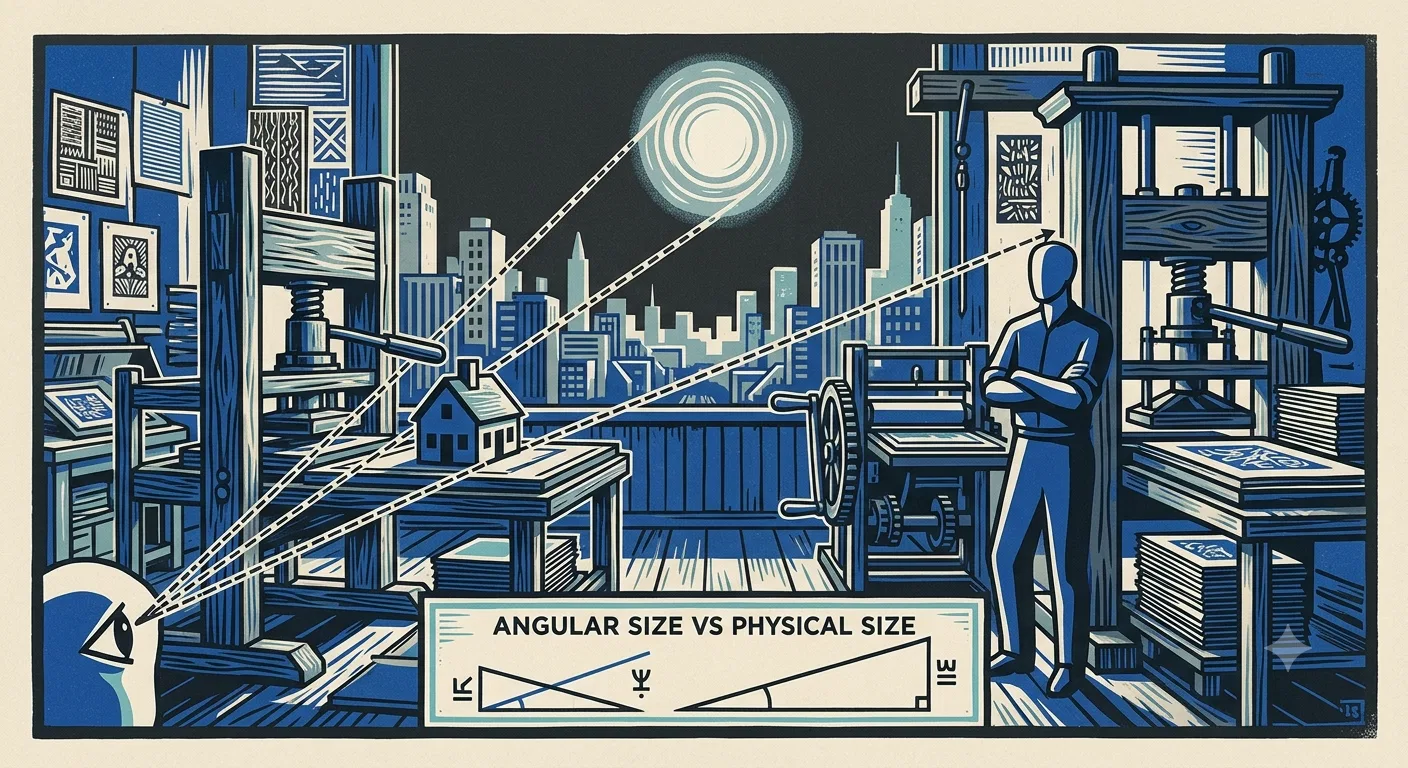
When people say that an object looked “the size of a dinner plate”, “as large as a house” or “hundreds of metres wide”, they are usually describing its angular size: the angle it subtended at the eye. Holding a coin close to the face can cover the Moon, although the two objects are radically different in physical size and distance.
The same ambiguity applies to an unidentified object in the sky. A one-metre balloon at modest range and a much larger object several kilometres away can occupy the same apparent width. The observation supplies one relationship between size and distance, but not enough information to calculate either quantity separately. Astronomy faces the same geometrical problem: measuring an object’s angular extent is not sufficient to establish its true dimensions unless its distance is also known.[The Open University]open.eduThe Open UniversityAstronomy: images of the Universe: 1.3 Measuring sizes | OpenLearn - Open UniversityAstronomy: images of the Universe…
For small viewing angles, physical size is approximately proportional to distance:
physical size ≈ distance × angular size[itu.physics.uiowa.edu]itu.physics.uiowa.eduangular sizeangular size
The practical consequence is simple. If the assumed distance is ten times too large, the inferred size will also be roughly ten times too large. A witness who unconsciously places a light among distant clouds may describe a vast craft, even though the source could be a much smaller object beneath the cloud layer.
Familiar shapes normally help the visual system resolve this uncertainty. Wings, windows, people, trees and buildings provide known scales. Many reported UFOs offer none of these clues. They are described as points of light, smooth discs, dark silhouettes or indistinct blobs. The All-domain Anomaly Resolution Office, or AARO, notes that forced-perspective errors become especially likely when an object lacks recognisable features such as wings or propellers and there is no reliable reference against which to compare it.[AARO]aaro.milEffect of Forced Perspective and Parallax View on UAP ObservationsEffect of Forced Perspective and Parallax View on UAP ObservationsMay 7, 2024 — Effect of Forced Perspective and Parallax View on UAP…
Even comparison with a nearby landmark can be misleading. From one viewpoint, an object may appear to pass beside, above or behind a building when it is actually far in front of it. A two-dimensional view does not automatically disclose the object’s three-dimensional position.
Why apparent speed can be deceptive
Speed requires both a measured distance travelled and a measured interval of time. A witness may estimate how quickly an object crosses part of the sky, but that is angular speed, not necessarily its physical speed.
Imagine two objects moving through an angle of ten degrees in one second. A nearby insect may cover that angle while travelling only a few metres. A distant aircraft would have to cover a much greater physical distance in the same second. Without knowing the range, the observation cannot distinguish between those possibilities.
The observer’s own motion adds another source of error. From a fast-moving aircraft, a nearby object may sweep rapidly across the background even when it is stationary or drifting slowly. This is motion parallax. Roadside posts seem to flash past a moving car, while distant hills appear almost fixed; most of the apparent difference comes from distance rather than from the objects’ actual movement.
AARO describes the same mechanism in UAP observations. As an aircraft or airborne sensor changes position, a stationary or slow object can be projected against rapidly changing points in the background. The resulting image may create the impression that the object itself is moving quickly in the opposite direction. Zoom can intensify that impression by narrowing the visible scene and removing contextual cues.[AARO]aaro.milEffect of Forced Perspective and Parallax View on UAP ObservationsEffect of Forced Perspective and Parallax View on UAP ObservationsMay 7, 2024 — Effect of Forced Perspective and Parallax View on UAP…
The “GoFast” lesson
The US Navy’s “GoFast” recording is a useful example because its nickname and visual presentation suggest an object skimming rapidly above the sea. AARO’s later reconstruction placed the object at approximately 13,000 feet rather than immediately above the water. Its analysis concluded with high confidence that it did not display anomalous speed, estimating a wind-adjusted range of roughly 5 to 92 miles per hour depending on unresolved variables such as heading and wind direction.[AARO]aaro.milGo Fast Case ResolutionNavy Sensor: Forward Looking Infrared Reported Behavior: Moved at high speeds near the ocean’s surface Assessed Behavior: An object movin…
The object appears fast partly because the observing F/A-18 is moving rapidly while its sensor tracks a relatively distant target against the ocean. Once range, aircraft movement, viewing angle and wind are introduced, the dramatic visual impression no longer translates directly into extraordinary performance.
This does not prove that every apparently fast UFO is slow, nor does it identify every object. It demonstrates a narrower but important point: speed cannot safely be read from screen motion alone. The geometry of the camera, platform and target must be reconstructed first.
AARO reached a comparable conclusion in its analysis of infrared footage recorded near Rafael Hernández Airport in Puerto Rico. The objects appeared to move at high speed, but modelling indicated that they travelled at about 8 miles per hour, broadly consistent with the wind. The apparent rapid motion was attributed to parallax produced by the aircraft’s movement, sensor zoom and changing viewing geometry.[AARO]aaro.milThe aircraft entered a layer of scattered cloudAARO Puerto Rico UAP Case ResolutionMarch 13, 2025 — an arc around the Rafael Hernandez Airport, gaining approximately 1,725 feet in…
Darkness removes the visual yardsticks
Distance judgement becomes still less reliable at night. In daylight, the visual system can use texture, haze, shadows, overlapping objects and changes in detail to estimate depth. The US Federal Aviation Administration lists comparative size, relative image motion, interposition, texture, contrast, illumination and atmospheric perspective among the cues people use to judge distance and speed. Many of these cues disappear when the observer sees only a bright point against a dark sky.[Federal Aviation Administration]faa.govspatiald visillusSo, it should not be any surprise to us that, when we fly under conditions of limited visibility, we have problems maintaining spatial or…
A light with no visible body could be a small nearby source, a distant aircraft, a planet, a balloon carrying illumination or something at an entirely different range. Brightness does not settle the question because apparent brightness depends on both the source’s intrinsic output and its distance. Glare may also make a point source look broader than it is, encouraging an inflated estimate of size.
Darkness can distort perceived movement as well. The FAA describes the autokinetic illusion, in which staring at a stationary light against a totally dark, featureless background creates the impression that the light is moving. Pilots may even interpret it as being on a collision course.[Federal Aviation Administration]faa.govFederal Aviation Administration Spatial DisorientationFederal Aviation AdministrationSpatial DisorientationApril 29, 2016 — Spatial Disorientation General Aviation FAA Joint Steering Commitee…
The effect does not mean that every nocturnal UFO report is imaginary. It means that small involuntary eye movements and the absence of a stable visual frame can produce apparent wandering, darting or oscillation without corresponding movement by the source.
Other misleading impressions arise when clouds, haze or the horizon cannot be seen clearly:
- A light that fades behind thin cloud may seem to accelerate away or vanish instantly.
- Two unrelated lights may appear to maintain a formation because their different distances are invisible.
- A moving cloud layer may make a fixed celestial object appear to drift.
- A witness’s head or vehicle movement may be attributed to the object.
- A light travelling towards or away from the observer may seem stationary because it changes little in angular position.
These are normal limitations of vision, not evidence that a witness is dishonest or careless. Aviation authorities train pilots about such illusions precisely because experience and attentiveness do not make human perception infallible.

Why one viewpoint is rarely enough
A single witness supplies a line of sight: the object was somewhere along an imaginary ray extending from the observer into the sky. Unless the object passes in front of or behind something at a known distance, its exact position along that ray remains uncertain.
A photograph from the same location usually preserves the ambiguity rather than resolving it. It may record direction, angular size and changes between frames, but it does not automatically provide range. Camera zoom, digital cropping, image stabilisation, unknown field of view and platform movement can further complicate attempts to calculate motion.
Even multiple witnesses do not necessarily solve the problem. People standing close together have almost the same viewing geometry. They can confirm that a light was visible and describe its appearance, but their agreement does not establish its altitude or speed. Separate recollections also need synchronised times and accurately recorded viewing directions before they can be combined quantitatively.
The uncertainty matters especially in celebrity UFO accounts. A well-known witness may sincerely and vividly remember an object appearing huge or crossing the sky in seconds. Fame, confidence and descriptive detail do not supply the missing baseline, range measurement or calibrated sensor information. The account remains evidence of an observation, but its numerical estimates should not be treated as measurements.
Why triangulation changes the evidence
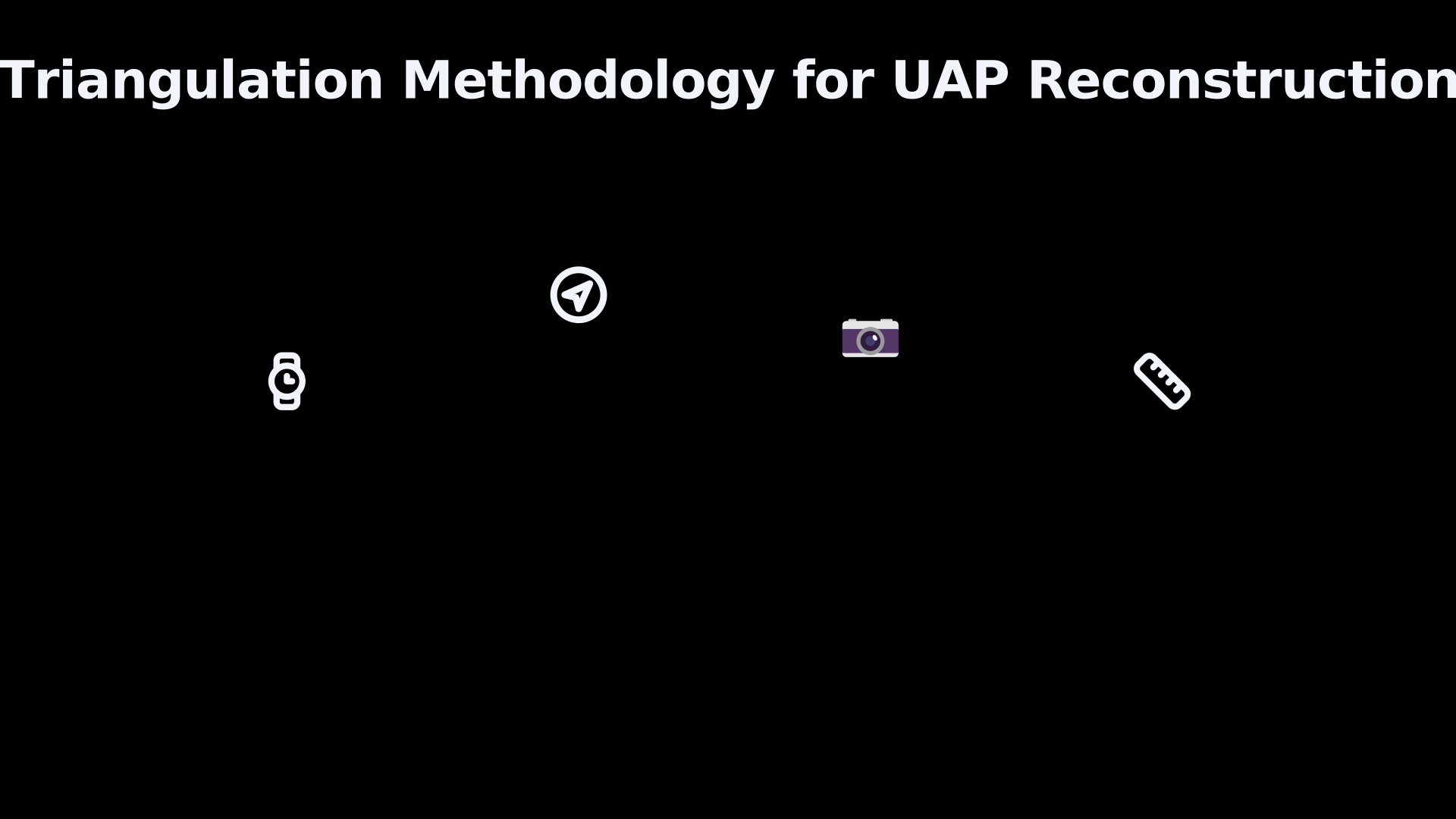
Triangulation uses observations from two or more known locations to calculate an object’s position. If two separated observers record their locations, viewing directions and times accurately, their lines of sight can be intersected geometrically. Once the range is constrained, investigators can convert angular size into approximate physical size and changes in position into physical speed.
The same principle is used to determine the range of artificial satellites. One observation provides an apparent position but leaves distance unresolved; simultaneous observations from separated sites create measurable parallax and allow the range to be calculated.[arXiv]arxiv.orgOpen source on arxiv.org.
For a useful UFO reconstruction, investigators ideally need:
- precise times, preferably synchronised to a common standard;
- exact observer or sensor locations;
- azimuth and elevation angles rather than phrases such as “over the hill”;
- known camera field of view, zoom and orientation;
- unedited original footage with metadata;
- information about the observer’s movement;
- radar, air-traffic, satellite or weather data where available;
- observations from sufficiently separated viewpoints.
The separation between viewpoints matters. If two cameras are almost beside one another, the difference in viewing angle may be too small to determine range accurately, especially for a distant target. Measurement errors, camera vibration and uncertain pointing angles can then produce very large errors in the reconstructed position.
This is why “multiple witnesses” and “multi-sensor evidence” are not interchangeable terms. Several people repeating the same visual estimate may strengthen confidence that something was present, but calibrated instruments can establish quantities that testimony alone cannot. NASA’s UAP study highlighted the need for multiple well-calibrated sensors, complete metadata and reliable information about time, location and sensor settings. It also warned that many existing recordings were captured incidentally by equipment not designed for scientific UAP measurement.[NASA]nasa.govuap independent study team final report 0uap independent study team final report 0
What responsible reporting can and cannot claim
An eyewitness can often report several things reasonably well: the direction in which they looked, the apparent shape or colour, the sequence of visible changes and whether other people were present. Greater caution is required when turning those observations into claims about metres, altitude, velocity or acceleration.
Descriptions such as “it crossed half the sky in three seconds” can be valuable because they preserve an angular observation and a time interval. Statements such as “it travelled at 10,000 miles per hour” are much weaker unless the range and flight path were measured independently.
The most defensible distinction is between appearance and calculation:
- “It looked larger than an aircraft” is a perceptual comparison.
- “It was 200 metres wide” is a physical claim requiring distance.
- “It moved rapidly across my view” describes angular motion.
- “It accelerated from zero to supersonic speed” requires measured positions over time.
- “It disappeared” records a loss of visibility.
- “It instantly travelled kilometres away” assumes a cause that the observation may not establish.
Some UFO incidents remain unidentified because the necessary measurements were never collected. That unresolved status should not be confused with confirmation of extraordinary size or performance. Without distance, the same visual evidence can often fit many combinations of object size and speed. With triangulation, calibrated sensors and complete metadata, investigators can begin to distinguish among them.

Amazon book picks
Further Reading
Books and field guides related to Why UFO Witnesses Misjudge Size and Speed. Use these as the next step if you want deeper reading beyond the article.
UFOs: Generals, Pilots, and Government Officials Go on the Re...
NEW YORK TIMES BESTSELLER • Impeccably researched, this riveting journalistic investigation separates fact from fiction, and documents th...
The Invisible Gorilla
NEW YORK TIMES BESTSELLER • Our minds don’t work the way we think they do. Two renowned psychologists explain how and why our intuitions...
The Demon-haunted World
Rating: 4.5/5 from 43 Google Books ratings
Are we on the brink of a new Dark Age of irrationality and superstition? In this book, the writer shows how scientific thinking is necess...
Thinking, Fast and Slow
Why is there more chance we'll believe something if it's in a bold type face? Why are judges more likely to deny parole before lunch? Why...
eBay marketplace picks
Marketplace Samples
Live-tested eBay searches with available results related to this page.
Selected fromUFO poster oneBay.co.uk.



Endnotes
1.
Source: nasa.gov
Title: uap independent study team final report 0
Link:https://www.nasa.gov/wp-content/uploads/2023/09/uap-independent-study-team-final-report-0.pdf?emrc=69d735b96d21b
Source snippet
Data signatures are vast, and theories that predict novel signatures help guide our searches. It is imperative to set...
2.
Source: open.edu
Link:https://www.open.edu/openlearn/science-maths-technology/astronomy-images-the-universe/content-section-2.3
Source snippet
The Open UniversityAstronomy: images of the Universe: 1.3 Measuring sizes | OpenLearn - Open UniversityAstronomy: images of the Universe...
3.
Source: aaro.mil
Title: Effect of Forced Perspective and Parallax View on UAP Observations
Link:https://www.aaro.mil/Portals/136/PDFs/Information%20Papers/AARO_Effect_of_Forced_Perspective_and_Parallax_View_on_UAP_Observations_2024.pdf
Source snippet
Effect of Forced Perspective and Parallax View on UAP ObservationsMay 7, 2024 — Effect of Forced Perspective and Parallax View on UAP...
Published: May 7, 2024
4.
Source: aaro.mil
Title: [Go Fast Case]({{ ‘go-fast-case/’ | relative_url }}) Resolution
Link:https://www.aaro.mil/Portals/136/PDFs/case_resolution_reports/AARO_GoFast_Case_Resolution_Card_Methodology_Final.pdf
Source snippet
Navy Sensor: Forward Looking Infrared Reported Behavior: Moved at high speeds near the ocean’s surface Assessed Behavior: An object movin...
5.
Source: aaro.mil
Title: The aircraft entered a layer of scattered cloud
Link:https://www.aaro.mil/Portals/136/PDFs/case_resolution_reports/AARO_Puerto_Rico_UAP_Case_Resolution.pdf
Source snippet
AARO Puerto Rico UAP Case ResolutionMarch 13, 2025 — an arc around the Rafael Hernandez Airport, gaining approximately 1,725 feet in...
Published: March 13, 2025
6.
Source: faa.gov
Title: spatiald visillus
Link:https://www.faa.gov/pilots/safety/pilotsafetybrochures/media/spatiald_visillus.pdf
Source snippet
So, it should not be any surprise to us that, when we fly under conditions of limited visibility, we have problems maintaining spatial or...
7.
Source: faa.gov
Title: Federal Aviation Administration Spatial Disorientation
Link:https://www.faa.gov/sites/faa.gov/files/2022-01/Spatial%20Disorientation.pdf
Source snippet
Federal Aviation AdministrationSpatial DisorientationApril 29, 2016 — Spatial Disorientation General Aviation FAA Joint Steering Commitee...
Published: April 29, 2016
8.
Source: faa.gov
Link:https://www.faa.gov/pilots/safety/pilotsafetybrochures/SpatialD.pdf
9.
Source: arxiv.org
Link:https://arxiv.org/abs/1504.00965
10.
Source: nasa.gov
Title: uap independent study team final report 0
Link:https://www.nasa.gov/wp-content/uploads/2023/09/uap-independent-study-team-final-report-0.pdf?emrc=6a7254450701b
11.
Source: aaro.mil
Link:https://www.aaro.mil/Next-AARO-Home-redesign/Next-Parent/Next-UAP-Report-Documents/
12.
Source: aaro.mil
Link:https://www.aaro.mil/Next-AARO-Home-redesign/Next-Parent/Next-UAP-Report-Documents/poster/dividLink/
13.
Source: aaro.mil
Title: AARO FY2025 Consolidated Annual Report on UAP
Link:https://www.aaro.mil/Portals/136/PDFs/FY25%20UAP%20Annual%20Report/AARO_FY2025_Consolidated_Annual_Report_on_UAP.pdf
14.
Source: science.nasa.gov
Link:https://science.nasa.gov/uap/
15.
Source: aaro.mil
Title: AAR O UAP Imagery
Link:https://www.aaro.mil/UAP-Cases/Official-UAP-Imagery/quot/
16.
Source: aaro.mil
Title: AAR O UAP Imagery
Link:https://www.aaro.mil/UAP-Cases/Official-UAP-Imagery/
17.
Source: aaro.mil
Title: Mt. Etna Object
Link:https://www.aaro.mil/Portals/136/PDFs/case_resolution_reports/Mt-Etna-Object.pdf
18.
Source: aaro.mil
Title: AAR O Go Fast Case Resolution
Link:https://www.aaro.mil/Portals/136/PDFs/case_resolution_reports/AARO_GoFast_Case_Resolution_Card_Methodology_Final.pdf?ver=qXvjrruO_0MgtnTsfYnCEQ%3D%3D
19.
Source: faa.gov
Title: Pilot Vision brochure_english
Link:https://www.faa.gov/pilots/safety/pilotsafetybrochures/Pilot_Vision_brochure_english.pdf
20.
Source: faa.gov
Title: januaryfebruary 2025 faa safety briefing
Link:https://www.faa.gov/newsroom/safety-briefing/januaryfebruary-2025-faa-safety-briefing
Published: february 2025
21.
Source: faa.gov
Link:https://www.faa.gov/sites/faa.gov/files/JanFeb2025.pdf
22.
Source: arxiv.org
Link:https://arxiv.org/pdf/2412.12142
23.
Source: faa.gov
Title: Airman Education Programs | Federal Aviation Administration
Link:https://www.faa.gov/pilots/training/airman_education/topics_of_interest/spatial_disorientation
24.
Source: aaro.mil
Link:https://www.aaro.mil/Portals/136/PDFs/SASC_AARO_Open_Hearing_Case_Slides_19Nov2024.pdf?ver=Hec1SwKwP-4zSRJwIEIlJw%3D%3D
25.
Source: aaro.mil
Link:https://www.aaro.mil/Portals/136/PDFs/SASC_AARO_Open_Hearing_Case_Slides_19Nov2024.pdf
26.
Source: aaro.mil
Title: Effect of Forced Perspective and Parallax View on UAP Observations
Link:https://www.aaro.mil/Portals/136/PDFs/Information%20Papers/AARO_Effect_of_Forced_Perspective_and_Parallax_View_on_UAP_Observations_2024.pdf?ver=WTwJtQaCvC3BkRlBJCGLzg%3D%3D
27.
Source: aaro.mil
Link:https://www.aaro.mil/Next-AARO-Home-redesign/Next-Parent/Presidential-UAP-Transparency-Initiative/videoid/1007707/dvpcc/false/
28.
Source: aaro.mil
Title: Unclassified Final DSD AARO Historical Report
Link:https://www.aaro.mil/Portals/136/PDFs/AARO_Historical_Record_Report_Vol_1_2024.pdf?emci=622cd777-b774-f011-8dc9-6045bda9d96b&emdi=ea000000-0000-0000-0000-000000000001&sourceid=1070813
29.
Source: nasa.gov
Title: uap independent study team final report 0
Link:https://www.nasa.gov/wp-content/uploads/2023/09/uap-independent-study-team-final-report-0.pdf?emrc=6a41b58c75aa9
30.
Source: nasa.gov
Title: uap independent study team final report 0
Link:https://www.nasa.gov/wp-content/uploads/2023/09/uap-independent-study-team-final-report-0.pdf?emrc=69fb3c3d5dcea
31.
Source: nasa.gov
Title: uap independent study team final report 0
Link:https://www.nasa.gov/wp-content/uploads/2023/09/uap-independent-study-team-final-report-0.pdf?emrc=6a5033ad2e021
32.
Source: nasa.gov
Title: uap independent study team final report 0
Link:https://www.nasa.gov/wp-content/uploads/2023/09/uap-independent-study-team-final-report-0.pdf?emrc=69d3785d47141
33.
Source: nasa.gov
Title: uap independent study team final report 0
Link:https://www.nasa.gov/wp-content/uploads/2023/09/uap-independent-study-team-final-report-0.pdf?emrc=6a4fc54602e71
34.
Source: nasa.gov
Title: uap independent study team final report 0
Link:https://www.nasa.gov/wp-content/uploads/2023/09/uap-independent-study-team-final-report-0.pdf?emrc=69fe93b0d708b
35.
Source: nasa.gov
Title: uap independent study team final report 0
Link:https://www.nasa.gov/wp-content/uploads/2023/09/uap-independent-study-team-final-report-0.pdf?emrc=69c0b0c0317b0
36.
Source: nasa.gov
Title: uap independent study team final report 0
Link:https://www.nasa.gov/wp-content/uploads/2023/09/uap-independent-study-team-final-report-0.pdf?emrc=69e438cacc128
37.
Source: nasa.gov
Title: uap independent study team final report 0
Link:https://www.nasa.gov/wp-content/uploads/2023/09/uap-independent-study-team-final-report-0.pdf?emrc=69dc3443a7e87
38.
Source: nasa.gov
Title: uap independent study team final report 0
Link:https://www.nasa.gov/wp-content/uploads/2023/09/uap-independent-study-team-final-report-0.pdf?emrc=6987cb9c10c4e
39.
Source: nasa.gov
Title: uap independent study team final report 0
Link:https://www.nasa.gov/wp-content/uploads/2023/09/uap-independent-study-team-final-report-0.pdf?emrc=6a498654ad358
40.
Source: nasa.gov
Title: uap independent study team final report 0
Link:https://www.nasa.gov/wp-content/uploads/2023/09/uap-independent-study-team-final-report-0.pdf?emrc=6a6fda40209a1
41.
Source: nasa.gov
Title: uap independent study team final report 0
Link:https://www.nasa.gov/wp-content/uploads/2023/09/uap-independent-study-team-final-report-0.pdf?emrc=6a5e4e8b0875b
42.
Source: nasa.gov
Title: uap independent study team final report 0
Link:https://www.nasa.gov/wp-content/uploads/2023/09/uap-independent-study-team-final-report-0.pdf?emrc=6a66f11d29e8c
43.
Source: nasa.gov
Title: uap independent study team final report 0
Link:https://www.nasa.gov/wp-content/uploads/2023/09/uap-independent-study-team-final-report-0.pdf?emrc=6a5fe1582553b
44.
Source: nasa.gov
Title: uap independent study team final report 0
Link:https://www.nasa.gov/wp-content/uploads/2023/09/uap-independent-study-team-final-report-0.pdf?emrc=69fdf2cab00ff
45.
Source: nasa.gov
Title: uap independent study team final report 0
Link:https://www.nasa.gov/wp-content/uploads/2023/09/uap-independent-study-team-final-report-0.pdf?emrc=69d75d761806a
46.
Source: nasa.gov
Title: uap independent study team final report 0
Link:https://www.nasa.gov/wp-content/uploads/2023/09/uap-independent-study-team-final-report-0.pdf?emrc=69d49fa419dfb
47.
Source: faa.gov
Title: 12 afh ch11
Link:https://www.faa.gov/sites/faa.gov/files/regulations_policies/handbooks_manuals/aviation/airplane_handbook/12_afh_ch11.pdf
48.
Source: faa.gov
Title: Helicopter Flying Handbook
Link:https://www.faa.gov/sites/faa.gov/files/2022-11/HFHandbook_Ch13.pdf
49.
Source: faa.gov
Title: Chapter 12 Night Operations
Link:https://www.faa.gov/sites/faa.gov/files/regulations_policies/handbooks_manuals/aviation/helicopter_flying_handbook/hfh_ch12.pdf
50.
Source: faa.gov
Title: Pilot Vision
Link:https://www.faa.gov/pilots/safety/pilotsafetybrochures/media/Pilot_Vision.pdf
51.
Source: faa.gov
Link:https://www.faa.gov/sites/faa.gov/files/2022-01/NovDec2015.pdf
52.
Source: faa.gov
Link:https://www.faa.gov/sites/faa.gov/files/other_visit/aviation_industry/airline_operators/airline_safety/SAFO15004.pdf
53.
Source: faa.gov
Link:https://www.faa.gov/sites/faa.gov/files/data_research/research/med_humanfacs/oamtechreports/AM78-15.pdf
54.
Source: faa.gov
Link:https://www.faa.gov/sites/faa.gov/files/2022-11/spatial_disorientation.pdf
55.
Source: faa.gov
Link:https://www.faa.gov/documentLibrary/media/Advisory_Circular/AC60-4A.pdf
56.
Source: faa.gov
Title: FA A AC60-4A, Pilots Spatial Disorientation
Link:https://www.faa.gov/sites/faa.gov/files/2022-11/AC60-4A.pdf
57.
Source: aaro.mil
Link:https://www.aaro.mil/Next-AARO-Home-redesign/Next-Parent/Next-AARO-UAP-Trends/
58.
Source: aaro.mil
Link:https://www.aaro.mil/UAP-Cases/UAP-Case-Resolution-Reports/
59.
Source: aaro.mil
Link:https://www.aaro.mil/Next-AARO-Home-redesign/Next-Parent/Presidential-UAP-Transparency-Initiative/videoid/1006062/dvpmoduleid/77396/
60.
Source: aaro.mil
Link:https://www.aaro.mil/
61.
Source: aaro.mil
Title: UNCLASSIFIED FY23 Consolidated Annual Report on UAP Oct 25 2023 1236
Link:https://www.aaro.mil/Portals/136/PDFs/UNCLASSIFIED-FY23_Consolidated_Annual_Report_on_UAP-Oct_25_2023_1236.pdf
62.
Source: faa.gov
Link:https://www.faa.gov/sites/faa.gov/files/Night_Ops_Ch13.pdf
63.
Source: Wikipedia
Link:https://en.wikipedia.org/wiki/Triangulation
64.
Source: data.ntsb.gov
Link:https://data.ntsb.gov/carol-repgen/api/Aviation/ReportMain/GenerateNewestReport/106409/pdf
65.
Source: data.ntsb.gov
Link:https://data.ntsb.gov/carol-repgen/api/Aviation/ReportMain/GenerateFinalReport/106409/pdf
66.
Source: data.ntsb.gov
Link:https://data.ntsb.gov/carol-repgen/api/Aviation/ReportMain/GenerateNewestReport/82730/pdf
67.
Source: data.ntsb.gov
Link:https://data.ntsb.gov/carol-repgen/api/Aviation/ReportMain/GenerateNewestReport/193342/pdf
68.
Source: data.ntsb.gov
Link:https://data.ntsb.gov/carol-repgen/api/Aviation/ReportMain/GenerateNewestReport/100208/pdf
69.
Source: data.ntsb.gov
Link:https://data.ntsb.gov/carol-repgen/api/Aviation/ReportMain/GenerateNewestReport/49158/pdf
70.
Source: data.ntsb.gov
Link:https://data.ntsb.gov/carol-repgen/api/Aviation/ReportMain/GenerateNewestReport/57676/pdf
71.
Source: data.ntsb.gov
Link:https://data.ntsb.gov/carol-repgen/api/Aviation/ReportMain/GenerateNewestReport/92710/pdf
72.
Source: data.ntsb.gov
Link:https://data.ntsb.gov/carol-repgen/api/Aviation/ReportMain/GenerateNewestReport/76962/pdf
73.
Source: data.ntsb.gov
Link:https://data.ntsb.gov/carol-repgen/api/Aviation/ReportMain/GenerateNewestReport/66923/pdf
74.
Source: itu.physics.uiowa.edu
Title: angular size
Link:https://itu.physics.uiowa.edu/labs/foundational/angular-size
75.
Source: itu.physics.uiowa.edu
Link:https://itu.physics.uiowa.edu/labs/foundational/parallax
Additional References
76.
Source: narcap.org
Link:https://www.narcap.org/blog/advisoryforpilots
77.
Source: narcap.de
Link:https://www.narcap.de/dokumente/aircat_DWeinstein_300cases_9-09.pdf
78.
Source: metabunk.org
Link:https://www.metabunk.org/curve/
79.
Source: metabunk.org
Link:https://www.metabunk.org/threads/f-16-pilot-chris-lehtos-interpretation-of-the-gofast-footage-focus-parallax-inaccurate-range.11789/
80.
Source: metabunk.org
Link:https://www.metabunk.org/threads/f-16-pilot-chris-lehtos-interpretation-of-the-gofast-footage-focus-parallax-inaccurate-range.11789/page-4
81.
Source: narcap.org
Link:https://www.narcap.org/blog/flightdynamicsofuap
82.
Source: metabunk.org
Link:https://www.metabunk.org/threads/gofast-is-the-background-moving-relatively-to-the-movement-of-the-jet-or-the-camera-only.11812/
83.
Source: narcap.org
Link:https://www.narcap.org/international-reports
84.
Source: narcap.org
Link:https://www.narcap.org/technical-reports
85.
Source: metabunk.org
Link:https://www.metabunk.org/threads/go-fast-footage-from-tom-delonges-[to-the-stars-academy