Within Size and Speed
Why One UFO Viewpoint Is Rarely Enough
A single sighting gives only a line of sight, leaving the object's exact distance and three-dimensional position unresolved.
On this page
- The line of sight problem
- Why landmarks can create false alignment
- How multiple viewpoints can constrain distance
Page outline Jump by section
Introduction
A single eyewitness cannot determine the exact three-dimensional position of an unidentified object in the sky because the observation provides only a line of sight, not a measured distance. This is one of the central reasons why reports of UFOs often contain uncertain estimates of height, size and speed. Whether the witness is a member of the public, a pilot or a celebrity, seeing an object in one direction does not reveal how far away it is. The object could lie almost anywhere along the observer’s visual ray unless additional information—such as a second viewpoint, radar data, or a known object crossing in front of or behind it—constrains its location. This geometric limitation is well understood in astronomy, surveying and computer vision, and it also underpins modern guidance on interpreting UAP (Unidentified Anomalous Phenomena) reports.[aaro.mil]aaro.milEffect of Forced Perspective and Parallax View on UAP ObservationsEffect of Forced Perspective and Parallax View on UAP ObservationsMay 8, 2024…
The line-of-sight problem
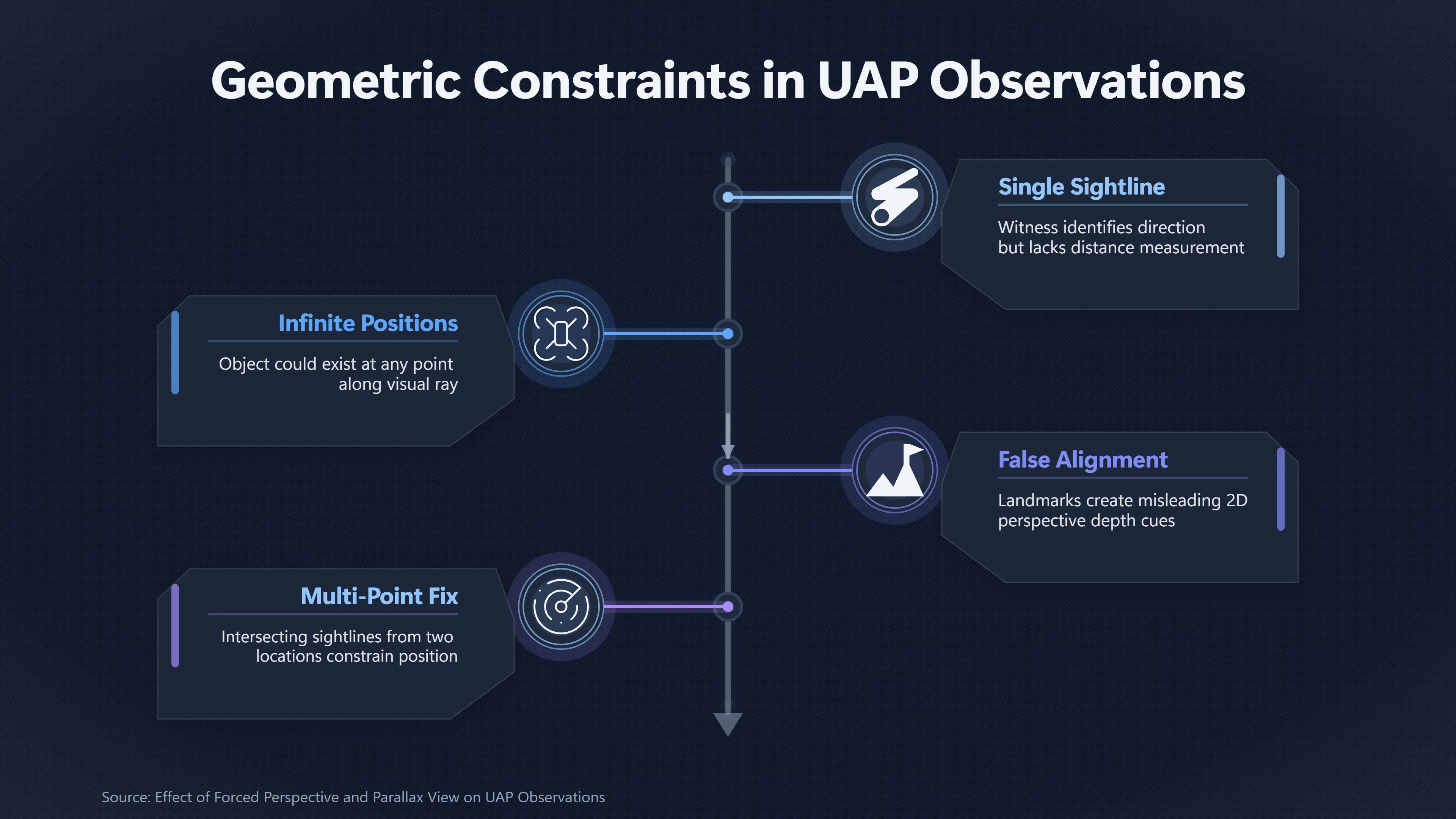
Imagine extending an invisible laser pointer from a witness’s eye towards the reported UFO. The witness can identify the direction of the object with varying accuracy, but not where along that imaginary beam the object actually sits.
This creates an infinite set of possible positions:
- a small balloon a few hundred metres away;
- a drone several kilometres away;
- an aircraft tens of kilometres away;
- or, in rare cases, an astronomical object aligned in the same direction.
All occupy essentially the same viewing angle despite being at vastly different distances. A single observation therefore defines a bearing, not a complete three-dimensional location.[astro.unl.edu]astro.unl.eduCosmic Distance Ladder - NAAP…
This uncertainty directly affects every later calculation. Without distance, investigators cannot reliably determine:
- altitude above the ground;
- physical size;
- true speed;
- acceleration;
- or the path travelled through space.
These quantities all depend on knowing where the object actually was.
Why landmarks can create false alignment
Witnesses frequently describe a UFO as being “over the trees”, “behind the hill”, or “next to the Moon”. These descriptions are often sincere but can be geometrically misleading.
A photograph or direct observation compresses three-dimensional space into a two-dimensional image. Objects at very different distances can appear perfectly aligned when viewed from one position.
For example:
- a nearby drone may appear directly above a distant mountain;
- a balloon may seem to hover beside a skyscraper while actually being hundreds of metres closer;
- a bright planet can appear to rest above a roofline despite being millions of kilometres farther away.
The apparent relationship exists only from that viewing position. Moving a short distance often changes the alignment dramatically, revealing that the objects were never close together in three-dimensional space. This is a classic consequence of perspective geometry rather than evidence that the objects shared the same location.[AARO]aaro.milEffect of Forced Perspective and Parallax View on UAP ObservationsEffect of Forced Perspective and Parallax View on UAP ObservationsMay 8, 2024…
Because many UFO reports involve isolated lights against the night sky, there are often few reliable depth cues available. Without overlapping objects, known-size references or measurable foreground crossings, the visual system has little information from which to infer range.[NCBI]ncbi.nlm.nih.govNCBIThe Perception of DepthWebvision - NCBI BookshelfMay 1, 2005…
Why one viewpoint leaves distance unresolved
Human vision normally estimates distance using many cues simultaneously, including binocular vision, motion, familiar object sizes and perspective.
Most reported UFOs remove many of those cues:
- they may appear only as points of light;
- they often lack recognisable structure;
- they may be observed against an empty sky;
- they frequently remain visible for only a short time.
When these cues disappear, the brain naturally fills in missing information using assumptions rather than measurements. This is one reason different witnesses can describe the same object as being both “just above the treetops” and “high above the clouds”. Neither estimate can be confirmed from a single viewing position alone.[nih.gov]ncbi.nlm.nih.govNCBIThe Perception of DepthWebvision - NCBI BookshelfMay 1, 2005…

How multiple viewpoints constrain distance
The geometric ambiguity changes as soon as two independent observation points become available.
If two observers at known locations record the same object at the same moment, each provides a different line of sight. The point where those sight lines intersect—or come closest when measurement uncertainty is included—places strong limits on the object’s position.
This is the same geometric principle behind:
- land surveying;
- stereo vision in human eyesight;
- astronomical parallax;
- multi-camera tracking systems.
Astronomers routinely determine stellar distances by measuring the tiny change in a star’s apparent position from two widely separated viewpoints. The underlying mathematics is identical even though the scales are vastly different.[NASA Science]science.nasa.govScience Depth Perception in SpaceNASA ScienceDepth Perception in Space - NASA Science…
In practical UAP investigations, useful second viewpoints may come from:
- another eyewitness at a known location;
- another aircraft;
- synchronised video from separate cameras;
- radar observations;
- electro-optical sensors with calibrated pointing data.
Each additional observation reduces the range of possible locations.
Why movement alone is not enough
Some witnesses assume that tracking an object’s motion automatically reveals its distance. In reality, following a target from one position usually traces only a changing direction over time.
Unless the observer’s own position changes in a measured way—or another observer contributes an independent angle—the object may still occupy many possible trajectories in three-dimensional space.
For example, a light appearing to travel horizontally across the sky could represent:
- a nearby object moving slowly;
- a distant aircraft moving much faster;
- or an object travelling partly towards or away from the observer.
These different paths can project almost identical motion onto the observer’s field of view. AARO notes that perspective effects and parallax can significantly distort perceived direction, speed and size, particularly when reports rely on a single moving observer or sensor.[AARO]aaro.milEffect of Forced Perspective and Parallax View on UAP ObservationsEffect of Forced Perspective and Parallax View on UAP ObservationsMay 8, 2024…
Why this matters when assessing UFO reports
This geometric limitation does not imply that witnesses are dishonest or that every report has a conventional explanation. Instead, it defines what can and cannot be inferred from the available evidence.
A lone eyewitness can often provide valuable information about:
- the object’s appearance;
- colour;
- brightness;
- duration;
- apparent motion;
- and changes over time.
However, that testimony alone cannot uniquely determine the object’s three-dimensional position. Consequently, claims that an observed UFO was extremely close, enormous or travelling at extraordinary speed remain difficult to verify unless independent measurements establish its distance.
For this reason, modern UAP investigations place particular value on observations that combine multiple viewpoints or independent sensor systems, allowing investigators to replace visual assumptions with measurable geometry.[AARO]aaro.milEffect of Forced Perspective and Parallax View on UAP ObservationsEffect of Forced Perspective and Parallax View on UAP ObservationsMay 8, 2024…
Amazon book picks
Further Reading
Books and field guides related to Why One UFO Viewpoint Is Rarely Enough. Use these as the next step if you want deeper reading beyond the article.
UFOs: Generals, Pilots, and Government Officials Go on the Re...
NEW YORK TIMES BESTSELLER • Impeccably researched, this riveting journalistic investigation separates fact from fiction, and documents th...
The Invisible Gorilla
NEW YORK TIMES BESTSELLER • Our minds don’t work the way we think they do. Two renowned psychologists explain how and why our intuitions...
The Demon-haunted World
Rating: 4.5/5 from 43 Google Books ratings
Are we on the brink of a new Dark Age of irrationality and superstition? In this book, the writer shows how scientific thinking is necess...
Eye and Brain
Since the publication of the first edition in 1966, Eye and Brain has established itself worldwide as an essential introduction to the ba...
eBay marketplace picks
Marketplace Samples
Live-tested eBay searches with available results related to this page.
Selected fromUFO poster oneBay.co.uk.

Endnotes
1.
Source: aaro.mil
Title: Effect of Forced Perspective and Parallax View on UAP Observations
Link:https://www.aaro.mil/Portals/136/PDFs/Information%20Papers/AARO_Effect_of_Forced_Perspective_and_Parallax_View_on_UAP_Observations_2024.pdf?ver=WTwJtQaCvC3BkRlBJCGLzg%3D%3D
Source snippet
Effect of Forced Perspective and Parallax View on UAP ObservationsMay 8, 2024...
Published: May 8, 2024
2.
Source: science.nasa.gov
Title: Science Depth Perception in Space
Link:https://science.nasa.gov/resource/depth-perception-in-space/
Source snippet
NASA ScienceDepth Perception in Space - NASA Science...
3.
Source: astro.unl.edu
Link:https://astro.unl.edu/naap/distance/parallax.html
Source snippet
Cosmic Distance Ladder - NAAP...
4.
Source: ncbi.nlm.nih.gov
Title: NCBIThe Perception of Depth
Link:https://www.ncbi.nlm.nih.gov/books/NBK11512/?report=reader
Source snippet
Webvision - NCBI BookshelfMay 1, 2005...
Published: May 1, 2005
5.
Source: cns.nyu.edu
Title: CNSOutline: Depth Perception
Link:https://www.cns.nyu.edu/~david/courses/perception/outlines/outline-depth.html
6.
Source: aaro.mil
Title: divid Link
Link:https://www.aaro.mil/Next-AARO-Home-redesign/Next-Parent/Next-UAP-Report-Documents/poster/dividLink/
Source snippet
Next - AARO UAP Report DocumentsMay 8, 2026 — The Federal Bureau of Investigation prepared this digital recreation at the request of the...
Published: May 8, 2026
7.
Source: aaro.mil
Link:https://www.aaro.mil/Next-AARO-Home-redesign/Next-Parent/Next-AARO-UAP-Imagery-Acc-Table/
Source snippet
AARO UAP Imagery Acc TableMay 8, 2026 — UAP Imagery Release Date | Title | DVIDS Page | Description | Imagery --- | --- | --- | --- |...
Published: May 8, 2026
8.
Source: science.nasa.gov
Link:https://science.nasa.gov/uap/
Source snippet
NASA ScienceFebruary 23, 2026 — Explore This Section UAP CONTENTS * NASA Unidentified Anomalous Phenomena Independent Study * Final Repor...
Published: February 23, 2026
9.
Source: nasa.gov
Title: UPDAT E: NASA Shares UAP Independent Study Report; Names Director
Link:https://www.nasa.gov/news-release/update-nasa-shares-uap-independent-study-report-names-director/
10.
Source: nodis3.gsfc.nasa.gov
Title: display All.cfm
Link:https://nodis3.gsfc.nasa.gov/displayAll.cfm?Internal_ID=N_PR_86210001&page_name=ALL
11.
Source: ntrs.nasa.gov
Link:https://ntrs.nasa.gov/citations/19750008518
12.
Source: ntrs.nasa.gov
Link:https://ntrs.nasa.gov/citations/19730012797
13.
Source: aaro.mil
Link:https://www.aaro.mil/FAQ/
14.
Source: aaro.mil
Link:https://www.aaro.mil/UAP-Cases/Official-UAP-Imagery/
Additional References
15.
Source: ufopress.com
Link:https://www.ufopress.com/articles/aaro-releases-four-information-papers-on-uap-classification-satellite-flaring-se/
Source snippet
AARO Releases Four Information Papers on UAP Classification, Satellite Flaring, Sensor Distortion, and Narrative Data — UFOPressJune 29...
16.
Source: defense.gov
Link:https://www.defense.gov/News/News-Stories/Article/Article/3701297/dod-report-discounts-sightings-of-extraterrestrial-technology/
17.
Source: cognitivepsychology.com
Link:https://www.cognitivepsychology.com/Monocular_Depth_Cues
18.
Source: youtube.com
Title: Gimbal UFO
Link:https://www.youtube.com/watch?v=qsEjV8DdSbs
Source snippet
Mick West UFO parallax line of sight [Aguadilla]({{ 'aguadilla/' | relative_url }}) - UFO Analysis with Lines of Sight...
19.
Source: youtube.com
Title: UFO Parallax Illusion
Link:https://www.youtube.com/watch?v=IRd1RY2PuvA
Source snippet
Explained: "Go Fast" UFO Video - Not Low and Not Fast - Like a Balloon...
20.
Source: youtube.com
Title: Explained: “Go Fast” UFO Video
Link:https://www.youtube.com/watch?v=PLyEO0jNt6M
Source snippet
Utah Drone UFO - A Meta-analysis...
21.
Source: youtube.com
Link:https://www.youtube.com/watch?v=0fho4YyXWfE
Source snippet
UFO Parallax Illusion...
22.
Source: sciencealert.com
Title: What Is Parallax?: Science Alert
Link:https://www.sciencealert.com/what-is-parallax
23.
Source: youtube.com
Title: Utah Drone UFO
Link:https://www.youtube.com/watch?v=xDkqKa_NQAo
Source snippet
Gimbal UFO - A New Analysis...
24.
Source: scribe.usc.edu
Title: monocular visual cues and vr
Link:https://scribe.usc.edu/monocular-visual-cues-and-vr/