Within Celebrity UFO Files
What NASA Says UFO Research Still Needs
NASA argues that calibrated instruments, consistent reporting and open data are essential for moving beyond anecdote.
On this page
- The limits of eyewitness reports
- Calibrated instruments and consistent collection
- Independent access and reproducible analysis
Page outline Jump by section
Introduction
NASA’s position on unidentified anomalous phenomena, or UAP, is straightforward: stronger research depends less on collecting more dramatic stories and more on collecting better measurements. Eyewitness accounts — including those from pilots, officials or celebrities — may be sincere and worth recording, but they rarely contain enough information to establish an object’s distance, size, speed or origin. NASA’s independent study therefore treated UAP primarily as a problem of research design and data quality, not as a catalogue of famous sightings or a verdict on extraterrestrial life.[NASA]nasa.govuap independent study team final report 0All photos are from NASA unless otherwise indicated. Panelists EXECUTIVE SUMMARY FOREWORD INTRODUCTION RESPONSES TO STATEMENT OF TASK OVE…
The standard it proposed has three connected parts. Observations should come from calibrated instruments and multiple sensors; reports should use consistent formats and preserve essential contextual information; and the resulting data, methods and assumptions should be available for independent scrutiny wherever security and privacy permit. This approach matters because many supposedly extraordinary characteristics can arise from incomplete records, uncertain distances, sensor artefacts or missing environmental context. Better governance would not guarantee spectacular discoveries, but it would make future cases far more likely to be resolved.[NASA]nasa.govuap independent study team final report 0Next, the U.S. commercial remote-sensing industry offers a potent mix of Earth-observing satellites that offer imagery at sub- to several…
Why eyewitness reports reach a scientific limit
A person who reports an unfamiliar object can provide useful starting information: where they were, what direction they faced, how long the event lasted and what appeared unusual. The difficulty is that human observation does not automatically produce measurements. Without a known distance, for example, angular movement across the sky cannot reliably establish physical speed. Without a stable reference point, an observer may also misjudge size, altitude or acceleration.
NASA’s study said eyewitness accounts can be “interesting and compelling” but are not reproducible and usually lack the information needed to determine a UAP’s provenance. Reproducibility means that other investigators can inspect the same underlying evidence, apply comparable methods and test whether the conclusion holds. A remembered experience, however honestly described, cannot normally be replayed under controlled conditions.[NASA]nasa.govuap independent study team final report 0TABLE OF CONTENTS 3 EXECUTIVE SUMMARY 7 FOREWORD 9 INTRODUCTION 11 RESPONSES TO STATEMENT OF TASK 21 OVERALL CONCLUSIONS AND RECOMMENDATI…
This is particularly important in the wider world of celebrity UFO stories. Fame may increase public interest and media coverage, but it does not supply missing coordinates, atmospheric records, lens specifications or radar returns. NASA’s framework does not require dismissing prominent witnesses; it requires keeping testimony in its proper evidential role. A sighting is a report that something was not identified at the time, not proof that the object possessed extraordinary capabilities.
Unexplained does not mean unmeasurable
A case may remain unresolved because the event was genuinely unusual. It may also remain unresolved because the available record is too weak to distinguish among ordinary explanations. NASA’s report emphasised that incomplete data archiving, poor calibration and absent metadata can preserve ambiguity long after the event itself has passed. In that situation, “unidentified” describes the limits of the evidence rather than a scientifically established property of the object.[NASA]nasa.govuap independent study team final report 0TABLE OF CONTENTS 3 EXECUTIVE SUMMARY 7 FOREWORD 9 INTRODUCTION 11 RESPONSES TO STATEMENT OF TASK 21 OVERALL CONCLUSIONS AND RECOMMENDATI…
This distinction changes the research question. Instead of asking witnesses to defend an interpretation, investigators ask what observations would discriminate between competing explanations. Could the apparent object have been a balloon, aircraft, satellite, drone, meteorological effect or imaging artefact? What measurement would rule each possibility in or out? NASA’s standard is designed to make those questions answerable.
Calibrated instruments and consistent collection
Calibration establishes how a sensor’s output relates to known physical quantities. For a camera, radar or infrared system, investigators need to understand such matters as resolution, field of view, timing accuracy, sensitivity, distortion and operating mode. Without that information, a bright blur or rapidly shifting target may look impressive while remaining unsuitable for reliable calculation.
NASA identified poor sensor calibration, a lack of multiple measurements, missing sensor metadata and inadequate baseline data as central weaknesses in existing UAP material. Metadata is the information surrounding an observation: time, location, sensor configuration, platform motion, weather, viewing geometry and other conditions required to interpret the recording. A video without this context may preserve what appeared on a screen while losing much of what would make it scientifically useful.[NASA]nasa.govuap independent study team final report 0Observations of objects in our skies that cannot be identified as balloons, aircraft, or natural known phenomena have been spotted worldw…
Multiple instruments are equally important because different sensors fail in different ways. A visual camera may record colour and shape but provide poor distance information. Radar can estimate range and motion but may be affected by clutter or processing assumptions. Infrared imagery records thermal contrast rather than an ordinary visual scene. When independent instruments observe the same event, researchers can compare their outputs and test whether an apparent feature exists in the environment or only in one sensing system.
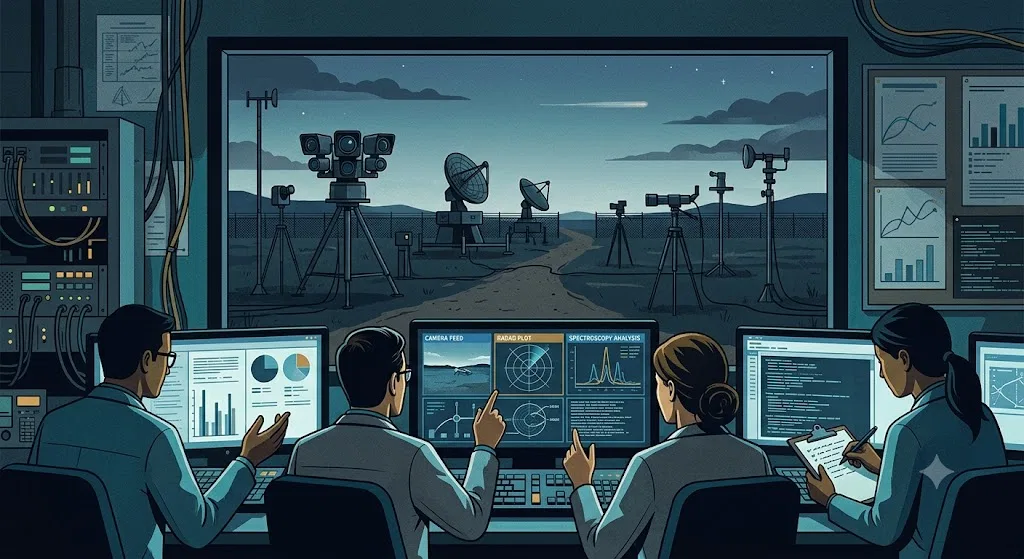
A published design for a ground-based UAP observatory illustrates what this standard can look like in practice. Its proposed system combines wide- and narrow-field cameras, radar receivers, radio-frequency instruments, microphones and environmental sensors. Triangulation from separated viewpoints can estimate position and movement, while multispectral observations and environmental measurements help distinguish physical targets from atmospheric effects or instrument artefacts. The importance of the example lies not in any claimed discovery but in the traceable connection between a scientific question, the quantity that must be measured and the instrument required to measure it.[arXiv]arxiv.orgH. Knuth, Anthony Lux, Gary J. Melnick, Amaya Moro-Martín, Javier MararXiv[2305.18566] The Scientific Investigation of Unidentified Aerial Phenomena (UAP) Using Multimodal Ground-Based ObservatoriesMay 29…
Consistency begins before the sighting
Strong collection systems cannot be improvised after an unusual event has ended. Researchers need agreed reporting fields, synchronised clocks, documented calibration procedures and rules for preserving original files. They also need baseline observations of ordinary air traffic, satellites, balloons, birds, weather and sensor noise. A detector cannot identify an anomaly reliably unless researchers first understand what normal activity looks like under comparable conditions.
NASA proposed drawing on existing Earth-observing assets and commercial remote-sensing satellites, particularly to examine the environmental conditions surrounding events first detected by other means. It cautioned, however, that satellite coverage is not continuous and that many platforms were not designed to identify small, fast or transient objects. Such systems are therefore more likely to provide corroborating context than a universal UAP surveillance network.[NASA]nasa.govuap independent study team final report 0Next, the U.S. commercial remote-sensing industry offers a potent mix of Earth-observing satellites that offer imagery at sub- to several…
The agency also discussed systematic public reporting, including the possible use of open-source smartphone applications capable of collecting images and sensor information from several observers. The scientific value would come not from producing a larger pile of anecdotes, but from collecting time-stamped, location-aware reports in a common format and looking for independently recorded coincidences.[NASA]nasa.govuap independent study team final report 0TABLE OF CONTENTS 3 EXECUTIVE SUMMARY 7 FOREWORD 9 INTRODUCTION 11 RESPONSES TO STATEMENT OF TASK 21 OVERALL CONCLUSIONS AND RECOMMENDATI…
NASA recommended making greater use of the Aviation Safety Reporting System, which it administers with the Federal Aviation Administration. That programme provides a voluntary, confidential and non-punitive route for aviation personnel to report safety events. Its relevance to UAP research is institutional: people are more likely to provide prompt, detailed information when reporting procedures are trusted and when they do not expect ridicule or punishment.[Federal Aviation Administration]faa.govOpen source on faa.gov.
Open data must support independent testing
NASA’s proposed standard does not end when an agency analyst reaches a conclusion. Scientific claims gain strength when qualified outsiders can inspect the evidence, evaluate the method and attempt to reproduce the analysis. That requires preserving original data, documenting any processing, stating uncertainty and making clear which information was unavailable.
The independent study deliberately relied on unclassified information, which its chair said was essential to open communication and scientific rigour. NASA’s broader science policy similarly promotes publicly accessible data, software and publications, accompanied by standards-compliant metadata so that research can be reused and reproduced.[nasa.gov]nasa.govUPDATE: NASA Shares UAP Independent Study Report; Names DirectorUPDATE: NASA Shares UAP Independent Study Report; Names Director
For UAP research, meaningful openness would include more than releasing a compressed video clip. A scientifically useful record may need:
- the original file rather than a social-media copy;
- exact time and location information;
- sensor model, settings and calibration history;
- the observer or platform’s position and motion;
- relevant weather, flight and astronomical data;
- a record of cropping, stabilisation, enhancement or other processing;
- the criteria used to classify or resolve the event;
- uncertainty ranges for estimates such as speed, distance and size.
These requirements help prevent a common failure in public debate: analysts reaching incompatible conclusions because each side is working from a different version of the evidence or making hidden assumptions. Open methods do not guarantee agreement, but they make disagreements more precise. One researcher might dispute a distance estimate, another a calibration parameter and another the selection of comparison data. Those are testable disputes rather than contests of reputation.
Artificial intelligence cannot repair missing evidence
NASA also identified artificial intelligence and machine learning as potentially useful for searching large datasets and detecting unusual patterns. Such systems could compare reports with known aircraft routes, satellite movements, weather conditions or recurring sensor artefacts. They could also flag observations that differ significantly from an established baseline.
The limitation is that automated analysis inherits the weaknesses of its inputs. A model trained on poorly labelled reports, inconsistent descriptions or uncalibrated imagery may classify errors more efficiently without making them more accurate. NASA therefore stressed the need for clear evidence thresholds when automated systems are used, while its current science-information policy requires the sharing of data needed to validate findings based on AI or machine-learning models.[NASA]nasa.govuap independent study team final report 0Observations of objects in our skies that cannot be identified as balloons, aircraft, or natural known phenomena have been spotted worldw…
Human review remains necessary because “anomalous” is not a single physical category. It can include rare weather, unfamiliar technology, data-processing errors and ordinary objects viewed under unusual conditions. Algorithms can help organise and compare observations, but researchers must still examine whether a detected outlier reflects the world, the instrument or the model itself.
What would count as a stronger UAP case?
Under NASA’s standard, a persuasive case would not be defined mainly by the witness’s status or by how extraordinary the object appeared. Its strength would come from the quality and independence of the evidence.
A stronger case would begin with prompt, structured reporting and retain the original observations. It would include precise timing, location and viewing geometry, with sensor characteristics documented well enough for independent analysts to reconstruct the event. Ideally, more than one calibrated system would detect the phenomenon, and the measurements would agree within known uncertainties.
Investigators would then compare the event against relevant baselines: aircraft and drone activity, balloon releases, satellites, astronomical objects, atmospheric conditions and known sensor behaviour. Any claim of exceptional speed or acceleration would need a defensible range estimate rather than an inference from apparent movement alone. Any proposed physical characteristic would need to be visible across independent measurements rather than confined to a single ambiguous image.
Finally, the analysis would be reproducible. Researchers outside the original team would need access to enough data and methodological detail to test alternative explanations. Security restrictions may prevent complete publication in some military cases, but that limitation should be acknowledged as an evidential constraint rather than treated as proof that hidden information supports an extraordinary interpretation.
NASA’s intervention is therefore a standard for better questions as much as better equipment. It asks whether a report was collected consistently, whether the instruments were capable of measuring the claimed behaviour, whether independent evidence corroborates it and whether other researchers can examine the reasoning. Applied to UFO stories involving celebrities or anyone else, the result is deliberately impartial: public prominence may draw attention to a sighting, but only transparent, calibrated and reproducible evidence can turn that sighting into a strong scientific case.
Amazon book picks
Further Reading
Books and field guides related to What NASA Says UFO Research Still Needs. Use these as the next step if you want deeper reading beyond the article.
The UFO Experience: A Scientific Inquiry
Cited by the New York Review of Books as "the best brief for visitation," this classic study presents an analysis of UFO reports and conc...
UFOs: Generals, Pilots, and Government Officials Go on the Re...
NEW YORK TIMES BESTSELLER • Impeccably researched, this riveting journalistic investigation separates fact from fiction, and documents th...
Calling Bullshit: The Art of Skepticism in a Data-Driven World
Bullshit isn’t what it used to be. Now, two science professors give us the tools to dismantle misinformation and think clearly in a world...
The Demon-Haunted World: Science as a Candle in the Dark
Are we on the brink of a new Dark Age of irrationality and superstition? In this book, the writer shows how scientific thinking is necess...
eBay marketplace picks
Marketplace Samples
Live-tested eBay searches with available results related to this page.
Selected fromUFO poster oneBay.co.uk.




Endnotes
1.
Source: nasa.gov
Title: uap independent study team final report 0
Link:https://www.nasa.gov/wp-content/uploads/2023/09/uap-independent-study-team-final-report-0.pdf?emrc=69d735b96d21b
Source snippet
All photos are from NASA unless otherwise indicated. Panelists EXECUTIVE SUMMARY FOREWORD INTRODUCTION RESPONSES TO STATEMENT OF TASK OVE...
2.
Source: nasa.gov
Title: Announces Unidentified Aerial Phenomena Study Team Members
Link:https://www.nasa.gov/general/nasa-announces-unidentified-aerial-phenomena-study-team-members/
Source snippet
A full report containing the team’s findings will be released to the public in mid-2023.... Without access to an extensive set of data...
3.
Source: nasa.gov
Title: uap independent study team final report 0
Link:https://www.nasa.gov/wp-content/uploads/2023/09/uap-independent-study-team-final-report-0.pdf?emrc=69cbd3a1688c9
Source snippet
Next, the U.S. commercial remote-sensing industry offers a potent mix of Earth-observing satellites that offer imagery at sub- to several...
4.
Source: nasa.gov
Title: uap independent study team final report 0
Link:https://www.nasa.gov/wp-content/uploads/2023/09/uap-independent-study-team-final-report-0.pdf?emrc=6a61d046cce7a
Source snippet
TABLE OF CONTENTS 3 EXECUTIVE SUMMARY 7 FOREWORD 9 INTRODUCTION 11 RESPONSES TO STATEMENT OF TASK 21 OVERALL CONCLUSIONS AND RECOMMENDATI...
5.
Source: nasa.gov
Title: uap independent study team final report 0
Link:https://www.nasa.gov/wp-content/uploads/2023/09/uap-independent-study-team-final-report-0.pdf?emrc=6a498654ad358
Source snippet
TABLE OF CONTENTS 3 EXECUTIVE SUMMARY 7 FOREWORD 9 INTRODUCTION 11 RESPONSES TO STATEMENT OF TASK 21 OVERALL CONCLUSIONS AND RECOMMENDATI...
6.
Source: nasa.gov
Title: uap independent study team final report 0
Link:https://www.nasa.gov/wp-content/uploads/2023/09/uap-independent-study-team-final-report-0.pdf?emrc=6a7254450701b
Source snippet
Observations of objects in our skies that cannot be identified as balloons, aircraft, or natural known phenomena have been spotted worldw...
7.
Source: arxiv.org
Title: H. Knuth, Anthony Lux, Gary J. Melnick, Amaya Moro-Martín, Javier Mar
Link:https://arxiv.org/abs/2305.18566
Source snippet
arXiv[2305.18566] The Scientific Investigation of Unidentified Aerial Phenomena (UAP) Using Multimodal Ground-Based ObservatoriesMay 29...
8.
Source: nasa.gov
Title: UPDATE: NASA Shares UAP Independent Study Report; Names Director
Link:https://www.nasa.gov/news-release/update-nasa-shares-uap-independent-study-report-names-director/
9.
Source: science.nasa.gov
Link:https://science.nasa.gov/researchers/science-information-policy/
10.
Source: ahed.nasa.gov
Link:https://ahed.nasa.gov/help/help-data-management-plan
11.
Source: science.nasa.gov
Link:https://science.nasa.gov/researchers/science-information-policy_faq/
12.
Source: science.nasa.gov
Link:https://science.nasa.gov/about-us/ocsdo/
13.
Source: science.nasa.gov
Title: open science
Link:https://science.nasa.gov/open-science/
14.
Source: science.nasa.gov
Link:https://science.nasa.gov/uap/
15.
Source: science.nasa.gov
Title: [open data]({{ ‘open-data/’ | relative_url }})
Link:https://science.nasa.gov/mission/landsat/open-data/
16.
Source: science.nasa.gov
Title: bps data management
Link:https://science.nasa.gov/biological-physical/data/bps-data-management/
17.
Source: science.nasa.gov
Link:https://science.nasa.gov/researchers/sara/faqs/osdmp/
18.
Source: nasa.gov
Title: Past Reports and Transcripts
Link:https://www.nasa.gov/past-reports-and-transcripts/
19.
Source: nasa.gov
Title: Biological and Physical Sciences New Data Management Policy
Link:https://www.nasa.gov/osdr-latest-news-biological-and-physical-sciences-new-data-management-policy/
20.
Source: nasa.gov
Title: nasa receives best possible audit opinion in 2023 financial report
Link:https://www.nasa.gov/news-release/nasa-receives-best-possible-audit-opinion-in-2023-financial-report/
21.
Source: science.nasa.gov
Title: s interstellar mapping and acceleration probe passes system integration review
Link:https://science.nasa.gov/blogs/imap/2023/09/25/nasas-interstellar-mapping-and-acceleration-probe-passes-system-integration-review/
22.
Source: jpl.nasa.gov
Title: releases independent reviews mars sample return report
Link:https://www.jpl.nasa.gov/news/nasa-releases-independent-reviews-mars-sample-return-report/
23.
Source: ntrs.nasa.gov
Link:https://ntrs.nasa.gov/citations/20230013660
24.
Source: nasa.gov
Title: Disruption Tolerant Networking Experiments with Optical Communications
Link:https://www.nasa.gov/directorates/somd/space-communications-navigation-program/disruption-tolerant-networking-experiments-with-optical-communications-2/
25.
Source: nasa.gov
Title: uap independent study team final report 0
Link:https://www.nasa.gov/wp-content/uploads/2023/09/uap-independent-study-team-final-report-0.pdf?emrc=661a8510ae608
26.
Source: nasa.gov
Title: uap independent study team final report 0
Link:https://www.nasa.gov/wp-content/uploads/2023/09/uap-independent-study-team-final-report-0.pdf?emrc=69e0da8529f66
27.
Source: nasa.gov
Title: uap independent study team final report 0
Link:https://www.nasa.gov/wp-content/uploads/2023/09/uap-independent-study-team-final-report-0.pdf?emrc=68cb5cc518b91
28.
Source: nasa.gov
Title: uap independent study team final report 0
Link:https://www.nasa.gov/wp-content/uploads/2023/09/uap-independent-study-team-final-report-0.pdf?emrc=69d3785d47141
29.
Source: nasa.gov
Title: uap independent study team final report 0
Link:https://www.nasa.gov/wp-content/uploads/2023/09/uap-independent-study-team-final-report-0.pdf?emrc=69d323f358b35
30.
Source: nasa.gov
Title: uap independent study team final report 0
Link:https://www.nasa.gov/wp-content/uploads/2023/09/uap-independent-study-team-final-report-0.pdf?emrc=69106352c99cd
31.
Source: nasa.gov
Title: uap independent study team final report 0
Link:https://www.nasa.gov/wp-content/uploads/2023/09/uap-independent-study-team-final-report-0.pdf?emrc=68934abe7989a
32.
Source: nasa.gov
Title: uap independent study team final report 0
Link:https://www.nasa.gov/wp-content/uploads/2023/09/uap-independent-study-team-final-report-0.pdf?emrc=6a08cbb25fd08
33.
Source: nasa.gov
Title: uap independent study team final report 0
Link:https://www.nasa.gov/wp-content/uploads/2023/09/uap-independent-study-team-final-report-0.pdf?emrc=69a0f362e3a3d
34.
Source: nasa.gov
Title: uap independent study team final report 0
Link:https://www.nasa.gov/wp-content/uploads/2023/09/uap-independent-study-team-final-report-0.pdf?emrc=69f94a6a06cfa
35.
Source: nasa.gov
Title: uap independent study team final report 0
Link:https://www.nasa.gov/wp-content/uploads/2023/09/uap-independent-study-team-final-report-0.pdf?emrc=69d99187b8057
36.
Source: nasa.gov
Title: uap independent study team final report 0
Link:https://www.nasa.gov/wp-content/uploads/2023/09/uap-independent-study-team-final-report-0.pdf?emrc=6a5033ad2e021
37.
Source: nasa.gov
Title: uap independent study team final report 0
Link:https://www.nasa.gov/wp-content/uploads/2023/09/uap-independent-study-team-final-report-0.pdf?emrc=69d6fcc34a9b5
38.
Source: nasa.gov
Title: uap independent study team final report 0
Link:https://www.nasa.gov/wp-content/uploads/2023/09/uap-independent-study-team-final-report-0.pdf?emrc=698fcdc90c4bf
39.
Source: nasa.gov
Title: uap independent study team final report 0
Link:https://www.nasa.gov/wp-content/uploads/2023/09/uap-independent-study-team-final-report-0.pdf?emrc=6987cb9c10c4e
40.
Source: nasa.gov
Title: uap independent study team final report 0
Link:https://www.nasa.gov/wp-content/uploads/2023/09/uap-independent-study-team-final-report-0.pdf?emrc=69f444481c3bf
41.
Source: nasa.gov
Title: uap independent study team final report 0
Link:https://www.nasa.gov/wp-content/uploads/2023/09/uap-independent-study-team-final-report-0.pdf?emrc=69fb3c3d5dcea
42.
Source: nasa.gov
Title: uap independent study team final report 0
Link:https://www.nasa.gov/wp-content/uploads/2023/09/uap-independent-study-team-final-report-0.pdf?emrc=69d49fa419dfb
43.
Source: nasa.gov
Title: uap independent study team final report 0
Link:https://www.nasa.gov/wp-content/uploads/2023/09/uap-independent-study-team-final-report-0.pdf?emrc=6a32daad7701c
44.
Source: nasa.gov
Title: uap independent study team final report 0
Link:https://www.nasa.gov/wp-content/uploads/2023/09/uap-independent-study-team-final-report-0.pdf?emrc=69c3d3047b693
45.
Source: nasa.gov
Title: uap independent study team final report 0
Link:https://www.nasa.gov/wp-content/uploads/2023/09/uap-independent-study-team-final-report-0.pdf?emrc=69d3f7030d7ca
46.
Source: nasa.gov
Title: uap independent study team final report 0
Link:https://www.nasa.gov/wp-content/uploads/2023/09/uap-independent-study-team-final-report-0.pdf?emrc=69dc3443a7e87
47.
Source: nasa.gov
Title: uap independent study team final report 0
Link:https://www.nasa.gov/wp-content/uploads/2023/09/uap-independent-study-team-final-report-0.pdf?emrc=69aa8f38e42d7
48.
Source: nasa.gov
Title: uap independent study team final report 0
Link:https://www.nasa.gov/wp-content/uploads/2023/09/uap-independent-study-team-final-report-0.pdf?emrc=6a4fc54602e71
49.
Source: nasa.gov
Title: uap independent study team final report 0
Link:https://www.nasa.gov/wp-content/uploads/2023/09/uap-independent-study-team-final-report-0.pdf?emrc=69dbdfe403c80
50.
Source: nasa.gov
Title: uap independent study team final report 0
Link:https://www.nasa.gov/wp-content/uploads/2023/09/uap-independent-study-team-final-report-0.pdf?emrc=69d75d761806a
51.
Source: nasa.gov
Title: uap independent study team final report 0
Link:https://www.nasa.gov/wp-content/uploads/2023/09/uap-independent-study-team-final-report-0.pdf?emrc=6a06590d8bb79
52.
Source: nasa.gov
Title: uap independent study team final report 0
Link:https://www.nasa.gov/wp-content/uploads/2023/09/uap-independent-study-team-final-report-0.pdf?emrc=6a67a8c547807
53.
Source: nasa.gov
Title: uap independent study team final report 0
Link:https://www.nasa.gov/wp-content/uploads/2023/09/uap-independent-study-team-final-report-0.pdf?emrc=69d8527c8ea80
54.
Source: nasa.gov
Title: uap independent study team final report 0
Link:https://www.nasa.gov/wp-content/uploads/2023/09/uap-independent-study-team-final-report-0.pdf?emrc=69f2fd80b1861
55.
Source: nasa.gov
Title: uap independent study team final report 0
Link:https://www.nasa.gov/wp-content/uploads/2023/09/uap-independent-study-team-final-report-0.pdf?emrc=69dbb5c1906e7
56.
Source: nasa.gov
Title: uap independent study team final report 0
Link:https://www.nasa.gov/wp-content/uploads/2023/09/uap-independent-study-team-final-report-0.pdf?emrc=69d6ab074102b
57.
Source: nasa.gov
Title: uap independent study team final report 0
Link:https://www.nasa.gov/wp-content/uploads/2023/09/uap-independent-study-team-final-report-0.pdf?emrc=6991bb3b38865
58.
Source: nasa.gov
Title: uap independent study team final report 0
Link:https://www.nasa.gov/wp-content/uploads/2023/09/uap-independent-study-team-final-report-0.pdf?emrc=6a56289587df4
59.
Source: nasa.gov
Title: uap independent study team final report 0
Link:https://www.nasa.gov/wp-content/uploads/2023/09/uap-independent-study-team-final-report-0.pdf?emrc=688cb9af3ae84
60.
Source: nasa.gov
Title: uap independent study team final report 0
Link:https://www.nasa.gov/wp-content/uploads/2023/09/uap-independent-study-team-final-report-0.pdf?emrc=6a42bc517751b
61.
Source: nasa.gov
Title: uap independent study team final report 0
Link:https://www.nasa.gov/wp-content/uploads/2023/09/uap-independent-study-team-final-report-0.pdf?emrc=6a41b58c75aa9
62.
Source: nasa.gov
Title: uap independent study team final report 0
Link:https://www.nasa.gov/wp-content/uploads/2023/09/uap-independent-study-team-final-report-0.pdf?emrc=69dc0a12a277f
63.
Source: nasa.gov
Title: uap independent study team final report 0
Link:https://www.nasa.gov/wp-content/uploads/2023/09/uap-independent-study-team-final-report-0.pdf?emrc=69e1b7013f55c
64.
Source: nasa.gov
Title: NAS A to Release, Discuss Unidentified Anomalous Phenomena Report
Link:https://www.nasa.gov/news-release/nasa-to-release-discuss-unidentified-anomalous-phenomena-report/
65.
Source: arxiv.org
Link:https://arxiv.org/abs/2305.18566v2
66.
Source: nasa.gov
Title: NAS A Provides Coverage of Unidentified Anomalous Phenomena Meeting
Link:https://www.nasa.gov/news-release/nasa-provides-coverage-of-unidentified-anomalous-phenomena-meeting/
67.
Source: science.data.nasa.gov
Title: science information policy update
Link:https://science.data.nasa.gov/features-events/science-information-policy-update
68.
Source: above.nasa.gov
Title: data policy
Link:https://above.nasa.gov/implementation_plan/data_policy.html
69.
Source: pds.nasa.gov
Link:https://pds.nasa.gov/datastandards/documents/policy/
70.
Source: nasa.gov
Title: News Release
Link:https://www.nasa.gov/news-release/page/91/
71.
Source: faa.gov
Link:https://www.faa.gov/uas/getting_started/asrp
72.
Source: faa.gov
Link:https://www.faa.gov/newsroom/aviation-voluntary-reporting-programs-1
73.
Source: faa.gov
Title: Federal Aviation Administration AC 00-46F
Link:https://www.faa.gov/regulations_policies/advisory_circulars/index.cfm/go/document.information/documentID/1039459
74.
Source: faa.gov
Title: Report Safety Issues | Federal Aviation Administration
Link:https://www.faa.gov/aircraft/safety/report
75.
Source: faa.gov
Title: Automation & Systems Management Branch | Federal Aviation Administration
Link:https://www.faa.gov/about/office_org/headquarters_offices/avs/offices/afx/afs/afs900/afs950
76.
Source: faa.gov
Title: Implementation & Integration Group | Federal Aviation Administration
Link:https://www.faa.gov/about/office_org/headquarters_offices/avs/offices/afx/afs/afs200/afs260/descriptions
77.
Source: faa.gov
Title: Mandatory and Voluntary Incident Reporting | Federal Aviation Administration
Link:https://www.faa.gov/hazmat/incident-reporting
78.
Source: faa.gov
Title: Line Operations Safety Assessments (LOSA) | Federal Aviation Administration
Link:https://www.faa.gov/about/initiatives/maintenance_hf/losa
79.
Source: faa.gov
Link:https://www.faa.gov/newsroom/faa-launches-voluntary-reporting-program-safety-office
80.
Source: asias.faa.gov
Link:https://www.asias.faa.gov/apex/f?p=100%3A43%3A%3A%3ANO%3A%3AP43_REGION_VAR%3A1
81.
Source: asias.faa.gov
Link:https://www.asias.faa.gov/apex/f?p=100%3A43%3A%3A%3ANO%3A%3AP43_REGION_VAR%3A2
82.
Source: faa.gov
Link:https://www.faa.gov/air_traffic/publications/atpubs/aim_html/chap7_section_7.html
Additional References
83.
Source: youtube.com
Title: Public Meeting on Unidentified Anomalous Phenomena (Official NASA Broadcast)
Link:https://www.youtube.com/watch?v=bQo08JRY0iM
Source snippet
Replay! NASA's Release of the Unidentified Anomalous Phenomena Report...
84.
Source: youtube.com
Title: Replay! NASA’s Release of the Unidentified Anomalous Phenomena Report
Link:https://www.youtube.com/watch?v=nuBMnluJfs0
Source snippet
UFOs: What Mysteries Could NASA's New UAP Report Help Solve? | WSJ...
85.
Source: youtube.com
Title: UFOs: What Mysteries Could NASA’s New UAP Report Help Solve? | WSJ
Link:https://www.youtube.com/watch?v=RKnXUlwdG6w
Source snippet
NASA: No evidence to suggest UFOs are 'extra-terrestrial in origin'...
86.
Source: nature.com
Link:https://www.nature.com/articles/s41598-024-53009-z
87.
Source: youtube.com
Title: Unidentified Anomalous Phenomena Independent Study Report
Link:https://www.youtube.com/watch?v=TQcqOW39ksk
Source snippet
Public Meeting on Unidentified Anomalous Phenomena (Official NASA Broadcast)...
88.
Source: [aaro]({{ ‘aaro/’ | relative_url }}). mil
Link:https://www.aaro.mil/Next-AARO-Home-redesign/Next-Parent/Next-AARO-Congressional-Press-Products/
89.
Source: aaro.mil
Link:https://www.aaro.mil/Next-AARO-Home-redesign/Inactive-Parent/FAQ-Datatable/
90.
Source: ufopress.com
Link:https://www.ufopress.com/articles/aaro-releases-four-information-papers-on-uap-classification-satellite-flaring-se/
91.
Source: aaro.mil
Link:https://www.aaro.mil/Next-AARO-Home-redesign/Next-Parent/Next-Submit-a-Report-dup/
92.
Source: aaro.mil
Link:https://www.aaro.mil/UAP-Cases/Official-UAP-Imagery/ftag/MSF0951a18/