Within Claim Checklist
What Records Could Solve the UFO Sighting?
Flight data, weather logs, satellite passes and local reports can confirm the setting of a sighting or reveal an ordinary match.
On this page
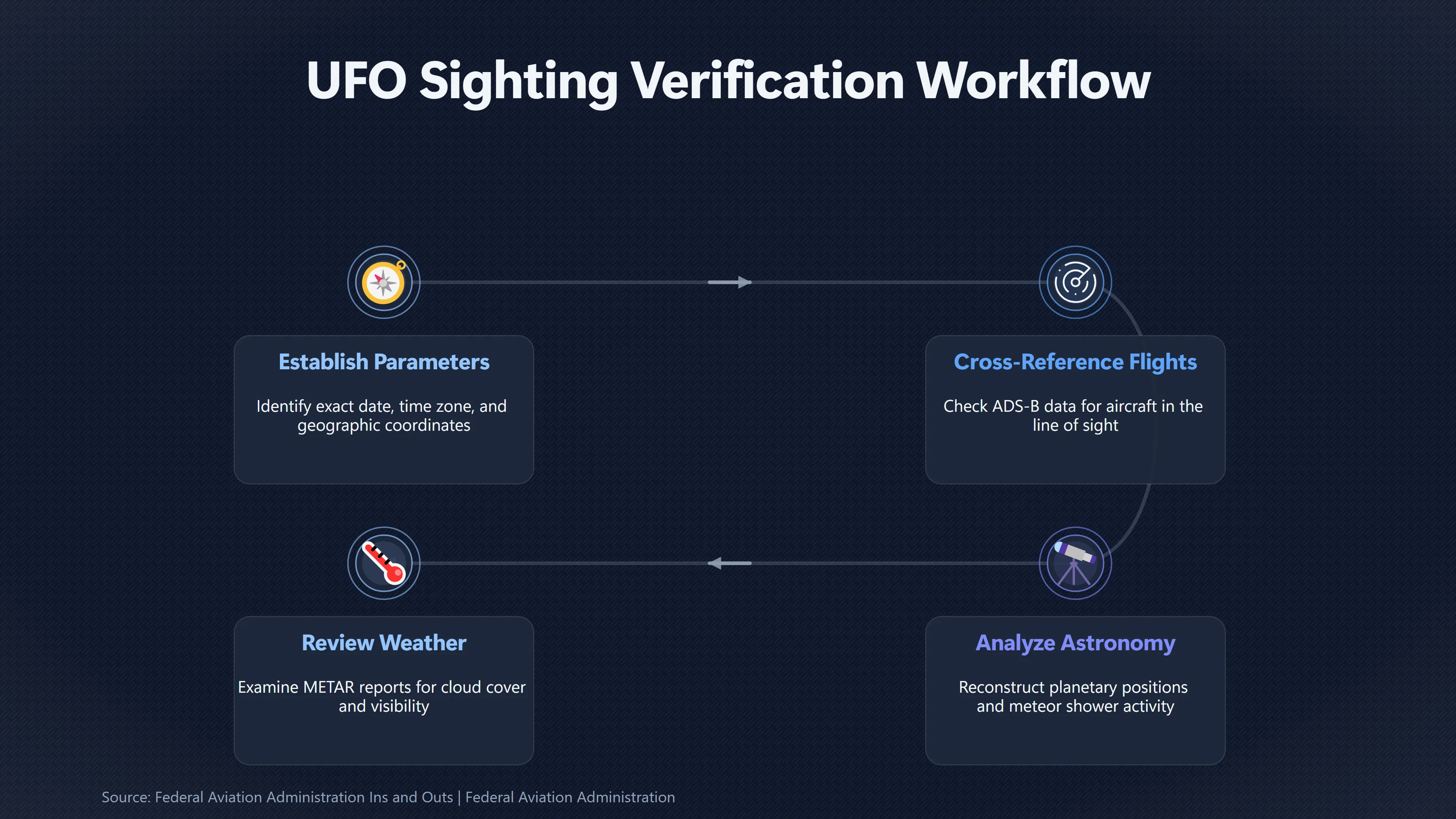
- Matching the exact time and location
- Comparing aircraft, astronomy and weather records
- Recognising missing data and false corroboration
Page outline Jump by section
Introduction
The most reliable way to assess a celebrity UFO story is not to ask whether the witness is famous or persuasive, but whether independent records support the reported time, place and conditions. A convincing investigation reconstructs the event minute by minute using objective sources such as flight data, historical weather observations, astronomical information, satellite pass predictions and local reports. These records can either strengthen the claim that something genuinely unusual occurred or show that a conventional explanation was available. Equally important, they reveal when there is simply too little evidence to reach a firm conclusion rather than encouraging speculation.
Matching the Exact Time and Location
The single most important step is to establish the precise circumstances of the reported sighting. Vague accounts such as “one summer evening” or “late at night in California” cannot be tested effectively. The more specific the reported time and location, the more external records can be compared.
Useful details include:
- The exact date or the narrowest possible date range.
- Local time, including time zone.
- Viewing location, ideally with coordinates or a recognisable landmark.
- Direction of travel or viewing.
- Estimated elevation above the horizon.
- Duration of the observation.
Small timing errors matter. A satellite may have crossed the sky at 21:17, while an aircraft approached the same direction at 21:24. Without an accurate timeline, unrelated events can be mistaken for corroboration.
When evaluating celebrity accounts told years later, investigators should also distinguish between the reported observation time and the date on which the story was first publicly described. A contemporary diary, interview or logbook provides a stronger anchor than a memory reconstructed decades afterwards.
Comparing Aircraft, Astronomy and Weather Records
Once the time and place are fixed, several independent record types can be checked together. No single database normally settles the question on its own.
Flight records
Aircraft are among the most common explanations for unusual lights. Historical flight tracking, radar coverage where available and ADS-B (Automatic Dependent Surveillance–Broadcast) records can show whether commercial, business or many private aircraft were present along the reported line of sight. ADS-B broadcasts an aircraft’s position, altitude and speed using satellite-based navigation, allowing investigators to reconstruct many flight paths after the event. Coverage varies by location and aircraft type, and not every aircraft broadcasts ADS-B continuously, but it remains one of the strongest objective datasets available.[Federal Aviation Administration]faa.govFederal Aviation Administration Ins and Outs | Federal Aviation AdministrationFederal Aviation AdministrationIns and Outs | Federal Aviation AdministrationFebruary 7, 2023…
When comparing flight data, consider:
- Flight direction rather than only proximity.
- Altitude and apparent viewing angle.
- Landing lights, which can make distant aircraft appear stationary.
- Holding patterns that create repeated or slow apparent movement.
- Military or restricted operations, recognising that public data may be incomplete.
The absence of a matching aircraft is informative but not decisive, since historical coverage is imperfect and some flights may not appear in public archives.
Astronomical records
Astronomical software can reconstruct the sky for almost any historical date.
Relevant checks include:
- Positions of bright planets such as Venus or Jupiter.
- The Moon’s phase and altitude.
- Bright stars near the horizon.
- Meteor showers.
- Fireballs recorded by meteor observation networks.
- Comets visible during the reported period.
Venus deserves particular attention because atmospheric conditions near the horizon can make it appear unusually bright, coloured or apparently mobile to an observer.
Astronomical predictions are highly precise, making them valuable for excluding certain explanations when the reported object occupied a very different position.
Satellite passes
Many satellites produce brief bright passes that can surprise observers unfamiliar with their behaviour. Older sightings may also coincide with visible spacecraft, rocket stages or satellite re-entries.
Modern prediction services and historical orbital databases can reconstruct whether:
- The International Space Station was visible.
- Bright satellites crossed the reported direction.
- A rocket stage re-entered the atmosphere.
- Large satellite constellations were passing overhead.
A satellite match should agree not only with timing but also with movement, brightness and duration.
Weather records
Historical weather observations provide an objective picture of viewing conditions.
Useful sources include:
- METAR aviation weather reports.[madisqa.ncep.noaa.gov]madisqa.ncep.noaa.govmadis metar.shtmlmadis metar.shtml * Local weather station observations.[ncdc.noaa.gov]ncdc.noaa.govNCEIClimate Data Online (CDONational Climatic Data Center (NCDC)…
- Cloud cover records.
- Wind direction and speed.
- Visibility measurements.
- Temperature and humidity.
- Radar imagery where available.
These records help determine whether atmospheric effects such as haze, temperature inversions or thin cloud could have altered the appearance of ordinary objects. Historical weather archives maintained by national meteorological agencies allow investigators to reconstruct these conditions with considerable accuracy.[NCEI]ncdc.noaa.govNCEIClimate Data Online (CDONational Climatic Data Center (NCDC)…
Local Reports Can Confirm the Setting, Not the Explanation
Independent reports from the same place and time can establish that an unusual aerial event was widely observed. However, they do not automatically confirm that an extraordinary object was present.
More useful corroboration comes from reports that:
- Were recorded independently.
- Were made before media publicity.
- Describe similar timing and direction.
- Include different viewing locations.
- Contain observations that overlap without being identical.
For example, several independent witnesses reporting an unusually bright object low in the western sky at the same time strengthens confidence that something visible was present. It does not by itself determine whether that object was a planet, aircraft, balloon or something genuinely unexplained.
Emergency service logs, air traffic communications and newspaper reports created close to the event may also help establish whether multiple observers noticed the same phenomenon.
Recognising Missing Data
Many celebrity UFO stories cannot be tested fully because essential records are absent.
Common limitations include:
- Only an approximate date is remembered.
- The location has changed over time.
- Flight archives do not extend far enough into the past.
- Weather stations were too distant.
- No original photographs survive.
- Public radar information is unavailable.[ncei.noaa.gov]ncei.noaa.govSource details in endnotes.
- Witnesses disagree about the timing.
Missing records should not be interpreted as evidence for an extraordinary explanation. Instead, they reduce the confidence with which any explanation—ordinary or unusual—can be evaluated.
Good investigations distinguish between “no conventional explanation has yet been identified” and “the available evidence is insufficient to determine what happened.”
Avoiding False Corroboration
A frequent mistake is treating unrelated records as confirmation simply because they occurred on the same day.
Reliable corroboration requires agreement across several dimensions:
- Same time.
- Same location.
- Same direction.
- Same duration.
- Compatible appearance.
- Compatible movement.
For instance, finding that a military exercise occurred somewhere in the region does not explain a sighting unless the exercise’s aircraft or equipment could realistically have appeared where the witness described them. Likewise, identifying a satellite pass that occurred two hours later does not meaningfully test the claim.
Independent records should be used to reconstruct the reported observation rather than to search retrospectively for anything unusual that happened nearby.
A Strong Record Check Uses Multiple Independent Sources
The most credible evaluations combine several objective records instead of relying on a single database. A reconstructed timeline that aligns historical flight information, weather observations, astronomical conditions and independent local reports provides a far stronger assessment than isolated anecdotes or retrospective memories.
Conversely, if these records consistently point towards an aircraft, bright planet, satellite, atmospheric effect or another well-understood phenomenon, that explanation is generally more persuasive than an unsupported extraordinary interpretation. When none of the available records fit and the evidence remains internally consistent, the appropriate conclusion is not necessarily that the object was extraordinary, but that the case remains genuinely unidentified because the available evidence is incomplete rather than conclusive.
Amazon book picks
Further Reading
Books and field guides related to What Records Could Solve the UFO Sighting?. Use these as the next step if you want deeper reading beyond the article.
The UFO Experience: A Scientific Inquiry
Cited by the New York Review of Books as "the best brief for visitation," this classic study presents an analysis of UFO reports and conc...
UFOs: Generals, Pilots, and Government Officials Go on the Re...
NEW YORK TIMES BESTSELLER • Impeccably researched, this riveting journalistic investigation separates fact from fiction, and documents th...
Bad Science
Rating: 5.0/5 from 5 Google Books ratings
Have you ever wondered how one day the media can assert that alcohol is bad for us and the next unashamedly run a story touting the benef...

The Craft of Research
Rating: 4.3/5 from 6 Google Books ratings
Since 1995, students, researchers, and professionals have turned to The Craft of Research for clear and helpful guidance on how to conduc...
eBay marketplace picks
Marketplace Samples
Live-tested eBay searches with available results related to this page.
Selected fromUFO poster oneBay.co.uk.



Endnotes
1.
Source: faa.gov
Title: Federal Aviation Administration Ins and Outs | Federal Aviation Administration
Link:https://www.faa.gov/air_traffic/technology/equipadsb/capabilities/ins_outs
Source snippet
Federal Aviation AdministrationIns and Outs | Federal Aviation AdministrationFebruary 7, 2023...
Published: February 7, 2023
2.
Source: ncdc.noaa.gov
Title: NCEIClimate Data Online (CDO)
Link:https://www.ncdc.noaa.gov/cdo-web/
Source snippet
National Climatic Data Center (NCDC)...
3.
Source: faa.gov
Link:https://www.faa.gov/air_traffic/technology/adsb/pilot
4.
Source: faa.gov
Title: To address privacy conc
Link:https://www.faa.gov/air_traffic/technology/equipadsb/privacy
Source snippet
ADS-B Privacy | Federal Aviation AdministrationMarch 22, 2025 — ADS-B PRIVACY The FAA acknowledges the desire of some operators to limit...
Published: March 22, 2025
5.
Source: faa.gov
Title: AD S-B FAQ | Federal Aviation Administration
Link:https://www.faa.gov/air_traffic/technology/adsb/faq
Source snippet
What will make me compliant to fly into ADS-B rule airspace? What other surveillance solutions were exami...
6.
Source: faa.gov
Title: Getting to Know Your ADS-B System | Federal Aviation Administration
Link:https://www.faa.gov/air_traffic/technology/equipadsb/installation/know_adsb_system
7.
Source: madisqa.ncep.noaa.gov
Title: madis metar.shtml
Link:https://madisqa.ncep.noaa.gov/madis_metar.shtml
8.
Source: aircraft.faa.gov
Link:https://aircraft.faa.gov/ardocs/Main.aspx
9.
Source: aircraft.faa.gov
Link:https://aircraft.faa.gov/ardocs/About.aspx/main.aspx
10.
Source: faa.gov
Link:https://www.faa.gov/air_traffic/publications/atpubs/aim_html/chap4_section_5.html
11.
Source: aircraft.faa.gov
Link:https://aircraft.faa.gov/ardocs/about.aspx
12.
Source: adsbperformance.faa.gov
Link:https://adsbperformance.faa.gov/PAPRRequest.aspx
13.
Source: ncei.noaa.gov
Link:https://www.ncei.noaa.gov/access/search/index
14.
Source: ncei.noaa.gov
Link:https://www.ncei.noaa.gov/access/search/
15.
Source: ncei.noaa.gov
Link:https://www.ncei.noaa.gov/index.php/about/our-impact/aviation
Additional References
16.
Source: transportation.gov
Title: Aircraft Registration System | US Department of Transportation
Link:https://www.transportation.gov/resources/individuals/privacy/aircraft-registration-system
Source snippet
August 25, 2025 — AIRCRAFT REGISTRATION SYSTEM Document Privacy - FAA - Aircraft Registration System - PIA - 2025.pdf The Aircraft Regist...
Published: August 25, 2025
17.
Source: youtube.com
Title: What Was This? UAP / UFO, Drone, Weather Balloon, or Something Else?
Link:https://www.youtube.com/watch?v=NFDJ52wT5iA
Source snippet
This collection of videos is directly relevant because it demonstrates how investigators use external records—such as flight tracking dat...
18.
Source: data.ntsb.gov
Link:https://data.ntsb.gov/Docket?ProjectID=106645
Source snippet
Management SystemFebruary 5, 2025 — PROJECT SUMMARY: AVIATION INVESTIGATION - 17 DOCKET ITEMS - CEN23FA095 DESCRIPTION: MODE: AVIA...
Published: February 5, 2025
19.
Source: youtube.com
Title: Identifying UFOs / Anti-Myth Superpowers
Link:https://www.youtube.com/watch?v=7GtoO00G_No
Source snippet
Mysterious light over Etna? It was a Boeing 777 – live webcam, 15 July 2026...
Published: July 2026
20.
Source: aviationweather.gov
Link:https://aviationweather.gov/tools/archive/
21.
Source: arxiv.org
Link:https://arxiv.org/abs/2505.06254
Source snippet
OpenSky Report 2025: Improving Crowdsourced Flight Trajectories with ADS-C Data...
22.
Source: opensky-network.org
Link:https://opensky-network.org/about
23.
Source: opensky-network.org
Link:https://opensky-network.org/data/
24.
Source: youtube.com
Title: How can I see the Starlink satellites?
Link:https://www.youtube.com/watch?v=2EhA0AQnOLE
Source snippet
Identifying UFOs / Anti-Myth Superpowers - Fact or Myth...
25.
Source: youtube.com
Title: How To Identify Stars in a Photo With Astrometry.net or Stellarium
Link:https://www.youtube.com/watch?v=uOEZjo4fGVg
Source snippet
How can I see the Starlink satellites?...