Within Storytelling
Did the Reconstruction Add More Than the Witness?
Re-enactments clarify a story but can invent shape, colour, movement and viewpoint beyond what witnesses actually reported.
On this page
- Why vague testimony becomes visually specific
- How repeated imagery reshapes viewer memory
- Standards for labelling and limiting re enactments
Page outline Jump by section
Introduction
Television reconstructions are often the most memorable part of a UFO programme, but they are not the same thing as the original testimony. To turn an eyewitness account into a watchable sequence, producers must decide what the object looked like, how it moved, what colour it was, how large it appeared, where the camera should be positioned and what surrounding details to include. Those choices can make an uncertain description appear visually precise. Over time, viewers—and sometimes even later witnesses discussing the event—may remember the reconstruction as if it were part of the original evidence rather than a production team’s interpretation. Research on eyewitness memory helps explain why this happens: human memory is reconstructive rather than a literal recording, making it vulnerable to later information, repetition and vivid imagery.[ojp.gov]ojp.govreconstructive memory processes eyewitness testimony trial processOffice of Justice ProgramsReconstructive Memory Processes in Eyewitness Testimony (From Trial Process, P 115-144, 1981, Bruce D Sales, ed…
Why vague testimony becomes visually specific
Most eyewitnesses do not report cinematic levels of detail. A witness might describe “a bright object”, “a dark shape” or “something hovering”, while remaining uncertain about its exact outline, surface texture or motion. Television, however, cannot easily present ambiguity for several minutes. A reconstruction therefore fills in the missing information.
Common production decisions include:
- Choosing a definite shape, such as a classic disc, triangle or glowing sphere.
- Assigning colours or lighting effects that the witness never specified.
- Showing smooth, dramatic movements instead of uncertain or intermittent motion.
- Fixing the object’s distance, size and angle despite the witness expressing uncertainty.
- Presenting a single viewpoint even when multiple observers described different perspectives.
None of these choices necessarily reflects deliberate deception. They are practical decisions required to create a coherent visual sequence. The problem arises when those artistic decisions become psychologically associated with the original account.
This issue is well understood in eyewitness research. Elizabeth Loftus and other researchers have shown that information introduced after an event can become integrated into a person’s recollection, especially when the original memory contained gaps or uncertainty. Later information does not simply sit alongside the original experience; under some conditions it becomes incorporated into what people sincerely believe they saw.[Office of Justice Programs]ojp.govreconstructive memory processes eyewitness testimony trial processOffice of Justice ProgramsReconstructive Memory Processes in Eyewitness Testimony (From Trial Process, P 115-144, 1981, Bruce D Sales, ed…
How repeated imagery reshapes viewer memory
Reconstructions influence more than the witnesses involved. They also shape how audiences remember the case.
Once a dramatic image has been seen repeatedly—through documentaries, streaming series, magazine illustrations or social media clips—it can become the mental “default” version of the incident. People recalling the case years later often remember the reconstruction rather than the original verbal description.
Psychological research identifies several mechanisms that make this possible.
Visual concreteness. Detailed images are easier to remember than verbal uncertainty. A glowing metallic craft hovering over trees leaves a stronger memory than “an unidentified object of uncertain shape.”
The misinformation effect. Later information presented after an event can alter recall of the original event. Even when people believe they are remembering firsthand evidence, they may instead be recalling information acquired afterwards.[Office of Justice Programs]ojp.govdistortions eyewitness memory postevent information part 3Office of Justice ProgramsDistortions in Eyewitness Memory From Postevent Information: Part 3: Eyewitness Testimony (From Criminal Behavi…
Repetition. Research suggests that repeated exposure increases acceptance and confidence more reliably than simply hearing the same claim from multiple independent sources. A reconstruction shown repeatedly across documentaries, television specials and online clips may therefore become increasingly familiar and subjectively convincing.[ScienceDirect]sciencedirect.comRepetition, not number of sources, increases both susceptibility to misinformation and confidence in the accuracy of eyewitn…
These mechanisms help explain why some famous UFO cases acquire increasingly detailed popular imagery over decades despite the earliest witness statements being comparatively restrained.
When reconstructions become mistaken for evidence
The greatest risk is not that viewers recognise a reconstruction as fictional. It is that they gradually forget where the visual details originated.
A reconstruction may unintentionally introduce features such as:
- metallic panels or rivets;
- spinning or rotating motion;
- coloured lights arranged in a pattern;
- perfectly symmetrical geometry;
- silent hovering at a fixed height;
- dramatic acceleration viewed from impossible camera angles.
If those elements were production choices rather than reported observations, later discussions can become distorted. People may cite the object’s apparent appearance or movement as though those characteristics came directly from eyewitness testimony.
This source-monitoring problem—remembering information while forgetting where it came from—is well documented in memory research. People often retain the content of later information while losing track of whether it came from personal experience, another person’s account or a visual reconstruction.[Office of Justice Programs]ojp.govreconstructive memory processes eyewitness testimony trial processOffice of Justice ProgramsReconstructive Memory Processes in Eyewitness Testimony (From Trial Process, P 115-144, 1981, Bruce D Sales, ed…
Within commercial UFO storytelling, that distinction is particularly important because many cases rely heavily on eyewitness reports rather than extensive physical evidence.
A feedback loop between witnesses and later media
The relationship can become circular.
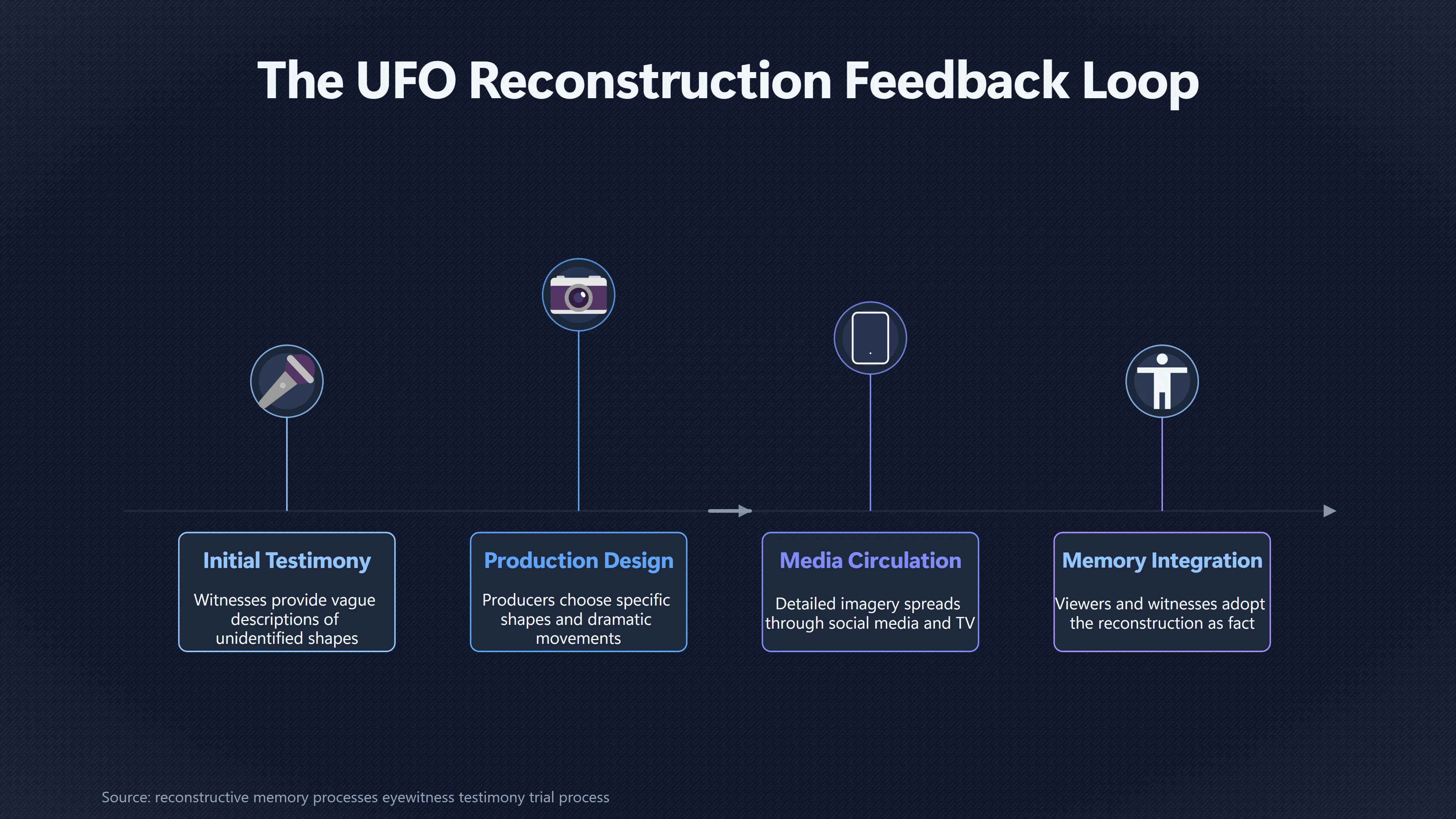
An initial witness gives an uncertain description.
A television programme creates a detailed reconstruction.
That reconstruction becomes widely circulated.
Years later, interviews with witnesses—or with people who learned about the case through media coverage—may include visual details resembling the reconstruction rather than the earliest recorded testimony.
This does not necessarily imply dishonesty. Memory naturally changes through repeated recall, discussion and exposure to later information. Researchers studying eyewitness evidence have consistently found that memories evolve as people integrate additional information encountered after the original event.[Office of Justice Programs]ojp.govreconstructive memory processes eyewitness testimony trial processOffice of Justice ProgramsReconstructive Memory Processes in Eyewitness Testimony (From Trial Process, P 115-144, 1981, Bruce D Sales, ed…
Discussions of long-running UFO incidents, including cases revisited decades after the original reports, often acknowledge that memories develop over time and that group discussion can reinforce a shared narrative without intentional fabrication. Recent reporting on the Westall incident, for example, highlights both the persistence of witness conviction and the recognised fallibility of reconstructive memory.[ABC News]abc.net.auABC News The Westall UFO MysteryABC NewsThe Westall UFO Mystery - ABC NewsApril 6, 2026…
What responsible reconstructions should do
Reconstructions are not inherently misleading. They can help audiences understand witness positions, viewing angles or the sequence of reported events. The difficulty lies in presenting interpretation as observation.
Better practice includes:
- Clearly labelling every reconstruction as an artist’s interpretation.
- Distinguishing reported details from inferred ones.
- Avoiding unnecessary specificity where testimony remains uncertain.
- Using narration that states when shape, colour or motion are unknown.
- Showing alternative visual possibilities if witnesses disagreed.
- Returning viewers to the original interview rather than allowing the reconstruction to become the dominant representation.
These practices preserve the useful explanatory role of re-enactments without allowing visual invention to replace documentary evidence.
Why this matters for commercial UFO storytelling
Commercial productions naturally favour images that are memorable, emotionally engaging and visually coherent. Yet those same qualities can blur the boundary between evidence and illustration.
For UFO cases that depend heavily on eyewitness testimony, every added visual decision carries interpretive weight. A reconstruction may communicate certainty that the original witness never expressed, and repeated exposure can make those additions feel increasingly authentic. The resulting story can become richer than the evidence itself—not because anyone deliberately falsified events, but because television requires concrete images while eyewitness memories often remain incomplete and uncertain. Understanding that distinction allows viewers to appreciate reconstructions as storytelling devices rather than treating every visual detail as part of the historical record.
Amazon book picks
Further Reading
Books and field guides related to Did the Reconstruction Add More Than the Witness?. Use these as the next step if you want deeper reading beyond the article.
The Seven Sins of Memory: How the Mind Forgets and Remembers
Rating: 3.5/5 from 5 Google Books ratings
A New York Times Notable Book: A psychologist's "gripping and thought-provoking" look at how and why our brains sometimes fail us (Steven...
The Memory Illusion: Remembering, Forgetting, and the Science...
THE INTERNATIONAL BESTSELLER 'Truly fascinating.' Steve Wright, BBC Radio 2 - Have you ever forgotten the name of someone you’ve met doze...
Amusing Ourselves to Death: Public Discourse in the Age of Sh...
Rating: 4.2/5 from 25 Google Books ratings
Originally published in 1985, Neil Postman's groundbreaking polemic about the corrosive effects of television on our politics and public...
Made to Stick: Why Some Ideas Survive and Others Die
Rating: 4.0/5 from 25 Google Books ratings
Urban legends, conspiracy theories, and bogus public-health scares circulate effortlessly. Meanwhile, people with important ideas--busine...
eBay marketplace picks
Marketplace Samples
Live-tested eBay searches with available results related to this page.
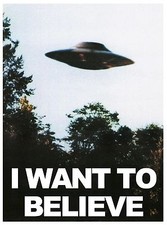
Selected fromUFO poster oneBay.co.uk.



Endnotes
1.
Source: ojp.gov
Title: reconstructive memory processes eyewitness testimony trial process
Link:https://www.ojp.gov/ncjrs/virtual-library/abstracts/reconstructive-memory-processes-eyewitness-testimony-trial-process
Source snippet
Office of Justice ProgramsReconstructive Memory Processes in Eyewitness Testimony (From Trial Process, P 115-144, 1981, Bruce D Sales, ed...
2.
Source: staff.washington.edu
Link:https://staff.washington.edu/eloftus/Articles/hoff.htm
Source snippet
UW StaffMisinformation and Memory The Creation of New Memories (1989)...
3.
Source: pbs.org
Title: Elizabeth Loftus | What Jennifer Saw | FRONTLINE | PBS
Link:https://www.pbs.org/wgbh/pages/frontline/shows/dna/interviews/loftus.html
Source snippet
Elizabeth Loftus | What Jennifer Saw | FRONTLINE | PBS...
4.
Source: ojp.gov
Title: distortions eyewitness memory postevent information part 3
Link:https://www.ojp.gov/ncjrs/virtual-library/abstracts/distortions-eyewitness-memory-postevent-information-part-3
Source snippet
Office of Justice ProgramsDistortions in Eyewitness Memory From Postevent Information: Part 3: Eyewitness Testimony (From Criminal Behavi...
5.
Source: sciencedirect.com
Link:https://www.sciencedirect.com/science/article/pii/S000169181100223X
Source snippet
Repetition, not number of sources, increases both susceptibility to misinformation and confidence in the accuracy of eyewitn...
6.
Source: abc.net.au
Title: ABC News The Westall UFO Mystery
Link:https://www.abc.net.au/news/2026-04-06/the-westall-ufo-mystery-/106528518
Source snippet
ABC NewsThe Westall UFO Mystery - ABC NewsApril 6, 2026...
Published: April 6, 2026
7.
Source: ojp.gov
Link:https://ojp.gov/ncjrs/virtual-library/abstracts/reports-suggested-memories-do-people-truly-believe-them-adult
Additional References
8.
Source: cambridge.org
Link:https://www.cambridge.org/core/journals/episteme/article/reevaluating-the-credibility-of-eyewitness-testimony-the-misinformation-effect-and-the-overcritical-juror/B8F651467F46D7D1BCA7F73D46C93FE4
Source snippet
THE MISINFORMATION EFFECT AND (UN)RELIABLE EYEWITNESSES There is now a vast body of psychological literature on the misinformation effect...
9.
Source: annualreviews.org
Title: Eavesdropping on Memory | Annual Reviews
Link:https://www.annualreviews.org/content/journals/10.1146/annurev-psych-010416-044138
Source snippet
Loftus^{1} * View Affiliations and Author Notes Hide Affiliations and Author Notes Department of Psychology and...
10.
Source: pmc.ncbi.nlm.nih.gov
Link:https://pmc.ncbi.nlm.nih.gov/articles/PMC8547847/
Source snippet
The effect of crime re-enactments on eyewitness memory - PMCJune 17, 2020 — Whilst crime re-enactments may improve memory as discussed ab...
Published: June 17, 2020
11.
Source: researchgate.net
Title: (PDF) Internal and external sources of misinformation in adult witness memory
Link:https://www.researchgate.net/publication/232471510_Internal_and_external_sources_of_misinformation_in_adult_witness_memory
12.
Source: youtube.com
Title: Investigating The Pentagon UFO Videos
Link:https://www.youtube.com/watch?v=NUebtejcoCk
Source snippet
Fiction of Memory - Professor Elizabeth Loftus...
13.
Source: youtube.com
Title: How Reliable is Your Memory?
Link:https://www.youtube.com/watch?v=PB2OegI6wvI
Source snippet
Breakdown of the Pentagon UFO Videos with Mick West...
14.
Source: youtube.com
Title: Breakdown of the Pentagon UFO Videos with Mick West
Link:https://www.youtube.com/watch?v=Le7Fqbsrrm8
Source snippet
Investigating The Pentagon UFO Videos...
15.
Source: youtube.com
Title: Raytheon ATFLIR Expert Discusses Navy Gimbal UFO Video with Mick West
Link:https://www.youtube.com/watch?v=FGHeu5GeR-0
16.
Source: zenodo.org
Link:https://zenodo.org/records/10588816