Within Flare Debate
How Separate Flares Become a Perfect Looking Formation
Separate flares dropped along an aircraft's path can appear as an organised line or arc when distance compresses their spacing and depth.
On this page
- Aircraft release patterns over a range
- Perspective compression at long distance
- Wind drift and changing flare spacing
Page outline Jump by section
Introduction
One of the most persistent questions in the Phoenix Lights debate is why a series of separate military flares could resemble a single organised formation. The answer lies less in the flares themselves than in how they are released and viewed over long distances. Aircraft typically dispense illumination flares sequentially while flying a steady course, creating a chain of individual light sources. When those lights are observed from tens of kilometres away, perspective compresses their spacing, making them appear to form a straight line or gentle arc rather than a series of separate descending objects. This mechanism is particularly relevant to the best-known video footage recorded around 10 p.m. on 13 March 1997, which shows a loose row of bright lights rather than a clearly defined solid object. Contemporary investigations and later image analyses found that the appearance is consistent with military flare deployment over the Barry M. Goldwater Range rather than a rigid luminous craft.[Skeptical Inquirer]skepticalinquirer.orgOpen source on skepticalinquirer.org.
Aircraft Release Patterns Create Ordered Rows
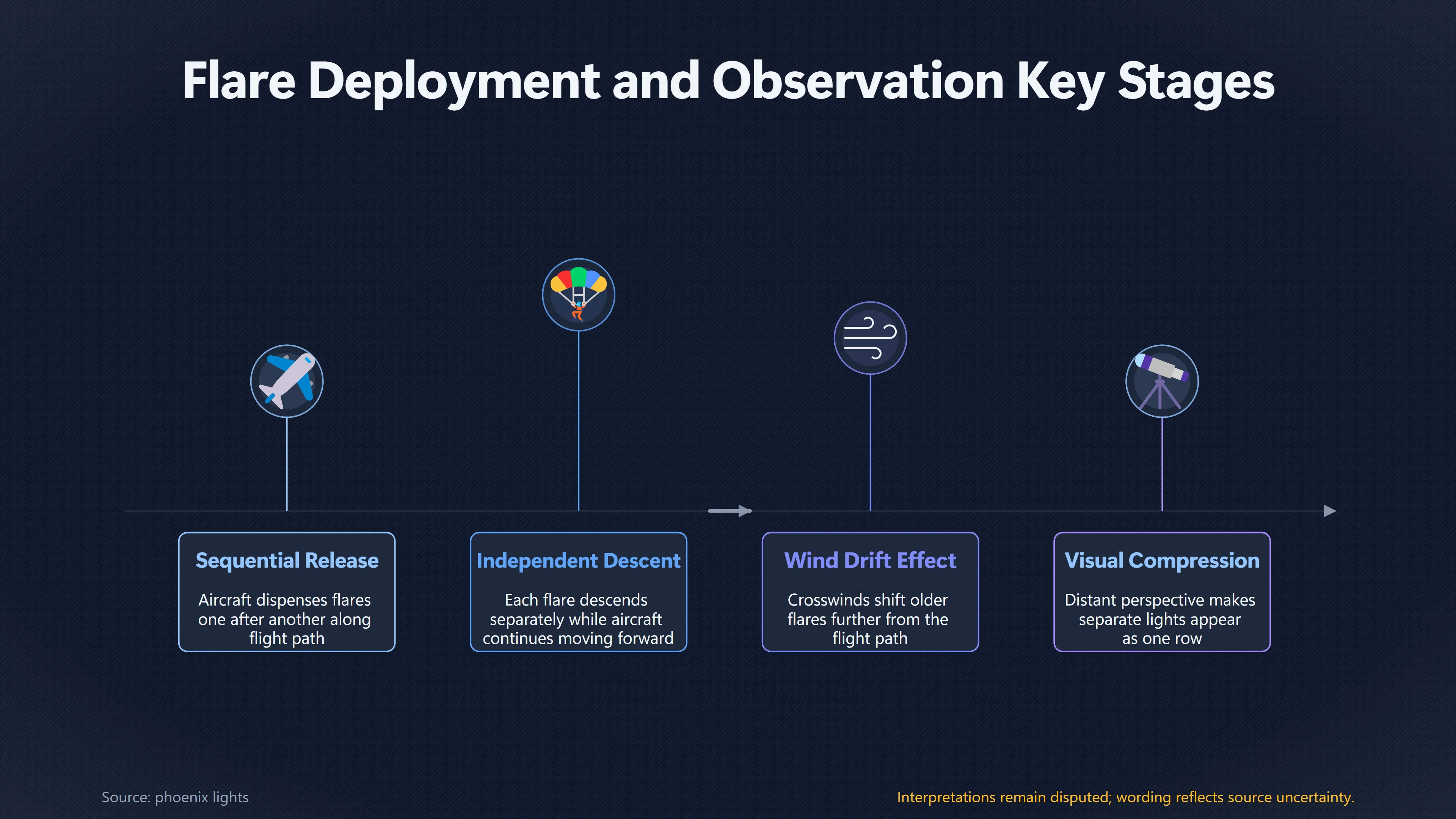
Illumination flares are rarely released simultaneously. Pilots typically dispense them one after another while the aircraft continues flying, producing a sequence of separate parachute-borne lights distributed along the aircraft’s flight path.
This release pattern naturally creates several visual effects:
- Each flare begins descending shortly after release while the aircraft continues moving forward.
- Earlier flares have more time to drift and descend than later ones.
- The resulting positions represent different moments in time rather than a rigid geometric arrangement.
- From the ground, however, those different release times are not immediately obvious because every flare burns with comparable brightness.
Instead of seeing a moving aircraft laying down a trail of lights, distant observers often perceive a stable row of luminous points suspended against the night sky. The human visual system tends to group evenly spaced lights into a coherent pattern, particularly when the aircraft itself is too distant or too dark to be seen.[Skeptical Inquirer]skepticalinquirer.orgOpen source on skepticalinquirer.org.
In the Phoenix case, investigators concluded that the famous row of lights corresponded well with illumination flares released during Maryland Air National Guard training over the military range southwest of Phoenix. The sequence visible in video recordings is consistent with multiple independent flares rather than one continuous illuminated structure.[Skeptical Inquirer]skepticalinquirer.orgOpen source on skepticalinquirer.org.
Why Distance Compresses Separate Lights into One Formation
Perspective plays a crucial role in transforming scattered lights into what appears to be a carefully organised formation.
When viewed over very long distances:
- Large physical gaps between flares occupy only tiny angles in the observer’s field of view.
- Differences in distance from the observer become difficult to judge.
- Individual flares at different depths appear almost side by side.
- The brain interprets the compressed pattern as belonging to one object or coordinated structure.
This effect is familiar in many everyday situations. Streetlights several hundred metres apart can appear almost touching when viewed from a distant hillside. Aircraft flying miles apart may appear nearly aligned from one viewpoint. The same geometry applies to parachute flares.
Because the Barry M. Goldwater Range lies many kilometres southwest of metropolitan Phoenix, the depth between successive flare positions becomes heavily compressed. What may be a substantial separation in three-dimensional space can appear as only a small gap on the observer’s retina. The result is a loose horizontal line or shallow arc that looks far more regular than the actual physical spacing.[Skeptical Inquirer]skepticalinquirer.orgOpen source on skepticalinquirer.org.
Why the Formation Often Looks Like an Arc Instead of a Straight Line
The familiar curved appearance seen in some Phoenix recordings does not require the flares themselves to be released in a curved pattern.
Several factors can produce a gentle arc:
- The aircraft’s flight path may not be perfectly perpendicular to the observer.
- Earlier flares descend farther before later ones are released.
- Wind gradually shifts older flares sideways.
- Perspective projects three-dimensional positions onto a two-dimensional view.
The combined result is often a shallow curve rather than a mathematically straight row.
Importantly, this curvature is expected to evolve slowly. Individual flares continue descending beneath their parachutes while new releases remain higher, subtly changing the apparent shape over several minutes. A rigid solid object would instead preserve fixed distances between its lights regardless of viewing time.
Wind Drift Changes Spacing Without Destroying the Pattern
After deployment, illumination flares become largely governed by their parachutes and the surrounding air.
Wind affects each flare differently depending on when it was released:
- Earlier flares remain exposed to crosswinds for longer.
- Later flares have experienced less horizontal drift.
- The row gradually stretches and changes shape.
- Spacing becomes slightly uneven over time.
These differences help explain why many recordings show an organised but imperfect formation rather than a perfectly regular geometric figure.
Because all flares continue burning while drifting, the pattern changes gradually rather than abruptly. Observers concentrating on the brightest lights may not notice the slow evolution, reinforcing the impression of stationary objects hovering in formation.[Skeptical Inquirer]skepticalinquirer.orgOpen source on skepticalinquirer.org.

The Phoenix Footage Shows Separate Lights Rather Than One Rigid Object
A key distinction in the Phoenix debate is between witness interpretation and what the recorded videos actually show.
The best-known recordings display several bright lights arranged in a loose row. Analyses have noted that the lights exhibit subtle relative motion rather than maintaining perfectly fixed positions. This behaviour is consistent with independent parachute flares descending separately, but it is difficult to reconcile with lights mounted on a single rigid craft whose geometry should remain constant throughout the recording.[Skeptical Inquirer]skepticalinquirer.orgOpen source on skepticalinquirer.org.
This observation does not address every report from earlier in the evening, many of which described a moving V-shaped formation across Arizona. Instead, it specifically explains why the later south-western display could appear as an organised line or arc despite consisting of individual military flares released sequentially along an aircraft’s flight path.
Amazon book picks
Further Reading
Books and field guides related to How Separate Flares Become a Perfect Looking Formation. Use these as the next step if you want deeper reading beyond the article.
The Phoenix Lights
An account of the March 13, 1997, appearance in the sky over Phoenix, Arizona, of a mile-long, v-shaped formation of lights, is accompani...
Visual Intelligence: Sharpen Your Perception, Change Your Life
An engrossing guide to seeing--and communicating--more clearly, from the groundbreaking course that helps FBI agents, cops, CEOs, ER doct...
Sleights of Mind: What the Neuroscience of Magic Reveals Abou...
What can magic tell us about ourselves and our daily lives? If you subtly change the subject during an uncomfortable conversation, did yo...
The UFO Experience: A Scientific Inquiry
Cited by the New York Review of Books as "the best brief for visitation," this classic study presents an analysis of UFO reports and conc...
eBay marketplace picks
Marketplace Samples
Live-tested eBay searches with available results related to this page.
Selected fromUFO poster oneBay.co.uk.



Endnotes
1.
Source: skepticalinquirer.org
Link:https://skepticalinquirer.org/2015/03/alien-lights-at-phoenix-stephenville-and-elsewhere-a-postmortem/
2.
Source: skepticalinquirer.org
Link:https://skepticalinquirer.org/2016/11/the-phoenix-lights-become-an-incident/
3.
Source: ufology.wikidot.com
Title: phoenix lights
Link:https://ufology.wikidot.com/phoenix-lights
4.
Source: probed.space
Title: Phoenix Lights | Events | Probed
Link:https://probed.space/events/phoenix-lights
5.
Source: skepticalinquirer.org
Link:https://skepticalinquirer.org/2022/02/truth-gets-its-boots-on/
6.
Source: skepticalinquirer.org
Title: the great starlink racetrack ufo flap of 2022
Link:https://skepticalinquirer.org/2023/02/the-great-starlink-racetrack-ufo-flap-of-2022/
7.
Source: skepticalinquirer.org
Title: ufo over arizona likely an ifo
Link:https://skepticalinquirer.org/2018/07/ufo-over-arizona-likely-an-ifo/
8.
Source: skepticalinquirer.org
Link:https://skepticalinquirer.org/2008/07/the-mysterious-phoenix-lights/
9.
Source: youtube.com
Link:https://www.youtube.com/watch?v=bvKLeaPWPyw
Source snippet
The Phoenix Lights - 17 years later...
Published: March 13, 1997
10.
Source: youtube.com
Title: The Phoenix Lights
Link:https://www.youtube.com/watch?v=8SUJTh6Hs-I
Source snippet
Revealing The Cover Up Of The Unexplained 'Phoenix Lights' | UFO Conspiracies...
Additional References
11.
Source: mdpi.com
Link:https://www.mdpi.com/2226-4310/10/1/51
Source snippet
January 4, 2023 — ^{2} College of Aerospace Engineering, Nanjing University of Aeronautics and Astronautics, Nanjing 210016, China ^{3} H...
Published: January 4, 2023
12.
Source: theoriesofanything.com
Title: phoenix lights 1997 and [mass sighting events]({{ ‘merged-events/’ | relative_url }}) deep dive
Link:https://theoriesofanything.com/research/phoenix-lights-1997-and-mass-sighting-events-deep-dive
Source snippet
Phoenix Lights (1997) and Mass Sighting Events Deep Dive | Theories of AnythingMarch 7, 2026 — PHOENIX LIGHTS (1997) AND MASS SIGHTING EV...
Published: March 7, 2026
13.
Source: paranormalportaluk.com
Title: thephoenixlights investigatingthe1997ufophenomena
Link:https://www.paranormalportaluk.com/post/thephoenixlights-investigatingthe1997ufophenomena
Source snippet
Air Force, after several months of public speculation, eventually stated that the lights seen in the later part of the night, particularl...
14.
Source: yahoo.com
Title: What caused the Phoenix Lights?
Link:https://www.yahoo.com/news/were-phoenix-lights-27-years-120058263.html
Source snippet
28 years after the UFO drama, here's what we knowMarch 13, 2024 — DID THE MILITARY EXPLAIN THE PHOENIX LIGHTS? Yes. The U.S. Air Force sa...
Published: March 13, 2024
15.
Source: youtube.com
Link:https://www.youtube.com/watch?v=M2j0GeHlm-8
Source snippet
The Phoenix Lights: Unravelling the Greatest UFO Mystery in History...
16.
Source: theconspiratory.com
Title: formation, plus a separ
Link:https://theconspiratory.com/theory/phoenix-lights
Source snippet
What were the Phoenix Lights of 1997?July 8, 2026 — WHAT THE SAME NIGHT ACTUALLY SHOWS Weighed against that testimony is a set of technic...
Published: July 8, 2026
17.
Source: uapedia.ai
Title: Thousands across th
Link:https://uapedia.ai/wiki/the-phoenix-lights-incident-a-mass-sighting-case/
Source snippet
The Phoenix Lights Incident: A Mass Sighting Case - UAPediaOctober 30, 2025 — THE PHOENIX LIGHTS INCIDENT: A MASS SIGHTING CASE On the ev...
Published: October 30, 2025
18.
Source: youtube.com
Title: The Phoenix Lights: Unravelling the Greatest UFO Mystery in History
Link:https://www.youtube.com/watch?v=978heKmAXW0
Source snippet
March 13, 1997 Phoenix, Arizona UFO Lights - ORIGINAL VIDEO...
Published: March 13, 1997
19.
Source: scribd.com
Link:https://www.scribd.com/document/793762586/TO-1-1M-34
20.
Source: uaparchive.org
Link:https://uaparchive.org/encounters/phoenix-lights-1997/preview