Within Fame vs Evidence
Why Pilots Can Misjudge Strange Lights
Pilot experience improves description of familiar aircraft but does not eliminate spatial illusions, false motion or distance errors at night.
On this page
- What aviation expertise genuinely contributes
- Night flight illusions and false motion
- Why training cannot replace range data
Page outline Jump by section
Introduction
When a celebrity is also an experienced pilot, their aviation background is often treated as giving unusual authority to a UFO or unidentified light report. Pilot training does provide genuine advantages: experienced aviators are generally better at recognising normal aircraft lighting, judging aviation procedures and describing what they observed in a structured way. However, aviation training also teaches a less widely appreciated lesson: human perception remains vulnerable to predictable visual illusions, especially during night flight. Experienced pilots are trained to expect these errors and, when flying, to rely on instruments rather than eyesight alone in situations where visual cues become unreliable.[Federal Aviation Administration]faa.govFederal Aviation AdministrationAirman Education Programs | Federal Aviation AdministrationDecember 16, 2024…
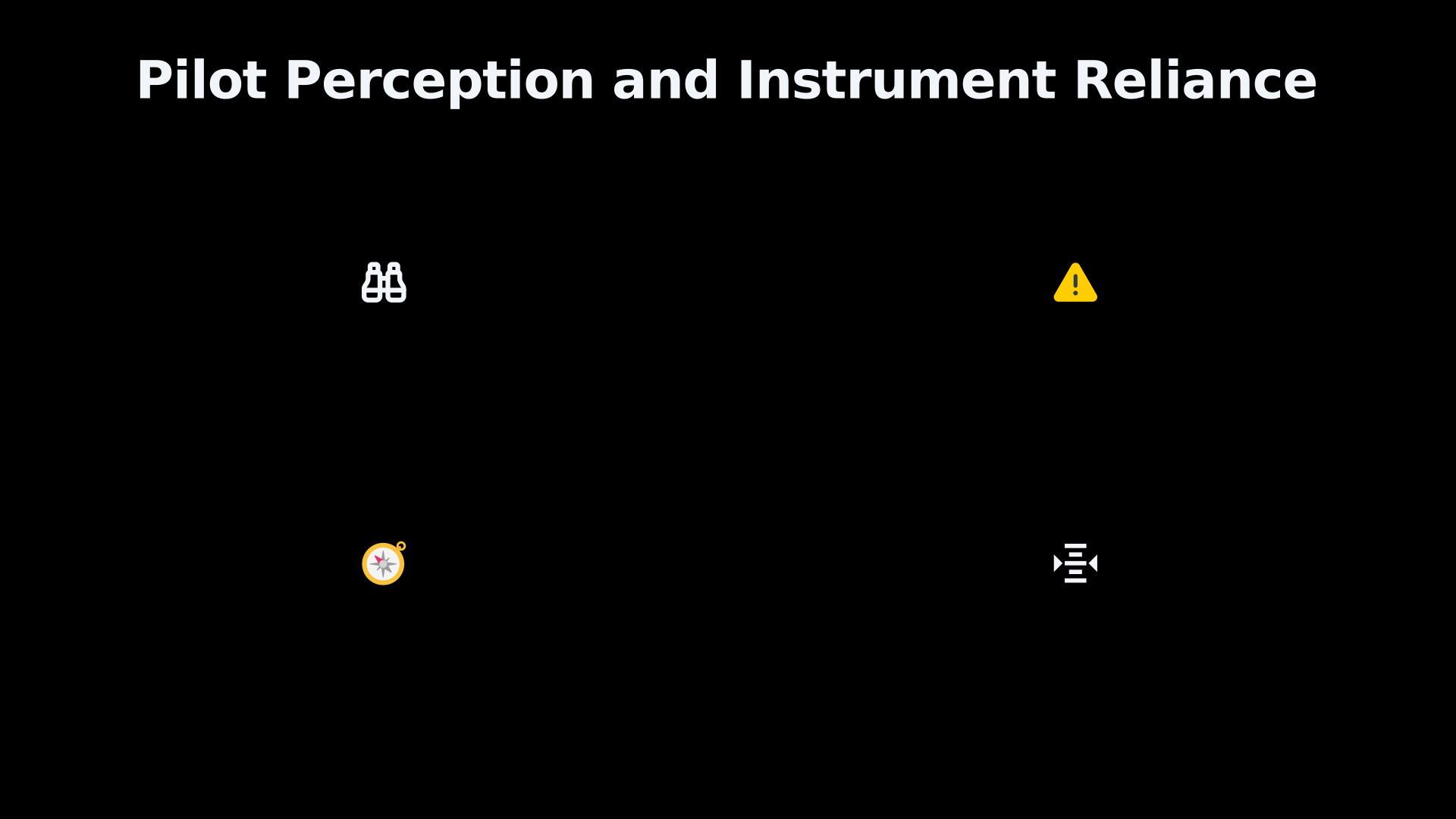
This distinction is important when assessing celebrity sightings. A pilot’s testimony may deserve careful attention because it is informed and detailed, but expertise does not transform an observation of distant lights into precise evidence about distance, speed, size or origin. Without independent measurements such as radar, multiple viewing positions or calibrated imagery, even highly experienced observers can misinterpret what they are seeing.
What Aviation Expertise Genuinely Contributes
Professional pilots develop skills that most members of the public do not possess. They routinely observe aircraft lighting configurations, understand normal flight paths, recognise common atmospheric conditions and communicate observations using standard aviation terminology.
As a result, a pilot who reports an unidentified light may provide valuable information about:
- the apparent direction of travel;
- estimated elevation above the horizon;
- weather and visibility conditions;
- whether the object resembled known aircraft lighting;
- the duration and sequence of events.
These observations can help investigators reconstruct an event more effectively than a vague eyewitness account.
However, aviation expertise mainly improves the quality of the description. It does not provide direct knowledge of an object’s distance, altitude or true speed when only a single visual viewpoint is available. Those quantities require geometric measurements or instrument data rather than experience alone.
Night-Flight Illusions and False Motion
Night flying removes many of the visual references that people unconsciously use to judge movement and distance. A single bright light against a dark background provides remarkably little information about where it actually is.
Autokinesis: When a Stationary Light Appears to Move
One of the best documented aviation illusions is autokinesis. After staring at a fixed light for several seconds in darkness, the human visual system may perceive the light as drifting or moving unpredictably even though it remains stationary.
The FAA specifically warns pilots about this effect because it can be convincing enough to tempt them into manoeuvring the aircraft in response to an object that has not moved at all. The recommended defence is not greater confidence in one’s eyesight, but shifting gaze and confirming position using instruments or additional visual references.[Federal Aviation Administration]faa.govFederal Aviation Administration Chapter 8. Medical Facts for PilotsFederal Aviation Administration Chapter 8. Medical Facts for Pilots
This phenomenon illustrates why sincere witnesses can honestly report motion that was perceptual rather than physical.
False Motion Between Observer and Object
Pilots may also attribute movement to an external light when the apparent motion actually results from changes in their own aircraft’s heading, bank angle or acceleration.
At night, when there is little visible terrain or horizon, the brain has difficulty separating movement of the observer from movement of distant lights. A planet, star or distant aircraft may appear to accelerate, pace the aircraft or change direction because the observer’s own motion changes the viewing geometry.
These effects become more pronounced when there is no reliable visual horizon to anchor perception.[Federal Aviation Administration]faa.govFederal Aviation AdministrationAirman Education Programs | Federal Aviation AdministrationDecember 16, 2024…

False Horizons
Another well-known illusion occurs when cloud layers, city lights or stars create an apparent horizon that differs from the real one.
FAA guidance notes that sloping cloud formations, geometric patterns of ground lighting and stars can all create a false horizon, encouraging pilots to perceive an incorrect aircraft attitude. While this is primarily a flight safety issue, it also demonstrates how night scenes can fundamentally alter spatial judgement.[Federal Aviation Administration]faa.govFederal Aviation Administration Chapter 8. Medical Facts for PilotsFederal Aviation Administration Chapter 8. Medical Facts for Pilots
Why Estimating Distance Is Exceptionally Difficult
Many UFO reports rely on estimates of extraordinary speed or enormous size. At night, however, these conclusions often rest on assumptions about distance rather than direct measurements.
A small nearby light and a much larger distant light can produce almost identical retinal images. Without independent range information, observers cannot reliably determine:
- actual size;
- true altitude;
- physical speed;
- acceleration.
This ambiguity is not unique to inexperienced observers. It is a consequence of basic visual geometry.
Research conducted for the FAA on simulated night approaches found that experienced pilots still exhibited substantial errors in visual judgement under reduced night-time cues. Although flying experience improved some aspects of performance, it did not eliminate large perceptual distortions or restore accurate distance estimation where visual information was fundamentally limited.[Federal Aviation Administration]faa.govFederal Aviation AdministrationOffice of Aerospace Medicine Technical Reports | Federal Aviation AdministrationMarch 1, 1978…
Why Training Cannot Replace Range Data
Modern pilot training does not assume that experience can overcome every illusion. Instead, it explicitly teaches pilots to recognise when vision becomes unreliable.
In instrument flight, pilots are trained to prioritise cockpit instruments over bodily sensations or visual impressions because decades of accident investigation have shown that human perception can be misleading under certain conditions.
The same principle applies when evaluating reports of unidentified lights. A highly experienced pilot may correctly conclude that a light did not resemble any familiar aircraft. That judgement carries weight because it reflects professional knowledge. But if the report also includes estimates of impossible acceleration or enormous size based solely on visual observation, those inferences remain uncertain unless supported by additional evidence such as radar tracks, multiple independent observation points or calibrated sensor data.[Federal Aviation Administration]faa.govFederal Aviation AdministrationAirman Education Programs | Federal Aviation AdministrationDecember 16, 2024…
What This Means for Celebrity Pilot UFO Reports
Celebrity pilots sometimes receive greater public credibility because their aviation credentials suggest expert observation. That expectation is reasonable only within the limits of what aviation expertise actually provides.
A pilot witness is often more reliable than an untrained observer when identifying ordinary aircraft behaviour, recognising unusual lighting patterns or documenting flight conditions. Conversely, aviation training itself acknowledges that night operations expose even experienced crews to predictable perceptual errors involving motion, attitude and distance.
Consequently, the strongest interpretation of a celebrity pilot’s UFO account is usually a restrained one: an experienced observer encountered lights that they could not confidently identify. That is an important observation worthy of investigation, but it is not, by itself, evidence that the lights represented extraordinary technology or an unconventional craft. Scientific assessment still depends on independent measurements capable of distinguishing genuine anomalous behaviour from the well-documented limitations of human night vision.[Federal Aviation Administration]faa.govFederal Aviation AdministrationAirman Education Programs | Federal Aviation AdministrationDecember 16, 2024…
Amazon book picks
Further Reading
Books and field guides related to Why Pilots Can Misjudge Strange Lights. Use these as the next step if you want deeper reading beyond the article.
The Killing Zone: How and Why Pilots Die
This is not AI-generated content. The contents were written and verified by subject matter experts from Aviation Supplies & Academics, an...
The Invisible Gorilla: How Our Intuitions Deceive Us
NEW YORK TIMES BESTSELLER • Our minds don’t work the way we think they do. Two renowned psychologists explain how and why our intuitions...
Human Factors in Flight
The late Captain Frank H Hawkins FRAes, M Phil, was Human Factors Consultant to KLM, for whom he had flown for over 30 years as line capt...

The Thinking Pilot's Flight Manual: Or, How to Survive Flying...
First published 2015.
eBay marketplace picks
Marketplace Samples
Live-tested eBay searches with available results related to this page.
Selected fromUFO sticker oneBay.co.uk.

Current eBay listing
Cow Abduction UFO Metal Phone Sticker With 3M Sticky Backing
Current eBay listing
UFO Alien Spaceship Outer Space Flying Saucer Self Adhesive Sticker

Endnotes
1.
Source: faa.gov
Link:https://www.faa.gov/pilots/training/airman_education/topics_of_interest/spatial_disorientation
Source snippet
Federal Aviation AdministrationAirman Education Programs | Federal Aviation AdministrationDecember 16, 2024...
Published: December 16, 2024
2.
Source: faa.gov
Title: Federal Aviation Administration Chapter 8. Medical Facts for Pilots
Link:https://www.faa.gov/Air_traffic/publications/atpubs/aim_html/chap8_section_1.html
3.
Source: faa.gov
Title: Federal Aviation Administration Chapter 8. Medical Facts for Pilots
Link:https://www.faa.gov/air_traffic/publications/atpubs/aim/aim0801.html
Source snippet
Medical Facts for PilotsJanuary 8, 2015 — 8-1-3. Hyperventilation in Flight a. Hyperventilation, or an abnormal increase in the volume of...
Published: January 8, 2015
4.
Source: faa.gov
Link:https://www.faa.gov/data_research/research/med_humanfacs/oamtechreports/1970s/1978/197815
Source snippet
Federal Aviation AdministrationOffice of Aerospace Medicine Technical Reports | Federal Aviation AdministrationMarch 1, 1978...
Published: March 1, 1978
5.
Source: faa.gov
Title: Perceived Pitch Versus Actual Pitch
Link:https://www.faa.gov/data_research/research/med_humanfacs/aeromedical/aircraftaccident/charlotte
Source snippet
Veronneau FAA Civil Aerospace Medical Institute Oklahoma City, OK 73125-5066 W.R. Ercoline...
6.
Source: faa.gov
Title: Fitness for Flight2
Link:https://www.faa.gov/air_traffic/publications/atpubs/aip_html/chap8_section_1.html
Source snippet
Most heaters in light aircraft work by air flowing over the manifold. Use of these heaters while exhaust fumes are escaping through manif...
7.
Source: faa.gov
Title: Chapter 10
Link:https://www.faa.gov/air_traffic/publications/atpubs/aim_html/chap10_section_2.html
Source snippet
Helicopter Operations10-2-2. HELICOPTER NIGHT VFR OPERATIONS 1. Effect of Lighting on Seeing Conditions in Night VFR Helicopter Operation...
8.
Source: youtube.com
Link:https://www.youtube.com/watch?v=zsZHfZz4Vr8
Source snippet
Night Flying - Everything You Need To Know...
9.
Source: youtube.com
Title: Night Flying
Link:https://www.youtube.com/watch?v=nqqMj_tLBzI
Source snippet
DANGERS of spatial DISORIENTATION! Explained by CAPTAIN JOE...
Additional References
10.
Source: faraim.org
Link:https://www.faraim.org/faa/aim/chapter-8/section-8-1-5.html
Source snippet
ILLUSIONS IN FLIGHT a. Introduction. Many different illusions can be experienced in flight. Some can lead to spatial disorientation. Othe...
11.
Source: science.nasa.gov
Link:https://science.nasa.gov/uap/
Source snippet
NASA ScienceFebruary 23, 2026 — Explore This Section UAP CONTENTS * NASA Unidentified Anomalous Phenomena Independent Study * Final Repor...
Published: February 23, 2026
12.
Source: faasafety.gov
Link:https://www.faasafety.gov/gslac/ALC/libview_chapter.aspx?chapter=Illusions+-+Have+I+Considered+Them%3F&id=6580
Source snippet
Learning Center Library Contents - FAA - FAASTeam - FAASafety.govLearning Center Library Contents Image: Aviation Learning Center Documen...
13.
Source: asrs.arc.nasa.gov
Title: cb 220
Link:https://asrs.arc.nasa.gov/publications/callback/cb_220.htm
Source snippet
220"A CERTAIN SLANT OF LIGHT" - Emily Dickinson At night, lights on and in the vicinity of the airport can also result in optical illusio...
14.
Source: asrs.arc.nasa.gov
Title: cb 246
Link:https://asrs.arc.nasa.gov/publications/callback/cb_246.htm
Source snippet
246December 1, 1999 — | Image: CALLBACK Masthead | | Issue Number 246 | | December 1999 | | A Monthly Safety Bulletin from The Office of...
Published: December 1, 1999
15.
Source: youtube.com
Title: PPGS Lesson 14.2 | Aeromedical: Illusions
Link:https://www.youtube.com/watch?v=ZBPmFaqECdM
Source snippet
Night Flying Ground Lesson for Private Pilot: Logging, Illusions and 3 Types of Night (E17)...
16.
Source: youtube.com
Title: DANGERS of spatial DISORIENTATION! Explained by CAPTAIN JOE
Link:https://www.youtube.com/watch?v=Kh-2SSYhhbA
Source snippet
Breakdown of the Pentagon UFO videos with Mick West...
17.
Source: youtube.com
Title: Breakdown of the Pentagon UFO videos with Mick West
Link:https://www.youtube.com/watch?v=Le7Fqbsrrm8