Within Reporting Stigma
Why Famous Witnesses Make Reporting Feel Safer
A calm celebrity account can make uncertainty feel discussable without asking audiences to accept an alien explanation.
On this page
- How public credibility lowers perceived social risk
- Why uncertainty matters more than belief
- Limits of celebrity led normalisation
Page outline Jump by section
Introduction
Celebrity accounts of unidentified aerial phenomena (UAP), often still referred to as UFOs in public discussion, can influence reporting even when they provide no new physical evidence. Their primary effect is social rather than factual: they can make it seem more acceptable to admit uncertainty about an unusual observation without immediately being labelled irrational or dishonest. This mechanism matters because official reviews of UAP reporting have repeatedly identified stigma as a barrier to collecting timely, accurate reports. A well-known person who calmly says, “I saw something I could not identify,” models a form of disclosure that separates reporting from extraordinary conclusions. Rather than persuading audiences that aliens are real, celebrity testimony can reduce the perceived personal cost of saying, “I don’t know what I saw.”
How public credibility lowers perceived social risk
The decision to report an unusual aerial observation is influenced by more than the observation itself. Witnesses often weigh potential embarrassment, professional consequences and public ridicule against any perceived benefit of speaking up.
A celebrity occupies a distinctive social position within this calculation. Their public identity already exists independently of the UFO story. An actor, musician or athlete is first recognised for established achievements, not for belonging to a community associated with extraordinary claims. When such a person describes an unexplained sighting in measured language, audiences see that reporting an anomalous experience does not necessarily erase an existing reputation.
This reflects a broader principle from research on stigma reduction. Studies of celebrity disclosure in mental health suggest that famous individuals can normalise discussion by providing a familiar public example, challenging stereotypes and demonstrating that disclosure itself is socially permissible. Importantly, this influence depends on how the disclosure is made, the credibility of the individual and whether the audience identifies with them rather than on fame alone.[Cambridge University Press]cambridge.orgCambridge University PressImpact of celebrity disclosure on mental health-related stigma | Epidemiology and Psychiatric Sciences | Cambri…
Applied to UAP reporting, the mechanism is subtle. Celebrity accounts do not automatically make witnesses believe they observed something extraordinary. Instead, they may alter a different judgement: whether admitting uncertainty is socially safe.
This distinction aligns with recommendations from official UAP reviews, which have argued that reducing stigma improves reporting quality because more witnesses are willing to submit observations through appropriate channels rather than remaining silent or waiting years before speaking publicly.
Why uncertainty matters more than belief
One of the most significant features of many celebrity UFO accounts is not what they claim but what they avoid claiming.
The strongest examples typically involve statements such as:
- the witness observed something unusual;
- they could not identify it;
- they are not asserting it was extraterrestrial;
- they simply believe the event deserves discussion.
That form of disclosure creates what psychologists sometimes describe as permission to acknowledge uncertainty. Rather than demanding agreement with an explanation, it models intellectual restraint.
This matters because reporting systems depend on observations before explanations. Aviation safety, astronomy and accident investigation all begin by collecting reports without assuming a cause. A witness who feels comfortable saying, “I don’t know what I saw,” contributes more useful information than one who stays silent because every possible interpretation seems socially risky.
Celebrity disclosure can therefore shift the perceived norm from “Only believers report UFOs” towards “Ordinary people—including well-known people—sometimes encounter things they cannot immediately identify.”
The resulting change is cultural rather than evidential. Better reporting does not automatically produce more extraordinary cases; it simply increases the likelihood that unusual observations enter the record while memories remain fresh.
How visibility changes reporting norms
Social scientists often distinguish between changing private beliefs and changing perceived social norms. These are related but not identical.
A person may privately think that reporting an unexplained aerial event is reasonable while still believing that everyone else would ridicule them. Public disclosures by recognisable figures can reduce this mismatch by making discussion visibly acceptable.
Several mechanisms may operate simultaneously:
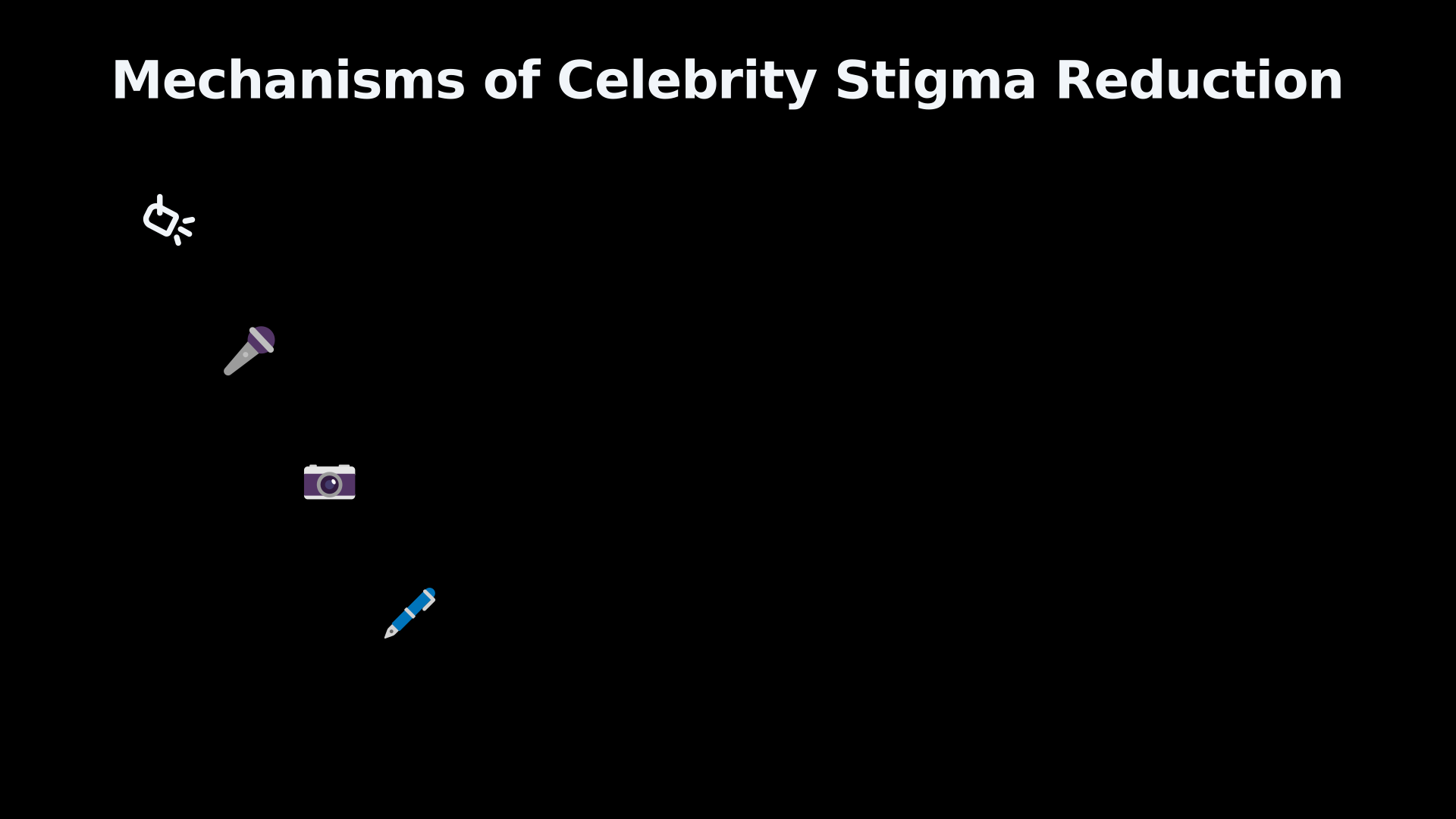
- Reduced expectation of ridicule. High-profile witnesses demonstrate that discussing uncertainty does not inevitably lead to complete reputational collapse.
- Expanded conversation space. Mainstream interviews and news coverage treat the topic as something that can be discussed rather than automatically mocked.
- Modelled language. Careful phrasing such as “unidentified” or “I cannot explain it” encourages descriptive reporting instead of speculative conclusions.
- Institutional reinforcement. When celebrities speak during periods of increased governmental or scientific attention to UAP reporting, the message that reporting is acceptable may appear more credible than either influence would alone.
These mechanisms concern social behaviour rather than proof. They help explain why the tone surrounding reporting can change even when the underlying evidence for individual sightings remains unchanged.
Why the messenger matters more than celebrity status alone
Not every famous person has the same influence.
Research on celebrity disclosure indicates that effectiveness depends on the relationship between the speaker, the message and the audience. Audiences tend to respond more positively when the celebrity appears authentic, speaks within the limits of their experience and avoids presenting themselves as an unquestionable authority.[Cambridge University Press]cambridge.orgCambridge University PressImpact of celebrity disclosure on mental health-related stigma | Epidemiology and Psychiatric Sciences | Cambri…
Within the UFO context, this suggests that restrained testimony may have greater social value than confident declarations about the origin of unexplained objects.
For example, a celebrity saying, “I witnessed something I could not identify,” leaves room for investigation. A celebrity insisting, without evidence, that an object was definitely extraterrestrial asks audiences to accept a conclusion rather than a report.
The first style lowers the barrier to reporting. The second risks turning discussion into a debate about belief.
Limits of celebrity-led normalisation
Celebrity disclosure also has important limitations.
First, there is little direct empirical research demonstrating that celebrity UFO stories measurably increase the number of formal UAP reports. The proposed mechanism is therefore inferred from broader evidence on stigma reduction, social norms and disclosure behaviour rather than established through controlled studies.
Second, fame can distort attention. Well-known figures often receive extensive media coverage for experiences that would attract little notice if reported by an unknown witness. This may create the false impression that celebrity testimony carries greater evidential weight than ordinary observations.
Third, celebrity influence can cut in opposite directions. Calm, qualified accounts may encourage thoughtful reporting, while sensational claims, commercial incentives or repeated assertions presented without supporting evidence can reinforce public polarisation. In those cases, the discussion shifts away from documenting observations and towards competing narratives about extraordinary explanations.
Finally, social permission is not the same as institutional trust. Witnesses may still hesitate to report if they doubt that governments, scientists or employers will treat their observations fairly. Celebrity disclosure can reduce perceived interpersonal stigma, but it cannot by itself create reliable reporting systems or improve the quality of the evidence collected.
What this mechanism contributes
The distinctive contribution of celebrity disclosure is not stronger proof of unusual aerial phenomena but a change in the social environment surrounding reporting. Famous witnesses can demonstrate that acknowledging uncertainty is compatible with maintaining a respected public identity. By separating observation from explanation, they make it easier for others to describe unusual experiences without first committing to extraordinary beliefs.
Within the broader effort to reduce UFO reporting stigma, this is the central mechanism: celebrities provide social permission to report, not scientific permission to conclude. That distinction helps explain why their greatest influence may lie in encouraging conversation and documentation rather than settling debates about what any particular sighting ultimately was.
Amazon book picks
Further Reading
Books and field guides related to Why Famous Witnesses Make Reporting Feel Safer. Use these as the next step if you want deeper reading beyond the article.
UFOs: Generals, Pilots, and Government Officials Go on the Re...
NEW YORK TIMES BESTSELLER • Impeccably researched, this riveting journalistic investigation separates fact from fiction, and documents th...
The Scout Mindset
"...an engaging and enlightening account from which we all can benefit."—The Wall Street Journal A better way to combat knee-jerk biases...
On Being Certain
Neurologist Robert Burton challenges common notions about how people think about what they know, demonstrating how the feeling of certain...
eBay marketplace picks
Marketplace Samples
Live-tested eBay searches with available results related to this page.
Selected fromUFO patch oneBay.co.uk.
Endnotes
1.
Source: cambridge.org
Link:https://www.cambridge.org/core/journals/epidemiology-and-psychiatric-sciences/article/impact-of-celebrity-disclosure-on-mental-healthrelated-stigma/087EA2D893AB48F1431660D977018794
Source snippet
Cambridge University PressImpact of celebrity disclosure on mental health-related stigma | Epidemiology and Psychiatric Sciences | Cambri...
2.
Source: disclosure.org
Link:https://disclosure.org/research
Source snippet
Research & Policy | Disclosure FoundationRESEARCH & POLICY Briefs, reports, and recommendations on oversight, transparency, and governanc...
3.
Source: disclosure.org
Title: Foundation — Advancing UAP Transparency
Link:https://disclosure.org/
Source snippet
Disclosure Foundation — Advancing UAP TransparencyJune 25, 2026 Kennedy Caucus Room DISCLOSURE Forum 2026 Humanity at the Edge of Discove...
Published: June 25, 2026
Additional References
4.
Source: archives.gov
Link:https://www.archives.gov/records-mgmt/uap-guidance
Source snippet
May 8, 2024 — GUIDANCE TO FEDERAL AGENCIES ON UNIDENTIFIED ANOMALOUS PHENOMENA RECORDS COLLECTION The 2024 National Defense Authorization...
Published: May 8, 2024
5.
Source: pmc.ncbi.nlm.nih.gov
Link:https://pmc.ncbi.nlm.nih.gov/articles/PMC9483822/
Source snippet
2022 Aug 30;31:e62. doi: 10.1017/S2045796022000488 IMPACT OF CELEBRITY DISCLOSURE ON MENTAL HEALTH-RELATED STIGMA Petra C Gronholm PETRA...
6.
Source: kclpure.kcl.ac.uk
Title: kcl.ac.uk Impact of celebrity disclosure on mental health-related stigma
Link:https://kclpure.kcl.ac.uk/portal/en/publications/impact-of-celebrity-disclosure-on-mental-health-related-stigma/
Source snippet
of celebrity disclosure on mental health-related stigma - King's College LondonAugust 30, 2022 — IMPACT OF CELEBRITY DISCLOSURE ON MENTAL...
Published: August 30, 2022
7.
Source: kclpure.kcl.ac.uk
Title: kcl.ac.uk Impact of celebrity disclosure on mental health-related stigma
Link:https://kclpure.kcl.ac.uk/portal/en/publications/impact-of-celebrity-disclosure-on-mental-health-related-stigma/fingerprints/
Source snippet
of celebrity disclosure on mental health-related stigma - Fingerprint - King's College LondonIMPACT OF CELEBRITY DISCLOSURE ON MENTAL HEA...
8.
Source: researchgate.net
Title: (PDF) Impact of celebrity disclosure on mental health-related stigma
Link:https://www.researchgate.net/publication/363123721_Impact_of_celebrity_disclosure_on_mental_health-related_stigma
Source snippet
August 5, 2022 — Article PDF Available IMPACT OF CELEBRITY DISCLOSURE ON MENTAL HEALTH-RELATED STIGMA * August 2022 * Epidemiology and Ps...
Published: August 5, 2022
9.
Source: youtube.com
Title: These Celebrities Say They’ve Seen UFOs — And Some of the Stories Are Wild
Link:https://www.youtube.com/watch?v=d9TAr20K7A0
Source snippet
This video provides a direct interview segment with former US President Barack Obama discussing UFO reports on television, providing a hi...
10.
Source: science.nasa.gov
Link:https://science.nasa.gov/uap/
Source snippet
NASA ScienceFebruary 23, 2026 — Explore This Section UAP CONTENTS * NASA Unidentified Anomalous Phenomena Independent Study * Final Repor...
Published: February 23, 2026
11.
Source: pmc.ncbi.nlm.nih.gov
Link:https://pmc.ncbi.nlm.nih.gov/articles/PMC11747871/
Source snippet
2025 Jan 21;40(1):daae204. doi: 10.1093/heapro/daae204 PUBLIC DISCLOSURES OF MENTAL HEALTH PROBLEMS ON SOCIAL MEDIA AND AUDIENCES’ SELF-R...
12.
Source: youtube.com
Title: Neil de Grasse Tyson: The Whistleblowers Were Right About Aliens
Link:https://www.youtube.com/watch?v=PHpsdIHpLUE
Source snippet
Barack Obama Asked if Aliens Were in Government Lab...
13.
Source: youtube.com
Title: Chris Colfer Claims He Was Visited by an Alien
Link:https://www.youtube.com/watch?v=5h7yBz7Rp7k
Source snippet
These Celebrities Say They've Seen UFOs — And Some of the Stories Are Wild...