Within Multi Sensor Study
How 500,000 Tracks Became 144 Ambiguities
Half a million reconstructed tracks showed how quickly apparent anomalies shrink when detections are calibrated and reviewed.
On this page
- How the infrared array built its trajectory set
- Why simple outlier rules flagged so many tracks
- What the remaining ambiguities could not prove
Page outline Jump by section
Introduction
The Galileo Project’s first large infrared dataset did not uncover evidence that extraordinary aerial objects were routinely appearing in the sky. Instead, it demonstrated something arguably more important for scientific UFO research: most apparent anomalies become less mysterious as measurements improve. During a five-month commissioning period, an eight-camera long-wave infrared array reconstructed roughly 500,000 aerial-object trajectories. An intentionally simple automated search initially identified about 80,000 potential outliers, yet detailed human review reduced that number to only 144 trajectories that could not immediately be classified. Even those remaining cases were not presented as evidence of unknown technology; rather, they highlighted where additional measurements—especially distance, velocity and independent sensor confirmation—were still missing.[MDPI]mdpi.comCommissioning an All-Sky Infrared Camera Array for Detection of Airborne ObjectsCommissioning an All-Sky Infrared Camera Array for Detection of Airborne ObjectsJanuary 28, 2025…
This commissioning exercise therefore serves as a practical case study in how a multi-sensor UFO observatory should be evaluated. Rather than asking whether an infrared camera “found UFOs”, the dataset shows how calibration, statistical testing and careful review establish a reliable baseline against which genuinely unusual events could eventually be judged.
How the infrared array built its trajectory set
The Galileo Project’s commissioning instrument consisted of eight uncooled long-wave infrared cameras arranged to provide continuous, wide-area monitoring of the sky. Unlike systems that rely on eyewitness reports, the array continuously recorded ordinary aerial activity, allowing researchers to build a representative catalogue of what typically appears overhead.[PubMed]pubmed.ncbi.nlm.nih.govCommissioning an All-Sky Infrared Camera Array for Detection of Airborne Objects - PubMed…
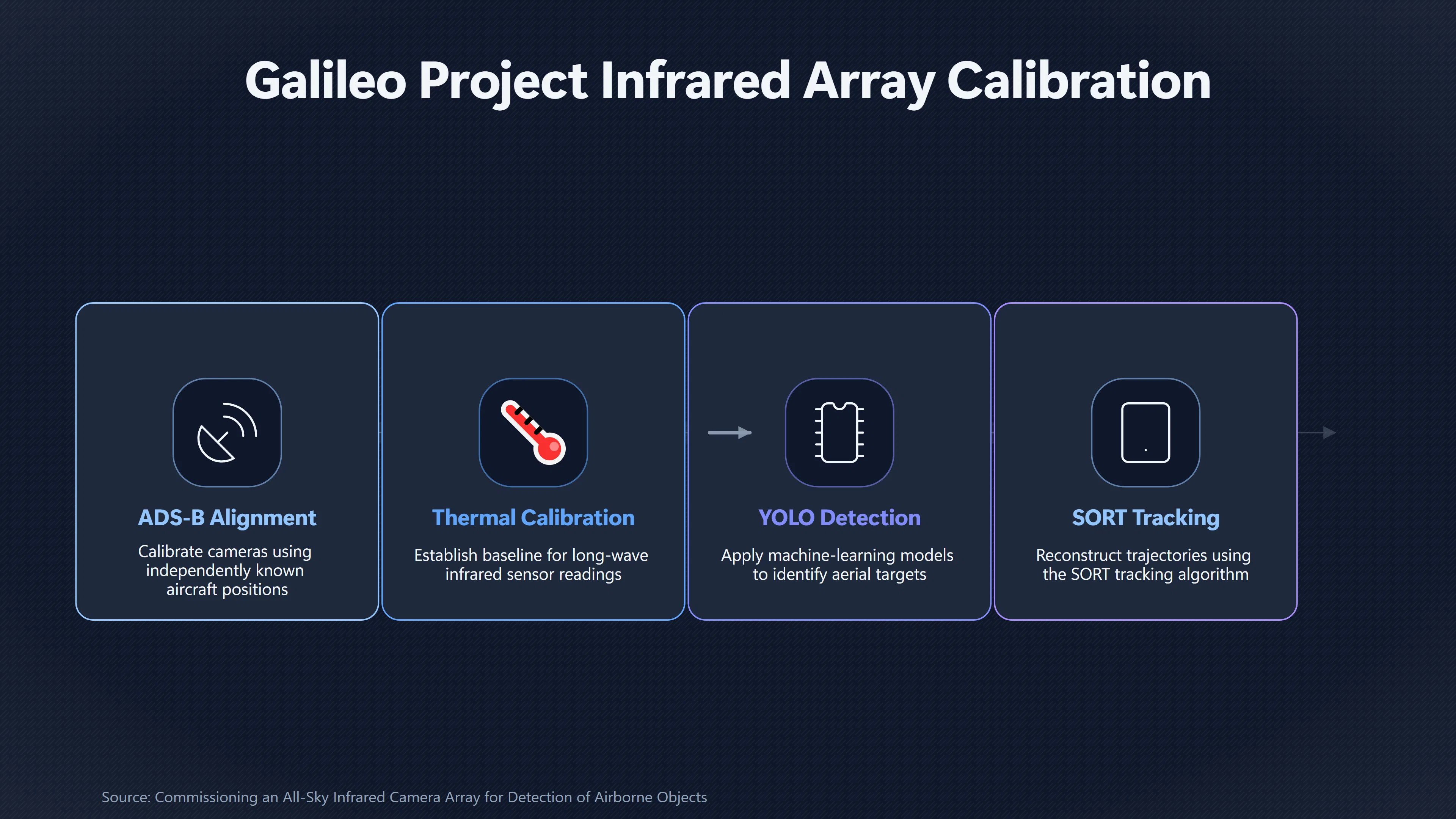
A crucial design decision was to calibrate the cameras using aircraft broadcasting Automatic Dependent Surveillance–Broadcast (ADS-B) positions. Because the locations of these aircraft were independently known, they provided reference points for aligning the cameras and evaluating tracking accuracy. The project also combined:
- intrinsic camera calibration;[ouci.dntb.gov.ua]ouci.dntb.gov.uaHardware and Software Platform for Aerial Object LocalizationIn addition to performing intrinsic and thermal calibrations, we implement a…
- thermal calibration;
- machine-learning object detection using YOLO;
- trajectory reconstruction with the SORT tracking algorithm; and
- synthetic and hand-labelled datasets to measure system performance.[PubMed]pubmed.ncbi.nlm.nih.govCommissioning an All-Sky Infrared Camera Array for Detection of Airborne Objects - PubMed…
The commissioning data also revealed the practical limits of the system. Aircraft detection rates depended strongly on weather, target size and distance. The researchers reported an acceptance rate of roughly 41% for ADS-B-equipped aircraft entering the observable field and an average frame-by-frame aircraft detection efficiency of about 36%, illustrating that the observatory was still undergoing optimisation rather than operating as a fully mature surveillance system.[PubMed Central (PMC)]pmc.ncbi.nlm.nih.govPubMed Central (PMC)Commissioning an All-Sky Infrared Camera Array for Detection of Airborne Objects - PMCJanuary 28, 2025…
Why simple outlier rules flagged so many tracks
One of the most instructive findings came from the project’s deliberately uncomplicated anomaly search.
Rather than attempting to identify exotic flight behaviour directly, the researchers applied a “toy” outlier analysis based on trajectory sinuosity—the amount a reconstructed two-dimensional track appeared to bend or wander across successive frames. This intentionally simple rule was chosen as a commissioning exercise rather than as a definitive anomaly detector.[MDPI]mdpi.comCommissioning an All-Sky Infrared Camera Array for Detection of Airborne ObjectsCommissioning an All-Sky Infrared Camera Array for Detection of Airborne ObjectsJanuary 28, 2025…
The results showed why automated anomaly detection alone is insufficient.
Approximately 16% of the reconstructed trajectories—around 80,000 tracks—were automatically classified as unusual. However, manual inspection revealed that the overwhelming majority reflected ordinary causes such as imperfect tracking, fragmented detections, changing viewing geometry or limitations inherent in reconstructing motion from two-dimensional infrared imagery.[PubMed]pubmed.ncbi.nlm.nih.govCommissioning an All-Sky Infrared Camera Array for Detection of Airborne Objects - PubMed…
This dramatic reduction illustrates an important lesson for multi-sensor UFO investigations: a large number of algorithmic “anomalies” should be expected during early data processing. The existence of an outlier in a statistical model does not imply an extraordinary object. It often indicates that the reconstruction algorithm encountered circumstances outside its normal assumptions.
What the remaining ambiguities could not prove
After manual review, only 144 trajectories remained unresolved.
Importantly, the authors did not describe these tracks as evidence of unidentified craft or non-human technology. Instead, they concluded that the objects were likely to be mundane but could not be confidently classified because the available measurements were incomplete. In particular, the infrared array alone could not determine:
- the true distance to the object;
- its three-dimensional velocity;
- its physical size; or
- whether another sensor independently observed the same event.[MDPI]mdpi.comCommissioning an All-Sky Infrared Camera Array for Detection of Airborne ObjectsCommissioning an All-Sky Infrared Camera Array for Detection of Airborne ObjectsJanuary 28, 2025…
Without range information, even apparently unusual motion in a two-dimensional image can be misleading. A nearby bird, distant aircraft or atmospheric effect may produce similar apparent trajectories despite having completely different physical behaviour. The study therefore argues that ambiguous infrared observations should be treated as prompts for additional measurement rather than as standalone evidence.
This finding aligns closely with the Galileo Project’s broader emphasis on combining infrared imagery with radar, visible-light cameras, radio-frequency monitoring and environmental sensors. Multiple independent measurements are needed before unusual motion can be translated into reliable estimates of acceleration, velocity or flight characteristics.[PubMed]pubmed.ncbi.nlm.nih.govCommissioning an All-Sky Infrared Camera Array for Detection of Airborne Objects - PubMed…
What the dataset contributes to UFO research
The principal contribution of the commissioning dataset is methodological rather than sensational.
First, it establishes a large baseline of ordinary aerial traffic observed under real operating conditions. Such a baseline is essential because anomaly detection only becomes meaningful after a system has learned how common aircraft, birds, insects and environmental effects normally appear.
Second, the study demonstrates that calibration against independently verified aircraft substantially improves confidence in the instrument’s measurements. Rather than relying solely on internal camera geometry, the observatory uses known flight data to validate its tracking pipeline.[PubMed]pubmed.ncbi.nlm.nih.govCommissioning an All-Sky Infrared Camera Array for Detection of Airborne Objects - PubMed…
Third, the project introduced a likelihood-based statistical framework for evaluating whether the number of ambiguous events exceeded expectations. Incorporating systematic uncertainties, the researchers derived a 95% confidence upper limit on the number of unresolved outliers during the five-month commissioning period. The statistical approach is intended to provide a consistent benchmark for future anomaly searches instead of relying on anecdotal impressions.[PubMed]pubmed.ncbi.nlm.nih.govCommissioning an All-Sky Infrared Camera Array for Detection of Airborne Objects - PubMed…

The main lesson from 500,000 tracks
The headline numbers—roughly half a million reconstructed trajectories, about 80,000 initial outliers and only 144 remaining ambiguities—illustrate how quickly apparent anomalies diminish when calibration, automated processing and expert review are applied together.[MDPI]mdpi.comCommissioning an All-Sky Infrared Camera Array for Detection of Airborne ObjectsCommissioning an All-Sky Infrared Camera Array for Detection of Airborne ObjectsJanuary 28, 2025…
Perhaps the most significant outcome is not that unresolved tracks remained, but that the researchers resisted interpreting them beyond what the data supported. The study treats “unidentified” as a statement about incomplete measurement rather than evidence of extraordinary origin. In the context of multi-sensor systems for studying UFOs, the dataset demonstrates that rigorous calibration and layered evidence are far more valuable than accumulating large numbers of unexplained detections.
Amazon book picks
Further Reading
Books and field guides related to How 500,000 Tracks Became 144 Ambiguities. Use these as the next step if you want deeper reading beyond the article.
Weapons of Math Destruction
'A manual for the 21st-century citizen... accessible, refreshingly critical, relevant and urgent' - Financial Times 'Fascinating and deep...
The Signal and the Noise: Why So Many Predictions Fail—but So...
This work explores the history, art and science of prediction.
Anomaly Detection Principles and Algorithms
This book provides a readable and elegant presentation of the principles of anomaly detection,providing an easy introduction for newcomer...
Calling Bullshit: The Art of Skepticism in a Data-Driven World
Bullshit isn’t what it used to be. Now, two science professors give us the tools to dismantle misinformation and think clearly in a world...
eBay marketplace picks
Marketplace Samples
Live-tested eBay searches with available results related to this page.
Selected fromUFO poster oneBay.co.uk.




Endnotes
1.
Source: mdpi.com
Title: Commissioning an All-Sky Infrared Camera Array for Detection of Airborne Objects
Link:https://www.mdpi.com/1424-8220/25/3/783
Source snippet
Commissioning an All-Sky Infrared Camera Array for Detection of Airborne ObjectsJanuary 28, 2025...
Published: January 28, 2025
2.
Source: pubmed.ncbi.nlm.nih.gov
Link:https://pubmed.ncbi.nlm.nih.gov/39943425/
Source snippet
Commissioning an All-Sky Infrared Camera Array for Detection of Airborne Objects - PubMed...
3.
Source: pmc.ncbi.nlm.nih.gov
Link:https://pmc.ncbi.nlm.nih.gov/articles/PMC11820869/
Source snippet
PubMed Central (PMC)Commissioning an All-Sky Infrared Camera Array for Detection of Airborne Objects - PMCJanuary 28, 2025...
Published: January 28, 2025
4.
Source: ouci.dntb.gov.ua
Link:https://ouci.dntb.gov.ua/en/works/4gBqgZW7/
Source snippet
Hardware and Software Platform for Aerial Object LocalizationIn addition to performing intrinsic and thermal calibrations, we implement a...
Additional References
5.
Source: thedebrief.org
Link:https://thedebrief.org/galileo-project-releases-commissioning-data-on-half-a-million-aerial-objects-are-any-of-them-uap/
Source snippet
The DebriefNovember 12, 2024 — These trajectories were analyzed with an outlier search algorithm. About 16% of the monitored trajectories...
Published: November 12, 2024
6.
Source: sciencecast.org
Link:https://www.sciencecast.org/casts/7ot52rwazd4m
7.
Source: researchgate.net
Link:https://www.researchgate.net/publication/388466760_Commissioning_an_All-Sky_Infrared_Camera_Array_for_Detection_of_Airborne_Objects
Source snippet
January 28, 2025 — Article PDF Available COMMISSIONING AN ALL-SKY INFRARED CAMERA ARRAY FOR DETECTION OF AIRBORNE OBJECTS Sensors * Janua...
Published: January 28, 2025
8.
Source: researchgate.net
Link:https://www.researchgate.net/publication/385750244_Commissioning_An_All-Sky_Infrared_Camera_Array_for_Detection_Of_Airborne_Objects
Source snippet
November 12, 2024 — To address this deficiency, the Galileo Project is designing, building, and commissioning a multi-modal ground-based...
Published: November 12, 2024
9.
Source: proceedings.mlr.press
Link:https://proceedings.mlr.press/v267/tseng25a.html
Source snippet
mlr.pressGalileo: Learning Global & Local Features of Many Remote Sensing ModalitiesOctober 6, 2025 — GALILEO: LEARNING GLOBAL & LOCAL FE...
Published: October 6, 2025
10.
Source: chatpaper.com
Title: We establish a first baseline for the system perf
Link:https://chatpaper.com/chatpaper/paper/75904
Source snippet
Commissioning An All-Sky Infrared Camera Array for Detection Of Airborne ObjectsNovember 13, 2024 — Their calibration includes a novel ex...
Published: November 13, 2024
11.
Source: galileo.hsites.harvard.edu
Title: A. et al. The Scientific Investigation of Uniden
Link:https://galileo.hsites.harvard.edu/publications/scientific-investigation-unidentified-aerial-phenomena-uap-using-multimodal
Source snippet
Scientific Investigation of Unidentified Aerial Phenomena (UAP) Using Multimodal Ground-Based Observatories | The Galileo ProjectTHE SCIE...
12.
Source: youtube.com
Title: Harvard Professor: The Truth About UFOs (He Finally Said It) | Prof. Avi Loeb
Link:https://www.youtube.com/watch?v=s_LBjvnegcI
Source snippet
The Galileo Project's First Data on Half a Million Objects with Avi Loeb Event Horizon · 68K views...
13.
Source: doaj.org
Link:https://doaj.org/article/e81d8ac0e12d45339c7b6e4e11301c26
Source snippet
Commissioning an All-Sky Infrared Camera Array for Detection of Airborne Objects – DOAJSensors (Jan 2025) COMMISSIONING AN ALL-SKY INFRAR...
14.
Source: youtube.com
Title: AI & Aliens: New Eyes on Ancient Questions // Richard Cloete // MLOps Podcast
Link:https://www.youtube.com/watch?v=ZUBrIlxlNdI
Source snippet
The Galileo Project will usher in a new frontier of "space archaeology" in search of ET relics...