Within Pilot Witnesses
Does Pilot Confidence Make a UFO Claim Accurate?
Professional confidence can strengthen a report's clarity without guaranteeing correct estimates of distance, speed or object identity.
On this page
- Where aviation expertise genuinely improves testimony
- Why familiar judgement does not transfer to unknown lights
- How investigators should separate description from interpretation
Page outline Jump by section
Introduction
Pilots are often regarded as especially credible UFO witnesses because aviation training develops disciplined observation, rapid decision-making and familiarity with aircraft behaviour. That expertise genuinely improves the quality of many witness reports. It does not, however, guarantee that a pilot’s interpretation of an unfamiliar aerial sighting is correct. The central issue is the distinction between confidence and accuracy. A pilot may be highly confident that something unusual was observed while still misjudging its distance, speed, size or identity because the visual cues needed for those judgements are absent or degraded, particularly at night. Research in aviation psychology and decades of flight-safety investigations consistently support this distinction, making it an essential consideration when assessing UFO testimony from celebrity pilots or any other aviation witness.[PubMed]pubmed.ncbi.nlm.nih.govPub Med Optical Illusions and Spatial Disorientation in Aviation PilotsOptical Illusions and Spatial Disorientation in Aviation Pilots - PubMedMarch 19, 2018…

Where aviation expertise genuinely improves testimony
Professional flying experience provides several advantages that make pilot testimony valuable to investigators.
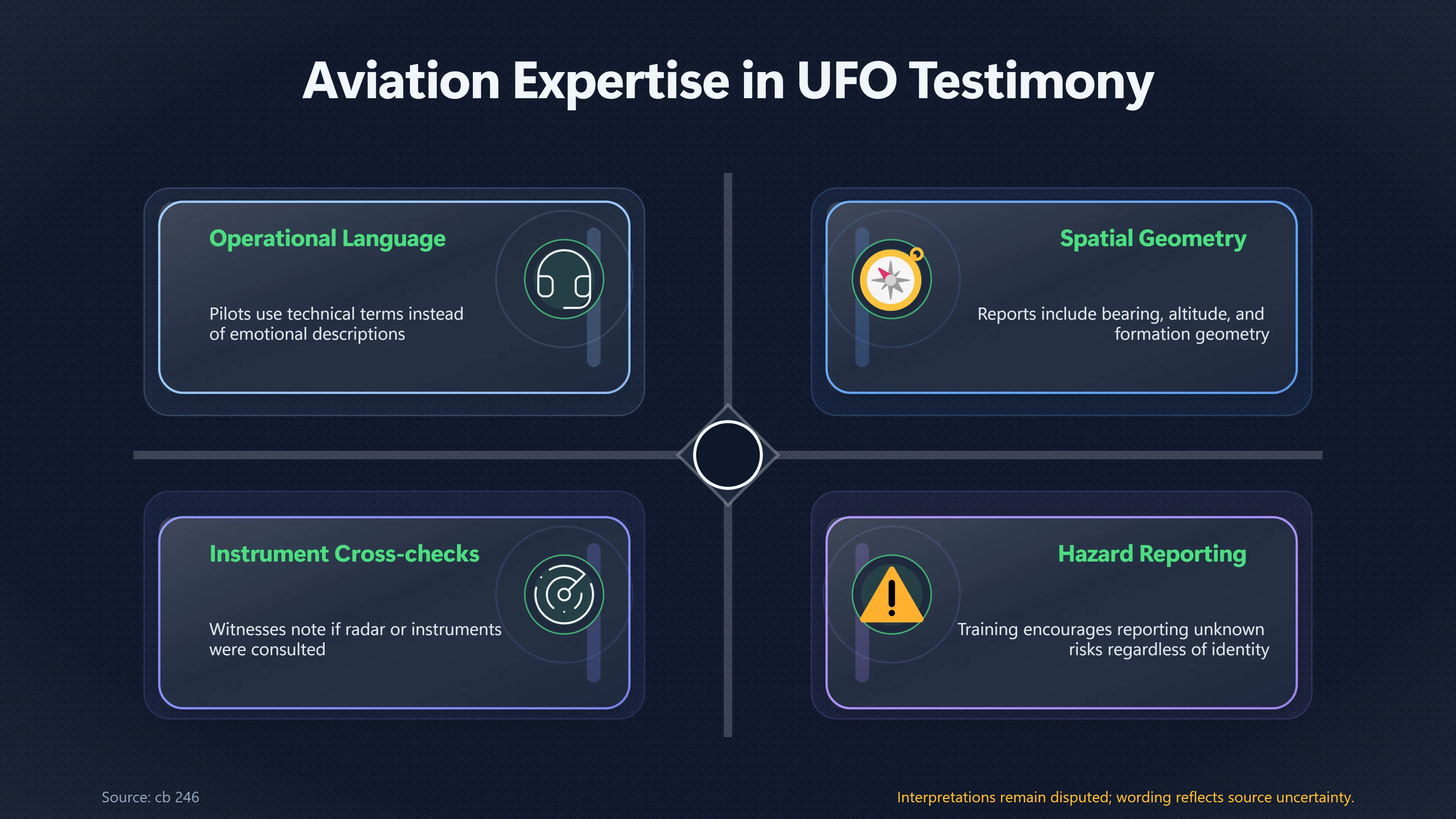
Pilots spend thousands of hours recognising ordinary aircraft lighting, judging relative motion, monitoring weather, communicating with air traffic control and scanning for potential conflicts. They are also trained to report observations in operational language rather than purely emotional terms. As a result, pilot reports often include useful information such as:
- Approximate bearing and altitude.
- Formation geometry.
- Whether lights appeared steady or flashing.
- Whether radar, instruments or air traffic control were consulted.
- The aircraft’s own position, heading and flight phase.
These details are considerably more useful than a general statement that “something strange was in the sky”. They provide investigators with information that can be compared against radar records, astronomical objects, satellite positions, military exercises and civilian traffic.
Importantly, aviation training also encourages pilots to report hazards even when they cannot identify them. From a flight-safety perspective, reporting an unknown object is appropriate because unidentified traffic represents a potential operational risk regardless of its eventual explanation.
None of these strengths, however, transform observational expertise into certainty about the object’s true nature.
Why familiar judgement does not transfer to unknown lights
The confidence gap appears because aviation expertise is highly specialised.
Pilots are trained to interpret objects within an environment that usually contains abundant visual references: runways, terrain, cloud layers, horizon lines, instrument readings and known aircraft lighting patterns. UFO reports frequently remove exactly those reference points.
A single bright light against a dark sky provides almost no direct information about:
- Distance.
- Physical size.
- Absolute speed.
- Direction of travel.
- Acceleration.
The visual system estimates these properties by comparing objects against surrounding cues. When those cues disappear, even experienced observers become vulnerable to perceptual errors.
NASA and FAA human-factors research has documented numerous situations in which highly trained pilots misjudge altitude, slope, movement and distance during night operations despite extensive experience. These errors arise from the limitations of human perception rather than inadequate training.[nasa.gov]ntrs.nasa.govNASA Technical Reports ServerHelicopter flights with night-vision goggles: Human factors aspects - NASA Technical Reports Server (NTRS)Ma…
This distinction explains why a pilot can accurately report what was seen while remaining mistaken about what caused it.
Why confidence often exceeds accuracy
Confidence is not random. It usually reflects the observer’s experience and willingness to make decisions under uncertainty.
Professional pilots are expected to make rapid judgements every day. That decision-making style is essential for aviation safety, but it does not automatically improve perception when the necessary information is unavailable.
Psychological research consistently shows that confidence and accuracy are related only under favourable viewing conditions. When sensory information becomes ambiguous, people—including experts—may remain highly confident despite increased error rates.
Night flying provides many examples.
NASA and FAA studies describe situations in which experienced pilots confidently perceived:
- another aircraft that proved to be a star or planet,
- incorrect glide paths,
- false horizons,
- misleading motion,
- erroneous distance estimates.
The confidence reflected honest perception rather than deliberate exaggeration, yet the interpretation proved incorrect because the visual evidence itself was misleading.[nasa.gov]asrs.arc.nasa.govcb 246CALLBACK 246December 1, 1999…
This same mechanism is directly relevant to many UFO reports involving isolated lights.
Night operations reveal the limits of expert vision
Night flying demonstrates why expertise has practical boundaries.
During daylight, pilots combine multiple cues simultaneously:
- texture on the ground,
- relative object size,
- cloud position,
- horizon orientation,
- motion parallax,
- instrument cross-checks.
Darkness removes many of these references.
Research dating back decades—and still informing modern flight training—shows that pilots can experience substantial visual illusions during night approaches, over water or featureless terrain, and under low-contrast conditions. Even experienced crews may misjudge glide angle, altitude or object location when environmental information becomes sparse.[bts.gov]rosap.ntl.bts.govMarch 1, 1978…
NASA’s work on night-vision systems similarly notes that reduced contrast, limited field of view and altered imagery can impair depth and distance estimation even for trained military aviators.[NASA Technical Reports Server]ntrs.nasa.govNASA Technical Reports ServerHelmet-mounted pilot night vision systems: Human factors issues - NASA Technical Reports Server (NTRS)July 1…
The lesson is broader than military equipment. Human visual perception itself has limits that training cannot eliminate.
Familiar aviation knowledge does not cover every phenomenon
Pilot expertise also has defined boundaries.
A commercial or private pilot is not automatically an expert in:
- atmospheric optics,
- astronomical observation,
- satellite appearance,
- military illumination flares,
- sensor artefacts,
- camera imaging,
- unusual meteorological effects.
Consequently, identifying an unfamiliar light may require knowledge outside normal flight training.
For example, Venus has repeatedly been mistaken for approaching aircraft during night operations because atmospheric conditions, motion of the observing aircraft and lack of visual references create convincing illusions of movement. NASA’s Aviation Safety Reporting System documents multiple cases where experienced pilots initially interpreted celestial objects as nearby traffic before recognising the perceptual error.[asrs.arc.nasa.gov]asrs.arc.nasa.govcb 246CALLBACK 246December 1, 1999…
These incidents do not demonstrate poor flying skills. Instead, they illustrate how unfamiliar stimuli can fall outside the pattern-recognition systems that normally serve pilots exceptionally well.

How investigators should separate description from interpretation
The most reliable investigations distinguish between observations and conclusions.
Descriptions include facts that can often be independently examined:
- time,
- location,
- bearing,
- weather,
- aircraft position,
- radio communications,
- duration,
- formation,
- lighting characteristics.
Interpretations are different. Statements such as:
- “it accelerated impossibly,”
- “it was enormous,”
- “it could not have been an aircraft,”
depend on assumptions about distance, orientation and scale that may not be directly observable.
Investigators therefore place greatest weight on information that can be cross-checked against independent evidence, including radar, flight tracks, air traffic recordings, satellite data and astronomical conditions.
This approach neither dismisses pilot testimony nor accepts it uncritically. Instead, it recognises that a highly reliable witness can accurately describe an unusual experience while reaching an incorrect explanation for what produced it.
What this means for celebrity pilot UFO accounts
Celebrity pilots occupy a distinctive position within UFO discussions because their professional credentials often increase public confidence in their reports.
That increased credibility is justified to a point. A pilot’s account deserves careful attention because it is likely to contain operationally useful observations and fewer basic aviation misunderstandings than an average eyewitness account.
However, celebrity status and aviation expertise should not be treated as substitutes for independent evidence.
The strongest assessment of any reported UFO encounter combines the witness’s experience with objective corroboration. Confidence can improve the quality of a report, but it cannot by itself establish the identity, distance or extraordinary nature of an observed object.
For that reason, modern aviation human-factors research and responsible UFO investigation reach a similar conclusion: the most valuable pilot testimony is descriptive rather than interpretive. A confident pilot may provide an excellent record of an event, but the accuracy of the explanation still depends on evidence beyond the witness’s certainty.
Amazon book picks
Further Reading
Books and field guides related to Does Pilot Confidence Make a UFO Claim Accurate?. Use these as the next step if you want deeper reading beyond the article.
UFOs: Generals, Pilots, and Government Officials Go on the Re...
NEW YORK TIMES BESTSELLER • Impeccably researched, this riveting journalistic investigation separates fact from fiction, and documents th...
Thinking, Fast and Slow
Why is there more chance we'll believe something if it's in a bold type face? Why are judges more likely to deny parole before lunch? Why...
The Invisible Gorilla: How Our Intuitions Deceive Us
NEW YORK TIMES BESTSELLER • Our minds don’t work the way we think they do. Two renowned psychologists explain how and why our intuitions...
The Confidence Game
A New York Times BestsellerThink you can't get conned? Think again. The bestselling author of Mastermind: How to Think Like Sherlock Holm...
eBay marketplace picks
Marketplace Samples
Live-tested eBay searches with available results related to this page.
Selected fromufo patch oneBay.co.uk.
Endnotes
1.
Source: ntrs.nasa.gov
Link:https://ntrs.nasa.gov/citations/19800034854
Source snippet
NASA Technical Reports ServerWhen day is done and shadows fall, we miss the airport most of all - NASA Technical Reports Server (NTRS)...
2.
Source: ntrs.nasa.gov
Link:https://ntrs.nasa.gov/archive/nasa/casi.ntrs.nasa.gov/19890012106.pdf
Source snippet
NASA Technical Reports ServerHelicopter flights with night-vision goggles: Human factors aspects - NASA Technical Reports Server (NTRS)Ma...
3.
Source: asrs.arc.nasa.gov
Title: cb 246
Link:https://asrs.arc.nasa.gov/publications/callback/cb_246.htm
Source snippet
CALLBACK 246December 1, 1999...
Published: December 1, 1999
4.
Source: faa.gov
Link:https://www.faa.gov/data_research/research/med_humanfacs/oamtechreports/1970s/1978/197815
5.
Source: rosap.ntl.bts.gov
Link:https://rosap.ntl.bts.gov/view/dot/21125
Source snippet
March 1, 1978...
Published: March 1, 1978
6.
Source: ntrs.nasa.gov
Link:https://ntrs.nasa.gov/citations/19900013614
Source snippet
NASA Technical Reports ServerHelmet-mounted pilot night vision systems: Human factors issues - NASA Technical Reports Server (NTRS)July 1...
7.
Source: human-factors.arc.nasa.gov
Title: Human Centered Systems Lab @ NASA Ames
Link:https://human-factors.arc.nasa.gov/groups/HCSL/research/enhancedvis.php
Source snippet
Human Centered Systems Lab @ NASA Ames - Research...
8.
Source: asrs.arc.nasa.gov
Title: CALLBAC K 220
Link:https://asrs.arc.nasa.gov/publications/callback/cb_220.htm
9.
Source: humansystems.arc.nasa.gov
Link:https://humansystems.arc.nasa.gov/groups/HCSL/publications.php
10.
Source: human-factors.arc.nasa.gov
Link:https://human-factors.arc.nasa.gov/groups/HCSL/research/fddisplays.php
11.
Source: ntrs.nasa.gov
Link:https://ntrs.nasa.gov/citations/20160001934
12.
Source: atsb.gov.au
Title: Avoidable Accidents No. 7
Link:https://www.atsb.gov.au/publications/avoidable-accidents/2013/aviation/avoidable-accidents-no-7-visual-flight-night
13.
Source: atsb.gov.au
Title: dark night take accidents australia
Link:https://www.atsb.gov.au/publications/research-and-analysis-report/2022/aviation/dark-night-take-accidents-australia
14.
Source: ntrs.nasa.gov
Link:https://ntrs.nasa.gov/search.jsp?R=19860047082
15.
Source: pubmed.ncbi.nlm.nih.gov
Title: Pub Med Optical Illusions and Spatial Disorientation in Aviation Pilots
Link:https://pubmed.ncbi.nlm.nih.gov/29557053/
Source snippet
Optical Illusions and Spatial Disorientation in Aviation Pilots - PubMedMarch 19, 2018...
Published: March 19, 2018
16.
Source: journals.sagepub.com
Title: Sage Journals Visual Illusions in Aviation: Simulating the Black Hole Phenomenon
Link:https://journals.sagepub.com/doi/10.1177/00187208261419347
Source snippet
Sage JournalsVisual Illusions in Aviation: Simulating the Black Hole Phenomenon - Arleen Aksay, Brittney Hartle, Robert S. Allison, Eliza...
17.
Source: pubmed.ncbi.nlm.nih.gov
Link:https://pubmed.ncbi.nlm.nih.gov/24919379/
18.
Source: trid.trb.org
Link:https://trid.trb.org/View/1312122
19.
Source: rosap.ntl.bts.gov
Link:https://rosap.ntl.bts.gov/view/dot/21105
20.
Source: skybrary.aero
Link:https://skybrary.aero/index.php/articles/visual-illusions
Additional References
21.
Source: youtube.com
Title: UFO Sightings: Navy Pilots Share Their Experiences | NOVA | PBS
Link:https://www.youtube.com/watch?v=4UP3c5UhlC8
Source snippet
Breakdown of the Pentagon UFO videos with Mick West This video is relevant because it features an empirical analysis demonstrating how pa...
22.
Source: ntsb.gov
Link:https://www.ntsb.gov/Advocacy/safety-alerts/Pages/default.aspx
23.
Source: ntsb.gov
Link:https://www.ntsb.gov/news/press-releases/Pages/NR20210209.aspx
24.
Source: sciencedirect.com
Link:https://www.sciencedirect.com/science/article/pii/S1529183907002734
25.
Source: tandfonline.com
Link:https://www.tandfonline.com/doi/abs/10.1080/10508414.2013.833755
26.
Source: narcap.org
Link:https://www.narcap.org/blog/flightdynamicsofuap
27.
Source: sciencedirect.com
Link:https://www.sciencedirect.com/science/article/pii/S0969699724000826
28.
Source: youtube.com
Title: Interview: Mick West, Identifying UFOs
Link:https://www.youtube.com/watch?v=lsMomLDKIz4
Source snippet
UFO Sightings: Navy Pilots Share Their Experiences | NOVA | PBS...
29.
Source: researchgate.net
Title: (PDF) Reliability of eyewitness reports to a major aviation accident
Link:https://www.researchgate.net/publication/268513973_Reliability_of_eyewitness_reports_to_a_major_aviation_accident
30.
Source: youtube.com
Title: Aviation visual illusions
Link:https://www.youtube.com/watch?v=zZOhH07h4Iw
Source snippet
Breakdown of the Pentagon UFO videos with Mick West...