Within Common Causes
When Ordinary Aircraft Appear to Make Impossible Moves
A turning aircraft, moving observer and missing horizon can make a steady light appear to dart, stop or accelerate without changing speed.
On this page
- How observer motion alters apparent target motion
- Why darkness removes distance and speed cues
- What flight and sensor data are needed to test acceleration claims
Page outline Jump by section
Introduction
A distant aircraft can appear to accelerate dramatically even when it is maintaining a constant speed and heading. At night, the effect becomes especially convincing because the observer often sees only one or two bright lights rather than the aircraft itself, while the horizon and other visual references disappear. As the viewing angle changes, a steady aircraft can seem to surge forwards, stop suddenly or dart sideways without undergoing any real change in velocity.
This optical effect is important when assessing UFO reports, including some involving celebrities, because eyewitnesses naturally describe what they perceive rather than the geometry of the encounter. Before any claim of extraordinary acceleration can be evaluated, investigators must reconstruct the positions and motions of both the observer and the aircraft. Modern aviation investigations and recent analyses by the US All-domain Anomaly Resolution Office (AARO) repeatedly show that apparent acceleration can arise from ordinary viewing geometry rather than extraordinary flight performance.[AARO]aaro.milUAP ImageryAARO UAP Imagery…
How observer motion alters apparent target motion
The key quantity is not an aircraft’s true speed but its angular motion across the observer’s field of view.
An aircraft flying directly across an observer’s line of sight produces obvious sideways movement. By contrast, one flying partly towards or away from the observer may travel hundreds of metres each second while appearing almost stationary because its direction changes only slightly. As either aircraft or observer changes position, this angular motion can increase or decrease rapidly even though the aircraft never changes speed.
The effect becomes stronger when the observer is also moving. Someone in a car, on another aircraft or even walking changes viewing angle continuously. A distant light that is effectively fixed in space can therefore appear to swing rapidly across the background as the observer’s own position changes. This is a form of motion parallax, in which apparent motion depends on relative geometry rather than on changes in the target’s velocity. FAA research has long recognised that reduced visual cues at night make motion-parallax judgements unreliable.[Federal Aviation Administration]faa.govFederal Aviation AdministrationOffice of Aerospace Medicine Technical Reports | Federal Aviation AdministrationMarch 1, 1978…
Aircraft turns can amplify the illusion further. Navigation lights, landing lights and wing-mounted lights become brighter or dimmer as their direction changes relative to the observer. When an aircraft rolls into or out of a turn, a landing light may suddenly point towards the witness, making the aircraft appear to leap forwards or accelerate. The increase in brightness is interpreted subconsciously as reduced distance, even though the aircraft may simply have rotated.
Why darkness removes distance and speed cues
During daylight, the brain estimates distance by comparing an aircraft with clouds, terrain, buildings and the visible horizon. Most of these reference points disappear after dark.
Without reliable depth cues, witnesses must estimate speed from only three pieces of information:
- the apparent movement of the light;
- changes in brightness;
- assumptions about distance.
These assumptions interact. If a witness unconsciously assumes the light is nearby, even a modest change in viewing angle implies an enormous sideways speed. If the same light is recognised as being tens of kilometres away, exactly the same apparent movement corresponds to ordinary aircraft flight.
Darkness also encourages the visual system to interpret isolated lights incorrectly. The FAA’s guidance for pilots notes that featureless dark scenes, obscured horizons and isolated lights can produce powerful visual illusions, including false impressions of movement and alignment. A stationary or slowly moving light may even appear to drift on its own when stared at for several seconds, a phenomenon known as autokinesis.[Federal Aviation Administration]faa.govFederal Aviation Administration Chapter 8. Medical Facts for PilotsFederal Aviation Administration Chapter 8. Medical Facts for Pilots
These effects do not require poor eyesight or inexperience. They arise because the human visual system evolved to judge motion against richly textured landscapes rather than isolated points of light suspended in darkness.

Why apparent acceleration is often mistaken for impossible manoeuvres
Many dramatic descriptions follow a similar sequence:
- the light appears stationary;
- it suddenly seems to surge sideways or upwards;
- it appears to stop again.
This pattern does not necessarily imply repeated acceleration and braking.
Instead, the observer’s changing viewpoint may briefly increase the apparent angular speed before reducing it again. The greatest visual change often occurs when an aircraft crosses a particular viewing angle relative to the observer rather than when the aircraft performs any unusual manoeuvre.
Missing the horizon makes this even harder to judge. If observers cannot distinguish whether they are turning, tilting their head or moving relative to the target, apparent changes in the light’s motion can easily be attributed to the object itself.
This is why eyewitness descriptions alone rarely permit reliable estimates of acceleration. Human observers are generally much better at reporting what they saw than at reconstructing the geometry that produced the appearance.
Modern examples from UFO investigations
Recent UAP investigations have demonstrated the importance of reconstructing geometry before estimating speed.
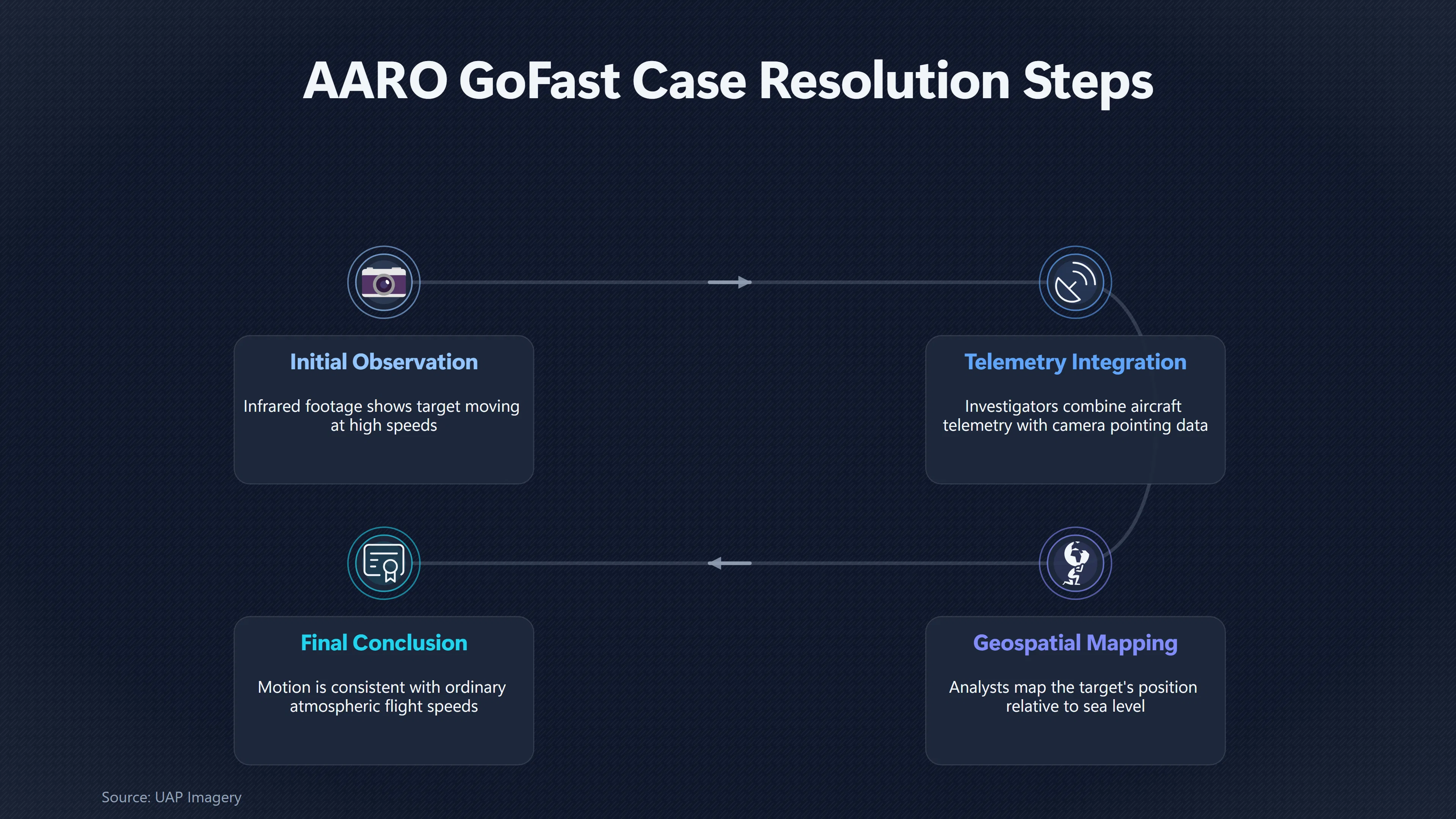
AARO’s analysis of the well-known GoFast infrared video concluded that the object’s apparent high speed resulted largely from viewing geometry and parallax. By combining aircraft telemetry, camera pointing information and geospatial analysis, investigators concluded that the object was much higher above the sea than initially assumed and was travelling at a speed consistent with ordinary atmospheric motion rather than extraordinary acceleration.[AARO]aaro.milUAP ImageryAARO UAP Imagery…
AARO reached similar conclusions in other reviewed cases where distant commercial aircraft initially appeared to perform unusual manoeuvres. In several instances, matching radar tracks and commercial flight data showed that apparently extraordinary targets were ordinary aircraft viewed from long range through a narrow sensor field of view.[AARO]aaro.milUAP ImageryAARO UAP Imagery…
These examples illustrate a broader investigative lesson: dramatic apparent motion in a camera or through the naked eye is not, by itself, reliable evidence of dramatic physical motion.
What flight and sensor data are needed to test acceleration claims
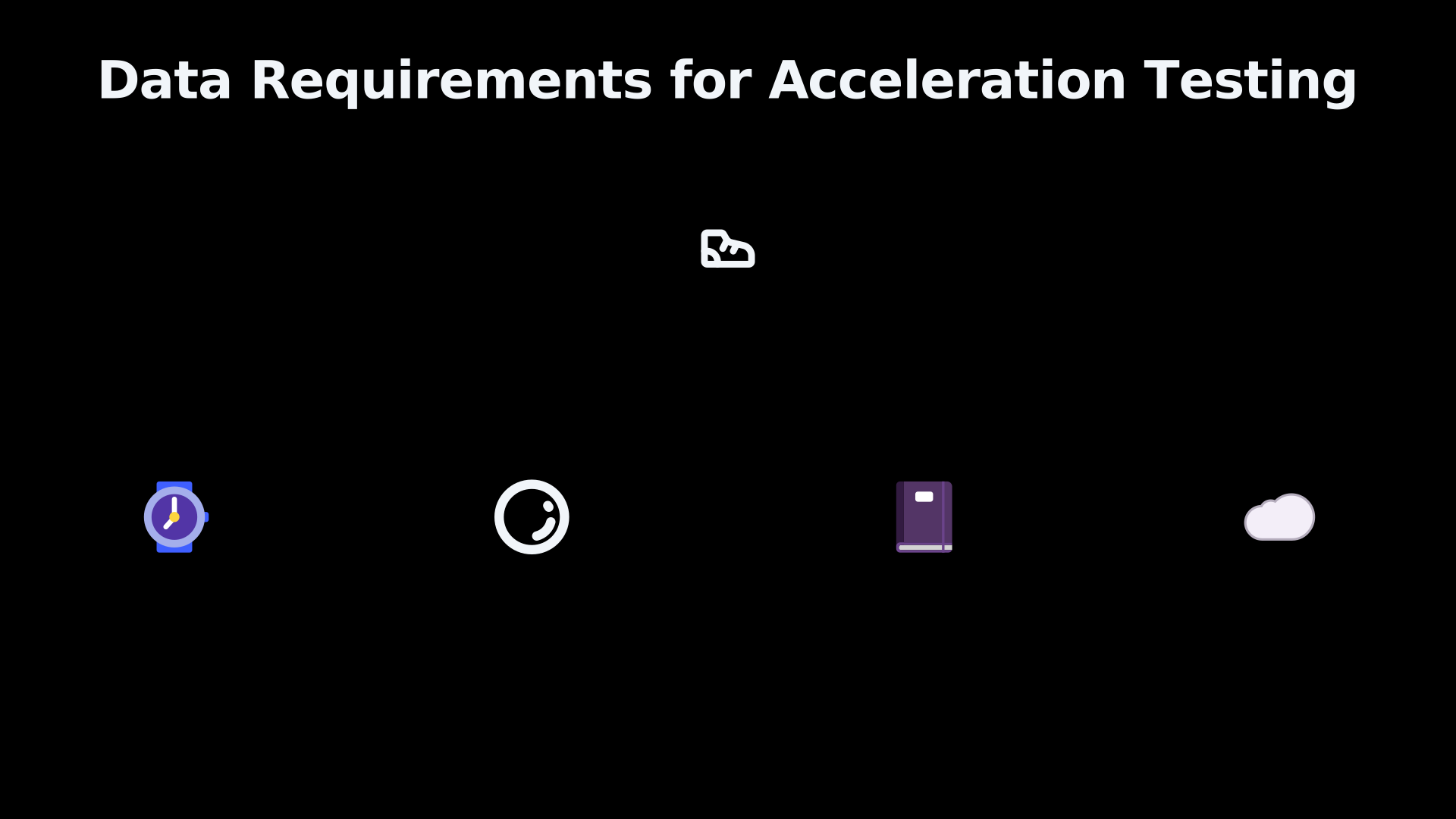
Investigators cannot determine whether an aircraft genuinely accelerated from eyewitness testimony alone. The minimum information needed includes:
- Observer position and movement, including whether the witness was walking, driving or flying.
- Precise time, allowing comparison with radar tracks and aircraft transponder records.
- Viewing direction and field of view, especially for cameras with zoom lenses or infrared sensors.
- Aircraft flight data, including heading, altitude and speed where available.
- Weather conditions, including visibility, haze and cloud layers that affect depth perception.
- Multiple independent viewpoints, allowing triangulation instead of relying on a single line of sight.
Without these data, apparent speed remains an impression rather than a measured quantity.
Why this mechanism matters when assessing UFO reports
Reports describing impossible acceleration deserve careful investigation rather than automatic dismissal. However, acceleration is one of the easiest flight characteristics to misjudge when only distant lights are visible.
A steady aircraft observed under changing geometry can appear to dart, pause or race across the sky despite maintaining essentially constant speed. For that reason, experienced investigators begin by reconstructing observer movement, viewing angle and available flight data before considering more unusual explanations.
Within the broader category of ordinary objects behind famous UFO reports, false acceleration is therefore not a minor visual curiosity but a central mechanism. It demonstrates how normal aircraft behaviour, combined with darkness and human perception, can produce some of the most striking and memorable descriptions of seemingly impossible aerial manoeuvres.
Amazon book picks
Further Reading
Books and field guides related to When Ordinary Aircraft Appear to Make Impossible Moves. Use these as the next step if you want deeper reading beyond the article.
Human Factors in Flight
The late Captain Frank H Hawkins FRAes, M Phil, was Human Factors Consultant to KLM, for whom he had flown for over 30 years as line capt...
The Invisible Gorilla: How Our Intuitions Deceive Us
NEW YORK TIMES BESTSELLER • Our minds don’t work the way we think they do. Two renowned psychologists explain how and why our intuitions...
The UFO Handbook: A Guide to Investigating, Evaluating, and R...
An explanation of the usual reasons for confusing IFOs (identified flying objects) with UFOs and a survey of the tools used to investigat...
Visual Perception: A Clinical Orientation
Provides a solid foundation for courses in visual perception. Featuring hundreds of drawings and photos, it covers the mechanisms and ass...
eBay marketplace picks
Marketplace Samples
Live-tested eBay searches with available results related to this page.
Selected fromairplane model oneBay.co.uk.



Endnotes
1.
Source: aaro.mil
Title: UAP Imagery
Link:https://www.aaro.mil/UAP-Cases/Official-UAP-Imagery/
Source snippet
AARO UAP Imagery...
2.
Source: faa.gov
Title: Federal Aviation Administration Chapter 8. Medical Facts for Pilots
Link:https://www.faa.gov/Air_traffic/publications/atpubs/aim_html/chap8_section_1.html
3.
Source: faa.gov
Link:https://www.faa.gov/data_research/research/med_humanfacs/oamtechreports/1970s/1978/197815
Source snippet
Federal Aviation AdministrationOffice of Aerospace Medicine Technical Reports | Federal Aviation AdministrationMarch 1, 1978...
Published: March 1, 1978
4.
Source: faa.gov
Link:https://www.faa.gov/data_research/research/med_humanfacs/oamtechreports/1970s/1977/197712
5.
Source: faa.gov
Title: 12 afh ch11
Link:https://www.faa.gov/sites/faa.gov/files/regulations_policies/handbooks_manuals/aviation/airplane_handbook/12_afh_ch11.pdf
Source snippet
Federal Aviation AdministrationAirplane Flying Handbook (FAA-H-8083-3C)...
6.
Source: aaro.mil
Title: [Puerto Rico]({{ ‘puerto-rico/’ | relative_url }}) Case Resolution Puerto Rico Object Digital System
Link:https://www.aaro.mil/Next-AARO-Home-redesign/Next-Parent/Next-AARO-UAP-Imagery-Acc-Table/
Source snippet
Next - AARO UAP Imagery Acc TableMay 8, 2026 — This reconstruction also demonstrates that the objects traveled in a straight line at wind...
Published: May 8, 2026
7.
Source: faa.gov
Title: Airman Education Programs | Federal Aviation Administration
Link:https://www.faa.gov/pilots/training/airman_education/topics_of_interest/spatial_disorientation
8.
Source: faa.gov
Title: Chapter 8. Medical Facts for Pilots
Link:https://www.faa.gov/air_traffic/publications/atpubs/aim/aim0801.html
9.
Source: faa.gov
Link:https://www.faa.gov/air_traffic/publications/atpubs/aip_html/chap8_section_1.html
10.
Source: faa.gov
Link:https://www.faa.gov/air_traffic/publications/atpubs/aip_html/chap7_section_6.html
11.
Source: aaro.mil
Link:https://www.aaro.mil/Next-AARO-Home-redesign/Inactive-Parent/FAQ-Datatable/
12.
Source: aaro.mil
Link:https://www.aaro.mil/UAP-Cases/Official-UAP-Imagery/ftag/MSF0951a18/
13.
Source: aaro.mil
Link:https://www.aaro.mil/FAQ/
14.
Source: aaro.mil
Title: UAP Imagery* “Go Fast” Object NAVAIR
Link:https://www.aaro.mil/Next-AARO-Home-redesign/Inactive-Parent/Next-UAP-Imagery-dup/
Additional References
15.
Source: ufotransparency.com
Link:https://ufotransparency.com/files/decade-2020s-aaro-gofast-case-resolution-2025-aaro-gofast-case-resolution-card-methodology-final
Source snippet
Department of Defense · 2025 · UFO TransparencyFebruary 6, 2025 — [Button: ✕]← FilesDisclosure Index/01 DISCLOSURES/FILES/2020S/AARO Reso...
Published: February 6, 2025
16.
Source: unexplained.ie
Title: International A newly released report from the United States Departmen
Link:https://www.unexplained.ie/article/1161-aaro-analysis–go-fast-uap-shows-no-anomalous-movement/
Source snippet
AARO Analysis - ’Go Fast’ UAP Shows No Anomalous Movement - Unexplained.ie - Unexplained Mysteries, Phenomena & DisappearancesFebruary 13...
17.
Source: aatip.com
Title: UAP Case Files & Official Reports | AATIP.com
Link:https://www.aatip.com/inpage/case-files/
Source snippet
Recorded by a U.S. Navy F/A-18F in January 2015 off Florida, GoFast appears to show a small target raci...
Published: January 2015
18.
Source: youtube.com
Title: Why Do Airplanes Sometimes “STOP” in the Sky? (It’s Not an Illusion)
Link:https://www.youtube.com/watch?v=aczDrrZQIBI
Source snippet
Breaking Down UAP Footage with the Head of The Pentagon's UAP Taskforce, Dr. Jon Kosloski...
19.
Source: youtube.com
Link:https://www.youtube.com/watch?v=mvsU4p0Gsas
Source snippet
Pentagon UFO Footage Looks Impossible. Here's the Catch...
20.
Source: youtube.com
Title: The SHOCKING Math Error Behind Viral UFO Videos | Mick West
Link:https://www.youtube.com/watch?v=ypfbhfEXnBo
Source snippet
3 Ways your BRAIN Tricks You into Thinking AIRPLANES HOVER...
21.
Source: youtube.com
Title: Breakdown of the Pentagon UFO videos with Mick West
Link:https://www.youtube.com/watch?v=Le7Fqbsrrm8
Source snippet
Why Do Airplanes Sometimes “STOP” in the Sky? (It's Not an Illusion)...
22.
Source: youtube.com
Title: 3 Ways your BRAIN Tricks You into Thinking AIRPLANES HOVER!
Link:https://www.youtube.com/watch?v=3osSwf7dgUI
Source snippet
Breakdown of the Pentagon UFO videos with Mick West...
23.
Source: youtube.com
Title: How scientists use math to help explain UFO videos
Link:https://www.youtube.com/watch?v=diPXow8zgc8
Source snippet
The SHOCKING Math Error Behind Viral UFO Videos | Mick West...
24.
Source: uap-archive.org
Link:https://uap-archive.org/uap/learn/aaro-case-resolution-reports-overview/