Within NASA Standard
Inside a Scientific Observatory Built to Study UAPs
A dedicated observatory could combine triangulation, multispectral cameras, radio receivers and environmental sensors in one traceable system.
On this page
- Core instruments and the questions they answer
- How separated viewpoints calculate position and motion
- Baseline monitoring of aircraft, birds, weather and noise
Page outline Jump by section
Introduction
A ground-based UAP (Unidentified Anomalous Phenomena) observatory is designed to answer a simple scientific question: what was actually in the sky? Rather than relying on isolated eyewitness accounts or a single camera recording, such an observatory continuously monitors the atmosphere with multiple calibrated instruments that observe the same event from different perspectives. This approach closely reflects the standards promoted by NASA’s independent UAP study, which argues that future progress depends on synchronised, high-quality measurements with complete metadata rather than more anecdotal reports.[NASA Science]science.nasa.govScience UAPNASA ScienceUAP - NASA ScienceFebruary 23, 2026…
Within the broader discussion of UFOs and celebrity sightings, a purpose-built observatory shifts attention away from who reported an event and towards what the instruments measured. Whether an unusual object is eventually identified as an aircraft, balloon, atmospheric effect or something genuinely unexplained, the objective is to gather enough independent evidence for the conclusion to be tested by other researchers.
Core instruments and the questions they answer
A scientific observatory does not rely on one “perfect” sensor. Instead, it combines complementary instruments that compensate for one another’s limitations.
A typical multimodal observatory would include:
- Wide-field visible-light cameras that continuously watch large areas of sky and detect transient objects.
- High-resolution tracking cameras that automatically zoom onto selected targets once detected.
- Infrared cameras that measure thermal signatures invisible to the human eye and continue operating at night.
- Passive radar receivers, which estimate position and motion using existing commercial radio transmissions rather than emitting radar pulses.
- Radio spectrum analysers that record radio-frequency emissions associated with an event.
- Acoustic sensors, including microphones covering audible, infrasonic and ultrasonic frequencies.
- Environmental instruments measuring temperature, humidity, atmospheric pressure, wind, electric and magnetic fields and other background conditions.[Galileo Project]galileo.hsites.harvard.eduGalileo ProjectThe Scientific Investigation of Unidentified Aerial Phenomena (UAP) Using Multimodal Ground-Based Observatories | The Gali…
Each instrument answers a different question.
Visible cameras determine appearance and motion across the sky. Infrared systems establish whether an object emits or reflects heat. Passive radar estimates range and velocity independently of optical images. Radio receivers determine whether the object produces detectable electromagnetic emissions. Environmental sensors help distinguish unusual observations from atmospheric phenomena or local interference.
Crucially, agreement between several independent sensors provides far stronger evidence than any single measurement. If one camera reports an extraordinary manoeuvre but radar, infrared and triangulation do not support it, investigators immediately have reason to suspect an optical artefact or processing error rather than a genuinely unusual object.[Galileo Project]galileo.hsites.harvard.eduGalileo ProjectThe Scientific Investigation of Unidentified Aerial Phenomena (UAP) Using Multimodal Ground-Based Observatories | The Gali…
How separated viewpoints calculate position and motion
One of the largest weaknesses of many historical UFO reports is that they cannot establish distance.
A single camera records only the direction in which an object appears. Without knowing range, investigators cannot reliably calculate its size, altitude or speed. A nearby insect and a distant aircraft can produce surprisingly similar apparent motion in a two-dimensional image.
Purpose-built observatories address this problem through triangulation.
If two or more stations observe the same object simultaneously from accurately surveyed locations, each camera records a different viewing angle. Combining these observations allows software to reconstruct the object’s three-dimensional position. Repeating the calculation frame by frame produces estimates of:
- altitude
- horizontal position
- velocity[galileo.hsites.harvard.edu]galileo.hsites.harvard.eduSource details in endnotes.
- direction of travel
- acceleration
Because timing is synchronised—typically using GPS or similarly accurate clocks—the reconstruction does not depend on human estimates of when an event occurred.[Galileo Project]galileo.hsites.harvard.eduGalileo ProjectThe Scientific Investigation of Unidentified Aerial Phenomena (UAP) Using Multimodal Ground-Based Observatories | The Gali…
Passive multistatic radar can strengthen these calculations further. Instead of transmitting its own signal, the system analyses reflections from existing FM radio broadcasts received at several locations. By comparing the timing and Doppler shifts of reflected signals across multiple receivers, researchers can estimate three-dimensional trajectories independently of the optical cameras. The resulting radar measurements can then be compared directly with the optical reconstruction.[Galileo Project]galileo.hsites.harvard.eduOpen source on harvard.edu.

Baseline monitoring of aircraft, birds, weather and noise
An effective UAP observatory spends most of its time documenting entirely ordinary events.
This continuous baseline is scientifically important because researchers need to understand what “normal” looks like before identifying statistical outliers.
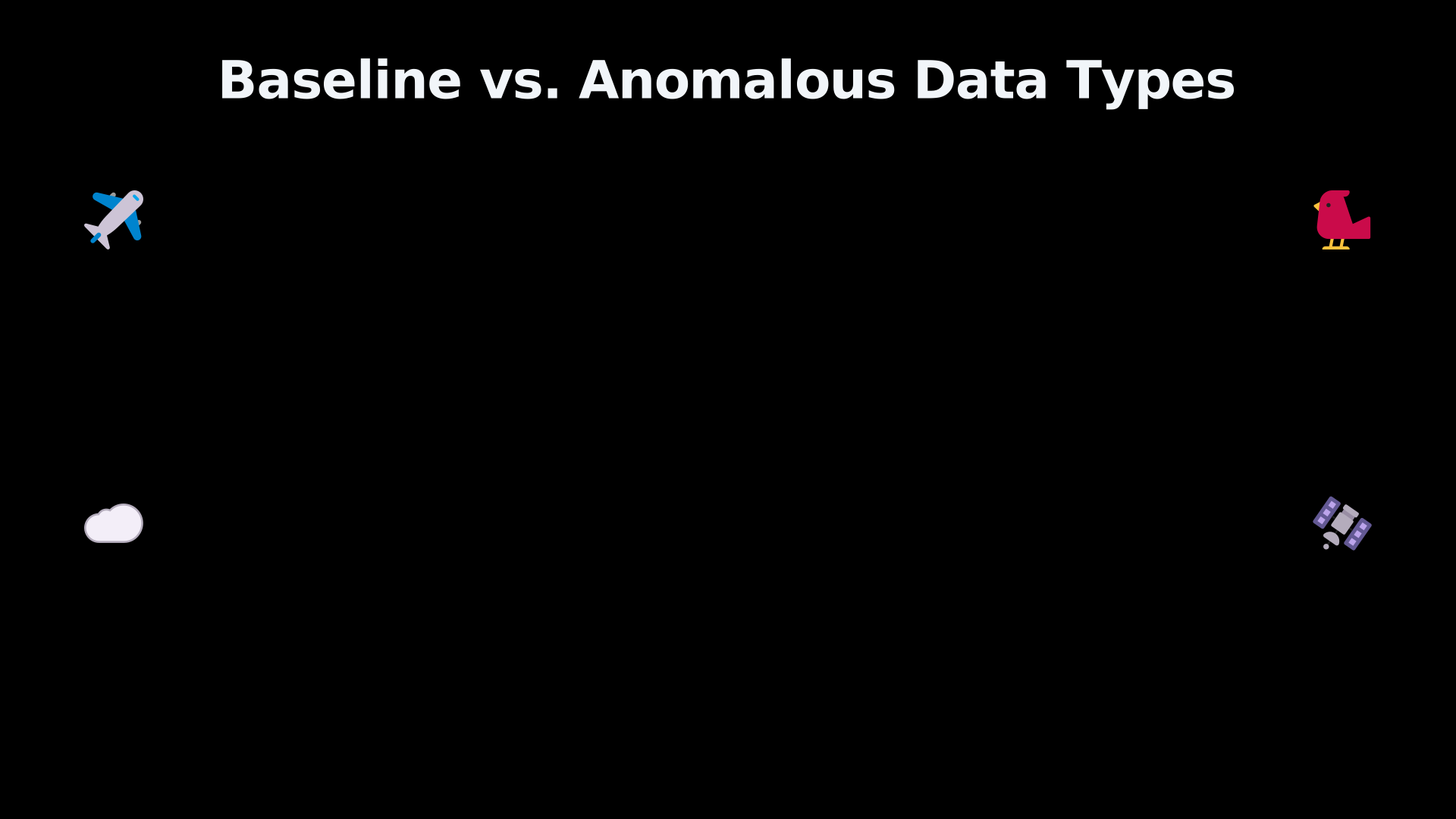
Typical observations include:
- commercial aircraft
- helicopters
- satellites
- birds
- insects
- drones
- balloons
- meteors
- clouds
- atmospheric turbulence
- astronomical objects
The observatory therefore builds a large reference library describing how common objects appear across different sensors under varying weather and lighting conditions. Rather than beginning with presumed anomalies, the system first learns the signatures of known phenomena.[Galileo Project]galileo.hsites.harvard.eduGalileo ProjectThe Scientific Investigation of Unidentified Aerial Phenomena (UAP) Using Multimodal Ground-Based Observatories | The Gali…
Environmental monitoring is equally important. Wind speed, humidity, cloud cover, temperature and atmospheric stability can all influence optical imaging and infrared measurements. Recording these variables continuously allows later investigators to determine whether unusual observations coincided with conditions known to produce mirages, thermal distortions or other observational effects.
Automated filtering before human investigation
Because modern observatories can generate enormous quantities of data, much of the initial analysis must be automated.
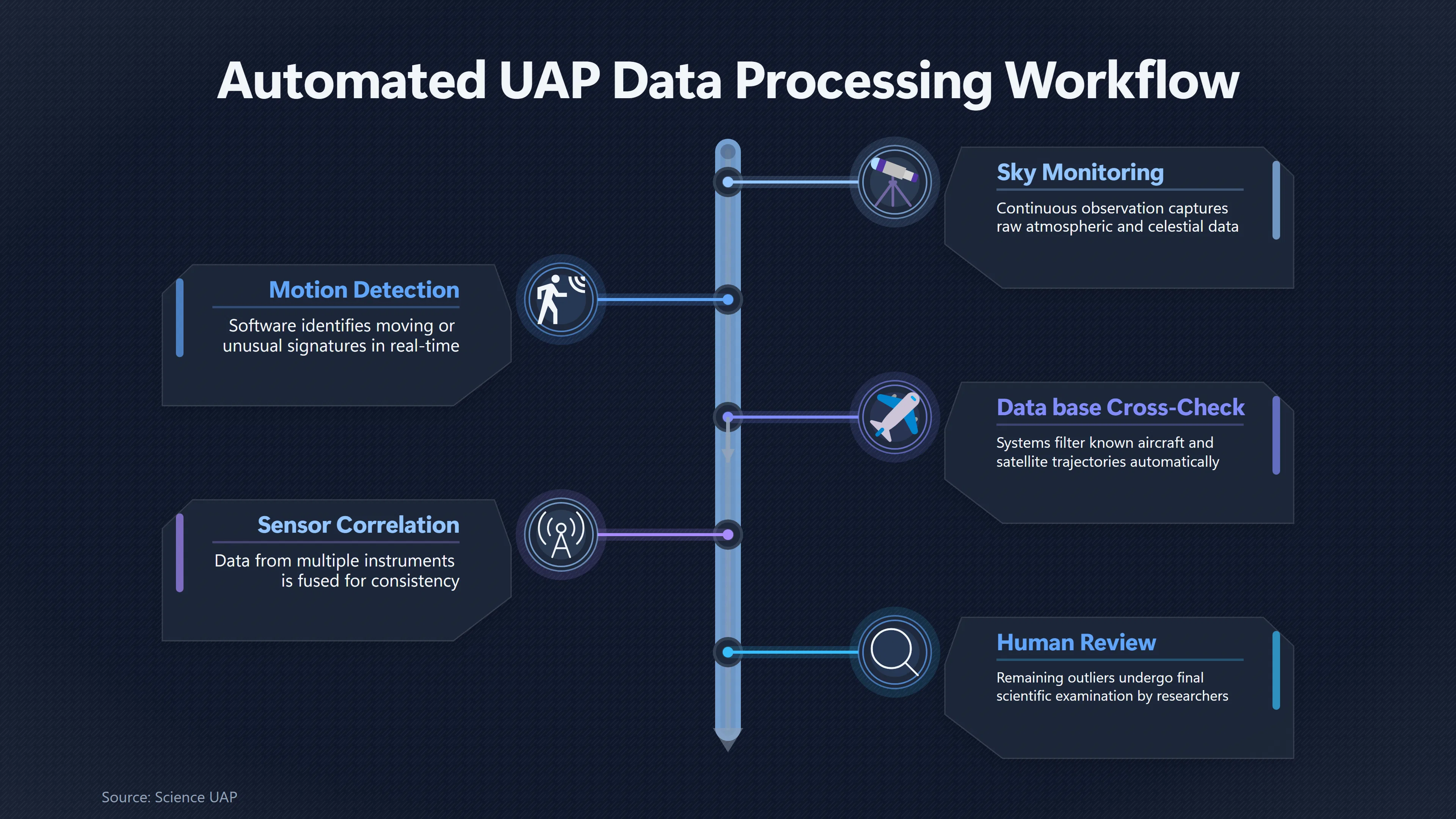
A typical workflow follows several stages:
- Continuous sky monitoring.
- Automatic detection of moving or unusual objects.
- Cross-checking against known aircraft tracking, satellites and astronomical databases where available.
- Correlation between multiple sensors.
- Identification of events that remain inconsistent with known categories.
- Human review of the remaining candidate cases.
Researchers developing multimodal observatories describe data-fusion pipelines that combine measurements from different instruments, track objects over time and identify statistical outliers rather than attempting to label every event immediately. The emphasis is on narrowing thousands of ordinary detections into a much smaller number deserving closer scientific examination.[Galileo Project]galileo.hsites.harvard.eduGalileo ProjectThe Scientific Investigation of Unidentified Aerial Phenomena (UAP) Using Multimodal Ground-Based Observatories | The Gali…
Calibration matters as much as the sensors
Adding more cameras alone does not improve scientific quality.
Every instrument must be calibrated so investigators understand exactly how it behaves. Calibration includes factors such as:
- lens distortion
- camera orientation
- timing accuracy
- pixel scale
- detector sensitivity
- thermal response
- measurement uncertainty
Without calibration, even expensive equipment can produce misleading measurements.
Recent work on experimental infrared observatories illustrates this principle. Researchers calibrated all-sky infrared camera arrays using independently verified aircraft positions from Automatic Dependent Surveillance–Broadcast (ADS-B) transmissions, allowing measured object positions to be compared against known trajectories before searching for anomalies. During commissioning, the systems reconstructed hundreds of thousands of ordinary aircraft tracks to establish baseline performance before interpreting any unusual detections.[arXiv]arxiv.orgCommissioning An All-Sky Infrared Camera Array for Detection Of Airborne ObjectsNovember 12, 2024…
Why continuous observation is more valuable than rare sightings
Many well-known UFO incidents—including those involving celebrities or prominent witnesses—were unexpected events recorded only after they began. Important contextual information was therefore never collected.
A permanent observatory changes this sequence.
Instead of reacting after someone reports an unusual object, it records the surrounding sky continuously before, during and after every event. This preserves information that eyewitness accounts usually lack, including changing weather conditions, nearby aircraft activity, multiple viewing angles and complete timing records.
The result is not necessarily more unexplained phenomena. In fact, the expectation is often the opposite: better measurements should allow more cases to be confidently identified. The scientific value lies equally in resolving ordinary events and in isolating the small number that remain unexplained despite comprehensive observations. This philosophy closely matches NASA’s recommendation that future UAP research should prioritise calibrated, transparent, multisensor observations over isolated testimony or incomplete recordings.[nasa.gov]science.nasa.govScience UAPNASA ScienceUAP - NASA ScienceFebruary 23, 2026…
Amazon book picks
Further Reading
Books and field guides related to Inside a Scientific Observatory Built to Study UAPs. Use these as the next step if you want deeper reading beyond the article.
The Backyard Astronomer's Guide
The touchstone for contemporary stargazers. This classic, groundbreaking guide has been the go-to field guide for both beginning and expe...
The UFO Experience: A Scientific Inquiry
Cited by the New York Review of Books as "the best brief for visitation," this classic study presents an analysis of UFO reports and conc...
Introduction to Radar Systems
Since the publication of the second edition of "Introduction to Radar Systems," there has been continual development of new radar capabil...
Turn Left at Orion
With over 100,000 copies sold since first publication, this is one of the most popular astronomy books of all time. It is a unique guideb...
eBay marketplace picks
Marketplace Samples
Live-tested eBay searches with available results related to this page.
Selected fromUFO poster oneBay.co.uk.



Endnotes
1.
Source: science.nasa.gov
Title: Science UAP
Link:https://science.nasa.gov/uap/
Source snippet
NASA ScienceUAP - NASA ScienceFebruary 23, 2026...
Published: February 23, 2026
2.
Source: nasa.gov
Title: UPDATE: NASA Shares UAP Independent Study Report; Names Director
Link:https://www.nasa.gov/news-release/update-nasa-shares-uap-independent-study-report-names-director/
Source snippet
UPDATE: NASA Shares UAP Independent Study Report; Names Director - NASA...
3.
Source: arxiv.org
Title: arXiv Galileo Project Observatory Class System Architecture
Link:https://arxiv.org/abs/2506.00125
4.
Source: arxiv.org
Link:https://arxiv.org/abs/2411.07956
Source snippet
Commissioning An All-Sky Infrared Camera Array for Detection Of Airborne ObjectsNovember 12, 2024...
Published: November 12, 2024
5.
Source: heasarc.gsfc.nasa.gov
Title: ixpe prop
Link:https://heasarc.gsfc.nasa.gov/docs/ixpe/proposals/ixpe_prop.html
Source snippet
Proposals and ToolsMay 26, 2026 — IXPE PROPOSALS AND TOOLS - CYCLE 4 * * * GENERAL OBSERVER PROGRAM * Cycle 4 proposals due: Sep 17th (Th...
Published: May 26, 2026
6.
Source: techport.nasa.gov
Link:https://techport.nasa.gov/projects/117026
Source snippet
ProjectMarch 2, 2026 — NASA Innovative Advanced Concepts HYBRID OBSERVATORY FOR EARTH-LIKE EXOPLANETS (HOEE) (HOEE) Updated 03...
Published: March 2, 2026
7.
Source: nasa.gov
Title: NAS A Selects Tech Proposals to Advance Search-for-Life Mission
Link:https://www.nasa.gov/news-release/nasa-selects-tech-proposals-to-advance-search-for-life-mission/
8.
Source: nasa.gov
Title: NAS A Announces Unidentified Aerial Phenomena Study Team Members
Link:https://www.nasa.gov/general/nasa-announces-unidentified-aerial-phenomena-study-team-members/
9.
Source: nasa.gov
Title: Hybrid Observatory for Earth-like Exoplanets
Link:https://www.nasa.gov/general/hybrid-observatory-for-earth-like-exoplanets-hoee/
10.
Source: galileo.hsites.harvard.edu
Link:https://galileo.hsites.harvard.edu/publications/scientific-investigation-unidentified-aerial-phenomena-uap-using-multimodal
Source snippet
Galileo ProjectThe Scientific Investigation of Unidentified Aerial Phenomena (UAP) Using Multimodal Ground-Based Observatories | The Gali...
11.
Source: galileo.hsites.harvard.edu
Link:https://galileo.hsites.harvard.edu/publications/skywatch-passive-multistatic-radar-network-measurement-object-position-and
12.
Source: galileo.hsites.harvard.edu
Title: Galileo Project Frequently Asked Questions | The Galileo Project
Link:https://galileo.hsites.harvard.edu/FAQ
13.
Source: galileo.hsites.harvard.edu
Link:https://galileo.hsites.harvard.edu/
14.
Source: skywatch.com
Title: Satellite Imagery & Geospatial Data | Sky Watch
Link:https://skywatch.com/
15.
Source: galileo.hsites.harvard.edu
Link:https://galileo.hsites.harvard.edu/search
16.
Source: galileo.hsites.harvard.edu
Title: integrated computing platform detection and tracking unidentified aerial
Link:https://galileo.hsites.harvard.edu/publications/integrated-computing-platform-detection-and-tracking-unidentified-aerial
Additional References
17.
Source: ufouap.com
Title: MULTIMODAL GROUND-BASED OBSERVATORIES The core concept is a conti
Link:https://www.ufouap.com/articles/galileo-project-scientific-alternative-uap-disclosure-2026/
Source snippet
The Galileo Project – What Harvard's UFO Observatory Has Actually Built, Found, and Promised — UFOUAPMarch 5, 2026 — WHAT THEY’VE BUILT T...
Published: March 5, 2026
18.
Source: youtube.com
Title: The Galileo Project’s First Data on Half a Million Objects with Avi Loeb
Link:https://www.youtube.com/watch?v=uJtER5ahdPY
Source snippet
Science Café: Looking for Signs of Interstellar Intelligent Life: The Galileo Project...
19.
Source: researchgate.net
Link:https://www.researchgate.net/publication/371163081_SkyWatch_A_Passive_Multistatic_Radar_Network_for_the_Measurement_of_Object_Position_and_Velocity
20.
Source: youtube.com
Title: Exploring the UFO/UAP Phenomenon
Link:https://www.youtube.com/watch?v=G1uOZwNDqqQ
Source snippet
The Galileo Project - Public Talk by Avi Loeb...
21.
Source: youtube.com
Title: Could There Be Alien Artifacts Orbiting Us? With Dr. Avi Loeb
Link:https://www.youtube.com/watch?v=tNCh6iQGbuk
Source snippet
Exploring the UFO/UAP Phenomenon...
22.
Source: researchgate.net
Title: (PDF) Galileo Project Observatory Class System Architecture
Link:https://www.researchgate.net/publication/392334596_Galileo_Project_Observatory_Class_System_Architecture
23.
Source: pubmed.ncbi.nlm.nih.gov
Link:https://pubmed.ncbi.nlm.nih.gov/39943425
24.
Source: youtube.com
Title: The Galileo Project
Link:https://www.youtube.com/watch?v=YSxF8SuTBtU
25.
Source: pmc.ncbi.nlm.nih.gov
Link:https://pmc.ncbi.nlm.nih.gov/articles/PMC11820869/
26.
Source: authors.library.caltech.edu
Title: rcjwj zr809
Link:https://authors.library.caltech.edu/records/rcjwj-zr809