Within Media Amplification
When Repetition Makes a UFO Claim Seem Verified
Repeated clips, quotes and articles can make a single celebrity account appear independently confirmed when every version traces to one source.
On this page
- How one statement becomes many searchable references
- Why repeated coverage can mimic independent confirmation
- Ways readers can trace a claim to its original source
Page outline Jump by section
Introduction
Celebrity UFO stories can appear to become stronger over time even when no new evidence emerges. The key mechanism is not necessarily the addition of independent witnesses or physical evidence, but repetition. A remark made in a single interview may later appear in news articles, documentaries, podcasts, social media clips, blog posts and television segments. To a casual reader, dozens of searchable references can resemble multiple confirmations when, in reality, they all originate from the same statement.
This distinction matters because public familiarity is not the same as verification. Research in psychology shows that repeated claims often feel more credible simply because they become familiar, while journalism and information science distinguish between independent corroboration and repeated reporting of one source. These ideas help explain why celebrity UFO accounts can seem increasingly established without the underlying evidence materially changing.[ScienceDirect]sciencedirect.comThe illusory truth effect: A review of how repetition increases belief in misinformation - ScienceDirect…
How one statement becomes dozens of searchable references
The process usually follows a recognisable pattern.
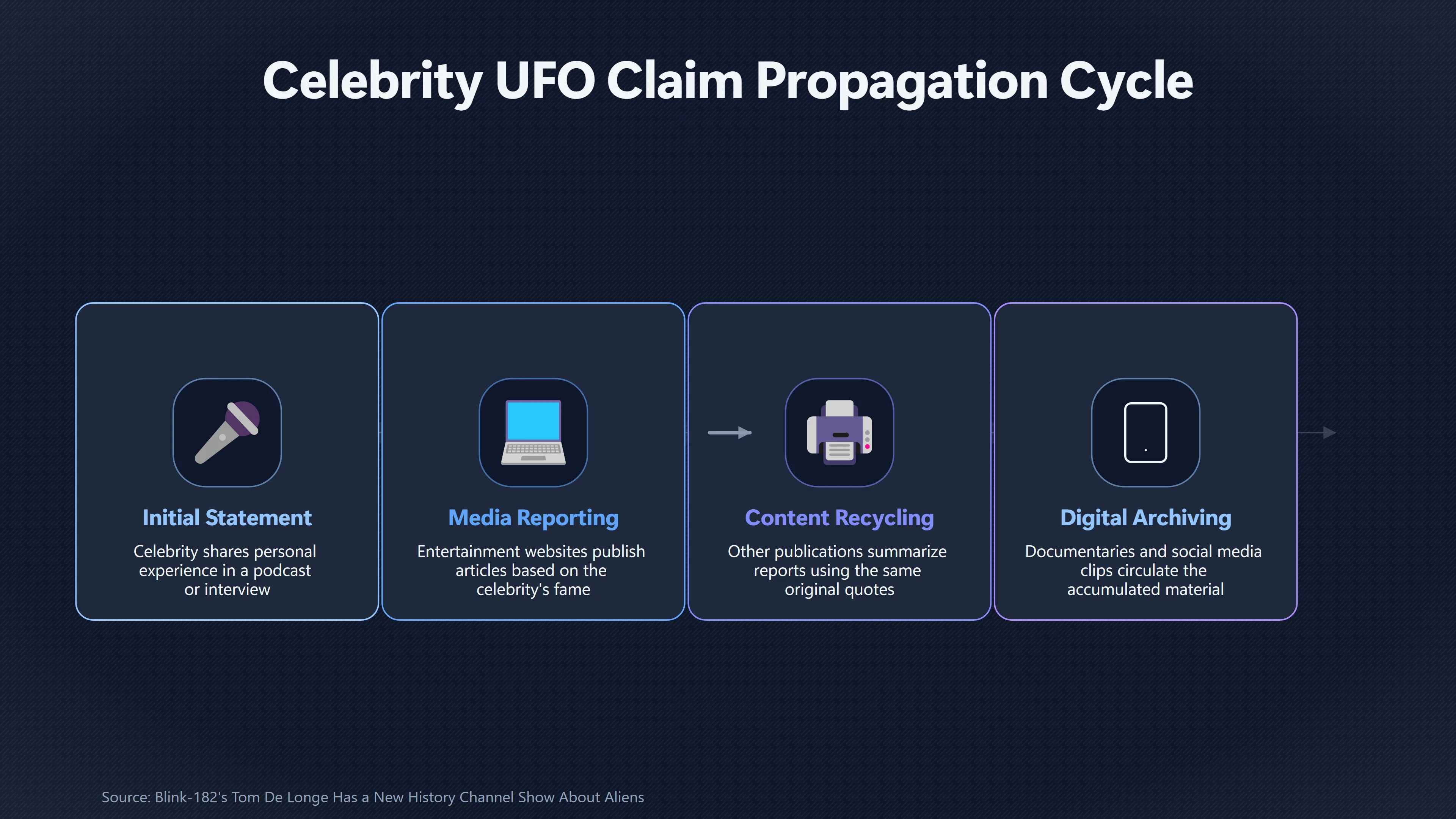
A celebrity mentions an unusual experience during an interview, podcast or television appearance. Entertainment websites report the interview because the individual is already newsworthy. Other publications summarise those reports, often quoting the same passages rather than conducting fresh reporting. Clips circulate on social media, where users repost the same excerpt. Later documentaries and podcasts cite these existing articles as background.
By this stage, searching for the claim may produce hundreds of results. Yet many of those results are not independent investigations. They are different presentations of the same original testimony.
This matters because search engines reward popularity and linkage rather than evidential independence. A large number of webpages discussing the same quotation does not automatically indicate that multiple witnesses, documents or measurements support it.
Why repeated coverage can look like independent confirmation
Readers naturally use shortcuts when judging information. One of the best-established findings in cognitive psychology is the illusory truth effect: repeated statements are more likely to be judged as true or plausible simply because they are familiar. The effect has been observed across many kinds of information, including news headlines and misinformation, although repetition alone does not make a claim factually correct.[sciencedirect.com]sciencedirect.comThe illusory truth effect: A review of how repetition increases belief in misinformation - ScienceDirect…
In the context of celebrity UFO stories, repetition creates several misleading signals:
- Source multiplication. Ten articles may appear to represent ten sources, even if every article traces back to one interview.
- Platform diversity. Seeing the claim in newspapers, podcasts and documentaries can create the impression that different communities independently verified it.
- Time persistence. Claims repeated over several years may seem increasingly established despite no additional evidence emerging.
- Search visibility. High-ranking search results often favour widely discussed topics, making repeated claims easier to find than less-publicised but better-documented investigations.
None of these effects proves that a celebrity account is false. They simply illustrate why visibility should not be confused with corroboration.
Celebrity status accelerates the repetition cycle
Famous people receive media attention that unknown witnesses rarely attract. Editors may cover the interview because of the celebrity rather than because the UFO account has been independently investigated.
This produces a feedback loop:
- The celebrity makes a claim.
- Mainstream entertainment media report it.
- Specialist UFO outlets discuss the mainstream coverage.
- General news later cites both the original interview and the subsequent discussion.
- Documentaries, podcasts and social media recycle the accumulated material.
Each step increases public exposure while often adding little or no new factual information. The expanding archive reflects growing attention rather than growing evidential support.
A practical example of citation recycling
Tom DeLonge’s public discussions of UFOs illustrate how this mechanism can operate. Over many years he has given interviews, appeared on podcasts, published books, produced television programmes and spoken through his organisation, To The Stars Academy. As a result, many articles reference earlier interviews rather than newly obtained evidence.
This does not mean every claim associated with DeLonge rests on a single source. Some later reporting concerns official documents, military videos or government investigations that have their own evidential histories. However, many statements about his personal beliefs, alleged conversations or interpretations are repeatedly quoted from the same interviews, creating a much larger media footprint than the underlying number of primary sources would suggest.[Pitchfork]pitchfork.comBlink-182's Tom De Longe Has a New History Channel Show About AliensElizondo now serves as Director of Global Security & Special Programs at the To The Stars Academy of Arts & Science, co-founded by DeLong…
The distinction is important: reporting that official material exists is different from independently confirming every interpretation offered by a celebrity discussing that material.
Why repeated reporting is not the same as corroboration
Independent confirmation requires evidence that does not rely on the original claimant.
For a celebrity UFO account, stronger corroboration might include:
- independent eyewitnesses who were not influenced by the celebrity’s account;
- authenticated government or institutional records;
- radar, sensor or photographic data that can be examined separately;
- contemporaneous documentation created before the story became widely known;
- investigators reaching similar conclusions through separate evidence.
By contrast, multiple articles repeating the same quotation, however reputable their publications, usually represent repeated reporting rather than independent verification.
Journalists frequently distinguish between reporting that a person made a claim and reporting that the claim has been confirmed. Readers benefit from making the same distinction.
Ways readers can trace a claim back to its original source
When evaluating a widely repeated celebrity UFO story, it helps to ask a few simple questions.
Can you identify the first public statement? Locate the earliest interview, broadcast or publication instead of relying on summaries.
Are later articles adding evidence or only repeating quotations? New reporting should introduce additional documents, witnesses or independently gathered information.
Do citations eventually loop back to the same interview? If many articles ultimately reference one podcast or television appearance, they are not independent confirmations.
Has any independent investigation reached the same conclusion? Separate reporting based on different evidence carries greater evidential weight than repeated commentary.
Is the article reporting facts or reporting reactions? Many news stories accurately report that a celebrity said something without claiming the statement itself has been verified.

The main lesson
Celebrity repetition changes how a UFO claim is perceived more readily than it changes what is known about the claim. Fame ensures that a single statement can be copied across media ecosystems, producing an extensive digital trail that feels authoritative through familiarity and visibility.
For readers, the crucial question is not how many times a celebrity’s account has been repeated, but how many genuinely independent sources support it. Repetition can explain why a claim becomes culturally established, whereas corroboration determines whether it becomes evidentially established.[sciencedirect.com]sciencedirect.comThe illusory truth effect: A review of how repetition increases belief in misinformation - ScienceDirect…
Amazon book picks
Further Reading
Books and field guides related to When Repetition Makes a UFO Claim Seem Verified. Use these as the next step if you want deeper reading beyond the article.
Calling Bullshit
Bullshit isn’t what it used to be. Now, two science professors give us the tools to dismantle misinformation and think clearly in a world...
Thinking, Fast and Slow
Why is there more chance we'll believe something if it's in a bold type face? Why are judges more likely to deny parole before lunch? Why...
Mistakes Were Made (but Not by Me)
Why do people dodge responsibility when things fall apart? Why the parade of public figures unable to own up when they make mistakes? Why...
The Death of Expertise
Technology and increasing levels of education have exposed people to more information than ever before. These societal gains, however, ha...
eBay marketplace picks
Marketplace Samples
Live-tested eBay searches with available results related to this page.
Selected fromUFO poster oneBay.co.uk.




Endnotes
1.
Source: sciencedirect.com
Link:https://www.sciencedirect.com/science/article/abs/pii/S2352250X23001811
Source snippet
The illusory truth effect: A review of how repetition increases belief in misinformation - ScienceDirect...
2.
Source: nature.com
Link:https://www.nature.com/articles/s41467-026-70041-x
Source snippet
February 27, 2026 — Systematic review and meta-analysis of the evidence for an illusory truth effect and its determinants Download PDF Do...
Published: February 27, 2026
3.
Source: pitchfork.com
Title: Blink-182’s [Tom De Longe]({{ ‘tom-de-longe/’ | relative_url }}) Has a New History Channel Show About Aliens
Link:https://pitchfork.com/news/blink-182s-tom-delonge-has-a-new-history-channel-show-about-aliens
Source snippet
Elizondo now serves as Director of Global Security & Special Programs at the To The Stars Academy of Arts & Science, co-founded by DeLong...
4.
Source: sciencedirect.com
Title: A referential theory of the repetition-induced truth effect
Link:https://www.sciencedirect.com/science/article/pii/S0010027716303110
5.
Source: sciencedirect.com
Title: Illusions of knowledge due to mere repetition
Link:https://www.sciencedirect.com/science/article/pii/S0010027724000775
6.
Source: sciencedirect.com
Link:https://www.sciencedirect.com/science/article/pii/S000169181100223X
7.
Source: sciencedirect.com
Link:https://www.sciencedirect.com/science/article/pii/S1053810017300879
Additional References
8.
Source: ew.com
Link:https://ew.com/celebrity/blink-182-tom-delonge-celebrates-being-right-about-aliens/
Source snippet
During Blink-182's current reunion tour, fellow band member Mark Hoppus acknowledges DeLonge's correctness before performing their song "...
9.
Source: pmc.ncbi.nlm.nih.gov
Link:https://pmc.ncbi.nlm.nih.gov/articles/PMC8116821/
Source snippet
PubMed Central (PMC)The effects of repetition frequency on the illusory truth effect - PMC...
10.
Source: pubmed.ncbi.nlm.nih.gov
Title: Illusions of knowledge due to mere repetition
Link:https://pubmed.ncbi.nlm.nih.gov/38593568/
Source snippet
2024 Jun:247:105791. doi: 10.1016/j.cognition.2024.105791. Epub 2024 Apr 8. ILLUSIONS OF KNOWLEDGE DUE TO MERE REPETITION Felix Speckmann...
11.
Source: youtube.com
Title: Challenge The Echo Chamber | Adam Greenwood | TEDx Royal Tunbridge Wells
Link:http://www.youtube.com/watch?v=UKyFL389qe8
Source snippet
Illusory truth effect UFO celebrity repetition documentary podcast Compilation: Our Reality is an Illusion...
12.
Source: youtube.com
Title: “Tic Tac” UFO Sighting | Analysis of Cmdr. David Fravor Interview with Joe Rogan
Link:http://www.youtube.com/watch?v=AjZPZdtkosk
Source snippet
Challenge The Echo Chamber | Adam Greenwood | TEDxRoyalTunbridgeWells...
13.
Source: youtube.com
Title: Illusory Truth Effect — How Repetition Tricks Your Brain Into Believing Lies
Link:http://www.youtube.com/watch?v=fB91uDR3syI
Source snippet
Why Repeated Lies Start to Feel True - Illusory Truth Effect...
14.
Source: youtube.com
Title: The Illusory Truth Effect Explained: Why Repetition Matters
Link:http://www.youtube.com/watch?v=g72vFSrJxyY
Source snippet
"Tic Tac" UFO Sighting | Analysis of Cmdr. David Fravor Interview with Joe Rogan...
15.
Source: link.springer.com
Link:https://link.springer.com/article/10.3758/s13415-025-01266-4
Source snippet
face of illusory truth: Repetition of information elicits affective facial reactions predicting judgments of truth | Cognitive, Affective...
16.
Source: youtube.com
Title: Why Repeated Lies Start to Feel True
Link:http://www.youtube.com/watch?v=cCjzcTVBL78
Source snippet
The Illusory Truth Effect Explained: Why Repetition Matters...
17.
Source: theguardian.com
Link:https://www.theguardian.com/tv-and-radio/2020/sep/15/star-of-bethlehem-spaceship-tom-delonges-new-career-ufo-expert-blink-182