Within NASA Standard
Can Smartphone Reports Turn Sightings Into Usable Data?
Shared reporting fields and synchronized smartphone data could help investigators find independent matches instead of collecting isolated anecdotes.
On this page
- Information every public UAP report should capture
- How multiple observers can provide independent corroboration
- Privacy, false reports and limits of smartphone sensors
Page outline Jump by section
Introduction
Could standardised public reporting make unidentified anomalous phenomenon (UAP) sightings more useful? Potentially yes—but only if the reports collect consistent, measurable information rather than isolated stories. NASA’s 2023 independent UAP study concluded that the main obstacle to scientific progress is not a lack of reports but a lack of comparable, high-quality data. Instead of treating each sighting as a unique anecdote, a structured reporting system could allow investigators to compare observations made by different people, combine them with weather, aviation and satellite records, and test competing explanations using reproducible methods.[NASA Science]science.nasa.govScience UAPNASA ScienceUAP - NASA ScienceFebruary 23, 2026…
This approach fits NASA’s broader standard for stronger UAP research: improve the quality, calibration and transparency of evidence before drawing conclusions. Within a wider discussion that may include celebrity sightings or highly publicised witness accounts, standardised reporting shifts attention away from who made the claim and towards what information was actually recorded.
Can smartphone reports turn sightings into usable data?
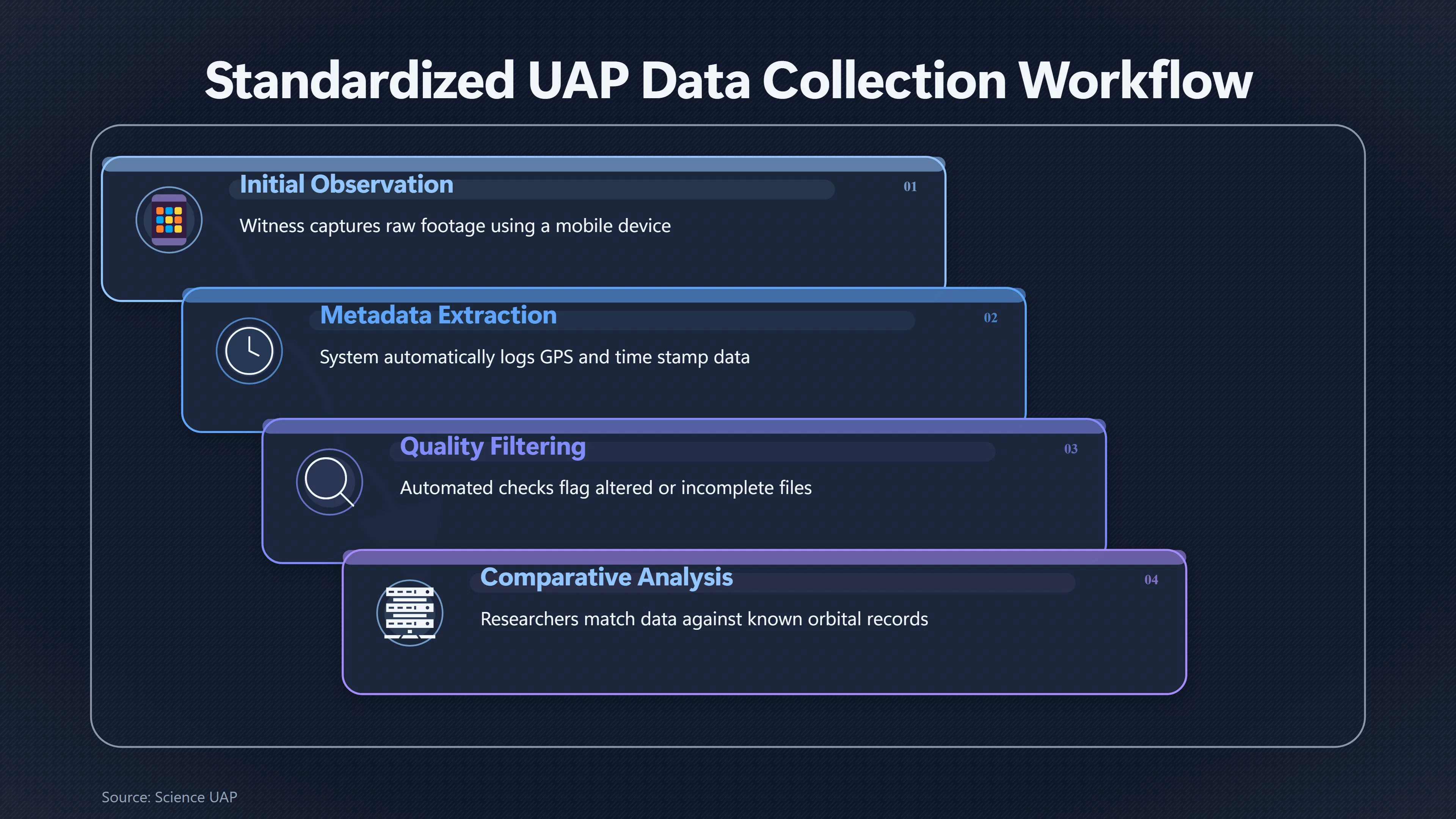
Modern smartphones contain far more than cameras. They automatically record metadata including time, date and GPS position, while many also include orientation sensors, accelerometers and compass data. NASA’s study recommended exploring crowdsourced smartphone-based reporting because these devices could provide consistent digital records from many independent observers rather than disconnected eyewitness recollections.[NASA]nasa.govUPDATE: NASA Shares UAP Independent Study Report; Names DirectorUPDATE: NASA Shares UAP Independent Study Report; Names Director - NASASeptember 14, 2023…
A standard reporting platform would not assume every observation represents something extraordinary. Instead, it would ask every observer to collect the same core information so investigators can compare reports directly. If several witnesses independently record the same event with synchronised timestamps and locations, researchers can estimate viewing geometry, compare camera perspectives and check whether the object matches known aircraft, satellites, balloons or atmospheric events.[NASA]nasa.govUPDATE: NASA Shares UAP Independent Study Report; Names DirectorUPDATE: NASA Shares UAP Independent Study Report; Names Director - NASASeptember 14, 2023…
This is a familiar scientific approach. Citizen-science projects in astronomy, meteor observation and wildlife monitoring already depend on thousands of participants submitting observations in consistent formats. Individual reports may have limited value, but large numbers of standardised observations can reveal patterns that isolated accounts cannot.
Information every public UAP report should capture
A reporting system becomes useful only if every submission contains enough contextual information for later analysis. NASA’s recommendations and guidance from the US All-domain Anomaly Resolution Office (AARO) point towards collecting structured metadata alongside images or videos rather than relying solely on written descriptions.[AARO]aaro.milAARO FAQ…
Useful information includes:
- Precise date and time, preferably generated automatically by the device.
- GPS location of the observer.
- Viewing direction, including approximate compass bearing and elevation.
- Duration of the observation.
- Original photographs or video, not compressed copies.
- Camera metadata, including focal length, exposure settings and resolution where available.
- Weather and visibility, including cloud cover if known.
- Observer movement, such as standing still, walking or travelling in a vehicle or aircraft.
- Other witnesses present at the same location.
- Any unusual sounds, lights or apparent motion, described separately from interpretations.
AARO similarly notes that metadata from mobile-phone images, accurate timestamps, GPS information and higher-resolution recordings are substantially more valuable than edited media or recollections recorded much later. It also highlights the usefulness of independently recorded radio-frequency measurements where available.[AARO]aaro.milAARO FAQ…
Standardisation also makes automated quality checks possible. Reports with missing timestamps, altered images or incomplete metadata can be flagged before investigators spend time analysing them.
How multiple observers can provide independent corroboration
The greatest scientific advantage of standardised reporting is not obtaining more reports but obtaining independent reports that can be compared mathematically.
If several observers submit reports of the same event from different locations, investigators may be able to:
- determine whether everyone observed the same object;
- estimate altitude through triangulation;
- reconstruct the object’s apparent path;
- compare different camera recordings against one another;
- eliminate explanations that are inconsistent with the combined geometry.
Because each report is submitted independently using the same format, agreement between observers becomes measurable rather than anecdotal.
A practical example comes from aviation rather than a public reporting app. Researchers investigating a 2022 Pacific sighting compared reports from multiple airline crews with photographs, flight-path data and satellite orbital information. The reconstruction showed that the apparently mysterious object was consistent with a recently launched Starlink satellite train viewed under unusual lighting conditions. The case illustrates how multiple independent observations become far more informative when combined with accurate timing and external datasets.[arXiv]arxiv.orgEnhancing Space Situational Awareness to Mitigate Risk: A Single-Case Study in the Misidentification of a Recently-Launched Starlink…
Equally important, if several well-documented reports cannot be reconciled with known aircraft, satellites or atmospheric phenomena, investigators have a stronger basis for identifying genuinely unresolved cases deserving further study.
Privacy, false reports and limits of smartphone sensors
Standardised reporting also creates governance challenges that must be addressed if public participation is to be sustainable.
Protecting personal information
Location, timestamps and photographs can reveal sensitive personal information. A public reporting system therefore needs clear policies covering:
- how precise location data are stored;
- whether reports are anonymous or attributable;
- who can access original files;
- how long information is retained;
- whether researchers receive raw or anonymised data.
Without transparent privacy protections, many witnesses may hesitate to participate even if they observed something genuinely unusual.
Reducing false or misleading reports
A structured form cannot eliminate fabricated submissions, but it can make them easier to identify.
Automatic consistency checks can compare reported weather against meteorological records, verify timestamps, examine image metadata and detect duplicate submissions. Reports that lack original files or contain inconsistent metadata can be separated from those supported by complete digital records.
Standardisation therefore improves data quality even when some inaccurate reports inevitably enter the system.
Smartphone limitations
Smartphones remain imperfect scientific instruments.
Small image sensors struggle in low light, autofocus systems can misidentify distant objects, digital zoom reduces detail, and rolling shutters may distort fast-moving targets. Without a known distance, even high-quality video cannot reliably establish an object’s size or speed. Optical effects, motion blur and perspective can all create misleading impressions. NASA therefore treats smartphone evidence as one source of information to be combined with radar, astronomical observations, aviation records and other calibrated measurements rather than as definitive proof on its own.[NASA Science]science.nasa.govScience UAP FAQsNASA ScienceUAP FAQs - NASA Science…
AARO likewise notes that many reports remain unidentified simply because available sensors did not capture enough information for confident attribution, not because the objects necessarily exhibited extraordinary characteristics.[AARO]aaro.milAARO Home…
What standardised reporting could realistically achieve
Standardised public reporting is best understood as a way to improve evidence quality rather than increase the number of unexplained sightings. A larger database alone does not produce better science if the observations cannot be compared or independently verified.
By collecting consistent metadata, synchronising observations from multiple witnesses and preserving original digital records, researchers can more efficiently match sightings against aircraft, satellites, balloons, astronomical objects and atmospheric phenomena. Many reports may become easier to explain, while the smaller number that remain unresolved would rest on a stronger evidential foundation.
Within NASA’s framework for stronger UAP research, that is the principal goal. A reporting system succeeds not because it generates more mystery, but because it reduces ambiguity and allows independent investigators to evaluate the same evidence using transparent, repeatable methods.[NASA Science]science.nasa.govScience UAPNASA ScienceUAP - NASA ScienceFebruary 23, 2026…
Amazon book picks
Further Reading
Books and field guides related to Can Smartphone Reports Turn Sightings Into Usable Data?. Use these as the next step if you want deeper reading beyond the article.
The Field Guide to Citizen Science
Learn how monitoring the night sky, mapping trees, photographing dragonflies, and identifying mushrooms can help save the world. Citizen...
Citizen Science: How Ordinary People Are Changing the Face of...
True stories of everyday volunteers participating in scientific research that "may well prompt readers to join the growing community" ( B...
Calling Bullshit: The Art of Skepticism in a Data-Driven World
Bullshit isn’t what it used to be. Now, two science professors give us the tools to dismantle misinformation and think clearly in a world...
eBay marketplace picks
Marketplace Samples
Live-tested eBay searches with available results related to this page.
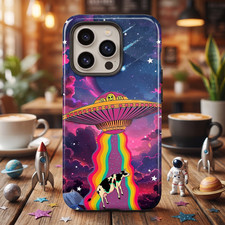
Selected fromUFO phone case oneBay.co.uk.


Endnotes
1.
Source: science.nasa.gov
Title: Science UAP
Link:https://science.nasa.gov/uap/
Source snippet
NASA ScienceUAP - NASA ScienceFebruary 23, 2026...
Published: February 23, 2026
2.
Source: science.nasa.gov
Title: Science UAP FAQs
Link:https://science.nasa.gov/uap/faqs/
Source snippet
NASA ScienceUAP FAQs - NASA Science...
3.
Source: nasa.gov
Title: UPDATE: NASA Shares UAP Independent Study Report; Names Director
Link:https://www.nasa.gov/news-release/update-nasa-shares-uap-independent-study-report-names-director/
Source snippet
UPDATE: NASA Shares UAP Independent Study Report; Names Director - NASASeptember 14, 2023...
Published: September 14, 2023
4.
Source: aaro.mil
Link:https://www.aaro.mil/FAQ/
Source snippet
AARO FAQ...
5.
Source: arxiv.org
Link:https://arxiv.org/abs/2403.08155
Source snippet
Enhancing Space Situational Awareness to Mitigate Risk: A Single-Case Study in the Misidentification of a Recently-Launched Starlink...
6.
Source: aaro.mil
Link:https://www.aaro.mil/
Source snippet
AARO Home...
7.
Source: aaro.mil
Link:https://www.aaro.mil/Next-AARO-Home-redesign/Next-Parent/Presidential-UAP-Transparency-Initiative/
Source snippet
Next - AARO Presidential UAP Transparency InitiativeJanuary 1, 2026 — PRESIDENTIAL UAP TRANSPARENCY INITIATIVE FOR NEXT RELEASE The Ameri...
Published: January 1, 2026
8.
Source: nasa.gov
Title: NAS A to Release, Discuss Unidentified Anomalous Phenomena Report
Link:https://www.nasa.gov/news-release/nasa-to-release-discuss-unidentified-anomalous-phenomena-report/
9.
Source: nasa.gov
Title: NAS A Provides Coverage of Unidentified Anomalous Phenomena Meeting
Link:https://www.nasa.gov/news-release/nasa-provides-coverage-of-unidentified-anomalous-phenomena-meeting/
10.
Source: nasa.gov
Title: NAS A Announces Unidentified Aerial Phenomena Study Team Members
Link:https://www.nasa.gov/general/nasa-announces-unidentified-aerial-phenomena-study-team-members/
11.
Source: aaro.mil
Link:https://www.aaro.mil/Next-AARO-Home-redesign/Next-Parent/Presidential-UAP-Transparency-Initiative/videoid/1006093/dvpcc/false/
12.
Source: aaro.mil
Link:https://www.aaro.mil/Next-AARO-Home-redesign/Next-Parent/Next-AARO-UAP-Imagery-Fixed-Table/
13.
Source: asrs.arc.nasa.gov
Link:https://asrs.arc.nasa.gov/uassafety.html
Additional References
14.
Source: uap-archive.org
Title: NAS A UAP Independent Study — Public Meeting & Briefings | UAP Records Archive
Link:https://uap-archive.org/uap/records/nasa-uap-independent-study-public-events/
Source snippet
NASA UAP Independent Study — Public Meeting & Briefings | UAP Records ArchiveJune 6, 2026 — NASA UAP INDEPENDENT STUDY — PUBLIC MEETING &...
Published: June 6, 2026
15.
Source: defense.gov
Title: DO D Examining Unidentified Anomalous Phenomena > U.S
Link:https://www.defense.gov/News/News-Stories/Article/Article/3965403/dod-examining-unidentified-anomalous-phenomena/
Source snippet
Department of Defense > Defense Department NewsNovember 14, 2024 — DOD EXAMINING UNIDENTIFIED ANOMALOUS PHENOMENA Nov. 14, 2024 | By Davi...
Published: November 14, 2024
16.
Source: youtube.com
Title: Something in the Sky? Something in the Water hosts app launch for UFO sightings
Link:https://www.youtube.com/watch?v=FqXg8EbbXZU
Source snippet
NASA UAP reporting public crowdsourcing smartphone report data NASA UAP (UFO) report released… can’t prove nor disprove aliens...
17.
Source: youtube.com
Link:https://www.youtube.com/watch?v=9smTqCCh7es
Source snippet
Something in the Sky? Something in the Water hosts app launch for UFO sightings...
18.
Source: youtube.com
Title: Nasa UFO report: What we learned from UAP study
Link:https://www.youtube.com/watch?v=eTaltOQLVLU
Source snippet
NASA team investigating UFOs stresses need for high-quality data in first public meeting...
19.
Source: youtube.com
Title: Public Meeting on Unidentified Anomalous Phenomena (Official NASA Broadcast)
Link:https://www.youtube.com/watch?v=bQo08JRY0iM
Source snippet
Unidentified Anomalous Phenomena Independent Study Report...
20.
Source: defense.gov
Link:https://www.defense.gov/News/Transcripts/Transcript/Article/3575588/aaro-director-dr-sean-kirkpatrick-holds-an-off-camera-media-roundtable/
21.
Source: defense.gov
Link:https://www.defense.gov/News/News-Stories/Article/Article/3575511/dod-unidentified-anomalous-phenomena-office-launches-new-reporting-tool/
22.
Source: archives.gov
Link:https://www.archives.gov/records-mgmt/uap-guidance
23.
Source: defense.gov
Link:https://www.defense.gov/News/Releases/Release/Article/3513171/the-department-of-defense-launches-the-all-domain-anomaly-resolution-office-web/