Within Claim Checklist
Has the UFO Footage Been Changed?
Cropping, compression, stabilisation and altered playback can make ordinary motion look stranger than it appeared in the original recording.
On this page
- Locating the earliest available file
- Checking metadata, edits and playback speed
- Using landmarks to verify camera position
Page outline Jump by section
Introduction
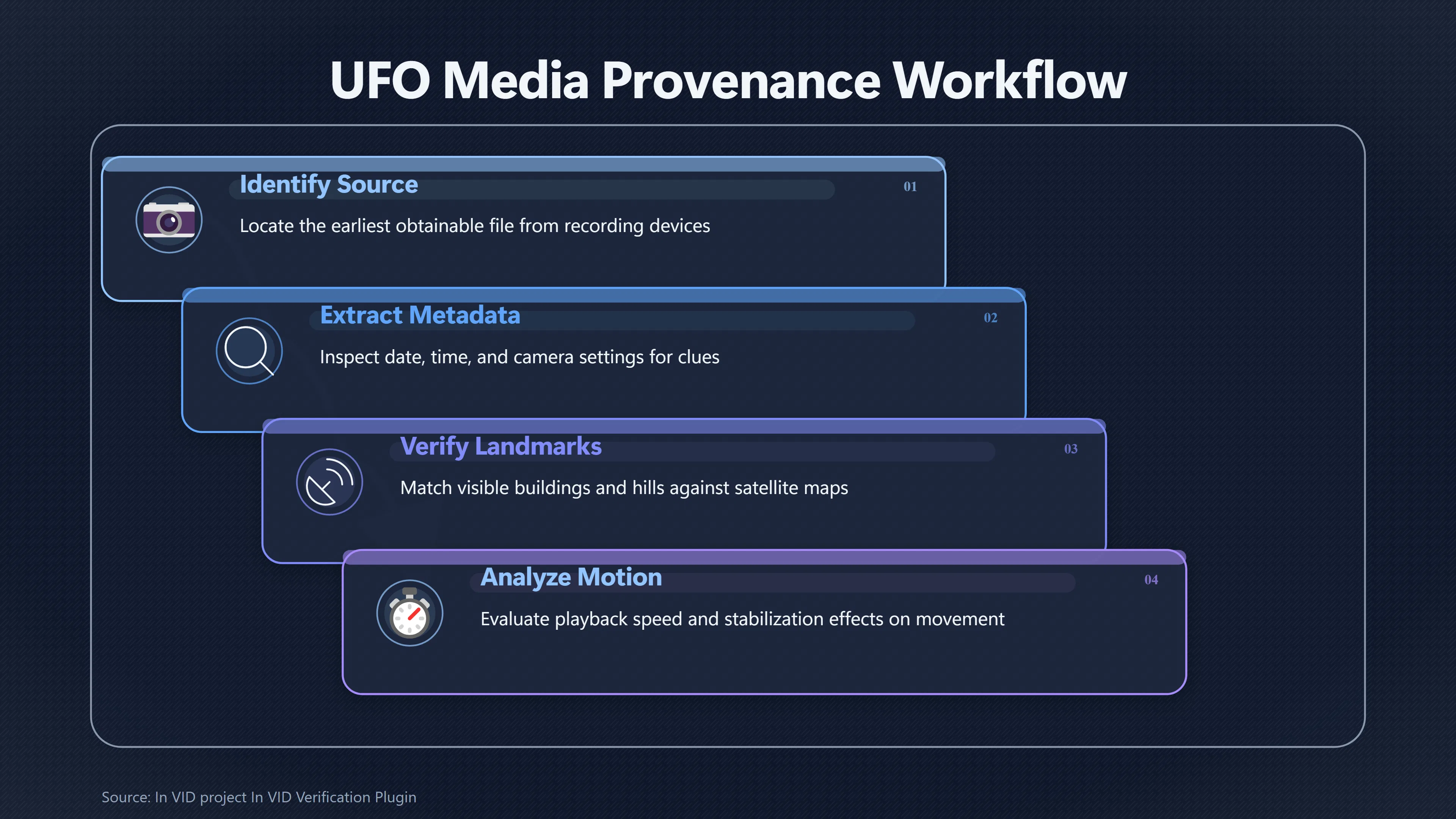
When a celebrity shares a UFO photograph or video, the most important question is often not what appears in the frame but whether the file being examined is the original recording. Clips that circulate on social media are frequently cropped, compressed, stabilised, slowed down, sped up or converted into different formats before investigators ever see them. Each change can remove evidence, alter apparent motion or make ordinary objects look more mysterious than they did in the source recording. For that reason, evaluating a celebrity UFO claim begins with establishing media provenance: finding the earliest available version, checking whether it has been edited, and comparing it against later reposts before drawing conclusions. Modern digital forensics treats the original file as evidence in its own right, not simply as a picture.
Locating the Earliest Available File
The strongest starting point is the earliest obtainable copy of the image or video, ideally the file exported directly from the recording device rather than a repost, screenshot or compilation.
A common problem in celebrity UFO stories is that the version attracting public attention is not the original. Entertainment websites, fan accounts and social-media users often trim a clip to its most dramatic seconds, remove the beginning or end, or combine footage with commentary and music. By the time investigators analyse the media, the original sequence may no longer be publicly available.
An evidence-first approach includes:
- Identifying who first uploaded the material.
- Looking for earlier versions through reverse image or keyframe searches.
- Comparing upload dates across platforms.
- Checking whether longer versions exist.
- Determining whether the file is a direct export from a camera or a re-encoded copy.
Verification tools developed for journalists and open-source investigators, such as the InVID Verification Plugin, support keyframe extraction, reverse-image searching and metadata inspection specifically because reposted media often loses essential context during redistribution.[InVID project]invid-project.euIn VID project In VID Verification PluginInVID projectInVID Verification Plugin - InVID projectJune 7, 2019…
Finding an earlier version can completely change the interpretation. A short clip may appear to show an object making an impossible turn, while the full recording reveals the camera operator changing direction or losing focus immediately beforehand.
Checking Metadata Before Trusting the Pixels
Digital photographs and many video files contain metadata describing how they were created. Depending on the device and settings, this may include:
- Date and time of capture.
- Camera or phone model.
- Lens and focal length.
- Exposure settings.
- GPS coordinates.
- Software used to edit or export the file.
This information should not be treated as infallible—metadata can be removed or altered—but it often provides valuable clues about provenance when combined with other evidence. For example, metadata that shows a video was exported through editing software after capture does not prove deception; it simply indicates that the available file is not the untouched original. Likewise, missing metadata is common because many social-media platforms deliberately strip it for privacy reasons.[afip.org]afip.orgMetadata ForensicsEXIF Analysis for Authenticity | AFIP…
Investigators therefore compare metadata with independent evidence such as:
- The claimed recording date.
- Local sunrise or sunset times.
- Weather records.
- Visible shadows.
- The witness’s public timeline.
Consistency across these independent sources is generally more informative than metadata alone.[afip.org]afip.orgMetadata ForensicsEXIF Analysis for Authenticity | AFIP…
How Compression Can Change What You See
Every time a video is uploaded, downloaded and re-uploaded, it is usually compressed again. Compression reduces file size by discarding visual information that the codec considers less important.
For ordinary viewing this loss is often acceptable. For analysing a distant light in the night sky, however, compression can introduce misleading effects such as:
- Flickering around bright points.
- Block-shaped artefacts.
- Smearing during motion.
- Colour banding.
- False edges surrounding small objects.
Small lights against a dark background are especially vulnerable because they occupy very few pixels. A bright planet, aircraft landing light or drone may appear to pulse, elongate or change shape after repeated compression despite remaining unchanged in the original recording. Video-forensics research has long recognised compression history as a key factor when assessing whether visual anomalies originate in the scene or in later processing.[Cambridge University Press]cambridge.orgCambridge University PressAn overview on video forensics | APSIPA Transactions on Signal and Information Processing | Cambridge CoreAugus…
Why Stabilisation Can Create Strange Motion
Many smartphones automatically stabilise video to reduce camera shake. Additional stabilisation is also frequently applied by editing software or social-media platforms.
Although stabilisation improves viewing comfort, it changes the relationship between the camera and the recorded scene. This matters when analysing distant aerial objects.
Potential side effects include:
- Artificially smooth movement that masks hand motion.
- Cropping that removes reference points.
- Frame warping near image edges.
- Apparent jumps when the software repositions successive frames.
- Misleading estimates of speed if the stabilisation process is not recognised.
If a stabilised clip is analysed without accounting for these corrections, an ordinary aircraft may appear to accelerate or change direction more dramatically than it actually did because the camera’s own motion has been digitally altered.
Playback Speed Can Alter Perceived Behaviour
Playback changes are another common source of confusion.
Videos shared online are often:
- Slowed for dramatic effect.
- Played faster to shorten their duration.
- Converted to different frame rates.
- Exported with dropped or duplicated frames.
These alterations influence how motion is perceived. A slow-moving aircraft crossing the frame can appear to hover if played at reduced speed. Conversely, a drifting balloon may appear to dart rapidly if frames are removed or the clip is accelerated.
Frame-by-frame analysis is therefore most reliable when performed on the original recording rather than a platform copy that may already have undergone transcoding. Video analysts emphasise obtaining the source file because re-encoded copies may lose frames and overwrite timestamps, reducing the reliability of motion analysis.[Skeptical Inquirer]skepticalinquirer.orgOpen source on skepticalinquirer.org.
Using Landmarks to Verify Camera Position
Even if metadata has disappeared, the scene itself often contains valuable evidence.
Fixed landmarks help reconstruct where the camera was and what direction it faced. Useful reference points include:
- Buildings.
- Hills and ridgelines.
- Utility poles.
- Road layouts.
- Trees.
- Coastlines.
- Mountain profiles.
- The Moon or bright planets when visible.
Matching these landmarks against satellite imagery, mapping services or publicly available photographs allows investigators to estimate the camera position and viewing direction independently of the witness’s recollection. Once the location is established, analysts can compare the reported sighting with known flight paths, satellite passes or astronomical objects visible from that position.
Landmarks also help distinguish genuine object movement from camera movement. If nearby buildings shift in the same way as the alleged UFO, the apparent motion may simply reflect the camera panning or shaking rather than the object itself. Verification workflows used in journalism and open-source investigations place geolocation alongside provenance and metadata as one of the core stages of media authentication.[osintguide.com]osintguide.comOSINT Guide How to Verify a Video — OSINT methods · OSINT GuideOSINT Guide How to Verify a Video — OSINT methods · OSINT Guide
Common Ways Celebrity UFO Footage Changes Before Investigation
Celebrity footage often accumulates alterations as it spreads through interviews, documentaries and social media. Typical changes include:
- Cropping out the beginning or end of the recording.
- Re-encoding at lower quality.
- Screen-recording instead of sharing the original file.
- Adding digital zoom.
- Applying image enhancement or sharpening.
- Overlaying graphics or captions.
- Removing metadata during upload.
- Combining clips from different times into a single sequence.
None of these changes automatically indicate fabrication. Most are ordinary publishing practices. However, each one weakens the evidential value of the media by increasing uncertainty about what the original camera actually recorded.
A Practical Provenance Checklist
Before treating a celebrity UFO image or video as evidence, ask the following questions:
- Is this the earliest available version of the file?
- Has the recording been cropped or edited?
- Does any original metadata remain, and is it internally consistent?
- Has the video been recompressed through multiple uploads?
- Is the playback speed identical to the original recording?
- Are there stable landmarks that allow the camera position to be reconstructed?
- Does the apparent motion remain unusual after accounting for camera movement, stabilisation and editing?
A file that survives these checks deserves more careful investigation than one that exists only as a heavily edited social-media clip. In many celebrity UFO cases, the greatest obstacle is not explaining an unusual object but recovering enough of the original recording to determine what the camera actually captured.
Amazon book picks
Further Reading
Books and field guides related to Has the UFO Footage Been Changed?. Use these as the next step if you want deeper reading beyond the article.
Bad Science
Rating: 5.0/5 from 5 Google Books ratings
Have you ever wondered how one day the media can assert that alcohol is bad for us and the next unashamedly run a story touting the benef...
Photo Forensics
The first comprehensive and detailed presentation of techniques for authenticating digital images. Photographs have been doctored since p...
The Digital Photography Book
Furnishes an overview of digital photography, covering such topics as cameras, exposure, lighting, shutter speed, depth of field, and res...
Calling Bullshit: The Art of Skepticism in a Data-Driven World
Bullshit isn’t what it used to be. Now, two science professors give us the tools to dismantle misinformation and think clearly in a world...
eBay marketplace picks
Marketplace Samples
Live-tested eBay searches with available results related to this page.
Selected fromcamera lens cap oneBay.co.uk.
Related eBay result
55mm front lens cap for camera lenses with 55 mm filter thread
Related eBay result
49mm Front camera Lens Cap for lenses with 49 filter thread
Endnotes
1.
Source: invid-project.eu
Title: In VID project In VID Verification Plugin
Link:https://www.invid-project.eu/tools-and-services/invid-verification-plugin/
Source snippet
InVID projectInVID Verification Plugin - InVID projectJune 7, 2019...
Published: June 7, 2019
2.
Source: invid-project.eu
Link:https://www.invid-project.eu/invid-verification-application/
3.
Source: afip.org
Title: Metadata Forensics
Link:https://afip.org/research/metadata-forensics/
Source snippet
EXIF Analysis for [Authenticity]({{ 'authenticity/' | relative_url }}) | AFIP...
4.
Source: cambridge.org
Link:https://www.cambridge.org/core/journals/apsipa-transactions-on-signal-and-information-processing/article/an-overview-on-video-forensics/585CF8F1CAB9400D215A7C8266A7FB22
Source snippet
Cambridge University PressAn overview on video forensics | APSIPA Transactions on Signal and Information Processing | Cambridge CoreAugus...
5.
Source: osint4all.com
Title: Verify an Image or Short Video | OSINT4ALL
Link:https://osint4all.com/use-case/verify-an-image-or-short-video/
Source snippet
Verify an Image or Short Video | OSINT4ALL...
6.
Source: commonslibrary.parliament.uk
Title: House of Commons Library How to verify images and videos
Link:https://commonslibrary.parliament.uk/research-briefings/cbp-10816/
Source snippet
House of Commons LibraryHow to verify images and videos - House of Commons Library...
7.
Source: skepticalinquirer.org
Link:https://skepticalinquirer.org/2024/12/quick-guide-to-modern-video-analysis-techniques-for-uap-and-ufos/
8.
Source: osintguide.com
Title: OSINT Guide How to Verify a Video — OSINT methods · OSINT Guide
Link:https://www.osintguide.com/en/methods/verify-a-video
Additional References
9.
Source: youtube.com
Title: BEST 6 tools to spot and verify FAKE NEWS!
Link:https://www.youtube.com/watch?v=yIdzZuPmOU0
Source snippet
This collection of videos is directly relevant because it provides technical analysis and open-source verification methods—including came...
10.
Source: archives.fbi.gov
Title: Archives FBI — Standards and Guidelines
Link:https://archives.fbi.gov/archives/about-us/lab/forensic-science-communications/fsc/april2008/standards/2008_04_standards02.htm
Source snippet
FBI ArchivesFBI — Standards and Guidelines - Forensic Science Communications - April 2008...
Published: April 2008
11.
Source: sciencedirect.com
Title: ScienceDirect Forensic analysis of video file formats
Link:https://www.sciencedirect.com/science/article/pii/S1742287614000140
Source snippet
Forensic analysis of video file formats - ScienceDirect...
12.
Source: forensicosint.com
Link:https://www.forensicosint.com/guides/what-is-exif-data-and-why-it-matters
13.
Source: aliencouncil.com
Link:https://aliencouncil.com/guides/fg-039-exif-metadata-credibility/
14.
Source: youtube.com
Title: How to use In VID-We Verify to run searches on X
Link:https://www.youtube.com/watch?v=-Tmw3suMMzs
Source snippet
BEST 6 tools to spot and verify FAKE NEWS...
15.
Source: youtube.com
Title: Interdimensional UFO Portal Tutorial!
Link:https://www.youtube.com/watch?v=FOkgpfcnG8o
Source snippet
How to use InVID-WeVerify to run searches on X...
16.
Source: youtube.com
Title: Gimbal UFO
Link:https://www.youtube.com/watch?v=qsEjV8DdSbs
Source snippet
NASA filmed TWO OBJECTS following Artemis II (UNDERSTAND)...
17.
Source: youtube.com
Title: NASA filmed TWO OBJECTS following Artemis II (UNDERSTAND)
Link:https://www.youtube.com/watch?v=EMKKHflw0zY
Source snippet
Interdimensional UFO Portal Tutorial...