Within NASA Standard
Why One Sensor Is Never Enough for UAPs
Camera, radar, infrared and environmental readings can expose whether an apparent UAP is a physical target or a sensor-specific artefact.
On this page
- What visual, radar and infrared sensors each measure
- How independent readings expose artefacts and clutter
- When multisensor agreement supports a physical event
Page outline Jump by section
Introduction
NASA’s approach to unidentified anomalous phenomena (UAP) rests on a simple scientific principle: a single sensor can be misleading, but independent sensors observing the same event can dramatically improve confidence in what actually occurred. Cameras, radar, infrared (IR) systems and environmental instruments each measure different physical properties. When their observations agree, investigators gain stronger evidence that they are tracking a genuine object rather than an illusion created by a particular instrument. When they disagree, the mismatch often reveals a sensor artefact, atmospheric effect or misinterpretation rather than an extraordinary phenomenon. This emphasis on coordinated observations is central to NASA’s recommendations for stronger UAP research and helps explain why isolated photographs or eyewitness videos rarely provide definitive answers.[NASA Science]science.nasa.govScience UAPNASA ScienceUAP - NASA ScienceFebruary 23, 2026…
Rather than treating every unexplained sighting as evidence of something exotic, NASA argues that the goal is to gather enough independent measurements to test competing explanations. That approach fits equally well whether the original report came from a military pilot, an amateur observer or a celebrity describing an unusual experience.
What different sensors actually measure
Different instruments observe different aspects of the same event. Their strengths complement one another, but so do their weaknesses.
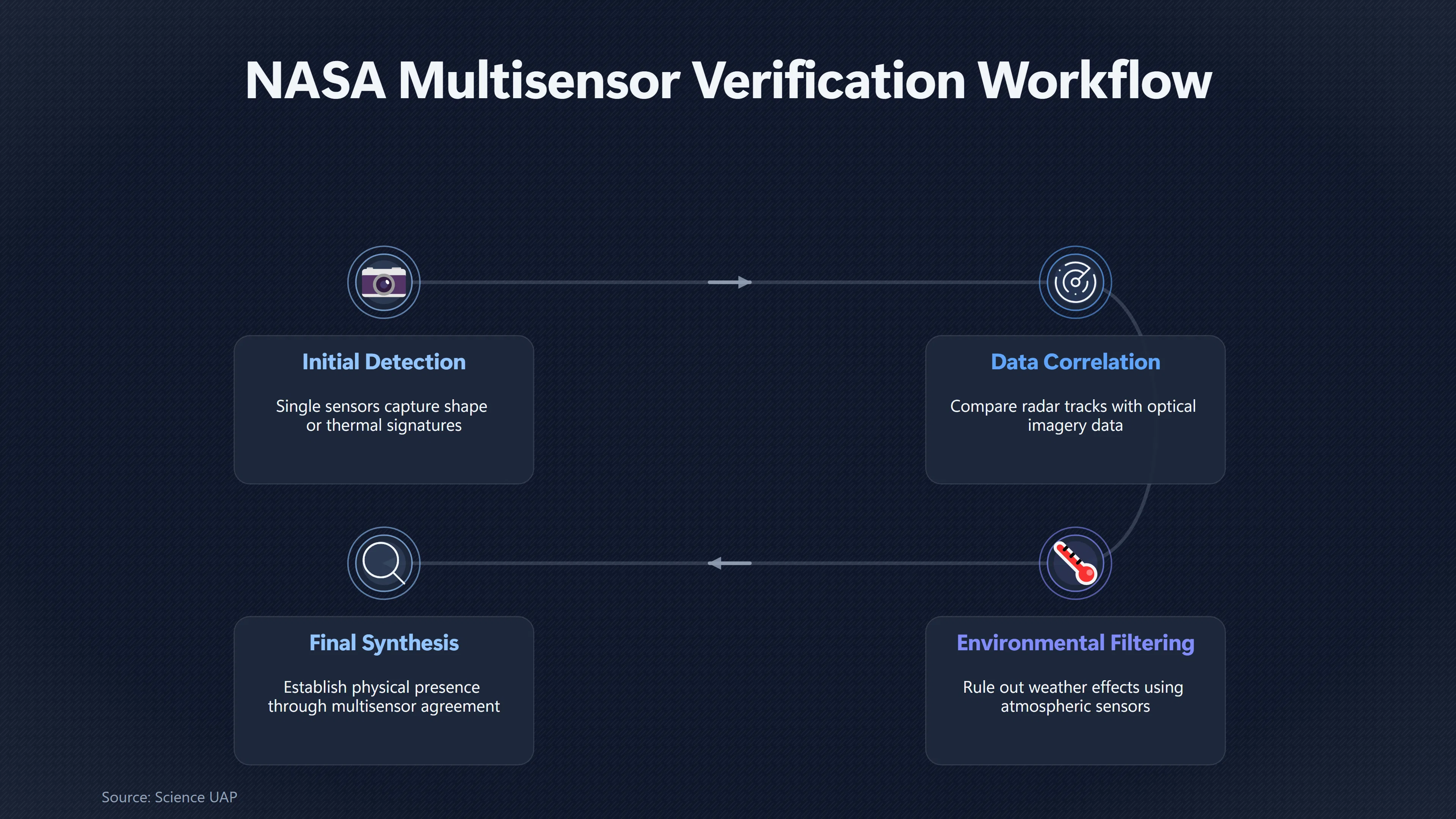
- Visible-light cameras record shape, colour, brightness and apparent motion. They provide valuable visual context but cannot determine distance or true speed on their own.
- Radar actively measures the position of objects by transmitting radio waves and analysing their reflections. Depending on the system, radar can estimate range, bearing, altitude and relative velocity using Doppler measurements.
- Infrared sensors detect thermal radiation rather than visible light. They can reveal heat signatures invisible to ordinary cameras, but the apparent brightness of an infrared target depends on temperature, emissivity, atmospheric conditions and sensor settings rather than simply how “hot” an object is.
- Environmental sensors record wind, temperature, humidity, atmospheric pressure and other conditions that may explain unusual observations or affect how other sensors perform.[NASA Science]science.nasa.govScience UAPNASA ScienceUAP - NASA ScienceFebruary 23, 2026…
Because each instrument measures different physical quantities, agreement between them provides stronger evidence than any single observation alone.
How independent sensors expose artefacts and clutter
Many apparently mysterious sightings become less mysterious once measurements from multiple systems are compared.
A camera may record an object that seems to accelerate dramatically across the sky. If radar fails to detect a corresponding target and atmospheric data show conditions favourable for optical distortion, investigators may conclude that the apparent motion resulted from camera perspective, lens effects or observer movement rather than extreme acceleration.
Conversely, radar alone is not infallible. It can produce false targets through anomalous propagation, ground reflections, weather effects or processing artefacts. Comparing radar returns with optical imagery, aircraft tracking information and weather observations helps determine whether the radar contact corresponds to a genuine airborne object.[AARO]aaro.milAARO FAQ…
Infrared imagery also benefits from cross-checking. Bright or dark regions in thermal images can arise from viewing geometry, changing sensor gain, atmospheric absorption or reflections rather than unusual heat sources. A simultaneous visible-light recording or radar track helps distinguish between sensor behaviour and object behaviour.
Motion parallax as a practical example
One of the best-known sources of apparent high-speed motion is motion parallax. When a fast-moving aircraft observes a relatively nearby stationary object, that object can appear to race across the background even though it is moving slowly or not at all.
This illusion becomes much easier to identify if independent measurements show that the object’s position remains consistent with winds, radar tracking or known aircraft movement. Without those additional measurements, video alone can greatly exaggerate apparent performance. AARO specifically identifies motion parallax as a common explanation for reports of seemingly extraordinary speed.[AARO]aaro.milAARO FAQ…

When multisensor agreement supports a physical event
Agreement across independent sensors does not automatically reveal what an object is, but it substantially increases confidence that investigators are observing a real physical target.
For example, if:
- radar consistently measures a target’s position,
- infrared detects a corresponding thermal signature,
- electro-optical cameras record the same object at matching times and locations, and
- environmental data rule out weather-related explanations,
then investigators have much stronger evidence that an object occupied a particular region of airspace than they would from any single dataset alone.
Importantly, multisensor confirmation establishes the existence of an event, not necessarily its identity. A balloon, aircraft, drone or genuinely unidentified object may all produce consistent signatures across several instruments. Identification still depends on analysing the combined measurements alongside known flight operations, atmospheric conditions and other contextual information. NASA therefore treats multisensor agreement as the beginning of rigorous analysis rather than the end of it.[NASA Science]science.nasa.govScience UAPNASA ScienceUAP - NASA ScienceFebruary 23, 2026…
Why disagreement between sensors can be just as valuable
In scientific investigations, disagreement is often informative.
Suppose an object appears to execute an impossible manoeuvre in a video. If radar indicates smooth, ordinary motion while aircraft telemetry shows the observing platform was banking sharply at the same moment, investigators may conclude that the apparent manoeuvre resulted from changing camera geometry.
Likewise, an infrared hotspot with no matching optical target may indicate a thermal reflection or sensor processing effect rather than a hidden vehicle.
These discrepancies help narrow explanations by identifying which measurement is likely to be misleading. Instead of treating conflicting evidence as a failure, NASA’s framework regards it as an opportunity to understand the limitations of individual sensors.[NASA Science]science.nasa.govScience UAPNASA ScienceUAP - NASA ScienceFebruary 23, 2026…

Real investigations increasingly rely on sensor fusion
Modern UAP investigations increasingly emphasise combining data streams rather than analysing isolated videos.
NASA’s independent study recommended improved calibration, complete sensor metadata and multiple simultaneous measurements whenever possible. It also suggested using existing Earth-observing assets, weather information and other scientific datasets to eliminate conventional explanations before considering rarer possibilities.[NASA]nasa.govUPDATE: NASA Shares UAP Independent Study Report; Names DirectorUPDATE: NASA Shares UAP Independent Study Report; Names Director - NASA…
Similarly, the U.S. All-domain Anomaly Resolution Office (AARO) notes that many reported UAP are ultimately identified as balloons, airborne clutter, drones, aircraft or optical effects after comparing imagery with additional sensor information and contextual data. Several officially released infrared cases have subsequently been assessed with high confidence as balloons because their movement matched prevailing winds and their appearance closely matched previously resolved examples.[AARO]aaro.milUAP ImageryAARO UAP Imagery…
Research groups developing dedicated scientific observatories have adopted the same philosophy. Proposed systems combine wide-field optical cameras, infrared imagers, passive radar techniques, radio-frequency receivers and environmental instruments so that any unusual detection can be tested independently across multiple measurement channels rather than relying on a single sensor.[arXiv]arxiv.orgOpen source on arxiv.org.
The key lesson for evaluating UAP evidence
The strongest UAP evidence is not necessarily the clearest photograph or the most dramatic eyewitness account. It is the event that survives repeated cross-checking by independent instruments measuring different physical properties.
A camera may suggest that something unusual happened. Radar may confirm whether a solid target occupied that location. Infrared may reveal whether it emitted or reflected heat. Environmental measurements may explain how weather influenced the observation. Together, these complementary datasets allow investigators either to eliminate ordinary explanations or to define precisely what remains unexplained.
That emphasis on sensor cross-checks explains why NASA’s recommended standard for future UAP research focuses less on collecting more reports and more on collecting better, synchronised measurements. Multiple independent sensors do not guarantee an identification, but they provide the most reliable path for distinguishing genuine physical events from perceptual errors, atmospheric phenomena and sensor-specific artefacts.[nasa.gov]science.nasa.govScience UAPNASA ScienceUAP - NASA ScienceFebruary 23, 2026…
Amazon book picks
Further Reading
Books and field guides related to Why One Sensor Is Never Enough for UAPs. Use these as the next step if you want deeper reading beyond the article.
The UFO Experience: A Scientific Inquiry
Cited by the New York Review of Books as "the best brief for visitation," this classic study presents an analysis of UFO reports and conc...
Introduction to Radar Systems
Since the publication of the second edition of "Introduction to Radar Systems," there has been continual development of new radar capabil...
Data Fusion: Concepts and Ideas
This textbook provides a comprehensive introduction to the concepts and idea of multisensor data fusion. It is an extensively revised sec...
The Demon-Haunted World: Science as a Candle in the Dark
Are we on the brink of a new Dark Age of irrationality and superstition? In this book, the writer shows how scientific thinking is necess...
eBay marketplace picks
Marketplace Samples
Live-tested eBay searches with available results related to this page.
Selected fromaviation poster oneBay.co.uk.




Endnotes
1.
Source: science.nasa.gov
Title: Science UAP
Link:https://science.nasa.gov/uap/
Source snippet
NASA ScienceUAP - NASA ScienceFebruary 23, 2026...
Published: February 23, 2026
2.
Source: nasa.gov
Title: UPDATE: NASA Shares UAP Independent Study Report; Names Director
Link:https://www.nasa.gov/news-release/update-nasa-shares-uap-independent-study-report-names-director/
Source snippet
UPDATE: NASA Shares UAP Independent Study Report; Names Director - NASA...
3.
Source: arxiv.org
Link:https://arxiv.org/abs/2305.18566
4.
Source: aaro.mil
Link:https://www.aaro.mil/FAQ/
Source snippet
AARO FAQ...
5.
Source: aaro.mil
Link:https://www.aaro.mil/
Source snippet
AARO Home...
6.
Source: aaro.mil
Title: UAP Imagery
Link:https://www.aaro.mil/UAP-Cases/Official-UAP-Imagery/
Source snippet
AARO UAP Imagery...
7.
Source: arxiv.org
Link:https://arxiv.org/abs/2411.07956
8.
Source: aaro.mil
Link:https://www.aaro.mil/Next-AARO-Home-redesign/Next-Parent/Next-UAP-Report-Documents/poster/dividLink/
9.
Source: nasa.gov
Title: NAS A to Release, Discuss Unidentified Anomalous Phenomena Report
Link:https://www.nasa.gov/news-release/nasa-to-release-discuss-unidentified-anomalous-phenomena-report/
10.
Source: nasa.gov
Title: NAS A Provides Coverage of Unidentified Anomalous Phenomena Meeting
Link:https://www.nasa.gov/news-release/nasa-provides-coverage-of-unidentified-anomalous-phenomena-meeting/
11.
Source: nasa.gov
Title: NAS A Announces Unidentified Aerial Phenomena Study Team Members
Link:https://www.nasa.gov/general/nasa-announces-unidentified-aerial-phenomena-study-team-members/
12.
Source: ntrs.nasa.gov
Link:https://ntrs.nasa.gov/citations/20150000753
13.
Source: uapradar.com
Title: AAR O | UAP Radar Watchlist
Link:https://uapradar.com/topics/aaro
14.
Source: defense.gov
Link:https://www.defense.gov/Multimedia/Videos/videoid/885193/
Additional References
15.
Source: ufouap.net
Link:https://www.ufouap.net/en/explainers/radar-uap-evidence
Source snippet
July 16, 2026 — Evidence / Updated 2026-07-16 / 6 min read RADAR UAP EVIDENCE: WHY RADAR CASES MATTER AND WHY THEY CAN STILL BE WRONG Rad...
Published: July 16, 2026
16.
Source: wired.com
Link:https://www.wired.com/story/nasa-ufos-aliens-report-2023
Source snippet
The agency stressed the need to shift the conversation from sensationalism to science and eliminate the stigma associated with reporting...
17.
Source: aliencouncil.com
Title: 00041 tic tac uss nimitz 2004
Link:https://aliencouncil.com/cases/00041-tic-tac-uss-nimitz-2004/
Source snippet
USS Nimitz — "Tic Tac" encounter, 14 November 2004 · The CouncilJuly 18, 2026 — The cumulative weight of corroborating testimony from per...
Published: July 18, 2026
18.
Source: youtube.com
Title: Public Meeting on Unidentified Anomalous Phenomena (Official NASA Broadcast)
Link:https://www.youtube.com/watch?v=bQo08JRY0iM
Source snippet
Unidentified Anomalous Phenomena Independent Study Report...
19.
Source: youtube.com
Title: Unidentified Anomalous Phenomena Independent Study Report
Link:https://www.youtube.com/watch?v=TQcqOW39ksk
Source snippet
How Military Sensors Proved UFO Craft Were Physically Real | WION Podcast...
20.
Source: youtube.com
Title: How Military Sensors Proved UFO Craft Were Physically Real | WION Podcast
Link:https://www.youtube.com/watch?v=H6eK1VbrHPY
Source snippet
Unidentified Aerial Phenomena: Real or Fantasy?...
21.
Source: defense.gov
Link:https://www.defense.gov/News/News-Stories/Article/article/3368109/dod-working-to-better-understand-resolve-anomalous-phenomena/
22.
Source: youtube.com
Title: Unidentified Aerial Phenomena: Real or Fantasy?
Link:https://www.youtube.com/watch?v=XP23zFRdokQ
Source snippet
Just Released MILITARY VIDEO of THREE UAP's in the Western U.S...
23.
Source: ufopress.com
Link:https://www.ufopress.com/articles/aaro-releases-four-information-papers-on-uap-classification-satellite-flaring-se/
24.
Source: scribd.com
Link:https://www.scribd.com/document/671256731/UAP-Independent-Study-Team-Final-Report