Within Early vs Late
What Early UFO Records Preserve That Memory Cannot
Early notes, interviews and reports preserve what a celebrity originally claimed before later retellings can add or reshape details.
On this page
- How contemporary records fix the original claim
- Which details later retellings may change
- Why early documentation still does not prove a UFO
Page outline Jump by section
Introduction
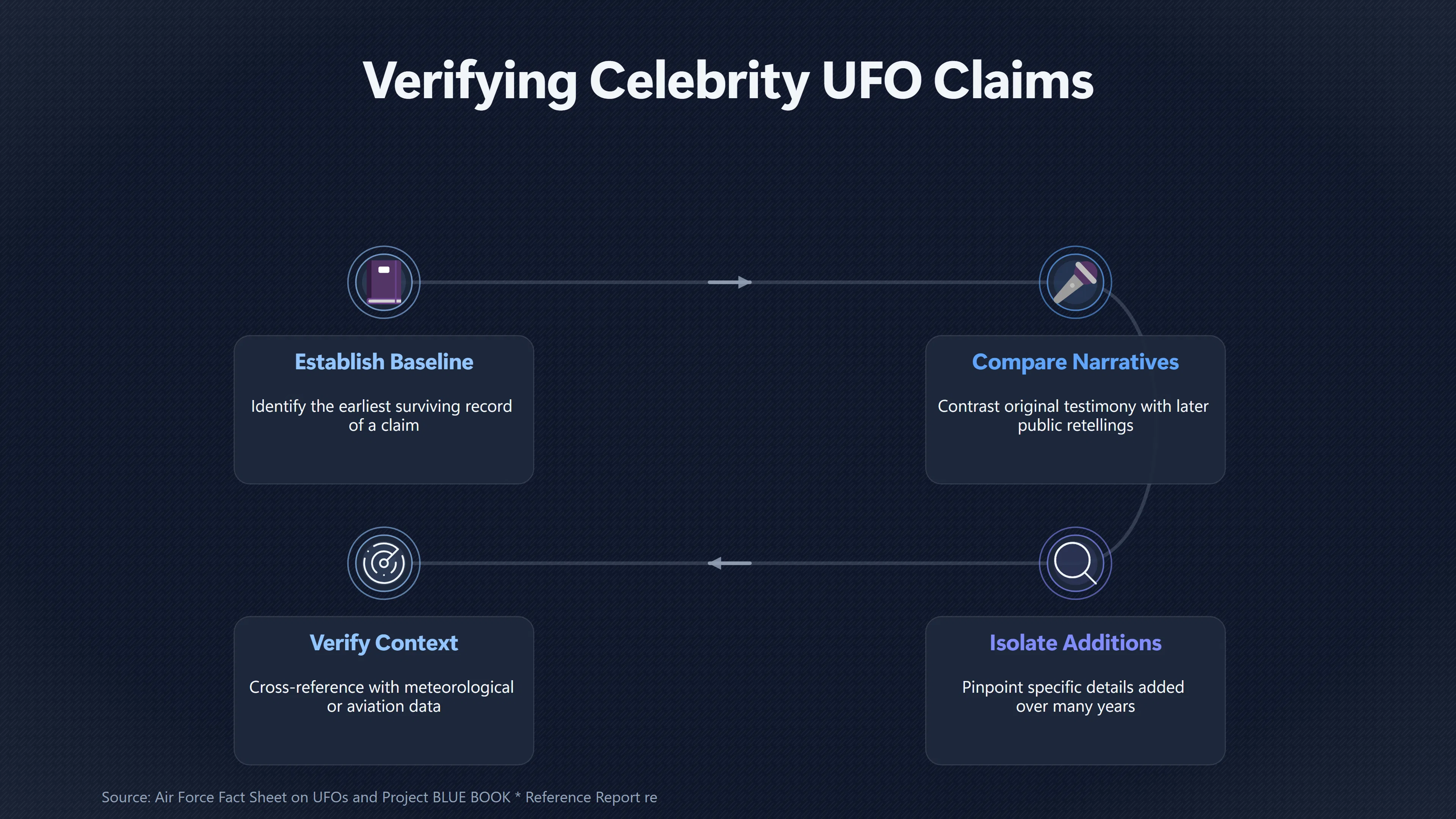
When evaluating celebrity UFO stories, the timing of the evidence often matters more than the fame of the witness. A diary entry, interview, album note, police report or aviation record created close to the alleged sighting establishes what the person originally claimed before decades of interviews, documentaries, biographies and public discussion could reshape the narrative. That does not make the original claim correct. A contemporaneous record may still describe an aircraft, astronomical object or perceptual error. Its value is narrower but crucial: it fixes the earliest version of the story, allowing later embellishments, omissions and reinterpretations to be identified rather than assumed.
Within celebrity UFO accounts, this distinction is especially important because many stories became widely known only years after the alleged event. Comparing those later recollections with records created at the time helps historians separate the original testimony from subsequent storytelling. This improves historical accuracy without settling the question of what was actually seen.[National Archives]nationalarchives.gov.ukNational Archives UFO reportsNational ArchivesUFO reports - The National Archives…
How contemporary records fix the original claim
A record made shortly after an event acts as a timestamped baseline. It captures details before memory is influenced by repeated retelling, media attention or changing personal beliefs.
For celebrity UFO reports, useful contemporary records include:
- Dated personal writings such as diaries, letters or notes.
- Television, radio or newspaper interviews recorded soon after the event.
- Police, military, airport or air-traffic documentation.
- Photographs or recordings with verifiable dates.
- Independent witness statements made without collaboration.
- Supporting environmental information such as astronomical, meteorological or aviation records.
These materials allow researchers to compare later versions against a documented starting point. Rather than asking whether every detail is true, historians can first ask a simpler question: “Is this detail present in the earliest surviving account?” That distinction is fundamental when assessing long-lived celebrity stories.[National Archives]nationalarchives.gov.ukNational Archives UFO reportsNational ArchivesUFO reports - The National Archives…
A good illustration is John Lennon’s reported sighting in August 1974. His handwritten statement printed with the Walls and Bridges album artwork publicly associated him with a specific UFO sighting only weeks after the event. Whatever the object may have been, that dated statement demonstrates that Lennon was already making the claim in 1974, rather than developing it decades afterwards.
Which details later retellings may change
Memory is reconstructive rather than photographic. Psychological research has repeatedly shown that recollections evolve as people repeatedly retrieve memories, encounter new information or discuss experiences with others. Consequently, long intervals between an event and its public description create opportunities for stories to change in subtle or significant ways.
In celebrity UFO narratives, later retellings commonly differ by adding or modifying:
- Descriptions of the object. Early reports may mention lights or an unusual shape, while later accounts describe structured craft with greater certainty.
- Duration and distance. Estimates often become more precise over time despite lacking measurements.
- Witness confidence. Initial uncertainty may later become confidence that the object could not have had an ordinary explanation.
- Extraordinary elements. Features such as silent hovering, impossible manoeuvres, telepathic communication or missing time sometimes appear only in later versions.
- Dialogue and emotional reactions. Conversations and exact wording frequently become more detailed with repeated retelling.
- Connections to later UFO events. Witnesses may reinterpret earlier experiences after exposure to popular UFO literature or media coverage.
These changes do not necessarily indicate deliberate fabrication. They may reflect normal memory processes, narrative simplification or the influence of subsequent information. The role of contemporary documentation is therefore not to accuse witnesses of invention, but to identify which parts of the story belong to the earliest record and which entered later.

Early records expose both additions and omissions
Contemporary documentation can work in two directions.
Sometimes it demonstrates that dramatic details were present from the beginning. If an early newspaper interview already describes a silent disc-shaped object or unusual flight characteristics, later repetition of those features is not evidence of embellishment.
In other cases, the earliest account is notably restrained. A witness may initially report only bright lights or an unidentified object, while later interviews include occupants, extraordinary behaviour or broader interpretations. Because the early record survives, researchers can see precisely when those additional claims entered the narrative.
This comparison is particularly valuable for celebrity cases, where interviews given decades apart often become the most widely circulated versions. Without earlier documentation, readers may mistakenly assume that every detail has been part of the account since the beginning.
Why immediate documentation improves verification
Records created close to the alleged sighting preserve practical information that is often lost later.
These commonly include:
- the exact date and time;
- viewing direction;
- weather conditions;
- duration;
- location;
- the number of witnesses;
- nearby aircraft or astronomical objects.
Such information allows investigators to compare reports with aircraft movements, satellite passes, rocket launches, meteor activity and astronomical observations. As time passes, these details become increasingly difficult to reconstruct accurately.
Modern scientific approaches to unidentified aerial phenomena place considerable emphasis on preserving calibrated observations, sensor data and metadata because eyewitness testimony alone rarely provides enough information for reliable analysis. NASA’s independent UAP study concluded that higher-quality reporting and systematic data collection are far more useful than retrospective personal recollections when attempting scientific evaluation.[National Archives]archives.govNational ArchivesRecords Related to Unidentified Flying Objects (UFOs) and Unidentified Anomalous Phenomena (UAPs) at the National Archiv…
Why early documentation still does not prove a UFO
The existence of a contemporary record should not be confused with proof that an extraordinary object was present.
A diary written on the day of an alleged sighting establishes that the witness believed they saw something unusual. It does not establish what produced the observation.
Official archives containing UFO reports make this distinction explicit. Many government collections preserve reports precisely because witnesses could not immediately identify what they observed, while also noting that many sightings were later explained as aircraft, balloons, astronomical objects or other conventional phenomena. An unidentified object simply means it was unidentified at the time of reporting.[National Archives]nationalarchives.gov.ukNational Archives UFO reportsNational ArchivesUFO reports - The National Archives…
For this reason, historians usually separate two questions:
- Is there reliable evidence that the witness made the claim when they said they did?
- Is there reliable evidence about the nature of the object itself?
Contemporary records can answer the first question far better than the second.

Reading celebrity UFO accounts with appropriate caution
Early documentation provides an important historical control when assessing celebrity UFO stories. It allows readers to distinguish between original testimony and decades of accumulated interpretation, helping identify when new details entered the narrative and whether the core account remained consistent over time.
This approach does not privilege sceptical or believing interpretations. Instead, it recognises that the strongest historical evidence usually comes from records created nearest the event. Celebrity status does not change that principle. A famous witness may sincerely report an unusual observation, but the evidential value of the claim still depends heavily on how soon it was documented, how consistently it was described and whether independent records preserve the original account before memory and retelling had an opportunity to reshape it.[National Archives]nationalarchives.gov.ukNational Archives UFO reportsNational ArchivesUFO reports - The National Archives…
Amazon book picks
Further Reading
Books and field guides related to What Early UFO Records Preserve That Memory Cannot. Use these as the next step if you want deeper reading beyond the article.
The UFO Experience: A Scientific Inquiry
Cited by the New York Review of Books as "the best brief for visitation," this classic study presents an analysis of UFO reports and conc...
The Report on Unidentified Flying Objects
The Report on Unidentified Flying Objects, written by Captain Edward Ruppelt in 1956, was the first serious, unbiased account written abo...
UFOs: Generals, Pilots, and Government Officials Go on the Re...
NEW YORK TIMES BESTSELLER • Impeccably researched, this riveting journalistic investigation separates fact from fiction, and documents th...
Extraordinary Popular Delusions and the Madness of Crowds
Rating: 4.0/5 from 5 Google Books ratings
First published in 1841, Extraordinary Popular Delusions and the Madness of Crowds is often cited as the best book ever written about mar...
eBay marketplace picks
Marketplace Samples
Live-tested eBay searches with available results related to this page.
Selected fromUFO poster oneBay.co.uk.

Endnotes
1.
Source: archives.gov
Link:https://www.archives.gov/research/topics/uaps/textual-and-microfilm
Source snippet
National ArchivesRecords Related to Unidentified Flying Objects (UFOs) and Unidentified Anomalous Phenomena (UAPs) at the National Archiv...
2.
Source: science.nasa.gov
Link:https://science.nasa.gov/uap/
Source snippet
NASA ScienceFebruary 23, 2026 — Explore This Section UAP CONTENTS * NASA Unidentified Anomalous Phenomena Independent Study * Final Repor...
Published: February 23, 2026
3.
Source: archives.gov
Link:https://www.archives.gov/research/topics/uaps/presidential-libraries
Source snippet
Library Holdings | National ArchivesJanuary 30, 2026 — RECORDS RELATED TO UNIDENTIFIED FLYING OBJECTS (UFOS) AND UNIDENTIFIED ANOMALOUS P...
Published: January 30, 2026
4.
Source: archives.gov
Link:https://www.archives.gov/research/topics/uaps/rg-collections
Source snippet
ecord Group or Collection | National ArchivesDecember 12, 2025 — RECORDS RELATED TO UNIDENTIFIED FLYING OBJECTS (UFOS) AND UNIDENTIFIED A...
Published: December 12, 2025
5.
Source: archives.gov
Link:https://www.archives.gov/research/topics/uaps/moving-images-and-sound
Source snippet
and Sound Recordings | National ArchivesApril 24, 2025 — RECORDS RELATED TO UNIDENTIFIED FLYING OBJECTS (UFOS) AND UNIDENTIFIED ANOMALOUS...
Published: April 24, 2025
6.
Source: archives.gov
Link:https://www.archives.gov/research/catalog/catalog-bulk-downloads/uap-bulk-download
Source snippet
April 24, 2025 — BULK DOWNLOADS FOR RECORDS RELATED TO UNIDENTIFIED ANOMALOUS PHENOMENA (UAPS) Digitized and born-digital records related...
Published: April 24, 2025
7.
Source: archives.gov
Link:https://www.archives.gov/research/topics/uaps/photographs
Source snippet
National ArchivesApril 24, 2025 — RECORDS RELATED TO UNIDENTIFIED FLYING OBJECTS (UFOS) AND UNIDENTIFIED ANOMALOUS PHENOMENA (UAPS) AT TH...
Published: April 24, 2025
8.
Source: archives.gov
Title: Air Force Fact Sheet on UFOs and Project BLUE BOOK * Reference Report re
Link:https://www.archives.gov/research/military/air-force/ufos
Source snippet
Project BLUE BOOK - Unidentified Flying Objects | National ArchivesJune 25, 2024 — PROJECT BLUE BOOK - UNIDENTIFIED FLYING OBJECTS * Gene...
Published: June 25, 2024
9.
Source: archives.gov
Link:https://www.archives.gov/records-mgmt/uap-guidance
Source snippet
May 8, 2024 — GUIDANCE TO FEDERAL AGENCIES ON UNIDENTIFIED ANOMALOUS PHENOMENA RECORDS COLLECTION The 2024 National Defense Authorization...
Published: May 8, 2024
10.
Source: nationalarchives.gov.uk
Title: National Archives UFO reports
Link:https://www.nationalarchives.gov.uk/explore-the-collection/explore-by-time-period/postwar/ufo-reports/
Source snippet
National ArchivesUFO reports - The National Archives...
11.
Source: nationalarchives.gov.uk
Title: National Archives UFOs
Link:https://www.nationalarchives.gov.uk/help-with-your-research/research-guides/ufos/
Source snippet
UFOS How many are online? * None * Some * All This is a brief guide to researching records of UFOs. The surviving records consist mainly...
Additional References
12.
Source: nsa.gov
Title: Unidentified Flying Objects UFOs
Link:https://www.nsa.gov/Helpful-Links/NSA-FOIA/Frequently-Requested-Information/Unidentified-Flying-Objects-UFOs/
Source snippet
National Security Agency/Central Security Service > Helpful Links > NSA FOIA > Frequently Requested Information > Unidentified Flying Obj...
13.
Source: youtube.com
Title: The Montana Film: The First Recorded UFO Sighting in the US
Link:https://www.youtube.com/watch?v=DJ2vKHj8rVM
Source snippet
UFO Project Blue Book at National Archives Museum...
14.
Source: youtube.com
Title: UFO Project Blue Book at National Archives Museum
Link:https://www.youtube.com/watch?v=JHeZjJgO9Ns
Source snippet
The UFO Movie THEY Don't Want You to See...
15.
Source: youtube.com
Title: Did John Lennon See a UFO over NYC?
Link:https://www.youtube.com/watch?v=J22gZspEWFU
Source snippet
The Montana Film: The First Recorded UFO Sighting in the US...
16.
Source: youtube.com
Title: The Night John Lennon Saw a UFO
Link:https://www.youtube.com/watch?v=VWACOycqTmc
Source snippet
Did John Lennon See a UFO over NYC?...
17.
Source: youtube.com
Title: The UFO Movie THEY Don’t Want You to See
Link:https://www.youtube.com/watch?v=kOM-F21FuHc