Within Flare Debate
Why Bright Lights Looked Much Closer Than They Were
Extremely luminous flares can remain visible from great distances, causing viewers to place them over nearby suburbs instead of a remote training range.
On this page
- The power and burn time of illumination flares
- Why brightness is a poor distance cue
- How mistaken distance changes size and altitude estimates
Page outline Jump by section
Introduction
One of the strongest reasons many people believed the later Phoenix Lights were nearby objects was not simply what they saw, but how the human visual system interprets bright lights at night. When isolated lights are viewed against a dark sky, the brain loses many of the normal cues used to judge distance, size and height. A very bright object can therefore appear much closer than it really is, even when it is tens of kilometres away. This perceptual limitation is central to understanding why military illumination flares remain a plausible explanation for the stationary lights seen south-west of Phoenix, without dismissing every witness account associated with the broader Phoenix Lights event. Research on night-time visual perception, together with analyses of the 1997 observations, shows that brightness is a remarkably poor guide to distance under these conditions.[nih.gov]pmc.ncbi.nlm.nih.govPub Med Central (PMC)Orientation and disorientation in aviationPubMed Central (PMC)Orientation and disorientation in aviation - PMCJanuary 3, 2013…
The power and burn time of illumination flares
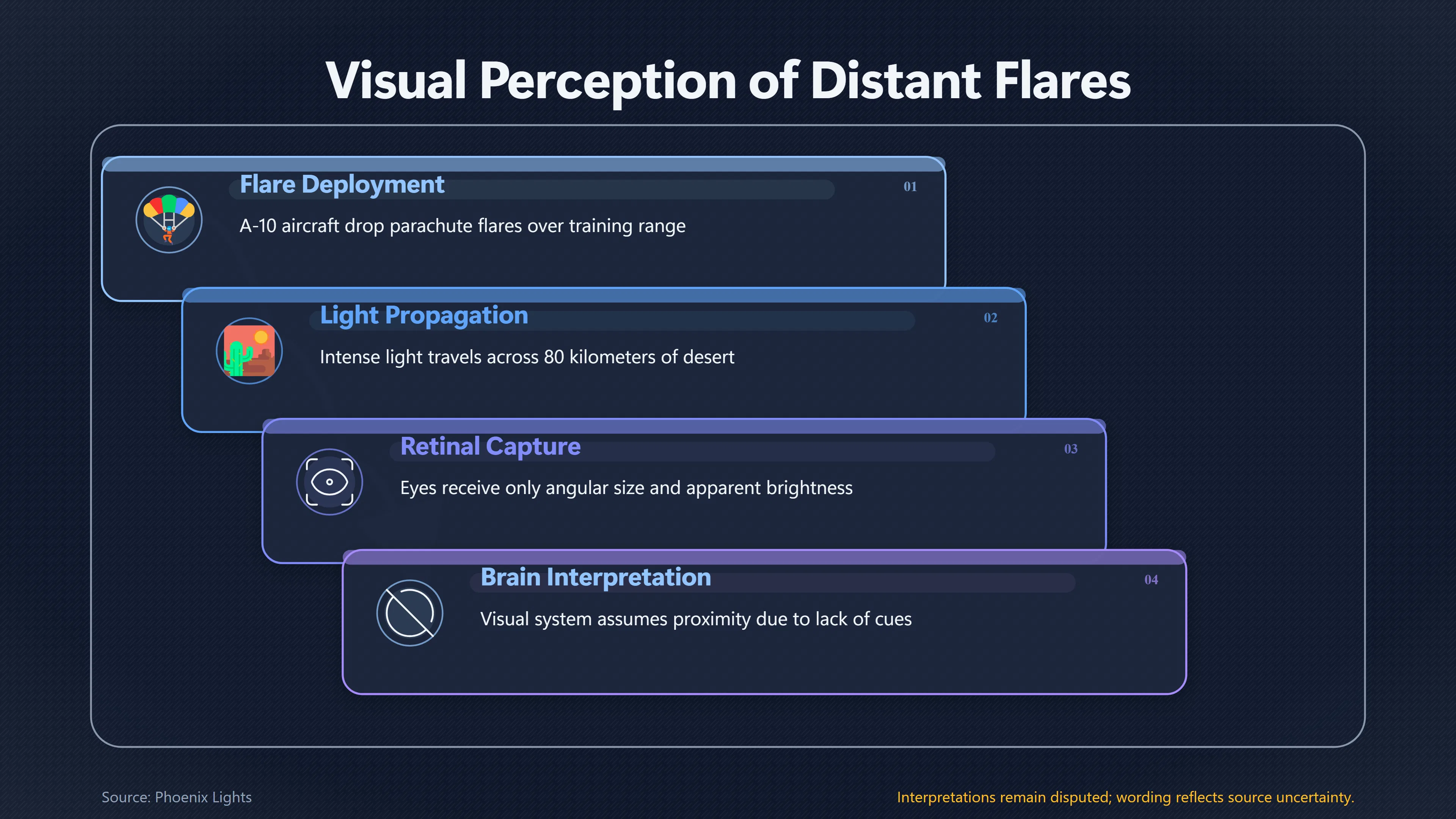
Military illumination flares are designed to light large areas of ground rather than to act as small signalling devices. Air-dropped parachute flares produce an intense, sustained light that remains visible for several minutes while descending slowly. From many tens of kilometres away, they appear not as expanding fireballs but as compact, exceptionally bright points of light.
For observers in the Phoenix metropolitan area, this brightness had two important consequences. First, the flares remained conspicuous despite the long distance to the Barry M. Goldwater Range. Second, because the surrounding landscape was largely invisible in the darkness, viewers had few visual references indicating that the lights were far beyond the nearby suburbs. Analyses of the flare type believed to have been used by A-10 aircraft concluded that their apparent brightness at approximately 50–70 miles (80–110 km) would still rival or exceed the brightest objects normally visible in the night sky, making them entirely capable of attracting widespread attention.[wikipedia.org]WikipediaPhoenix LightsPhoenix Lights
Why brightness is a poor distance cue
Human vision estimates distance by combining many sources of information, including perspective, texture, atmospheric haze, relative motion and familiar object sizes. At night, most of these cues disappear.
A single bright light suspended against a dark background provides almost no reliable information about how far away it is. The eye measures only the angular size and apparent brightness reaching the retina. Because the actual brightness of the source is unknown, the brain cannot determine whether it is:
- a modest light nearby,
- an extremely powerful light much farther away, or
- something between the two.
This ambiguity affects pilots as well as observers on the ground. Aviation research has documented that night flying frequently produces substantial errors in judging distance, altitude and orientation because external visual references become severely limited. Even experienced pilots can misjudge spatial relationships when relying solely on isolated lights rather than instrument information.[nih.gov]pmc.ncbi.nlm.nih.govPub Med Central (PMC)Orientation and disorientation in aviationPubMed Central (PMC)Orientation and disorientation in aviation - PMCJanuary 3, 2013…
The Phoenix Lights presented almost ideal conditions for such uncertainty. Observers were looking towards a largely unlit desert beyond the Sierra Estrella mountains. The mountain ridge itself was difficult or impossible to see in darkness, removing one of the strongest natural indicators that the lights lay well beyond it.
How mistaken distance changes size and altitude estimates
Once the brain assumes a light is nearby rather than distant, every other estimate shifts accordingly.
If a bright flare is believed to be only a few kilometres away instead of roughly 80 kilometres away, it will naturally be interpreted as:
- lower in the sky,
- physically smaller,
- hovering above nearby neighbourhoods rather than beyond distant terrain, and
- potentially associated with a large object if several lights appear together.
This illustrates an important feature of visual perception: estimates of distance, size and altitude are not independent. They reinforce one another. A mistaken assumption about one variable leads observers to derive incorrect values for the others.
The effect is especially pronounced when several bright lights appear in a loose line. Without visible terrain between them and the observer, the lights can seem attached to a single nearby object rather than being independent flares descending at different positions over a distant training range.
Brightness can overpower other visual clues
Extremely bright lights do more than attract attention—they also reduce the visibility of surrounding features.
The proposed military flares were considerably brighter than stars, making nearby stars difficult to see and reducing the contrast needed to judge where the lights sat relative to the background sky. The result is a simplified visual scene dominated almost entirely by the luminous sources themselves.
Observers therefore lost information that would normally help distinguish foreground from background. Instead of perceiving distant points beyond a mountain range, many people experienced what psychologists describe as an impoverished visual environment, where the brain fills in missing spatial information using assumptions rather than reliable measurements.[Wikipedia]WikipediaPhoenix LightsPhoenix Lights
The Phoenix Lights as an example of a common night-time illusion
The brightness explanation does not depend on witnesses being careless or dishonest. It depends on well-established characteristics of human vision.
Night-time aviation has long recognised illusions involving isolated lights. Stationary lights may appear to move, distant lights may appear closer than they are, and inaccurate altitude estimates become common when horizons and terrain are poorly defined. These effects are sufficiently well documented that pilot training explicitly addresses them as operational hazards.[wikipedia.org]WikipediaSensory illusions in aviationSensory illusions in aviation
Applied to the later Phoenix Lights display, this means that sincere observers could accurately report what they saw—a row of brilliant lights apparently hanging over the city—while still being mistaken about where those lights were located.
What this explains—and what it does not
The brightness effect strengthens the flare explanation for the later stationary lights because it accounts for one of the most persistent questions: why so many witnesses believed the lights were close to Phoenix despite evidence placing them over the Barry M. Goldwater Range.
It also explains why later image analyses found that the lights disappeared in sequence behind the Sierra Estrella mountains rather than extinguishing simultaneously in open sky. If observers misjudged the distance, they would naturally perceive the lights as hovering over the city instead of descending behind terrain that was effectively invisible at night.[Wikipedia]WikipediaPhoenix LightsPhoenix Lights
However, this perceptual mechanism should not be stretched beyond its evidence. It addresses the stationary lights widely filmed around 10 p.m. and helps explain why their apparent proximity was misleading. It does not, by itself, resolve separate questions surrounding earlier reports of a moving V-shaped formation, which require independent evaluation rather than assuming the same explanation applies to every aspect of the broader Phoenix Lights event.
Amazon book picks
Further Reading
Books and field guides related to Why Bright Lights Looked Much Closer Than They Were. Use these as the next step if you want deeper reading beyond the article.
Visual Intelligence: Sharpen Your Perception, Change Your Life
An engrossing guide to seeing--and communicating--more clearly, from the groundbreaking course that helps FBI agents, cops, CEOs, ER doct...
Sleights of Mind: What the Neuroscience of Magic Reveals Abou...
What can magic tell us about ourselves and our daily lives? If you subtly change the subject during an uncomfortable conversation, did yo...
The Man Who Mistook His Wife for a Hat
With an introduction by Will SelfA classic work of psychology, this international bestseller provides a groundbreaking insight into the h...
The Demon-Haunted World: Science as a Candle in the Dark
Are we on the brink of a new Dark Age of irrationality and superstition? In this book, the writer shows how scientific thinking is necess...
eBay marketplace picks
Marketplace Samples
Live-tested eBay searches with available results related to this page.
Selected fromUFO wall art oneBay.co.uk.
Endnotes
1.
Source: Wikipedia
Title: Phoenix Lights
Link:https://en.wikipedia.org/wiki/Phoenix_Lights
2.
Source: Wikipedia
Title: Sensory illusions in aviation
Link:https://en.wikipedia.org/wiki/Sensory_illusions_in_aviation
3.
Source: youtube.com
Link:https://www.youtube.com/watch?v=bvKLeaPWPyw
Source snippet
Phoenix Lights - The Dark Truth?...
Published: March 13, 1997
4.
Source: youtube.com
Title: Phoenix Lights
Link:https://www.youtube.com/watch?v=N1fW1l1sh-A
Source snippet
Explained & Debunked...
5.
Source: pmc.ncbi.nlm.nih.gov
Title: Pub Med Central (PMC)Orientation and disorientation in aviation
Link:https://pmc.ncbi.nlm.nih.gov/articles/PMC3710190/
Source snippet
PubMed Central (PMC)Orientation and disorientation in aviation - PMCJanuary 3, 2013...
Published: January 3, 2013
6.
Source: faa.gov
Link:https://www.faa.gov/data_research/research/med_humanfacs/oamtechreports/1970s/1978/197815
7.
Source: projectunredacted.com
Title: phoenix lights 1997
Link:https://www.projectunredacted.com/cases/phoenix-lights-1997
Source snippet
Project UnredactedThe Phoenix Lights (1997) — UFO sighting Explained | Project Unredacted...
8.
Source: faa.gov
Link:https://www.faa.gov/data_research/research/med_humanfacs/oamtechreports/1970s/1977/197712
9.
Source: probed.space
Title: Phoenix Lights | Events | Probed
Link:https://probed.space/events/phoenix-lights
10.
Source: pubmed.ncbi.nlm.nih.gov
Link:https://pubmed.ncbi.nlm.nih.gov/17760289/
Additional References
11.
Source: thecurious.city
Title: Thousands witnessed it. The Air Force said it was flares. Witnesses say that
Link:https://www.thecurious.city/phoenix/articles/phoenix-lights
Source snippet
The Phoenix Lights: What Thousands of People Saw - phoenix - The Curious CityDecember 8, 2025 — THE PHOENIX LIGHTS: WHAT THOUSANDS OF PEO...
Published: December 8, 2025
12.
Source: theoriesofanything.com
Title: phoenix lights 1997 and [mass sighting events]({{ ‘merged-events/’ | relative_url }}) deep dive
Link:https://theoriesofanything.com/research/phoenix-lights-1997-and-mass-sighting-events-deep-dive
Source snippet
Phoenix Lights (1997) and Mass Sighting Events Deep Dive | Theories of AnythingMarch 7, 2026 — PHOENIX LIGHTS (1997) AND MASS SIGHTING EV...
Published: March 7, 2026
13.
Source: thegalacticmind.com
Title: The later Phoenix lights were likely military flares,
Link:https://www.thegalacticmind.com/case-file-the-phoenix-lights-1997-arizona-nevada/
Source snippet
Phoenix Lights Case File: The 1997 Arizona UFO MysteryApril 3, 2026 — THE PHOENIX LIGHTS: TWO EVENTS, ONE AMERICAN MYSTERY On March 13, 1...
Published: April 3, 2026
14.
Source: faa.gov
Link:https://www.faa.gov/data_research/research/med_humanfacs/oamtechreports/1960s/1967/196716
15.
Source: youtube.com
Title: Phoenix Lights Explained & Debunked
Link:https://www.youtube.com/watch?v=TD6MYZcucQA
Source snippet
'Phoenix Lights' witness says 'data speaks for itself' | Elizabeth Vargas Reports...
16.
Source: tandfonline.com
Link:https://www.tandfonline.com/doi/abs/10.1080/10508414.2013.833755
17.
Source: skybrary.aero
Link:https://skybrary.aero/index.php/articles/night-visual-approaches
18.
Source: alienresearch.com.au
Link:https://www.alienresearch.com.au/phoenix-lights/
19.
Source: skybrary.aero
Link:https://skybrary.aero/index.php/articles/visual-illusions
20.
Source: researchgate.net
Link:https://www.researchgate.net/publication/6080586_Visual_spatial_disorientation_Revisiting_the_black_hole_illusion