Within Official Actions
How New UAP Rules Changed What Pilots Reported
New reporting procedures gave military personnel a clearer way to document unexplained encounters without treating them as fringe claims.
On this page
- Why pilots often avoided formal reports
- What the Navy's new procedures required
- How better reporting served safety and intelligence goals
Page outline Jump by section
Introduction
The US Navy’s decision to formalise reporting procedures for unidentified aerial phenomena (UAP) marked a practical policy change rather than an endorsement of extraordinary explanations. The main goal was to ensure that military aviators could report unusual encounters without fearing that their professionalism would be questioned. By reframing UAP reports as aviation-safety and operational-intelligence matters, the Navy sought to replace an informal culture of silence with standardised reporting that could identify hazards, improve situational awareness and support national security. This shift became one of the clearest examples of how official UAP policy changed during the period when public attention, including celebrity advocacy, helped move the subject from the cultural margins into mainstream institutional debate.[Time]time.comNavy is drafting formal guidelines for reporting sightings of unidentified flying objects (UFOs) following a significant increase in unex…
Why pilots often avoided formal reports
Before the Navy introduced dedicated reporting guidance, there was no consistent service-wide process for documenting unexplained aerial encounters. Pilots who observed unusual objects often had to decide whether an incident justified a conventional aviation hazard report or intelligence report, even when they could not identify what they had seen.
Several factors discouraged reporting:[aiaauap.org]aiaauap.orgSource details in endnotes.
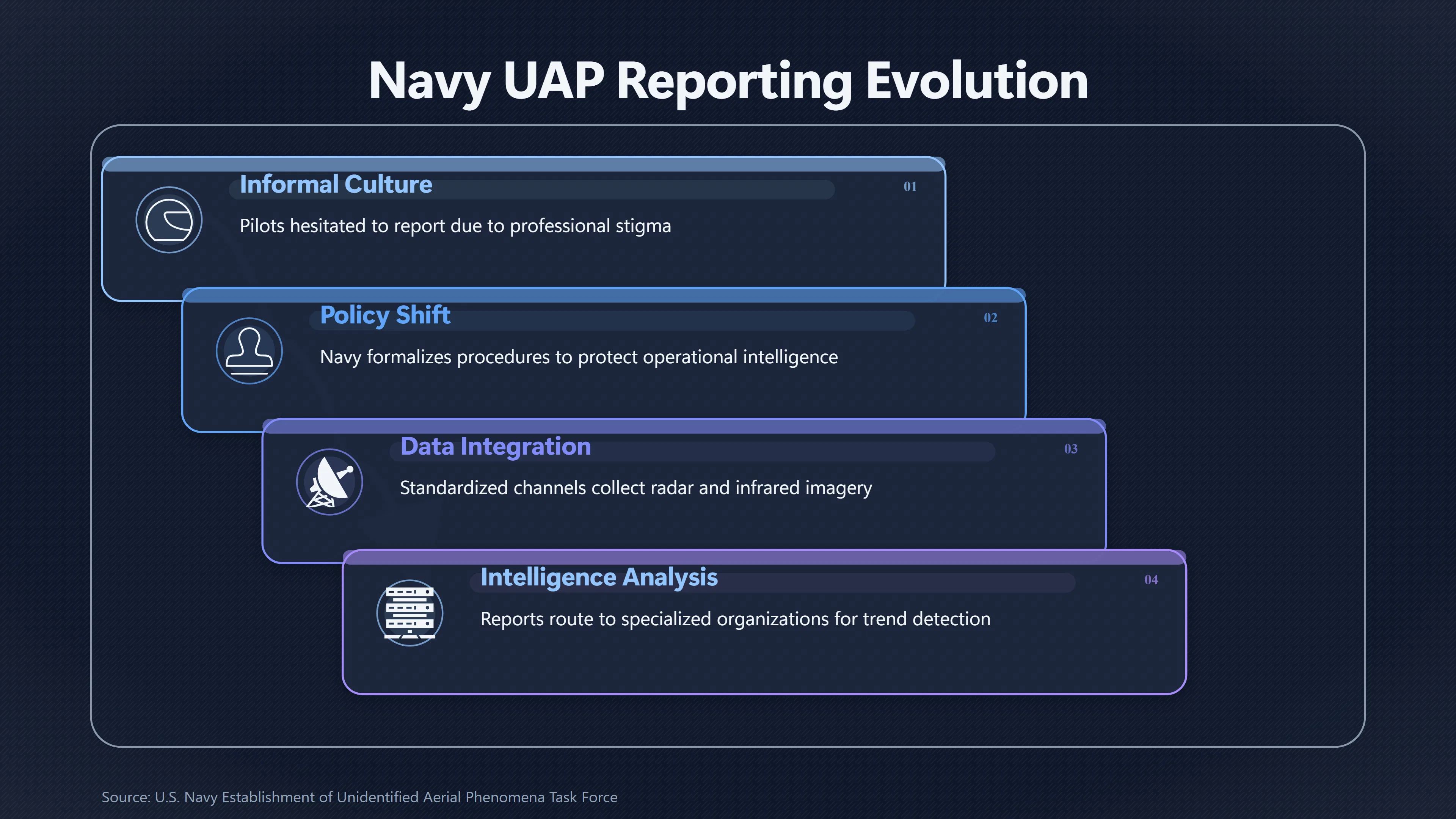
- Professional stigma. Pilots worried that reporting an unexplained object could lead colleagues or superiors to question their judgement or competence.
- Lack of clear procedures. Without dedicated guidance, reports could be inconsistent or never reach analysts equipped to compare similar incidents.
- Operational priorities. Fast-moving training missions often left little opportunity to gather detailed evidence, increasing concern that reports would be dismissed as anecdotal.
- Fear of ridicule. The popular association of “UFOs” with science fiction or conspiracy theories discouraged some aviators from raising incidents that they could not immediately explain.[Time]time.comNavy is drafting formal guidelines for reporting sightings of unidentified flying objects (UFOs) following a significant increase in unex…
Former Navy pilots, including those involved in well-publicised encounters off the US East Coast, later argued that the reluctance to report unusual observations created blind spots in aviation safety. Their concern was not that every sighting represented exotic technology, but that unexplained objects in military training airspace deserved systematic investigation regardless of their eventual explanation.[Vanity Fair]vanityfair.comThe hearing featured testimonies from former Navy pilots Ryan Graves and David Fravor, as well as whistleblower and former intelligence o…
What the Navy’s new procedures required
The Navy announced in 2019 that it was developing formal guidance for reporting unexplained aerial encounters. Rather than creating a special category for extraordinary claims, the policy integrated UAP reporting into existing operational and intelligence processes.
The new approach emphasised several implementation principles:
- Standardised documentation using consistent reporting channels.
- Collection of sensor data, including radar, infrared imagery and other available information where possible.
- Routing reports to appropriate intelligence organisations for analysis rather than leaving individual commands to handle incidents independently.
- Treating unidentified observations as operational events, regardless of whether they were ultimately explained as drones, aircraft, balloons, sensor artefacts or something else.[Time]time.comNavy is drafting formal guidelines for reporting sightings of unidentified flying objects (UFOs) following a significant increase in unex…
The emphasis was on identification rather than speculation. An object remained a UAP only because it had not yet been identified—not because officials believed it represented alien technology.
How reporting became an aviation safety issue
A crucial feature of the policy change was its framing. Navy leaders repeatedly described UAP reporting as part of protecting personnel and military operations.
This represented an important cultural shift. Instead of asking whether pilots had witnessed something extraordinary, commanders asked whether unknown objects were entering restricted airspace, interfering with training or indicating surveillance by foreign systems.
Possible explanations included:
- foreign drones or intelligence platforms;
- experimental aircraft;
- balloons or airborne clutter;
- sensor limitations or observational errors;
- other currently unidentified causes.
Treating every report as potentially relevant to flight safety reduced the pressure on individual pilots to provide immediate answers. Their responsibility became accurate observation rather than interpretation. The Department of Defense later reiterated that every report of an initially unidentified object entering military operating areas should be examined because safety and security remain paramount.[U.S. Navy]navy.milOpen source on navy.mil.
From isolated sightings to searchable data
Another important consequence of standardised reporting was improved data quality.
Aviation investigators generally rely on identifying patterns across multiple reports rather than evaluating isolated anecdotes. Standard reporting increased the likelihood that analysts could compare:
- locations and times;
- aircraft involved;
- weather conditions;
- sensor recordings;
- recurring object characteristics;
- links between multiple incidents.
This approach recognised that many reports would ultimately receive conventional explanations while still preserving potentially valuable operational information. The Office of the Director of National Intelligence’s later UAP assessments similarly noted that earlier reporting had been fragmented and inconsistent, making trend analysis difficult, and recommended continued standardisation to improve future investigations.[U.S. Navy]navy.milOpen source on navy.mil.
How reduced stigma supported intelligence goals
Reducing stigma was not simply a workplace culture initiative. It also addressed an intelligence collection problem.
If pilots avoided reporting because they feared embarrassment, the military risked missing information about:
- foreign surveillance activity;
- emerging drone technologies;
- repeated incursions into military training areas;
- hazards to flight operations;
- weaknesses in sensor systems.
The creation of the Unidentified Aerial Phenomena Task Force in 2020 reflected this logic. Its mission focused on detecting, analysing and cataloguing UAP that could present national security concerns rather than validating extraordinary claims. The Navy stressed that incursions into military training ranges were taken seriously regardless of whether the initial report involved an unidentified object.[U.S. Navy]navy.milOpen source on navy.mil.
Later legislation expanded this philosophy by requiring secure reporting mechanisms that would allow personnel to submit information without fear that classification rules or non-disclosure agreements would improperly prevent reporting through authorised channels.[Senate Intelligence Committee]intelligence.senate.govSenate Intelligence CommitteeIntelligence Authorization Act for Fiscal Year 2023, as reported on July 12, 2022 | Senate Select Committee…

What changed—and what did not
The reporting reforms significantly altered institutional behaviour but not the government’s evidentiary standards.
What changed was the expectation that unexplained observations should be documented consistently and investigated professionally. Pilots increasingly received the message that reporting unidentified objects was compatible with responsible military service rather than evidence of poor judgement.
What did not change was the burden of proof. The Navy’s reporting system did not assume extraordinary explanations. Official investigations continued to treat UAP as a category of observations requiring identification, with many cases ultimately attributed to ordinary objects or insufficient data rather than unknown technology. Current reporting guidance through the All-domain Anomaly Resolution Office (AARO) continues this evidence-driven approach, directing military personnel to report through established command channels while analysing cases according to available data rather than preconceived conclusions.[AARO]aaro.milAARO FAQ…
Why this policy became a lasting milestone
Within the broader story of celebrity advocacy and official UAP action, the Navy’s reporting reforms stand out because they produced a concrete institutional change. Public attention may have helped create political momentum, but the policy itself addressed a practical military problem: how to ensure that trained observers reported unusual encounters without unnecessary professional risk.
By replacing informal hesitation with structured procedures, the Navy shifted UAP reporting from a culturally sensitive subject to a routine component of aviation safety and intelligence collection. That change did not resolve what every reported object was, but it improved the military’s ability to gather evidence before reaching conclusions—an outcome that remains central to subsequent US government UAP policy.[time.com]time.comNavy is drafting formal guidelines for reporting sightings of unidentified flying objects (UFOs) following a significant increase in unex…
Amazon book picks
Further Reading
Books and field guides related to How New UAP Rules Changed What Pilots Reported. Use these as the next step if you want deeper reading beyond the article.
The UFO Experience: A Scientific Inquiry
Cited by the New York Review of Books as "the best brief for visitation," this classic study presents an analysis of UFO reports and conc...
The Report on Unidentified Flying Objects
The Report on Unidentified Flying Objects, written by Captain Edward Ruppelt in 1956, was the first serious, unbiased account written abo...
UFO: The Inside Story of the US Government's Search for Alien...
"The full story of our national obsession with UFOs--and the covert, decades-long search by scientists, the United States military, and t...
UFOs: Generals, Pilots, and Government Officials Go on the Re...
NEW YORK TIMES BESTSELLER • Impeccably researched, this riveting journalistic investigation separates fact from fiction, and documents th...
eBay marketplace picks
Marketplace Samples
Live-tested eBay searches with available results related to this page.
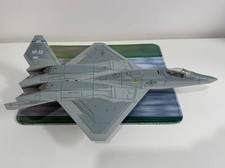
Selected fromfighter jet model oneBay.co.uk.
Endnotes
1.
Source: time.com
Link:https://time.com/5577853/navy-ufo-reporting-guidelines/
Source snippet
Navy is drafting formal guidelines for reporting sightings of unidentified flying objects (UFOs) following a significant increase in unex...
2.
Source: navy.mil
Link:https://www.navy.mil/Press-Office/News-Stories/Article/2314280/establishment-of-unidentified-aerial-phenomena-task-force/
3.
Source: aaro.mil
Link:https://www.aaro.mil/FAQ/
Source snippet
AARO FAQ...
4.
Source: navy.mil
Title: U.S. Navy Establishment of Unidentified Aerial Phenomena Task Force
Link:https://www.navy.mil/DesktopModules/ArticleCS/Print.aspx?Article=2314280&ModuleId=685&PortalId=1
5.
Source: intelligence.senate.gov
Link:https://www.intelligence.senate.gov/2022/07/14/legislation-intelligence-authorization-act-fiscal-year-2023-reported-july-12-2022/
Source snippet
Senate Intelligence CommitteeIntelligence Authorization Act for Fiscal Year 2023, as reported on July 12, 2022 | Senate Select Committee...
Published: July 12, 2022
6.
Source: aaro.mil
Title: Submit A Report
Link:https://www.aaro.mil/Next-AARO-Home-redesign/Next-Parent/Next-Submit-a-Report-dup/
Source snippet
AARO Submit A Report...
7.
Source: mynavyhr.navy.mil
Title: mil Reporting Requirements
Link:https://www.mynavyhr.navy.mil/Support-Services/Culture-Resilience/Equal-Opportunity/Reporting-Requirements/
8.
Source: defense.gov
Link:https://www.defense.gov/News/News-Stories/Article/Article/3575511/dod-unidentified-anomalous-phenomena-office-launches-new-reporting-tool/
9.
Source: defense.gov
Link:https://www.defense.gov/News/Transcripts/Transcript/Article/3575588/aaro-director-dr-sean-kirkpatrick-holds-an-off-camera-media-roundtable/
10.
Source: defense.gov
Link:https://www.defense.gov/News/Releases/Release/Article/3513171/the-department-of-defense-launches-the-all-domain-anomaly-resolution-office-web/
11.
Source: warner.senate.gov
Title: statement of senate intel chair mark r warner on uap report
Link:https://www.warner.senate.gov/newsroom/press-releases/statement-of-senate-intel-chair-mark-r-warner-on-uap-report/
12.
Source: intelligence.senate.gov
Link:https://www.intelligence.senate.gov/2021/09/02/publications-report-accompany-s-2610-intelligence-authorization-act-fiscal-year-2022-august-10-2021/
13.
Source: aaro.mil
Link:https://www.aaro.mil/Next-AARO-Home-redesign/Next-Parent/Next-Index/
14.
Source: navalsafetycommand.navy.mil
Link:https://navalsafetycommand.navy.mil/Resources/Instructions-Policy-Guidance/v/
15.
Source: mynavyhr.navy.mil
Link:https://www.mynavyhr.navy.mil/References/BUPERS-Instructions/
16.
Source: secnav.navy.mil
Title: mil Pages
Link:https://www.secnav.navy.mil/ig/Pages/MakingaComplaint.aspx
17.
Source: navalsafetycommand.navy.mil
Link:https://navalsafetycommand.navy.mil/Contact-Us/FOIA/Reading-Room/
18.
Source: vanityfair.com
Link:https://www.vanityfair.com/news/2023/07/ufo-hearing-congress
Source snippet
The hearing featured testimonies from former Navy pilots Ryan Graves and David Fravor, as well as whistleblower and former intelligence o...
19.
Source: congress.gov
Link:https://www.congress.gov/bill/119th-congress/house-bill/5231/text
20.
Source: abcnews.go.com
Link:https://abcnews.go.com/Politics/unauthorized-aircraft-sightings-lead-navy-develop-ufo-reporting/story?id=62625928
21.
Source: aiaauap.org
Link:https://aiaauap.org/reporting/guidance
Additional References
22.
Source: axios.com
Link:https://www.axios.com/2023/07/26/ufo-house-hearing
Source snippet
Military pilots testified, urging the declassification of documents and describing the challenges they face, including stigma and potenti...
23.
Source: youtube.com
Title: Navy pilots describe encounters with UFOs
Link:https://www.youtube.com/watch?v=ZBtMbBPzqHY
Source snippet
This selection of videos directly features former US Navy aviators like Ryan Graves discussing how official reporting mechanisms and chan...
24.
Source: youtube.com
Link:https://www.youtube.com/watch?v=lTGJt7Gho0w
Source snippet
Navy pilots describe encounters with UFOs...
25.
Source: youtube.com
Title: Eyewitness UFO Encounters | Ryan Graves (Ep. 334)
Link:https://www.youtube.com/watch?v=tnQtfv93agA
Source snippet
Inside the Data: What 1,000+ Pilot Reports Reveal About UAP | iConnections Webinar with Ryan Graves...
26.
Source: youtube.com
Title: UAPs are ‘in our airspace’
Link:https://www.youtube.com/watch?v=dUn2IbIb8wU
Source snippet
Eyewitness UFO Encounters | Ryan Graves (Ep. 334)...
27.
Source: faa.gov
Link:https://www.faa.gov/air_traffic/publications/atpubs/foa_html/chap4_section_7.html
28.
Source: faa.gov
Link:https://www.faa.gov/air_traffic/publications/atpubs/aim_html/chap7_section_7.html
29.
Source: youtube.com
Title: Why Military Pilots Stay Silent About UFOs
Link:https://www.youtube.com/watch?v=T4UxBL43e64
Source snippet
UAPs are 'in our airspace' - witnesses testify at UFO Congressional hearing...
30.
Source: law.cornell.edu
Link:https://www.law.cornell.edu/uscode/text/50/3373b
Source snippet
Legal Information Institute50 U.S. Code § 3373b - Unidentified anomalous phenomena reporting procedures | U.S. Code | US Law | LII / Lega...
31.
Source: narcap.org
Link:https://www.narcap.org/faa-reporting-recommendation