Within UFO Meaning
Why Expert Witnesses Can Still Misread UFOs
Training improves observation, but darkness, glare, sparse reference points and visual illusions can still defeat accurate identification.
On this page
- What pilot expertise adds
- How night vision creates false motion
- Why credibility does not guarantee identification
Page outline Jump by section
Introduction
Pilots are often among the most credible witnesses to unusual objects in the sky. They are trained to estimate aircraft movement, monitor weather, recognise common aerial hazards and report abnormal events accurately. That expertise means pilot reports deserve careful attention. It does not, however, mean that every unidentified observation represents an extraordinary object.
The aviation profession has long recognised that even highly experienced pilots can misidentify what they see under certain conditions. Darkness, glare, unusual lighting, sparse visual references, atmospheric effects and the limits of human vision can all create convincing but misleading impressions. Aviation training explicitly teaches these limitations because they are well-known safety hazards. Understanding those limits helps explain why a UFO report from a qualified pilot should be investigated seriously without assuming it is evidence of alien spacecraft. NASA likewise emphasises that eyewitness accounts are valuable but require supporting data before firm conclusions can be drawn.[NASA Science]science.nasa.govScience UAPNASA ScienceUAP - NASA ScienceFebruary 23, 2026…
What Pilot Expertise Adds
Professional pilots bring important advantages that make their observations more valuable than casual sightings.
They are familiar with aircraft lighting patterns, navigation procedures, weather conditions and the appearance of many natural and human-made objects in the sky. They also operate within structured reporting systems and often have access to cockpit instruments, radar information and air traffic control communications. These factors generally make their descriptions more disciplined and technically informative than those from untrained observers.
However, pilot training is not designed to eliminate perceptual error. Instead, aviation training assumes that such errors are inevitable and teaches pilots how to compensate for them. The Federal Aviation Administration (FAA) devotes extensive guidance to visual illusions, spatial disorientation and night-flight limitations because these affect experienced aviators as well as beginners. The recommended solution is not greater confidence in perception but greater reliance on instruments and corroborating evidence.[Federal Aviation Administration]faa.govFederal Aviation Administration Chapter 8. Medical Facts for PilotsFederal Aviation Administration Chapter 8. Medical Facts for Pilots
This distinction is important in discussions of UFOs. A credible witness can provide a credible account of what they experienced while still being unable to identify the object correctly.
How Night Vision Creates False Motion
Night flying removes many of the visual cues people unconsciously rely upon to judge distance, speed and direction.
Without terrain, buildings or a visible horizon, the brain struggles to determine whether an object is moving or whether the observer is moving relative to it. A distant light may appear to accelerate, stop abruptly or change direction even when following a steady path.
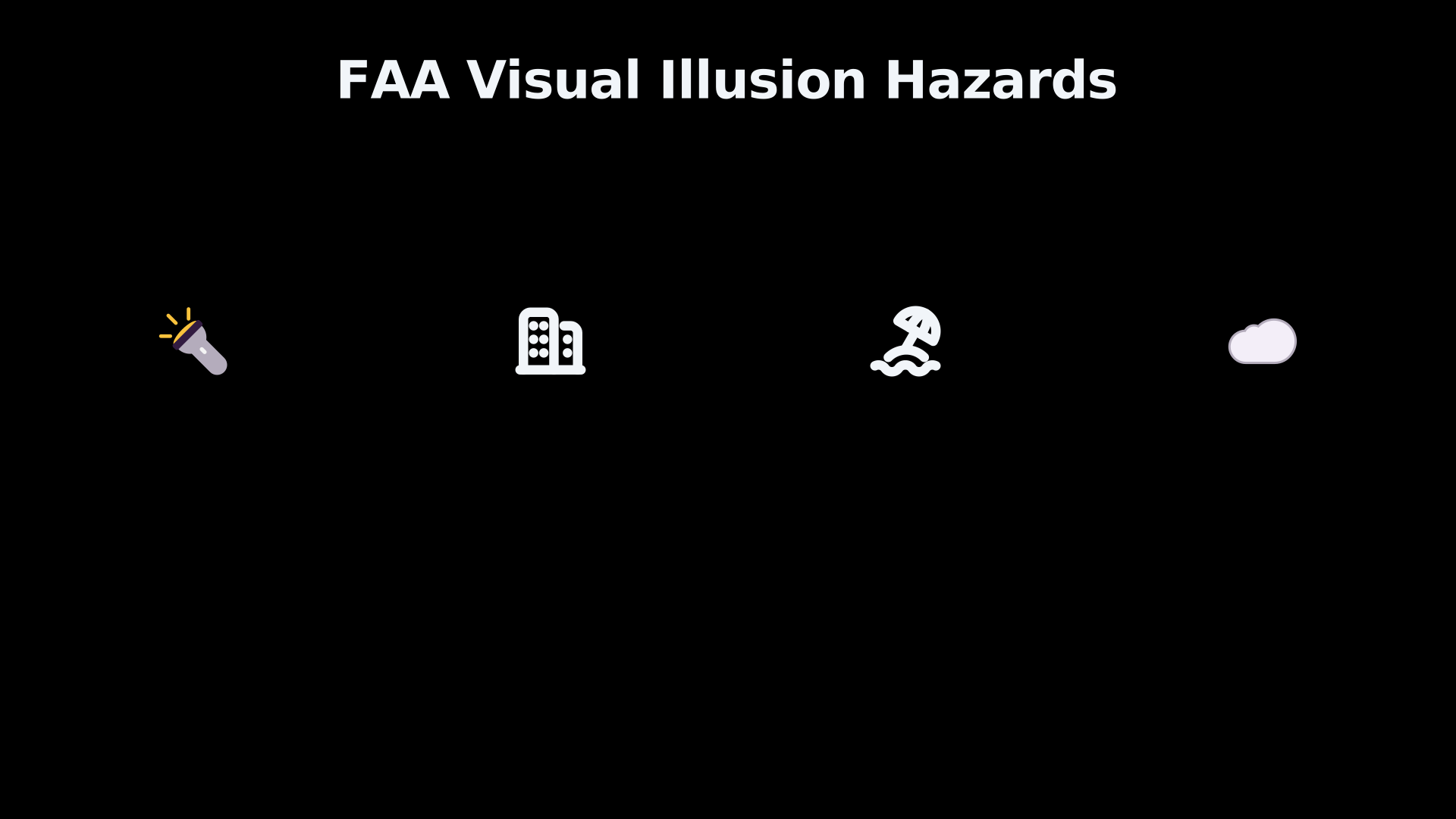
One of the best-known examples is autokinesis. When a pilot stares at a single stationary light against a dark background for several seconds, the light can appear to drift or manoeuvre. The FAA identifies this as a recognised visual illusion that has affected pilots for decades.[Federal Aviation Administration]faa.govFederal Aviation Administration Chapter 8. Medical Facts for PilotsFederal Aviation Administration Chapter 8. Medical Facts for Pilots
Other conditions can produce similar effects:
- Bright stars or planets viewed through thin cloud layers.
- Satellites whose brightness changes as they reflect sunlight.
- Aircraft viewed head-on, where little apparent motion is visible until the final moments.
- Lights seen over featureless water or desert, where there are few reference points for judging distance.
Because these effects arise from normal human perception rather than poor judgement, they can create sincere reports of apparently extraordinary manoeuvres.
False Horizons and Sparse Reference Points
The human visual system depends heavily on the horizon to determine orientation.
At night, the true horizon may disappear entirely. Sloping cloud layers, city lights, stars or illuminated coastlines can instead create a convincing but false horizon. The FAA warns that pilots may unknowingly align their aircraft with these misleading visual references, illustrating how persuasive such illusions can become.[Federal Aviation Administration]faa.govFederal Aviation Administration Chapter 8. Medical Facts for PilotsFederal Aviation Administration Chapter 8. Medical Facts for Pilots
Similar problems arise when flying over oceans, deserts or snow-covered landscapes, where the lack of contrasting features makes depth and movement difficult to judge. Under these conditions, even experienced crews rely far more heavily on cockpit instruments than on outside visual impressions.

Credibility Does Not Guarantee Identification
A witness’s credibility and the correctness of an identification are separate questions.
A pilot may accurately report:
- the time and location of an observation,
- the object’s apparent brightness,
- its apparent direction,
- its duration,
- and the circumstances under which it was seen.
Those observations can all be truthful while the object’s identity remains uncertain.
This distinction explains why aviation investigators often separate witness reliability from identification confidence. A reliable observer may still encounter an unfamiliar combination of lighting, viewing angle and atmospheric conditions that prevents correct recognition.
NASA’s independent UAP study similarly concluded that eyewitness testimony is valuable but generally insufficient on its own to determine what was observed. The report recommends combining human observations with calibrated sensor data, environmental information and other measurements wherever possible.[NASA Science]science.nasa.govScience UAPNASA ScienceUAP - NASA ScienceFebruary 23, 2026…
Real Examples of Misidentification
Modern aviation provides several examples in which multiple experienced pilots observed genuinely puzzling phenomena that later received conventional explanations.
One documented case involved commercial airline crews over the Pacific reporting an unusual luminous formation that initially appeared anomalous. Subsequent reconstruction using flight data, satellite orbital information and photographs showed the lights were consistent with a recently launched Starlink satellite train seen under unusual illumination conditions. The case demonstrated that several trained observers could independently describe the same unfamiliar phenomenon while still misidentifying its source.[arXiv]arxiv.orgEnhancing Space Situational Awareness to Mitigate Risk: A Single-Case Study in the Misidentification of a Recently-Launched Starlink…
This does not imply that every pilot report will eventually receive an ordinary explanation. Rather, it shows that unusual viewing geometry and unfamiliar aerospace objects can produce convincing observations that remain unidentified until additional evidence becomes available.
Why Aviation Training Emphasises Instrument Verification
One reason aviation has achieved its high safety record is that it explicitly teaches pilots not to rely solely on perception.
Visual illusions are treated as routine operational hazards rather than rare psychological curiosities. Pilots learn that their senses can conflict with reality, especially at night or in poor visibility, and that aircraft instruments usually provide the more reliable reference.
Investigations of accidents involving spatial disorientation reinforce this lesson. The US National Transportation Safety Board has repeatedly found that experienced pilots can lose accurate awareness of aircraft orientation when visual cues disappear, even though they remain convinced their perception is correct.[National Transportation Safety Board]ntsb.govNational Transportation Safety BoardPilot’s Poor Decision Making, Spatial Disorientation, Led to Fatal Helicopter CrashFebruary 9, 2021…
The same principle applies when assessing UFO reports. Pilot testimony should neither be dismissed nor accepted uncritically. Instead, investigators seek radar returns, infrared recordings, satellite tracking, weather information, astronomical data and other independent evidence that can confirm or challenge the initial observation.
The Key Lesson for UFO Reports
Pilot reports deserve respect because they often contain careful observations made by trained professionals operating in demanding environments. Their expertise increases the value of what they report, particularly regarding the circumstances of an event.
Yet aviation itself recognises that human perception has well-defined limits. Darkness, glare, false horizons, sparse visual references and optical illusions can all produce convincing experiences that even skilled pilots cannot immediately interpret correctly. Consequently, a report remaining a UFO—or unidentified flying object—means only that the object has not yet been confidently identified. It does not, by itself, establish the presence of alien technology or any other extraordinary explanation.
Amazon book picks
Further Reading
Books and field guides related to Why Expert Witnesses Can Still Misread UFOs. Use these as the next step if you want deeper reading beyond the article.
The UFO Handbook: A Guide to Investigating, Evaluating, and R...
An explanation of the usual reasons for confusing IFOs (identified flying objects) with UFOs and a survey of the tools used to investigat...
Human Factors in Flight
The late Captain Frank H Hawkins FRAes, M Phil, was Human Factors Consultant to KLM, for whom he had flown for over 30 years as line capt...
The Limits of Expertise: Rethinking Pilot Error and the Cause...
The Limits of Expertise reports a study of the 19 major U.S. airline accidents from 1991-2000 in which the National Transportation Safety...
The Invisible Gorilla: How Our Intuitions Deceive Us
NEW YORK TIMES BESTSELLER • Our minds don’t work the way we think they do. Two renowned psychologists explain how and why our intuitions...
eBay marketplace picks
Marketplace Samples
Live-tested eBay searches with available results related to this page.
Selected fromUFO poster oneBay.co.uk.
Endnotes
1.
Source: science.nasa.gov
Title: Science UAP
Link:https://science.nasa.gov/uap/
Source snippet
NASA ScienceUAP - NASA ScienceFebruary 23, 2026...
Published: February 23, 2026
2.
Source: faa.gov
Title: Federal Aviation Administration Chapter 8. Medical Facts for Pilots
Link:https://www.faa.gov/Air_traffic/publications/atpubs/aim_html/chap8_section_1.html
3.
Source: faa.gov
Title: Federal Aviation Administration Chapter 8. Medical Facts for Pilots
Link:https://www.faa.gov/air_traffic/publications/atpubs/aim/aim0801.html
4.
Source: arxiv.org
Link:https://arxiv.org/abs/2403.08155
Source snippet
Enhancing Space Situational Awareness to Mitigate Risk: A Single-Case Study in the Misidentification of a Recently-Launched Starlink...
5.
Source: science.nasa.gov
Title: Trump’s direction for whole-of-government transparency and will alw
Link:https://science.nasa.gov/uap/faqs/
Source snippet
FAQs - NASA ScienceMay 8, 2026 — UAP FAQS NASA UNIDENTIFIED ANOMALOUS PHENOMENA STUDY Frequently Asked Questions < Back to UAP NASA appl...
Published: May 8, 2026
6.
Source: faa.gov
Title: spatial disorientation fatal general aviation
Link:https://www.faa.gov/dataresearch/research/medhumanfacs/oamtechreports/spatial-disorientation-fatal-general-aviation
Source snippet
Spatial Disorientation in Fatal General Aviation Accidents (2003 – 2021) | Federal Aviation AdministrationMarch 3, 2025 — SPATIAL DISORIE...
Published: March 3, 2025
7.
Source: faa.gov
Title: Where does it come from? Can tra
Link:https://www.faa.gov/pilots/training/airman_education/topics_of_interest/spatial_disorientation
Source snippet
Airman Education Programs | Federal Aviation AdministrationDecember 16, 2024 — AIRMAN EDUCATION PROGRAMS TOPICS OF INTEREST Spatial Disor...
Published: December 16, 2024
8.
Source: nasa.gov
Title: UPDAT E: NASA Shares UAP Independent Study Report; Names Director
Link:https://www.nasa.gov/news-release/update-nasa-shares-uap-independent-study-report-names-director/
9.
Source: nasa.gov
Title: NAS A Announces Unidentified Aerial Phenomena Study Team Members
Link:https://www.nasa.gov/general/nasa-announces-unidentified-aerial-phenomena-study-team-members/
10.
Source: human-factors.arc.nasa.gov
Link:https://human-factors.arc.nasa.gov/groups/HCSL/research/enhancedvis.php
11.
Source: faa.gov
Title: Office of Aerospace Medicine Technical Reports | Federal Aviation Administration
Link:https://www.faa.gov/data_research/research/med_humanfacs/oamtechreports/1990s/1995/9501
12.
Source: ntrs.nasa.gov
Link:https://ntrs.nasa.gov/citations/19900013614
13.
Source: ntrs.nasa.gov
Link:https://ntrs.nasa.gov/archive/nasa/casi.ntrs.nasa.gov/19890012106.pdf
14.
Source: ntrs.nasa.gov
Link:https://ntrs.nasa.gov/citations/19800034854
15.
Source: faa.gov
Title: Office of Aerospace Medicine Technical Reports | Federal Aviation Administration
Link:https://www.faa.gov/data_research/research/med_humanfacs/oamtechreports/1970s/1978/197815
16.
Source: faa.gov
Link:https://www.faa.gov/air_traffic/publications/atpubs/aim_html/chap7_section_6.html
17.
Source: faa.gov
Link:https://www.faa.gov/air_traffic/publications/atpubs/aip_html/chap8_section_1.html
18.
Source: faa.gov
Link:https://www.faa.gov/air_traffic/publications/atpubs/aim_html/chap10_section_2.html
19.
Source: faa.gov
Link:https://www.faa.gov/air_traffic/publications/atpubs/aip_html/chap7_section_6.html
20.
Source: ntsb.gov
Link:https://www.ntsb.gov/news/press-releases/Pages/NR20210209.aspx
Source snippet
National Transportation Safety BoardPilot’s Poor Decision Making, Spatial Disorientation, Led to Fatal Helicopter CrashFebruary 9, 2021...
Published: February 9, 2021
21.
Source: atsb.gov.au
Link:https://www.atsb.gov.au/statements/2022/atsb-study-reviews-spatial-disorientation
Additional References
22.
Source: youtube.com
Title: How to Solve Starlink UFOs with Sitrec
Link:https://www.youtube.com/watch?v=WkzRJQ3rWa0
Source snippet
Pilot visual illusions perception UFO misidentification aviation Navy Fighter Pilot: The Truth About UFOs. "I've Seen Them With My Own Ey...
23.
Source: youtube.com
Title: Why “Racetrack” UFOs are mostly Starlink Flares
Link:https://www.youtube.com/watch?v=_VmrRGln1XA
Source snippet
Spatial Disorientation Explained: Deadly Flight Illusions Every Pilot Must Know...
24.
Source: faraim.org
Link:https://faraim.org/faa/aim/chapter-7/section-7-6-14.html
25.
Source: fivemilefinal.com
Link:https://www.fivemilefinal.com/vfr/afh/110.shtml
26.
Source: sciencedirect.com
Link:https://www.sciencedirect.com/science/article/pii/S0969699724000826
27.
Source: faraim.org
Link:https://www.faraim.org/faa/aim/chapter-8/section-8-1-5.html
28.
Source: youtube.com
Title: Spatial Disorientation Explained: Deadly Flight Illusions Every Pilot Must Know
Link:https://www.youtube.com/watch?v=6BD9fyyIJzY
Source snippet
These UFOs are Starlink Flares, 100%...
29.
Source: youtube.com
Title: These UFOs are Starlink Flares, 100%
Link:https://www.youtube.com/watch?v=Ea8BCl2yVU0
Source snippet
Illusions In Flight Spaitial Disorientation MzeroA com...
30.
Source: [aaro]({{ ‘aaro/’ | relative_url }}). mil
Link:https://www.aaro.mil/
31.
Source: flight-study.com
Link:https://www.flight-study.com/2019/09/night-illusions.html