Within Pilot Witnesses
Why Pilots Cannot Size a Light in Darkness
Without a measured distance, even an experienced pilot cannot reliably turn a light's apparent size into its true dimensions or speed.
On this page
- Why apparent angle does not reveal true size
- How distance uncertainty distorts speed estimates
- Which measurements can resolve the ambiguity
Page outline Jump by section
Introduction
When celebrity pilots describe an unidentified light or formation, readers often assume that aviation experience allows them to estimate its true size or speed. In reality, one of the biggest obstacles in interpreting such reports is range ambiguity: without a reliable measurement of distance, the apparent size of an object tells an observer almost nothing about its actual dimensions. A nearby light a few metres across can subtend exactly the same visual angle as a much larger object many kilometres away. The same uncertainty also affects estimates of speed, because an object’s apparent motion across the sky depends on both its true velocity and its distance from the observer. Pilot training improves observation and communication, but it does not eliminate this fundamental geometric limitation.[Federal Aviation Administration]faa.govFederal Aviation AdministrationPilot’s Handbook of Aeronautical Knowledge | Federal Aviation AdministrationNovember 3, 2023…

Why apparent angle does not reveal true size
Human vision measures an object’s angular size—how much of the observer’s field of view it occupies—not its physical dimensions. Converting that angular size into metres requires knowing the object’s range.
That simple relationship creates a major ambiguity during many reported UFO sightings:
- A small drone a few hundred metres away can appear identical in size to a transport aircraft several kilometres away.
- A bright landing light viewed head-on may appear much larger than the aircraft producing it.
- A distant formation of lights can resemble a single enormous object if the individual sources cannot be visually separated.
Night-time conditions make the problem substantially worse. Darkness removes many of the normal cues people unconsciously use to estimate distance, including surface texture, intervening objects, atmospheric perspective and motion relative to foreground features. The FAA’s guidance on visual illusions warns that featureless terrain, isolated lights and reduced visual references can produce significant errors in distance and position judgement even for trained pilots.[Federal Aviation Administration]faa.govFederal Aviation Administration Chapter 8. Medical Facts for PilotsFederal Aviation Administration Chapter 8. Medical Facts for Pilots
This limitation explains why witness statements sometimes describe apparently enormous craft spanning hundreds of metres while other observers interpret the same event as multiple distant lights. Neither interpretation can be confirmed from apparent size alone.
How distance uncertainty distorts speed estimates
The same uncertainty affects claims about extraordinary velocity.
Observers usually estimate motion from the angular rate at which an object moves across their field of view. Without knowing range, angular motion cannot be converted into true speed.
For example:
- A nearby object moving slowly may sweep rapidly across the observer’s vision.
- A distant aircraft travelling several hundred kilometres per hour may appear almost stationary.
- A light approaching directly towards the observer may show very little sideways movement despite high speed.
This geometry means that reports of an object “accelerating instantly” or “moving impossibly fast” cannot usually be translated into physical performance unless its distance is independently established.
Even experienced pilots are susceptible because the limitation is mathematical rather than experiential. Training helps pilots recognise conventional aircraft, maintain situational awareness and communicate bearings, but it cannot supply missing range information when visual references are absent. FAA research into night perception has shown that reduced visual cues produce substantial judgement errors despite flying experience, with pilots still vulnerable to important night-time visual illusions.[Federal Aviation Administration]faa.govFederal Aviation AdministrationOffice of Aerospace Medicine Technical Reports | Federal Aviation AdministrationMarch 1, 1978…
Why pilot expertise cannot remove the ambiguity
Within discussions of celebrity pilot witnesses, this distinction is important.
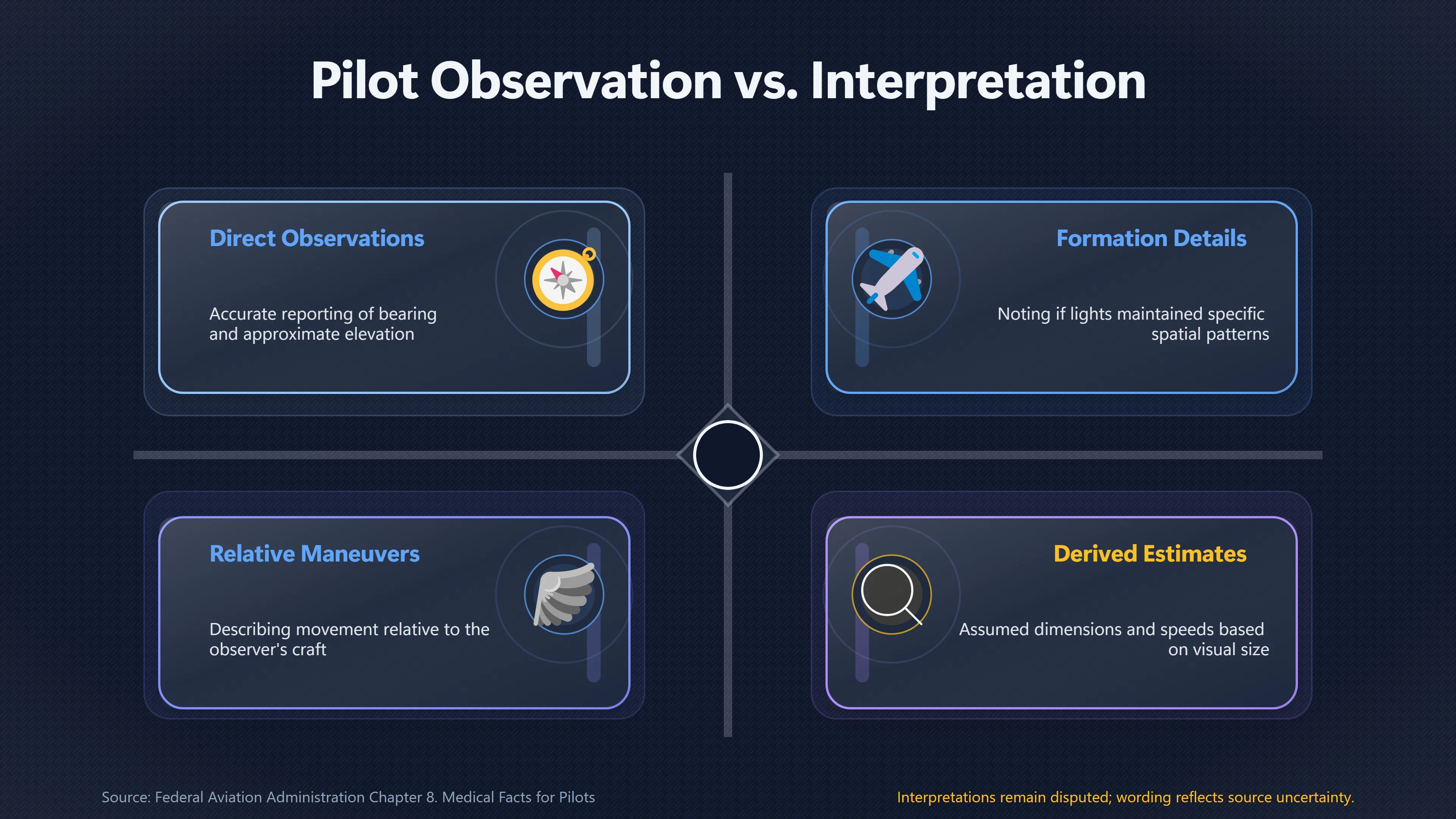
A pilot may accurately report:
- the bearing of a light;
- its approximate elevation;
- whether it maintained formation;
- whether it appeared to manoeuvre relative to the aircraft;
- whether air traffic control reported other traffic.
Those observations can be operationally valuable.
However, statements such as “it was a mile wide”, “it was hovering directly over the city”, or “it accelerated to impossible speeds” generally require assumptions about distance that may never have been verified. If the assumed distance is incorrect, every derived estimate of size and speed changes accordingly.
This is why investigators distinguish between the observation (“I saw six lights maintaining formation”) and the interpretation (“therefore the object must have been enormous”). The first may be well documented; the second often depends on unknown geometry.
Which measurements can resolve the ambiguity
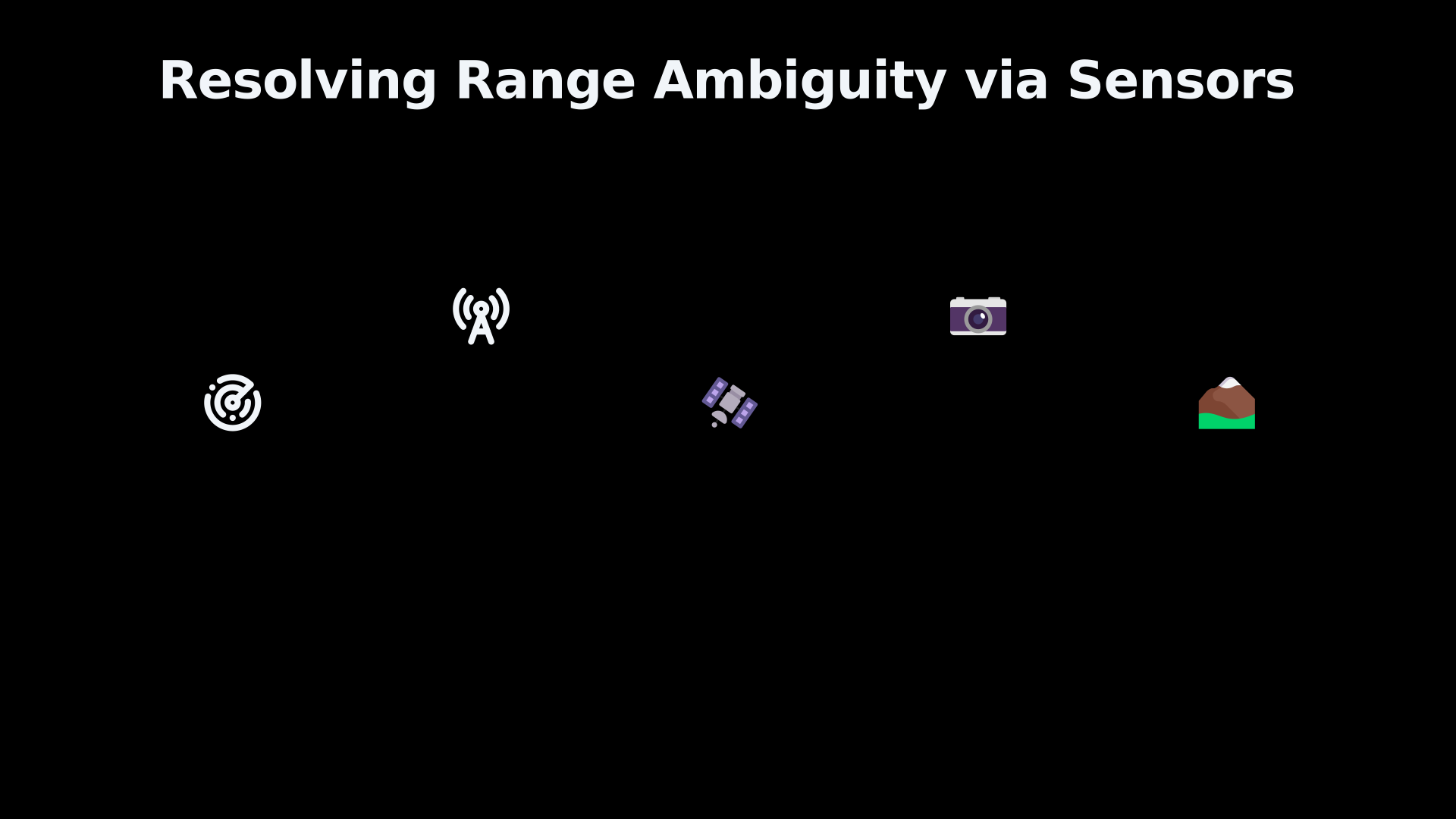
Range ambiguity is not impossible to overcome, but it requires independent measurements rather than visual impression alone.
Useful methods include:
- Radar ranging, which directly measures distance and allows genuine speed calculations.
- Simultaneous observations from multiple locations, enabling triangulation.
- Known aircraft position data, combining GPS tracks with measured bearings.
- Calibrated camera systems that record field of view, timing and pointing direction.
- Background references, such as stars, terrain or buildings with known geometry.
Once distance is established, investigators can calculate actual dimensions and velocity using straightforward geometry. Without that information, even apparently precise witness estimates remain speculative.
Modern instrumented observation projects therefore prioritise multiple synchronized sensors rather than relying solely on eyewitness descriptions. The goal is to replace assumptions about distance with measured values before drawing conclusions about unusual aerial objects.[NASA Technical Reports Server]ntrs.nasa.govNASA Technical Reports ServerVisual space perception on a computer graphics night visual attachment - NASA Technical Reports Server (NTRS…

What this means for celebrity UFO testimony
Celebrity pilots often provide higher-quality observational descriptions than untrained witnesses because they are accustomed to scanning the sky, recognising aircraft lighting and communicating positional information. That expertise deserves consideration, but it should not be confused with an ability to determine the true dimensions or performance of an unidentified light seen against a dark sky.
Range ambiguity remains a fundamental constraint. A pilot can accurately report what appeared on the horizon while still being unable to determine whether it was a small nearby object or a much larger distant one. Until independent measurements establish distance, estimates of extraordinary size or speed remain interpretations rather than directly observed facts.
Amazon book picks
Further Reading
Books and field guides related to Why Pilots Cannot Size a Light in Darkness. Use these as the next step if you want deeper reading beyond the article.
The Invisible Gorilla: How Our Intuitions Deceive Us
NEW YORK TIMES BESTSELLER • Our minds don’t work the way we think they do. Two renowned psychologists explain how and why our intuitions...
The UFO Experience: A Scientific Inquiry
Cited by the New York Review of Books as "the best brief for visitation," this classic study presents an analysis of UFO reports and conc...
Visual Intelligence: Sharpen Your Perception, Change Your Life
An engrossing guide to seeing--and communicating--more clearly, from the groundbreaking course that helps FBI agents, cops, CEOs, ER doct...
Human Factors in Flight
The late Captain Frank H Hawkins FRAes, M Phil, was Human Factors Consultant to KLM, for whom he had flown for over 30 years as line capt...
eBay marketplace picks
Marketplace Samples
Live-tested eBay searches with available results related to this page.
Selected fromUFO light display oneBay.co.uk.


Endnotes
1.
Source: faa.gov
Link:https://www.faa.gov/regulations_policies/handbooks_manuals/aviation/phak
Source snippet
Federal Aviation AdministrationPilot’s Handbook of Aeronautical Knowledge | Federal Aviation AdministrationNovember 3, 2023...
Published: November 3, 2023
2.
Source: faa.gov
Title: Federal Aviation Administration Chapter 8. Medical Facts for Pilots
Link:https://www.faa.gov/Air_traffic/publications/atpubs/aim_html/chap8_section_1.html
3.
Source: faa.gov
Link:https://www.faa.gov/data_research/research/med_humanfacs/oamtechreports/1970s/1978/197815
Source snippet
Federal Aviation AdministrationOffice of Aerospace Medicine Technical Reports | Federal Aviation AdministrationMarch 1, 1978...
Published: March 1, 1978
4.
Source: faa.gov
Link:https://www.faa.gov/data_research/research/med_humanfacs/oamtechreports/1970s/1977/197712
5.
Source: ntrs.nasa.gov
Link:https://ntrs.nasa.gov/citations/19760046522
Source snippet
NASA Technical Reports ServerVisual space perception on a computer graphics night visual attachment - NASA Technical Reports Server (NTRS...
6.
Source: faa.gov
Title: Handbooks & Manuals | Federal Aviation Administration
Link:https://www.faa.gov/regulations_policies/handbooks_manuals
Source snippet
July 11, 2023 — HANDBOOKS & MANUALS TOP TASKS * Read the Aeronautical Information Manual * Download the Airplane Flying Handbook * Downlo...
Published: July 11, 2023
7.
Source: faa.gov
Title: Chapter 8. Medical Facts for Pilots
Link:https://www.faa.gov/air_traffic/publications/atpubs/aim/aim0801.html
8.
Source: ntrs.nasa.gov
Link:https://ntrs.nasa.gov/citations/19860047082
9.
Source: ntrs.nasa.gov
Link:https://ntrs.nasa.gov/search.jsp?R=19800011510
10.
Source: faa.gov
Link:https://www.faa.gov/air_traffic/publications/atpubs/aim_html/chap10_section_2.html
11.
Source: faa.gov
Link:https://www.faa.gov/data_research/research/med_humanfacs/oamtechreports/1960s/1962/196215
12.
Source: faa.gov
Link:https://www.faa.gov/air_traffic/publications/atpubs/aip_html/chap8_section_1.html
13.
Source: faa.gov
Link:https://www.faa.gov/data_research/research/med_humanfacs/oamtechreports/1960s/1966/196624
14.
Source: faa.gov
Link:https://www.faa.gov/data_research/research/med_humanfacs/oamtechreports/1970s/1971/7131
15.
Source: faa.gov
Link:https://www.faa.gov/data_research/research/med_humanfacs/oamtechreports/1960s/1968/196810
16.
Source: faa.gov
Title: Aerospace Medicine Technical Reports | Federal Aviation Administration
Link:https://www.faa.gov/data_research/research/med_humanfacs/oamtechreports/1960s/1963/196320
Additional References
17.
Source: faraim.org
Title: AI M § 8-1-5 Illusions in Flight | Aeronautical Information Manual | FAR/AIM.org
Link:https://faraim.org/faa/aim/chapter-8/section-8-1-5.html
Source snippet
ILLUSIONS IN FLIGHT a. Introduction. Many different illusions can be experienced in flight. Some can lead to spatial disorientation. Othe...
18.
Source: pubmed.ncbi.nlm.nih.gov
Link:https://pubmed.ncbi.nlm.nih.gov/29255437/
Source snippet
2017 Dec 4:8:2078. doi: 10.3389/fpsyg.2017.02078. eCollection 2017. A BINOCULAR INFORMATION SOURCE FOR SIZE PERCEPTION Nam-Gyoon Kim^{ 1...
19.
Source: studylib.net
Link:https://studylib.net/doc/28203421/faa-h-8083-25c
Source snippet
Pilot's Handbook of Aeronautical Knowledge FAA 2023January 1, 2023 — Distance Estimation and Depth Perception........17-25 Binocular Cue...
Published: January 1, 2023
20.
Source: youtube.com
Title: The SHOCKING Math Error Behind Viral UFO Videos | Mick West
Link:https://www.youtube.com/watch?v=ypfbhfEXnBo
Source snippet
Breakdown of the Pentagon UFO videos with Mick West...
21.
Source: youtube.com
Title: PPGS Lesson 14.2 | Aeromedical: Illusions
Link:https://www.youtube.com/watch?v=ZBPmFaqECdM
Source snippet
Apparent Size (or Angular Size): A Description and Example Problem...
23.
Source: studocu.com
Title: airplane flying handbook faa h 8083 3c chapter 11 night operations
Link:https://www.studocu.com/en-us/document/embry-riddle-aeronautical-university/aerospace/airplane-flying-handbook-faa-h-8083-3c-chapter-11-night-operations/119520215
24.
Source: youtube.com
Title: Apparent Size (or Angular Size): A Description and Example Problem
Link:https://www.youtube.com/watch?v=csYSuiSFUpA
25.
Source: youtube.com
Title: Breakdown of the Pentagon UFO videos with Mick West
Link:https://www.youtube.com/watch?v=Le7Fqbsrrm8
Source snippet
My UFO Mistake...
26.
Source: pubmed.ncbi.nlm.nih.gov
Link:https://pubmed.ncbi.nlm.nih.gov/1744773/