Within Multi Sensor Study
When the UFO Sensor Is the Problem
Weather, range and object size can lower detection rates enough to make routine aircraft tracks appear incomplete or strange.
On this page
- What detection efficiency actually measures
- How weather and range create gaps
- Why tracking failures can mimic unusual motion
Page outline Jump by section
Introduction
A multi-sensor UFO monitoring system is only as trustworthy as its ability to detect ordinary aircraft consistently. If a system regularly loses track of known aeroplanes because of weather, distance, terrain or sensor limitations, then intermittent or fragmented tracks should not be treated as evidence of unusual behaviour. Instead, they reveal the system’s own blind spots.
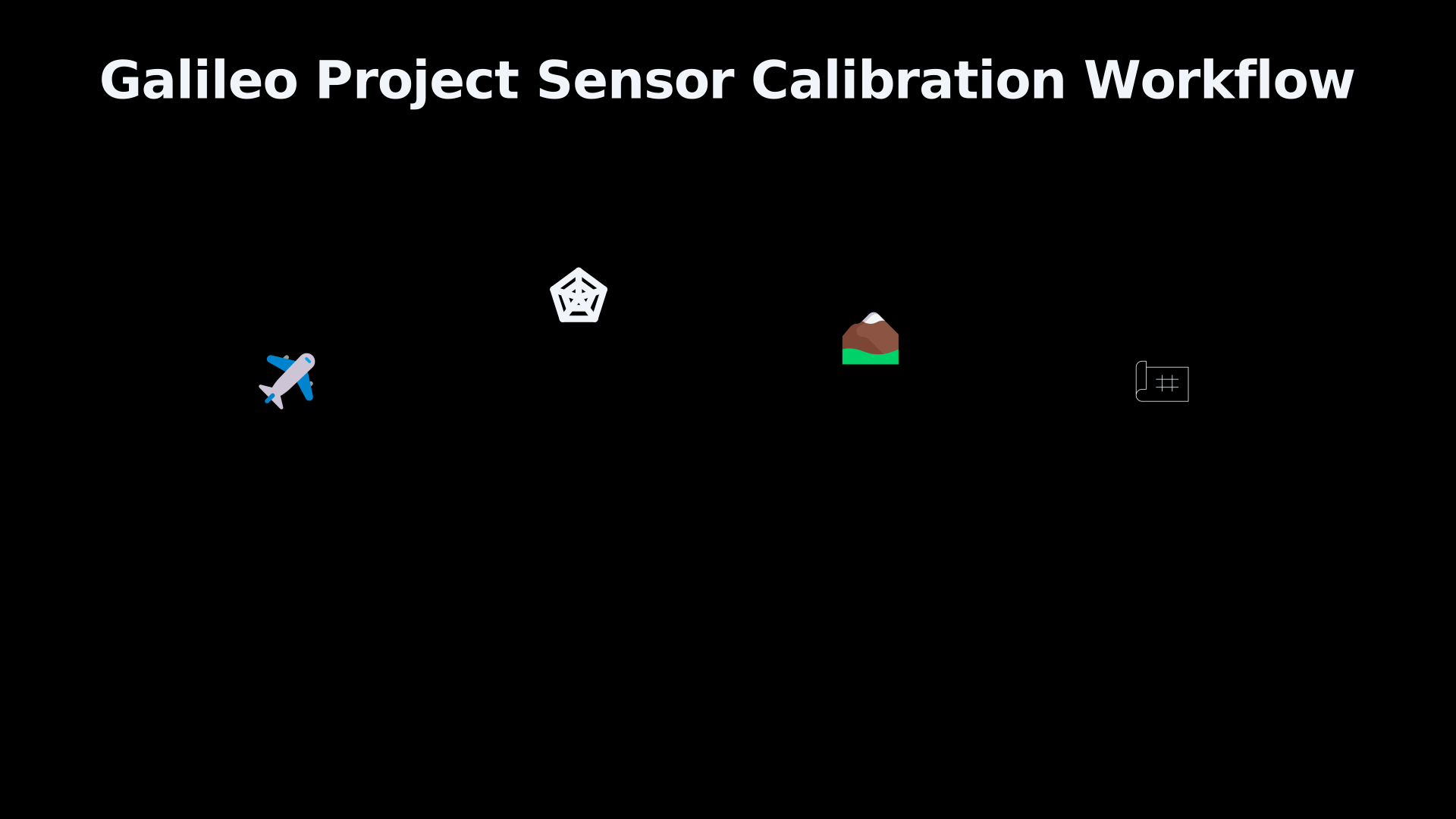
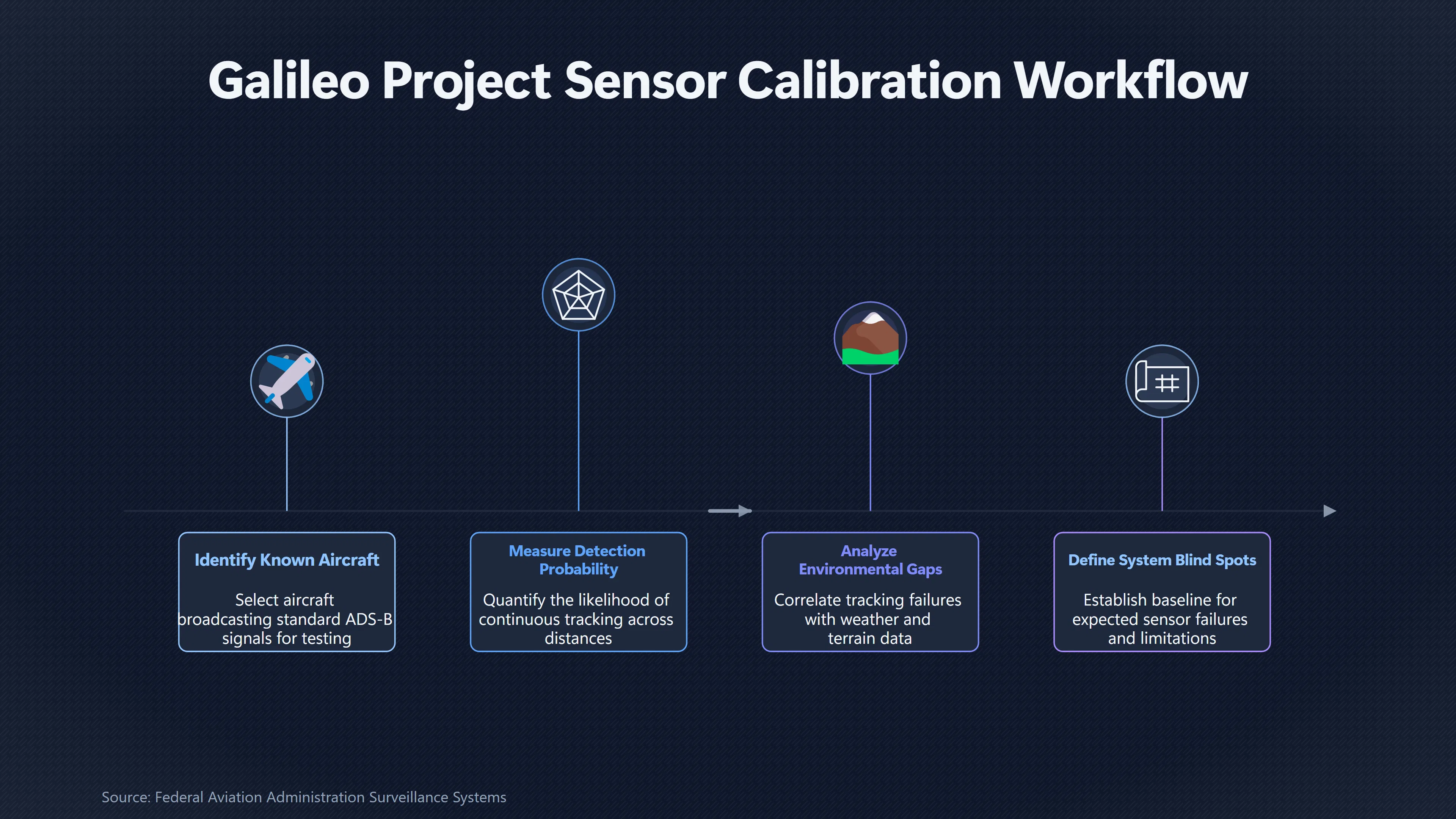
This distinction is fundamental to serious UFO research. “Unidentified” often reflects incomplete measurement rather than extraordinary flight. A robust observatory therefore measures its own detection efficiency—the probability that it will detect and continuously track normal aircraft under varying conditions—before interpreting broken tracks as anomalies. Modern projects, including the Galileo Project, explicitly use known aircraft broadcasting Automatic Dependent Surveillance–Broadcast (ADS-B) signals to calibrate their sensors and quantify where they succeed and fail.[Federal Aviation Administration]faa.govFederal Aviation Administration Surveillance SystemsFederal Aviation Administration Surveillance Systems
What detection efficiency actually measures
Detection efficiency is not simply whether a sensor can see an object once. It measures how reliably a system detects, identifies and continuously follows objects across different observing conditions.
For a UFO observatory, important questions include:
- At what distance does an ordinary aircraft disappear from the system?
- How often does tracking software lose and later reacquire the same target?
- Which weather conditions reduce performance?
- Does detection depend on the aircraft’s size, direction or altitude?
- Do different sensors fail under the same conditions, or independently?
These questions matter because detection probability is rarely 100%. Even sophisticated radar systems work with probabilities rather than guarantees, and optical systems experience similar limitations caused by contrast, atmospheric conditions and image quality. Research on radar detection likewise treats detection as a statistical process influenced by noise and clutter rather than a simple yes-or-no outcome.[arXiv]arxiv.orgOptimization of Radar Parameters for Maximum Detection Probability Under Generalized Discrete Clutter Conditions Using Stochastic Ge…
Without measuring these probabilities, investigators cannot know whether an apparently unusual trajectory reflects the target or merely inconsistent observation.
How weather and range create gaps
Weather does not merely obscure distant objects from human observers. It also changes how electronic sensors perform.
Heavy precipitation, clouds containing large water droplets, atmospheric turbulence and temperature inversions can weaken, scatter or redirect radar signals. Optical cameras lose contrast through haze, rain and fog, while infrared cameras may experience reduced target-background contrast under certain atmospheric conditions. FAA guidance notes that radar performance is affected by precipitation, terrain, anomalous propagation and other atmospheric phenomena that alter radio-wave behaviour.[Federal Aviation Administration]faa.govFederal Aviation Administration Chapter 4. Air Traffic ControlFederal Aviation Administration Chapter 4. Air Traffic Control
Distance compounds these effects.
Every sensor has practical range limits:
- Optical targets occupy fewer pixels as distance increases.
- Infrared signatures become weaker.
- Radar echoes decrease rapidly with range.
- Small pointing or calibration errors become more significant.
Near these limits, an aircraft may alternate between detectable and undetectable from one measurement to the next. Instead of a smooth flight path, software reconstructs several disconnected track segments.
From a casual inspection, these gaps can resemble sudden appearances, disappearances or abrupt manoeuvres even though the aircraft maintained ordinary flight throughout.
Why ordinary aircraft are sometimes missed
Even conventional aircraft are not equally easy to detect.
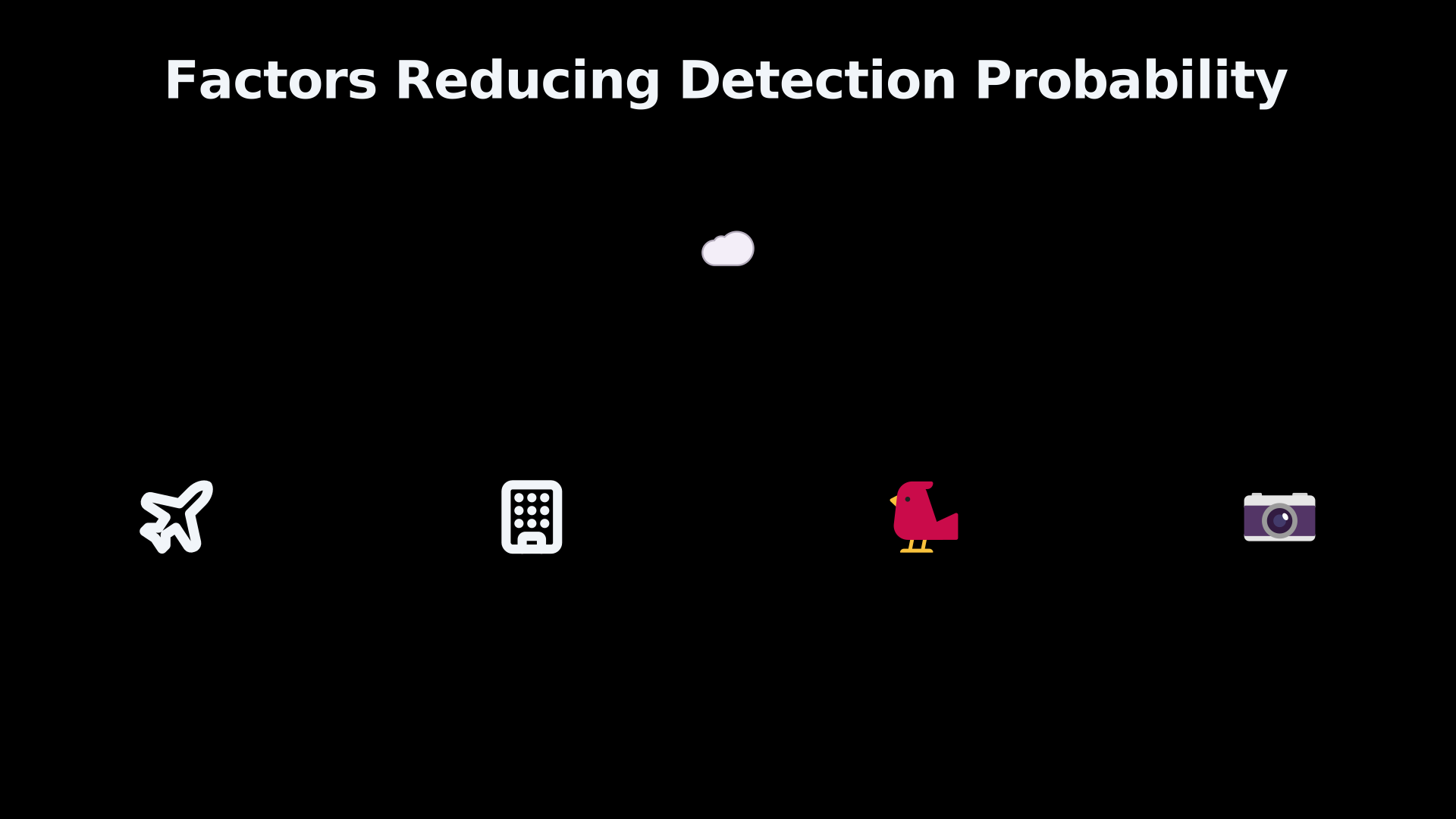
Several factors influence detection probability simultaneously:
- Aircraft size. Small general aviation aircraft present weaker radar reflections than large airliners.
- Viewing geometry. Certain orientations expose less reflective surface area to radar.
- Altitude. Low-flying aircraft can be hidden behind terrain or beneath radar coverage.
- Background clutter. Birds, buildings, vegetation and precipitation all compete with genuine targets.
- Sensor saturation. Bright sunlight, cloud reflections or thermal backgrounds may reduce optical performance.
The FAA specifically notes that smaller aircraft are generally harder for primary radar to detect than larger transport aircraft, while terrain, mountains and heavy precipitation can block or weaken radar returns. ADS-B and transponders improve surveillance, but only for equipped aircraft and only when those broadcasts are available.[Federal Aviation Administration]faa.govFederal Aviation Administration Surveillance SystemsFederal Aviation Administration Surveillance Systems
A UFO observatory relying primarily on passive cameras faces analogous problems. A distant aircraft moving through thin cloud may simply become too faint for reliable tracking before reappearing once contrast improves.

Why tracking failures can mimic unusual motion
Continuous tracking is usually harder than initial detection.
Object-tracking software predicts where a target should appear in the next frame. If image quality suddenly deteriorates, the tracker may briefly lose the aircraft. When detection resumes, the software must decide whether the new observation belongs to the previous target or represents a different object.
This process creates several common artefacts:
- apparent instantaneous jumps;
- sudden changes in estimated speed;
- fragmented trajectories;
- duplicated tracks;
- unexplained disappearances and reappearances.
These artefacts arise because the software is reconstructing motion from incomplete observations rather than observing continuous flight.
The Galileo Project’s early infrared observations illustrate this problem. Automated analysis initially labelled many trajectories as statistical outliers. After further examination, most appeared consistent with ordinary objects observed under imperfect measurement conditions. The remaining ambiguous cases lacked sufficient distance or corroborating sensor information to justify stronger conclusions. Rather than demonstrating extraordinary flight, the exercise showed how incomplete measurements naturally produce apparently unusual tracks.
Why multi-sensor agreement matters
No individual sensor should be trusted to establish an extraordinary event on its own.
Suppose a visible-light camera loses an aircraft behind haze while radar continues tracking it normally. The missing optical data reveal a camera limitation rather than an unexplained disappearance.
Conversely, if radar momentarily loses the target because of terrain masking while infrared and ADS-B continue uninterrupted, the radar gap reflects known surveillance limitations.
Confidence increases only when independent sensors observing through different physical mechanisms produce mutually consistent measurements.
This is one reason why modern multi-sensor UAP observatories combine:
- visible cameras;
- infrared cameras;
- radar or radar-derived information where available;
- radio-frequency monitoring;
- environmental measurements;
- astronomical and aviation databases.
Agreement across independent sensors is generally more informative than any striking observation from a single instrument.
Measuring blind spots before searching for anomalies
A scientifically credible UFO detection programme treats missed detections as data rather than embarrassment.
Routine aircraft provide an ideal calibration population because their positions are often independently known through ADS-B or flight records. Comparing these known trajectories against sensor observations allows researchers to estimate:
- detection probability versus range;[arxiv.org]arxiv.orgOptimization of Radar Parameters for Maximum Detection Probability Under Generalized Discrete Clutter Conditions Using Stochastic Ge…
- performance during different weather conditions;
- false-negative rates;
- track fragmentation frequency;
- systematic blind regions in the sensor network.
Only after these baseline characteristics are understood can genuinely unusual observations be separated from expected sensor failures.
This approach changes the interpretation of unidentified events. Instead of asking whether an interrupted track represents extraordinary motion, investigators first ask whether the interruption matches the system’s measured detection efficiency. If ordinary aircraft regularly produce similar gaps under comparable conditions, then the observation is better explained as a limitation of the observing system than as evidence of anomalous flight.
Amazon book picks
Further Reading
Books and field guides related to When the UFO Sensor Is the Problem. Use these as the next step if you want deeper reading beyond the article.
Detection Estimation and Modulation Theory, Part I
Originally published in 1968, Harry Van Trees’s Detection, Estimation, and Modulation Theory, Part I is one of the great time-tested clas...
Introduction to Radar Systems
Since the publication of the second edition of "Introduction to Radar Systems," there has been continual development of new radar capabil...
The Signal and the Noise: Why So Many Predictions Fail—but So...
This work explores the history, art and science of prediction.
Calling Bullshit: The Art of Skepticism in a Data-Driven World
Bullshit isn’t what it used to be. Now, two science professors give us the tools to dismantle misinformation and think clearly in a world...
eBay marketplace picks
Marketplace Samples
Live-tested eBay searches with available results related to this page.
Selected fromUFO display model oneBay.co.uk.

Endnotes
1.
Source: faa.gov
Title: Federal Aviation Administration Surveillance Systems
Link:https://www.faa.gov/air_traffic/publications/atpubs/aip_html/chap4_section_5.html
2.
Source: arxiv.org
Link:https://arxiv.org/abs/2101.12429
Source snippet
Optimization of Radar Parameters for Maximum Detection Probability Under Generalized Discrete Clutter Conditions Using Stochastic Ge...
3.
Source: arxiv.org
Title: arXiv Sensitivity of Single-Pulse Radar Detection to Aircraft Pose Uncertainties
Link:https://arxiv.org/abs/2201.06727
4.
Source: faa.gov
Title: Federal Aviation Administration Chapter 4. Air Traffic Control
Link:https://www.faa.gov/air_traffic/publications/atpubs/aim_html/chap4_section_5.html
5.
Source: faa.gov
Title: Federal Aviation Administration Chapter 7. Safety of Flight
Link:https://www.faa.gov/air_traffic/publications/atpubs/aim_html/chap7_section_1.html
6.
Source: faa.gov
Title: Federal Aviation Administration ADS-B FAQ | Federal Aviation Administration
Link:https://www.faa.gov/air_traffic/technology/adsb/faq
Source snippet
What will make me compliant to fly into ADS-B rule airspace? What other surveillance solutions were exami...
7.
Source: faa.gov
Link:https://www.faa.gov/air_traffic/publications/atpubs/aim/aim0405.html
8.
Source: faa.gov
Link:https://www.faa.gov/air_traffic/publications/atpubs/aip_html/part2_enr_section_1.1.html
9.
Source: faa.gov
Link:https://www.faa.gov/air_traffic/publications/atpubs/atc_html/chap5_section_1.html
10.
Source: faa.gov
Link:https://www.faa.gov/air_traffic/publications/atpubs/aip_html/chap7_section_1.html
11.
Source: science.nasa.gov
Link:https://science.nasa.gov/mission/galileo/
Additional References
12.
Source: newspaceeconomy.ca
Link:https://newspaceeconomy.ca/2025/08/20/the-galileo-project-a-scientific-search-for-extraterrestrial-technology/
Source snippet
August 20, 2025 — THE TOOLS OF A NEW ASTRONOMY: SENSORS, SOFTWARE, AND SCIENCE At the heart of the Galileo Project is a technological and...
Published: August 20, 2025
13.
Source: azosensors.com
Title: Noopur Jain By Dr. Noopur Jain Reviewed by Bethan Davies Feb 7
Link:https://www.azosensors.com/news.aspx?newsID=16214
Source snippet
Galileo Project Ramps Up Scientific Search for UAP EvidenceFebruary 7, 2025 — GALILEO PROJECT RAMPS UP SCIENTIFIC SEARCH FOR UAP EVIDENCE...
Published: February 7, 2025
14.
Source: youtube.com
Title: Deconstructing UAP: What the Data Actually Proves
Link:https://www.youtube.com/watch?v=35p_8z0ZcII
Source snippet
Galileo Project UAP sensor tracking software Episode 3: The Galileo Project: Can Science Finally Detect UFOs? | Prof. Avi Loeb Documentary...
15.
Source: legalclarity.org
Title: How to Locate and Interpret the FAA Radar Coverage Map
Link:https://legalclarity.org/how-to-locate-and-interpret-the-faa-radar-coverage-map/
Source snippet
Identify radar gaps caused by terrain and altitude, and learn the role of modern ADS-B coverage...
16.
Source: youtube.com
Title: Listening for UFOs
Link:https://www.youtube.com/watch?v=87POecVP-s4
Source snippet
Harvard’s AI Skywatcher Is Tracking UFOs in Real Time | Inside the Galileo Project...
17.
Source: faraim.org
Link:https://faraim.org/faa/aim/chapter-4/section-4-1-17.html
18.
Source: faraim.org
Link:https://www.faraim.org/faa/aim/chapter-7/section-7-1-11.html
19.
Source: intechopen.com
Link:https://www.intechopen.com/chapters/6850
20.
Source: thedebrief.org
Link:https://thedebrief.org/galileo-project-releases-commissioning-data-on-half-a-million-aerial-objects-are-any-of-them-uap/
21.
Source: sciencecast.org
Link:https://www.sciencecast.org/casts/7ot52rwazd4m