Within Multi Sensor Study
When Multiple Sensors See the Same UFO
A sighting becomes more useful when cameras, radar and environmental instruments independently track the same event.
On this page
- What counts as genuine corroboration
- How timestamps and locations are matched
- Why conflicting detections still matter
Page outline Jump by section
Introduction
The value of a reported unidentified flying object (UFO), more commonly termed an unidentified anomalous phenomenon (UAP) in scientific literature, depends less on the number of witnesses than on the number of independent measurements. A light seen by a single camera may be a lens flare, sensor glitch or atmospheric effect. A target detected simultaneously by calibrated optical cameras, infrared instruments, radar and environmental sensors is far harder to dismiss as a failure of one instrument. For that reason, modern scientific proposals for studying UAPs emphasise multi-sensor agreement rather than collecting more photographs or testimony alone. NASA’s independent UAP study and projects such as the Galileo Project both argue that future progress depends on systematic, calibrated observations in which different sensors either independently confirm the same event or provide enough information to rule out conventional explanations.[nasa.gov]science.nasa.govScience UAPNASA ScienceUAP - NASA ScienceFebruary 23, 2026…
What counts as genuine corroboration?
True corroboration is not simply several instruments recording something unusual at roughly the same time. The measurements must be independently acquired yet consistent with a single physical object or event.
Researchers generally look for agreement across several dimensions:
- Time: detections occur within the expected timing uncertainty of each instrument.
- Location: each sensor indicates the same position after accounting for viewing angle.
- Motion: calculated direction and speed are mutually consistent.
- Physical behaviour: visible, infrared, radar or radio observations do not contradict one another.
- Instrument independence: the sensors rely on different physical principles, reducing the likelihood that one common failure produced every detection.
For example, a bright reflection may fool a visible-light camera but leave no radar return. Conversely, a radar echo caused by anomalous atmospheric propagation might not appear in optical imagery. When both systems independently detect an object following the same trajectory, many single-sensor explanations become much less plausible.[harvard.edu]galileo.hsites.harvard.eduGalileo ProjectThe Scientific Investigation of Unidentified Aerial Phenomena (UAP) Using Multimodal Ground-Based Observatories | The Gali…
This does not automatically prove that an object is extraordinary. Instead, it increases confidence that investigators are studying a genuine external phenomenon rather than an artefact of measurement.
How timestamps and locations are matched
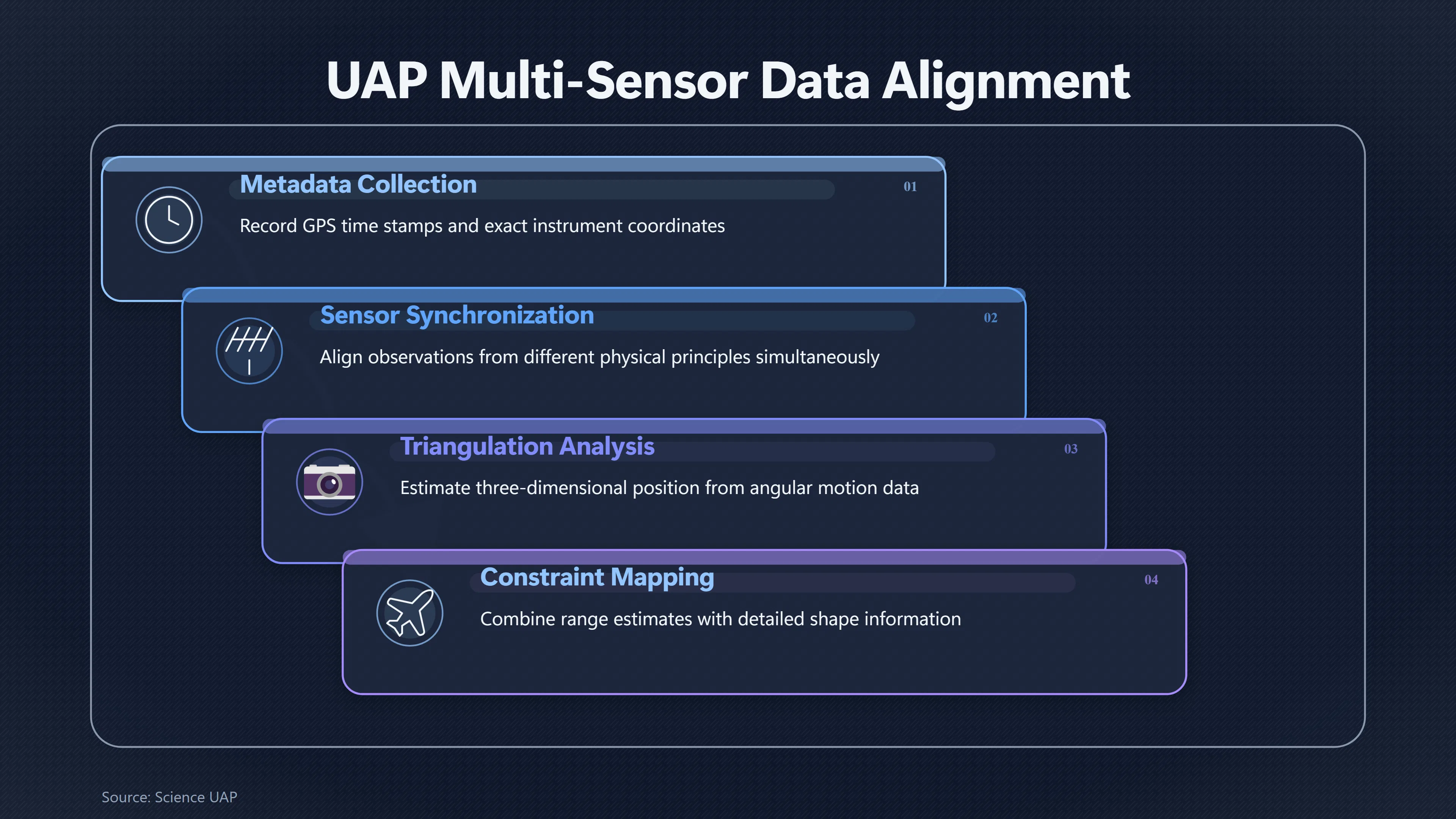
Multi-sensor evidence depends on precise synchronisation. Every observation must be tied to an accurate clock and a known sensor position.
Modern observation systems typically record:
- GPS-synchronised timestamps.
- Exact latitude, longitude and elevation of each instrument.
- Camera orientation and calibration parameters.
- Weather and atmospheric conditions.
- Sensor status and calibration history.
Once these metadata are available, software aligns observations from different instruments. If two cameras several kilometres apart observe the same object simultaneously, triangulation can estimate its three-dimensional position instead of relying only on apparent angular motion. This helps distinguish a nearby insect or bird from a distant aircraft or astronomical object.[harvard.edu]galileo.hsites.harvard.eduGalileo ProjectThe Scientific Investigation of Unidentified Aerial Phenomena (UAP) Using Multimodal Ground-Based Observatories | The Gali…
The same principle applies when combining radar with optical tracking. Radar contributes range and velocity estimates, while cameras provide detailed shape and brightness information. Neither measurement is complete by itself, but together they produce a far more constrained description of the event.
Why different sensor types complement one another
Each sensing technology has characteristic strengths and weaknesses.
SensorMain strengthCommon limitationsOptical camerasShape, colour and visible appearanceGlare, focus errors, perspective effectsInfrared camerasThermal signatures and night observationsAtmospheric absorption, limited resolutionRadarRange, speed and trackingClutter, multipath reflections, incomplete coverageRadio-frequency receiversDetect emissions or interferenceMany objects emit nothing detectableEnvironmental sensorsWeather and local conditionsProvide context rather than direct object detection
Because these systems rely on different physical processes, they usually fail in different ways. A genuine external object is therefore more likely to leave a coherent signature across several instruments than an internal sensor fault.
NASA’s UAP study identified calibrated multi-sensor observations and complete metadata as priorities precisely because they enable investigators to compare independent measurements instead of relying on isolated images.[NASA Science]science.nasa.govScience UAPNASA ScienceUAP - NASA ScienceFebruary 23, 2026…
Why conflicting detections still matter
Perfect agreement is uncommon, and disagreement does not automatically invalidate an observation.
Instead, conflicting detections often reveal useful diagnostic information.
For example:
- A radar contact without an optical detection may indicate poor visibility, limited camera sensitivity or radar clutter.
- An optical detection without radar may suggest a small balloon, bird, atmospheric optical effect or a target below radar sensitivity.
- An infrared source lacking visible-light emission may indicate temperature differences rather than unusual behaviour.
- Environmental sensors may reveal that apparent anomalies coincided with temperature inversions, strong winds or other atmospheric conditions known to affect observations.
Rather than discarding such events, investigators compare the expected performance limits of every instrument. The disagreement itself becomes evidence about which explanations remain viable.[harvard.edu]galileo.hsites.harvard.eduGalileo ProjectThe Scientific Investigation of Unidentified Aerial Phenomena (UAP) Using Multimodal Ground-Based Observatories | The Gali…
A practical example from the Galileo Project
The Galileo Project’s commissioning of an all-sky infrared observatory illustrates why sensor agreement matters even before any unusual object is identified.
During approximately five months of operation, researchers reconstructed around 500,000 aerial trajectories. An automated search initially classified roughly 16% as statistical outliers. After manual inspection, only 144 trajectories remained ambiguous, and the researchers concluded these were most likely ordinary objects that could not yet be classified confidently because additional information—particularly distance estimates and corroboration from other sensor modalities—was unavailable.[Galileo Project]galileo.hsites.harvard.eduGalileo ProjectThe Scientific Investigation of Unidentified Aerial Phenomena (UAP) Using Multimodal Ground-Based Observatories | The Gali…
The lesson was not that the remaining objects were extraordinary. Instead, it demonstrated that apparently unusual behaviour often reflects incomplete measurements. Adding radar, stereo observations or additional sensing modalities would reduce ambiguity by providing independent confirmation or identifying a conventional explanation.
Why sensor agreement raises confidence but not certainty
Scientific confidence increases as independent evidence converges, but corroboration is not the same as proof of an exotic origin.
Even when multiple sensors agree, investigators must still eliminate conventional possibilities such as:
- commercial and military aircraft;
- balloons;
- satellites;
- meteors;
- birds or insects;
- atmospheric optical phenomena;
- calibration errors;
- processing or software mistakes.
Only after these explanations have been systematically tested does an event remain genuinely unidentified. Multi-sensor agreement narrows the range of plausible explanations, but it does not determine which explanation is correct.[harvard.edu]galileo.hsites.harvard.eduGalileo ProjectThe Scientific Investigation of Unidentified Aerial Phenomena (UAP) Using Multimodal Ground-Based Observatories | The Gali…
Why multi-sensor agreement is central to future UFO research
The greatest contribution of multi-sensor systems is not that they make extraordinary discoveries more likely, but that they make ordinary explanations easier to verify or reject. Independent agreement between radar, optical, infrared and environmental measurements transforms anecdotal sightings into datasets that can be analysed, replicated and scrutinised.
That approach reflects a broader shift in UAP research away from isolated witness accounts and towards calibrated, transparent observations with complete metadata. Whether a future event proves to be an aircraft, an atmospheric phenomenon or something that initially resists explanation, evidence supported by multiple independent sensors provides a far stronger scientific foundation than any single photograph or eyewitness account alone.[harvard.edu]galileo.hsites.harvard.eduGalileo ProjectThe Scientific Investigation of Unidentified Aerial Phenomena (UAP) Using Multimodal Ground-Based Observatories | The Gali…
Amazon book picks
Further Reading
Books and field guides related to When Multiple Sensors See the Same UFO. Use these as the next step if you want deeper reading beyond the article.
The UFO Experience: A Scientific Inquiry
Cited by the New York Review of Books as "the best brief for visitation," this classic study presents an analysis of UFO reports and conc...
UFOs: Generals, Pilots, and Government Officials Go on the Re...
NEW YORK TIMES BESTSELLER • Impeccably researched, this riveting journalistic investigation separates fact from fiction, and documents th...
Data Fusion: Concepts and Ideas
This textbook provides a comprehensive introduction to the concepts and idea of multisensor data fusion. It is an extensively revised sec...
The Demon-Haunted World: Science as a Candle in the Dark
Are we on the brink of a new Dark Age of irrationality and superstition? In this book, the writer shows how scientific thinking is necess...
eBay marketplace picks
Marketplace Samples
Live-tested eBay searches with available results related to this page.
Selected fromUFO poster oneBay.co.uk.



Endnotes
1.
Source: science.nasa.gov
Title: Science UAP
Link:https://science.nasa.gov/uap/
Source snippet
NASA ScienceUAP - NASA ScienceFebruary 23, 2026...
Published: February 23, 2026
2.
Source: nasa.gov
Title: UPDATE: NASA Shares UAP Independent Study Report; Names Director
Link:https://www.nasa.gov/news-release/update-nasa-shares-uap-independent-study-report-names-director/
Source snippet
UPDATE: NASA Shares UAP Independent Study Report; Names Director - NASA...
3.
Source: techport.nasa.gov
Title: Tech Port NASA Tech Port
Link:https://techport.nasa.gov/projects/93971
Source snippet
ProjectDecember 18, 2025 — Center Innovation Fund: LaRC CIF TIME-SYNCHRONIZED BEACONS FOR RELATIVE UAV POSITION DETERMINATION...
Published: December 18, 2025
4.
Source: techport.nasa.gov
Link:https://techport.nasa.gov/projects/17861
Source snippet
ProjectJanuary 22, 2026 — Small Business Innovation Research/Small Business Tech Transfer ASYNCHRONOUS SENSOR FUSION FOR IMPRO...
Published: January 22, 2026
5.
Source: ntrs.nasa.gov
Link:https://ntrs.nasa.gov/citations/20230017656
Source snippet
Testing of Data Fusion in A Distributed Ground-Based Sensing Network for Advanced Air Mobility - NASA Technical Reports Server (NTRS)Dece...
6.
Source: ntrs.nasa.gov
Link:https://ntrs.nasa.gov/citations/20210025560
7.
Source: earth.jpl.nasa.gov
Title: sar fusion
Link:https://earth.jpl.nasa.gov/estd-missions/airborne/sar-fusion
8.
Source: youtube.com
Link:https://www.youtube.com/watch?v=mvsU4p0Gsas
Source snippet
GALILEO PROJECT & UAP Technosignatures • AVI LOEB...
9.
Source: youtube.com
Title: GALILEO PROJECT & UAP Technosignatures • AVI LOEB
Link:https://www.youtube.com/watch?v=jgd3tV137dc
Source snippet
NASA UAP study multi sensor Galileo Project radar infrared UAP UAPs and Electromagnetic Theories: Plasma, Sensor Interference, and the Sc...
10.
Source: galileo.hsites.harvard.edu
Link:https://galileo.hsites.harvard.edu/publications/scientific-investigation-unidentified-aerial-phenomena-uap-using-multimodal
Source snippet
Galileo ProjectThe Scientific Investigation of Unidentified Aerial Phenomena (UAP) Using Multimodal Ground-Based Observatories | The Gali...
11.
Source: bpb-us-e1.wpmucdn.com
Title: Bpb Us Confronting Unknowns
Link:https://bpb-us-e1.wpmucdn.com/sites.mit.edu/dist/1/1528/files/2026/06/CU26_Confronting-Unknowns-rev.1.07-20260625-1217_jm.pdf
12.
Source: galileo.hsites.harvard.edu
Title: Galileo Project Scope | The Galileo Project
Link:https://galileo.hsites.harvard.edu/scope
13.
Source: galileo.hsites.harvard.edu
Link:https://galileo.hsites.harvard.edu/FAQ
14.
Source: galileo.hsites.harvard.edu
Title: integrated computing platform detection and tracking unidentified aerial
Link:https://galileo.hsites.harvard.edu/publications/integrated-computing-platform-detection-and-tracking-unidentified-aerial
15.
Source: galileo.hsites.harvard.edu
Title: hardware and software platform aerial object localization
Link:https://galileo.hsites.harvard.edu/publications/hardware-and-software-platform-aerial-object-localization
Additional References
16.
Source: youtube.com
Link:https://www.youtube.com/watch?v=m8rPOipV2EU
Source snippet
Breaking Down UAP Footage with the Head of The Pentagon’s UAP Taskforce, Dr. Jon Kosloski...
17.
Source: youtube.com
Title: Public Meeting on Unidentified Anomalous Phenomena (Official NASA Broadcast)
Link:https://www.youtube.com/watch?v=bQo08JRY0iM
Source snippet
Episode 3: The Galileo Project: Can Science Finally Detect UFOs? | Prof. Avi Loeb Documentary...
18.
Source: youtube.com
Title: How Science is Revolutionising UAP Research: Data Triumphs Over Stigma
Link:https://www.youtube.com/watch?v=t75k2dAHwaU
Source snippet
Public Meeting on Unidentified Anomalous Phenomena (Official NASA Broadcast)...
19.
Source: arxiv.org
Link:https://arxiv.org/abs/2411.07956