Within Multiple Witnesses
Can Multiple Witnesses Measure a UFO's Distance?
Witnesses at different locations can estimate range only when their positions, sightlines and timing are recorded accurately.
On this page
- What triangulation requires from each observer
- Why vague locations and directions defeat calculation
- How distance uncertainty distorts size and speed
Page outline Jump by section
Introduction
Multiple witnesses can strengthen a UFO report by showing that more than one person observed the same event, but they do not automatically reveal how far away the object was. Without a reliable distance, it is impossible to calculate an object’s true size, speed or altitude. Triangulation is the main geometric method for estimating range from separate observations, yet it only works when each observer’s position, viewing direction and timing are known with sufficient accuracy. In most historical UFO reports—including many involving well-known public figures or celebrities—those measurements were never recorded. As a result, even sincere and mutually consistent accounts often cannot answer one of the most important physical questions: how far away was the object? Modern scientific studies of unidentified anomalous phenomena (UAP) repeatedly identify this lack of calibrated, multi-point data as a central obstacle to meaningful analysis.[NASA Science]science.nasa.govScience UAPNASA ScienceUAP - NASA ScienceFebruary 23, 2026…
What triangulation requires from each observer
Triangulation is a straightforward surveying principle. If two or more observers are at known locations and each measures the direction to the same object at the same instant, their lines of sight can be projected into space. Where those sightlines intersect—or come closest, once measurement error is considered—the object’s position can be estimated. The greater the separation between observers (the baseline), the more precisely distance can usually be determined, provided the directional measurements are accurate.[OpenStax]openstax.orgOpen Stax19.2 Surveying the Stars19.2 Surveying the Stars - Astronomy 2e | OpenStaxMarch 9, 2022…
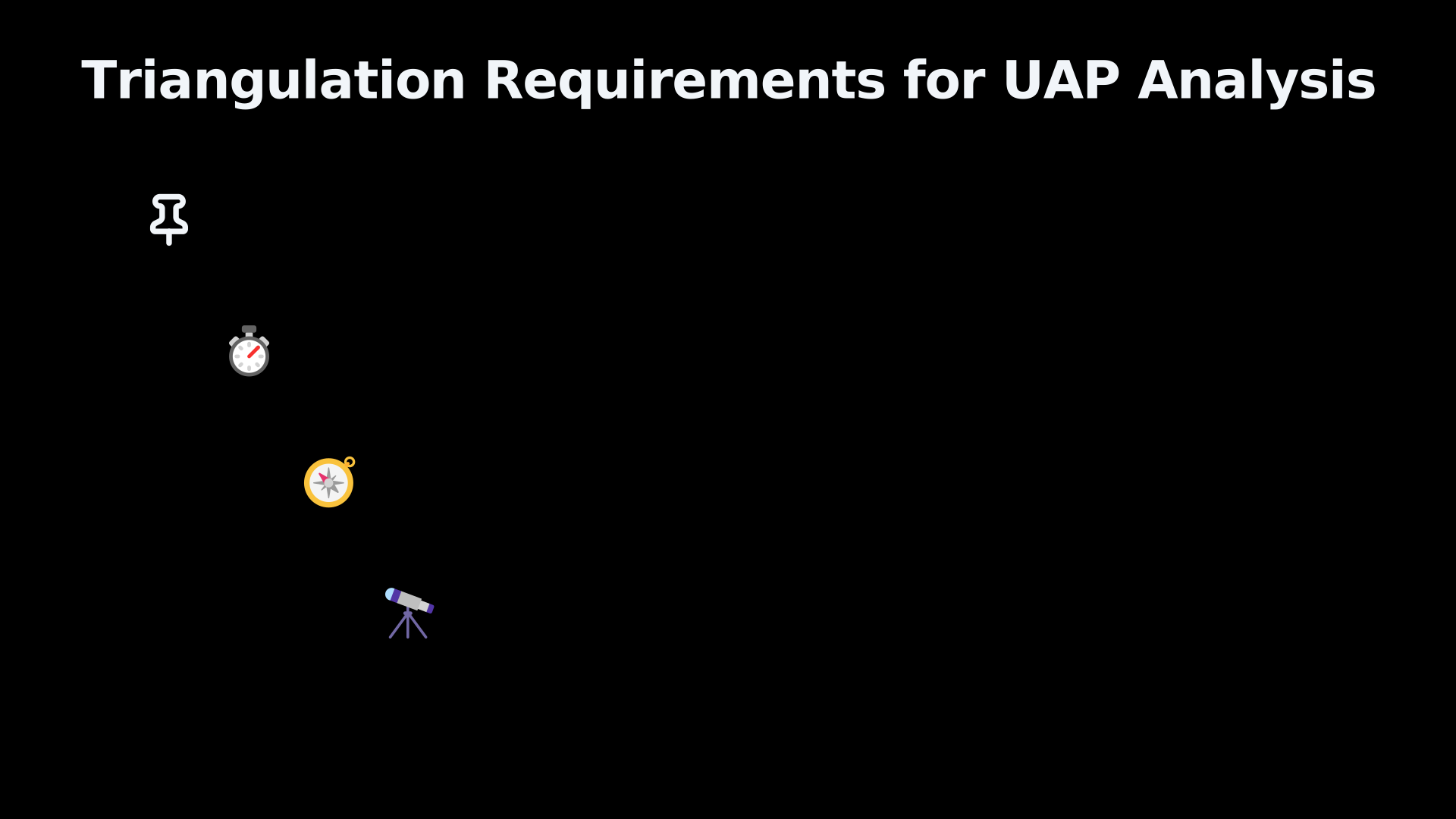
For a UFO investigation, every observer ideally needs to record:
- An accurately known observing location.
- The exact observation time, synchronised as closely as possible.
- The object’s compass bearing (azimuth).
- Its elevation above the horizon.
- How those angles changed over time.
These measurements are far more valuable than descriptive language such as “very large”, “hovering” or “moving incredibly fast”. Geometry depends on angles, not impressions.
Professional astronomy, satellite tracking and land surveying all rely on this same principle. The underlying mathematics is well established; the difficulty lies in obtaining measurements that are precise enough before a transient event disappears.[OpenStax]openstax.orgOpen Stax19.2 Surveying the Stars19.2 Surveying the Stars - Astronomy 2e | OpenStaxMarch 9, 2022…
Why vague locations and directions defeat calculation
Most historical UFO reports lack exactly the information triangulation requires.
Witnesses commonly report being “outside the house”, “driving along a motorway” or “in the garden”. Such descriptions may identify the general area but not the observer’s position to the precision needed for geometric reconstruction. Likewise, statements such as “towards the west” or “above the trees” are too approximate to define a reliable line of sight.
Timing creates another problem. Even a difference of several seconds matters when an aircraft, satellite or meteor is moving rapidly across the sky. If observers did not record time independently—or later reconstructed it from memory—it becomes uncertain whether everyone was actually looking at the object in exactly the same position.
Human estimates of direction also contain unavoidable error. A bearing estimated by eye may easily be wrong by several degrees. Over tens of kilometres, that uncertainty can shift the calculated position by many kilometres, making the intersection of sightlines too broad to produce a meaningful distance estimate.
This explains why multiple eyewitnesses can honestly agree on an event while investigators remain unable to calculate where the object actually was.
How missing distance distorts size and speed
Distance is the missing variable behind almost every dramatic estimate in a UFO report.
An object’s apparent angular size is what the eye measures directly. Its true physical size depends entirely on how far away it is. A small nearby drone and a large distant aircraft can subtend almost the same angle in the sky.
The same applies to speed. Angular motion across the sky becomes physical velocity only after range is known.
For example:
- A light moving five degrees across the sky in ten seconds could represent a nearby drone travelling relatively slowly.
- The identical angular motion could correspond to a distant aircraft moving hundreds of kilometres per hour.
- If the object were much farther away still, the implied speed would become dramatically greater.
Without distance, all of these interpretations remain geometrically possible.
Altitude also becomes uncertain. A light observed twenty degrees above the horizon might be a low-flying nearby object or a much higher object many kilometres away. The viewing angle alone cannot distinguish between them.
This is why reports describing an object as “enormous”, “stationary” or “travelling at impossible speed” often cannot be evaluated quantitatively. Those conclusions usually depend on an assumed distance rather than a measured one.
Why several witnesses are not automatically enough
A common misunderstanding is that adding witnesses automatically solves the distance problem.
If everyone stands together in the same field or along the same roadside, they share nearly the same viewpoint. Their sightlines are almost parallel, providing essentially no usable baseline for triangulation. They may reinforce one another’s descriptions, but they contribute little additional geometric information.
Even observers separated by hundreds of metres may produce only weak triangulation if the object is tens of kilometres away. In that situation the difference in viewing angle—the parallax—is extremely small and may be overwhelmed by ordinary observational error.
Effective triangulation benefits from:[ion.org]ion.orgSource details in endnotes.
- Wide geographical separation.
- Independent observations.
- Accurate timing.
- Measured rather than estimated bearings.
- Calibrated cameras or other instruments that preserve viewing geometry.
Absent those conditions, corroboration confirms that multiple people saw something unusual but rarely determines its physical location.

Modern investigations increasingly seek instrument-based triangulation
Recent scientific approaches to UAP investigation place much greater emphasis on obtaining simultaneous observations from multiple calibrated sensors rather than relying solely on witness recollections.
NASA’s Independent UAP Study concluded that future progress depends on systematic data collection, calibrated instruments, multiple independent measurements and complete sensor metadata rather than isolated eyewitness accounts. The report repeatedly identifies the lack of multiple well-characterised observations as one of the main reasons current cases cannot support firm physical conclusions.[NASA Science]science.nasa.govScience UAPNASA ScienceUAP - NASA ScienceFebruary 23, 2026…
The same geometric principles are already used routinely in astronomy and satellite tracking, where simultaneous observations from separated locations can determine range through parallax. Experimental UAP monitoring projects have likewise proposed fixed networks of synchronised optical stations specifically to recover distance, velocity and trajectory from simultaneous observations rather than from eyewitness estimates alone.[arXiv]arxiv.orgOpen source on arxiv.org.
What this means for celebrity UFO reports
Within the broader discussion of UFOs and celebrities, triangulation explains why even widely reported multi-witness incidents often remain physically unresolved.
When a celebrity and companions independently report seeing the same unusual object, the agreement strengthens the historical record that an unexplained visual event occurred. It does not, by itself, establish whether the object was a nearby helicopter, a distant aircraft, an atmospheric phenomenon or something genuinely anomalous.
Unless investigators possess accurately recorded observer positions, precise timing and reliable sightlines from multiple locations, the crucial quantity—distance—remains unknown. Without that missing measurement, estimates of size, altitude and speed remain speculative, regardless of the number or prominence of the witnesses.
Amazon book picks
Further Reading
Books and field guides related to Can Multiple Witnesses Measure a UFO's Distance?. Use these as the next step if you want deeper reading beyond the article.
How to Measure Anything
Now updated with new research and even more intuitive explanations, a demystifying explanation of how managers can inform themselves to m...
The UFO Experience: A Scientific Inquiry
Cited by the New York Review of Books as "the best brief for visitation," this classic study presents an analysis of UFO reports and conc...
The Signal and the Noise
This work explores the history, art and science of prediction.
Visual Intelligence: Sharpen Your Perception, Change Your Life
An engrossing guide to seeing--and communicating--more clearly, from the groundbreaking course that helps FBI agents, cops, CEOs, ER doct...
eBay marketplace picks
Marketplace Samples
Live-tested eBay searches with available results related to this page.
Selected fromRoswell UFO poster oneBay.co.uk.



Endnotes
1.
Source: science.nasa.gov
Title: Science UAP
Link:https://science.nasa.gov/uap/
Source snippet
NASA ScienceUAP - NASA ScienceFebruary 23, 2026...
Published: February 23, 2026
2.
Source: nasa.gov
Title: UPDATE: NASA Shares UAP Independent Study Report; Names Director
Link:https://www.nasa.gov/news-release/update-nasa-shares-uap-independent-study-report-names-director/
Source snippet
UPDATE: NASA Shares UAP Independent Study Report; Names Director - NASA...
3.
Source: openstax.org
Title: Open Stax19.2 Surveying the Stars
Link:https://openstax.org/books/astronomy-2e/pages/19-2-surveying-the-stars
Source snippet
19.2 Surveying the Stars - Astronomy 2e | OpenStaxMarch 9, 2022...
Published: March 9, 2022
4.
Source: arxiv.org
Link:https://arxiv.org/abs/1504.00965
5.
Source: arxiv.org
Title: arXiv Absolute Triangulation Algorithms for Space Exploration
Link:https://arxiv.org/abs/2205.12197
6.
Source: nasa.gov
Title: NAS A to Release, Discuss Unidentified Anomalous Phenomena Report
Link:https://www.nasa.gov/news-release/nasa-to-release-discuss-unidentified-anomalous-phenomena-report/
7.
Source: nasa.gov
Title: NAS A Provides Coverage of Unidentified Anomalous Phenomena Meeting
Link:https://www.nasa.gov/news-release/nasa-provides-coverage-of-unidentified-anomalous-phenomena-meeting/
8.
Source: nasa.gov
Title: NAS A Announces Unidentified Aerial Phenomena Study Team Members
Link:https://www.nasa.gov/general/nasa-announces-unidentified-aerial-phenomena-study-team-members/
9.
Source: en.wikisource.org
Link:https://en.wikisource.org/wiki/NASA_Unidentified_Anomalous_Phenomena%3A_Independent_Study_Team_Report/Introduction
Additional References
10.
Source: doi.org
Link:https://doi.org/10.5281/Zenodo.10287332
Source snippet
, 1947-2016 | ZenodoDecember 7, 2023 — Published December 7, 2023 | Version v1 Peer review Open THE REPORTED SHAPE, SIZE, KINEMATICS, ELE...
Published: December 7, 2023
11.
Source: ufopress.com
Link:https://www.ufopress.com/articles/[aaro
Source snippet
AARO Releases Four Information Papers on UAP Classification, Satellite Flaring, Sensor Distortion, and Narrative Data — UFOPressJune 29...
12.
Source: uap-archive.org
Title: NAS A UAP Independent Study — Public Meeting & Briefings | UAP Records Archive
Link:https://uap-archive.org/uap/records/nasa-uap-independent-study-public-events/
Source snippet
NASA UAP Independent Study — Public Meeting & Briefings | UAP Records ArchiveJune 6, 2026 — NASA UAP INDEPENDENT STUDY — PUBLIC MEETING &...
Published: June 6, 2026
13.
Source: ufouap.net
Title: NAS A UAP Study: Findings and Remaining Questions | Global UFO Archive
Link:https://www.ufouap.net/en/explainers/nasa-uap-study
Source snippet
NASA UAP Study: Findings and Remaining Questions | Global UFO ArchiveJuly 23, 2026 — Science / Updated 2026-07-23 / 9 min read NASA AND U...
Published: July 23, 2026
14.
Source: youtube.com
Title: Replay! NASA’s Release of the Unidentified Anomalous Phenomena Report
Link:https://www.youtube.com/watch?v=nuBMnluJfs0
Source snippet
UNIDENTIFIED ANOMALOUS PHENOMENA: THE SEARCH FOR CLARITY...
15.
Source: youtube.com
Title: How scientists use math to help explain UFO videos
Link:https://www.youtube.com/watch?v=diPXow8zgc8
Source snippet
Replay! NASA's Release of the Unidentified Anomalous Phenomena Report...
16.
Source: youtube.com
Link:https://www.youtube.com/watch?v=CeCFwMuh0a4
Source snippet
These Celebrities Say They've Seen UFOs — And Some of the Stories Are Wild...
17.
Source: ion.org
Link:https://www.ion.org/publications/abstract.cfm?articleID=102551
18.
Source: zenodo.org
Link:https://zenodo.org/records/10287332
19.
Source: spinics.net
Link:https://www.spinics.net/lists/nasa/msg08046.html