Within To the Stars
Could TTSA Sell Stories and Test Claims Fairly?
TTSA's mix of investment, entertainment and speculative research generated publicity but blurred the line between evidence, promotion and revenue.
On this page
- How entertainment was meant to finance research
- What investor disclosures revealed about uncertainty
- Why commercial incentives complicated scientific credibility
Page outline Jump by section
Introduction
To the Stars Academy of Arts & Science (TTSA) attempted an unusual experiment: using entertainment, celebrity visibility and public investment to finance research into unidentified aerial phenomena (UAP), advanced materials and speculative aerospace technologies. That model generated extraordinary publicity and helped move UAP discussions into mainstream political and media debate. It also created a persistent credibility problem. Because the same organisation was simultaneously producing television, books and films, selling securities to investors, and promoting extraordinary scientific possibilities, critics argued that commercial success and evidential standards became difficult to separate. TTSA’s business model did not automatically invalidate its claims, but it did make every scientific announcement vulnerable to questions about marketing incentives, fundraising and audience engagement.[TWZ]twz.comThe Army Wants To Verify To The Stars Academy's Fantastic UFO Mystery Material ClaimsOctober 20, 2019…

How entertainment was meant to finance research
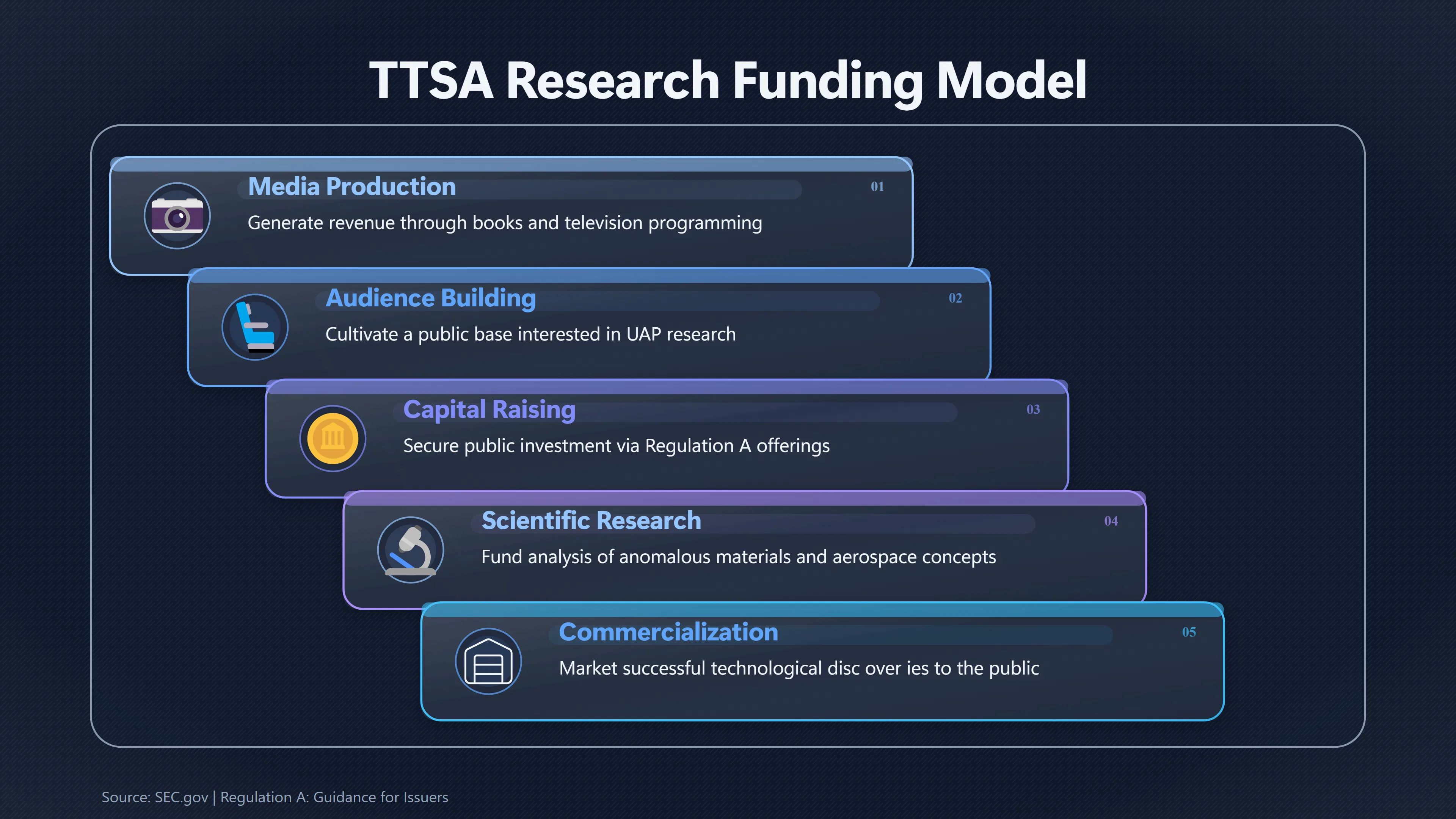
TTSA never presented itself as a conventional research institute funded by universities, government grants or established scientific foundations. Instead, it described itself as a public-benefit corporation whose entertainment division would generate revenue that could support ambitious scientific and aerospace programmes.
At launch, the organisation outlined several interconnected activities:
- producing books, films, television and digital media;
- building an audience interested in UAP research;
- raising capital from public investors through a Regulation A securities offering;
- funding research into reported anomalous materials and advanced aerospace concepts;
- eventually commercialising any successful technological discoveries.
This structure reflected founder Tom DeLonge’s long-standing belief that compelling storytelling could attract both public attention and financial resources to subjects that traditional institutions avoided. Rather than treating media as simple outreach, TTSA positioned entertainment as an integral funding mechanism for scientific exploration.[SEC]sec.govRegulation A: Guidance for IssuersRegulation A: Guidance for Issuers
In theory, the approach offered advantages. Research into controversial topics often struggles to obtain conventional funding, while successful media products can generate flexible income without depending on government priorities or academic grant cycles. The same documentaries and books that attracted new audiences could also expand the investor base needed for expensive technical work.
The difficulty lay in aligning incentives. A documentary benefits from dramatic narratives and unresolved mysteries, whereas scientific research benefits from cautious interpretation, negative findings and lengthy verification. Those priorities do not always reinforce one another.
What investor disclosures revealed about uncertainty
One of the clearest contrasts between TTSA’s public messaging and its formal obligations appeared in its securities filings.
Marketing material frequently highlighted ambitious objectives involving exotic materials, revolutionary propulsion concepts and potentially transformative technologies. By contrast, the company’s Regulation A offering documents repeatedly warned prospective investors that these ambitions involved substantial uncertainty. The filings stated that many proposed technologies had not generated commercial revenue, research could fail entirely, products might never reach the market, and company valuations had not been independently established.[SEC]sec.govRegulation A: Guidance for IssuersRegulation A: Guidance for Issuers
These disclosures are significant because securities law requires companies raising investment to explain material risks rather than simply emphasise opportunities. The offering documents acknowledged, among other uncertainties:
- scientific research might not validate underlying assumptions;
- commercial applications might never emerge;
- revenue projections were speculative;
- investors could lose their investment.
Those warnings were legally appropriate, but they also underscored how speculative TTSA’s scientific programme remained. Readers comparing optimistic public presentations with the detailed risk disclosures could reasonably conclude that the certainty implied by promotional material exceeded the confidence justified by the available evidence.[SEC]sec.govRegulation A: Guidance for IssuersRegulation A: Guidance for Issuers

Why commercial incentives complicated scientific credibility
The central credibility issue was not simply that TTSA sought profit. Many respected biotechnology, pharmaceutical and aerospace companies pursue commercial objectives while conducting legitimate research.
The difference was that TTSA operated across four roles simultaneously:
- media producer;
- speculative technology venture;
- UAP advocacy organisation;
- scientific research programme.
Each role rewarded different behaviour.
Entertainment rewards compelling narratives and public attention. Investment fundraising rewards ambitious future possibilities. Advocacy seeks to persuade audiences that an issue deserves greater recognition. Scientific research, however, rewards scepticism, replication, methodological transparency and willingness to abandon hypotheses when evidence fails.
When a single organisation performs all four functions, outsiders may question whether evidence is being evaluated independently or promoted because it also supports media products and investment narratives.
This did not mean TTSA’s personnel lacked genuine scientific or defence expertise. The organisation included former intelligence officials, physicists and aerospace engineers whose professional backgrounds lent credibility to some aspects of its work. The structural concern instead centred on institutional incentives rather than individual qualifications.
The ADAM project as a case study
TTSA’s Acquisition and Data Analysis of Materials (ADAM) project illustrates this tension particularly well.
The organisation acquired pieces of unusual layered metallic material reported to have anomalous origins and announced plans for extensive scientific evaluation. Company statements emphasised the possibility that rigorous analysis might identify properties with significant technological value while acknowledging that chain-of-custody documentation varied between samples.[TWZ]twz.comThe Army Wants To Verify To The Stars Academy's Fantastic UFO Mystery Material ClaimsOctober 20, 2019…
In 2019, TTSA announced a Cooperative Research and Development Agreement (CRADA) with the US Army to evaluate certain materials and explore potential applications in areas including advanced materials, active camouflage and other emerging technologies. The agreement demonstrated that government laboratories considered the materials worth examining rather than dismissing outright. Importantly, however, the purpose of the agreement was to test TTSA’s claims—not to confirm them.[TWZ]twz.comThe Army Wants To Verify To The Stars Academy's Fantastic UFO Mystery Material ClaimsOctober 20, 2019…
That distinction became central to later criticism. Public announcements often highlighted the Army partnership as evidence of seriousness, while independent observers noted that agreeing to investigate unusual claims is fundamentally different from validating extraordinary conclusions.
Years later, no publicly released peer-reviewed findings have demonstrated that the materials possess exotic or non-human origins. The absence of such confirmation did not prove the materials were ordinary, but it meant that the strongest scientific claims remained unverified despite substantial publicity.[TWZ]twz.comThe Army Wants To Verify To The Stars Academy's Fantastic UFO Mystery Material ClaimsOctober 20, 2019…
Why publicity became evidence for some audiences
Another credibility challenge emerged from the interaction between celebrity influence and institutional association.
TTSA’s launch combined Tom DeLonge’s existing public profile with former officials from the intelligence community, defence establishment and aerospace industry. News coverage naturally focused on this unusual combination, generating widespread attention that few conventional research organisations could have matched.
For many supporters, the involvement of recognised figures and subsequent Army collaboration appeared to strengthen confidence in TTSA’s broader claims. Critics argued that institutional proximity sometimes substituted for direct evidence. Headlines about former officials, military cooperation or government interest could easily be interpreted as implicit validation even when underlying research remained preliminary.
This illustrates a broader communication problem in controversial science. Public attention often follows reputation, while scientific confidence depends on independently reproducible evidence. Those two measures of credibility are not equivalent.
The lasting lesson for public trust
TTSA demonstrated that entertainment can dramatically expand public engagement with neglected subjects. Without its media strategy, UAP discussions might not have entered mainstream political debate as rapidly as they did.
At the same time, the organisation showed the risks of combining commercial storytelling with unresolved scientific claims. When audience growth, investment, media production and research all depend on the same organisation, observers may struggle to distinguish evidence from promotion—even if participants sincerely pursue both goals.
For supporters, TTSA proved that unconventional funding models can bring attention and resources to neglected research questions. For sceptics, it illustrated why extraordinary scientific claims require independent validation before publicity, celebrity endorsement or commercial success can be treated as evidence of reliability.
The result is a mixed legacy. TTSA’s business model succeeded in attracting unprecedented public interest in UAP issues, but it also became a textbook example of how intertwined commercial incentives can complicate perceptions of scientific credibility long before decisive evidence emerges.[TWZ]twz.comThe Army Wants To Verify To The Stars Academy's Fantastic UFO Mystery Material ClaimsOctober 20, 2019…
Amazon book picks
Further Reading
Books and field guides related to Could TTSA Sell Stories and Test Claims Fairly?. Use these as the next step if you want deeper reading beyond the article.
Bad Blood: Secrets and Lies in a Silicon Valley Startup
‘I couldn’t put down this thriller’ – Bill Gates Winner of the Financial Times/McKinsey Business Book of the Year Award. The shocking tru...
Trust Me, I'm Lying: Confessions of a Media Manipulator
Recently, fake news has become real news, making headlines as its consequences become crushingly obvious in political upsets and global t...
The Smartest Guys in the Room: The Amazing Rise and Scandalou...
In this tenth-anniversary edition, acclaimed investigative journalists Bethany McLean and Peter Elkind deliver the definitive account of...
The Halo Effect: ... and the Eight Other Business Delusions T...
Controversial and iconoclastic, a veteran corporate manager and business school professor exposes the dangerous myths, fantasies, and del...
eBay marketplace picks
Marketplace Samples
Live-tested eBay searches with available results related to this page.
Selected fromUFO collectible oneBay.co.uk.

Endnotes
1.
Source: twz.com
Link:https://www.twz.com/30498/the-army-wants-to-verify-to-the-stars-academys-fantastic-ufo-mystery-material-claims
Source snippet
The Army Wants To Verify To The Stars Academy's Fantastic UFO Mystery Material ClaimsOctober 20, 2019...
Published: October 20, 2019
2.
Source: sec.gov
Title: Regulation A: Guidance for Issuers
Link:https://www.sec.gov/resources-small-businesses/small-business-compliance-guides/regulation-guidance-issuers
3.
Source: sec.gov
Title: SE C.gov | Securities Act Rules
Link:https://www.sec.gov/rules-regulations/staff-guidance/corporation-finance-interpretations/securities-act-rules
4.
Source: sec.gov
Link:https://www.sec.gov/Archives/edgar/data/1710274/000110465920101562/0001104659-20-101562-index.htm
5.
Source: twz.com
Link:https://www.twz.com/30481/what-we-know-about-the-army-teaming-up-with-rockstar-tom-delonges-ufo-research-company
6.
Source: sec.gov
Title: SE C.gov | Risky Business: “Pre-IPO” Investing
Link:https://www.sec.gov/about/reports-publications/investorpubspreipohtm
7.
Source: sec.gov
Title: SE C.gov | Certain Research and Development Companies
Link:https://www.sec.gov/rules-regulations/2003/06/certain-research-development-companies
8.
Source: youtube.com
Title: Tom Delonge vs The Aliens
Link:https://www.youtube.com/watch?v=ucHTMyxZxYM
Source snippet
Tom DeLonge - To The Stars (Meta Documentary - 2019)...
9.
Source: youtube.com
Title: [Tom De Longe]({{ ‘tom-de-longe/’ | relative_url }})
Link:https://www.youtube.com/watch?v=o39YkW-WmdM
Source snippet
Tom Delonge: Skinwalkers & CIA Spooks | With Jim Semivan...
10.
Source: decur.org
Title: To The Stars Academy
Link:https://decur.org/programs/ttsa
Additional References
11.
Source: advfn.com
Link:https://www.advfn.com/stock-market/USOTC/EARI/stock-news/98946207/form-1-a-offering-statement-regulation-a
Source snippet
Form 1-A - Offering Statement [Regulation A]July 20, 2026 — PRELIMINARY OFFERING CIRCULAR SUBJECT TO COMPLETION DATED July 20, 2026 Enter...
Published: July 20, 2026
12.
Source: filtron.co
Title: To The Stars Academy: What Really Happened to Tom [De Longe]({{ ‘de-longe/’ | relative_url }})’s UFO Project
Link:https://filtron.co/to-the-stars-academy-what-really-happened-to-tom-delonges-ufo-project-2ts
Source snippet
To The Stars Academy: What Really Happened to Tom DeLonge's UFO Project - FiltronOctober 29, 2025 — TO THE STARS ACADEMY: WHAT REALLY HAP...
Published: October 29, 2025
13.
Source: willwriteuback.substack.com
Title: disclosure the case of two missing
Link:https://willwriteuback.substack.com/p/disclosure-the-case-of-two-missing
Source snippet
government is documented in the October 2019 Cooperative Research and Development Agreement (CRAD...
Published: October 2019
14.
Source: gao.gov
Link:https://www.gao.gov/products/gao-15-577r
15.
Source: youtube.com
Link:https://www.youtube.com/watch?v=NWp-3fHIaDA
Source snippet
Episode three: Unidentified aerial phenomena — what are the facts, and are they a threat?...
16.
Source: theblackvault.com
Title: What the U.S
Link:https://www.theblackvault.com/documentarchive/what-the-u-s-military-now-says-about-ttsas-anomalous-artifact/
Source snippet
Military Now Says About TTSA’s Anomalous Artifact - The Black VaultMay 29, 2025 — WHAT THE U.S. MILITARY NOW SAYS ABOUT TTSA’S ANOMALOUS...
Published: May 29, 2025
17.
Source: secinfo.com
Title: SE C Info
Link:https://www.secinfo.com/d1jbnf.N5fh.a.htm
Source snippet
‘1-A’ on 7/20/26 - ‘EX1A-4 SUBS AGMT’July 20, 2026 — ‘EX1A-4 SUBS AGMT’ — FORM OF SUBSCRIPTION AGREEMENT * * * THIS IS AN HTML DOCUMENT R...
Published: July 20, 2026
18.
Source: theblackvault.com
Link:https://www.theblackvault.com/documentarchive/army-and-to-the-stars-academy-of-arts-science-unveiling-the-secrecy-behind-the-ufo-material-testing-agreement/
19.
Source: badufos.blogspot.com
Link:https://badufos.blogspot.com/2019/10/to-stars-seeking-government-grants-to.html
20.
Source: tothestars.media
Link:https://tothestars.media/en-ca/pages/research